Hello, I'm Hamamoto from TIMEWELL.
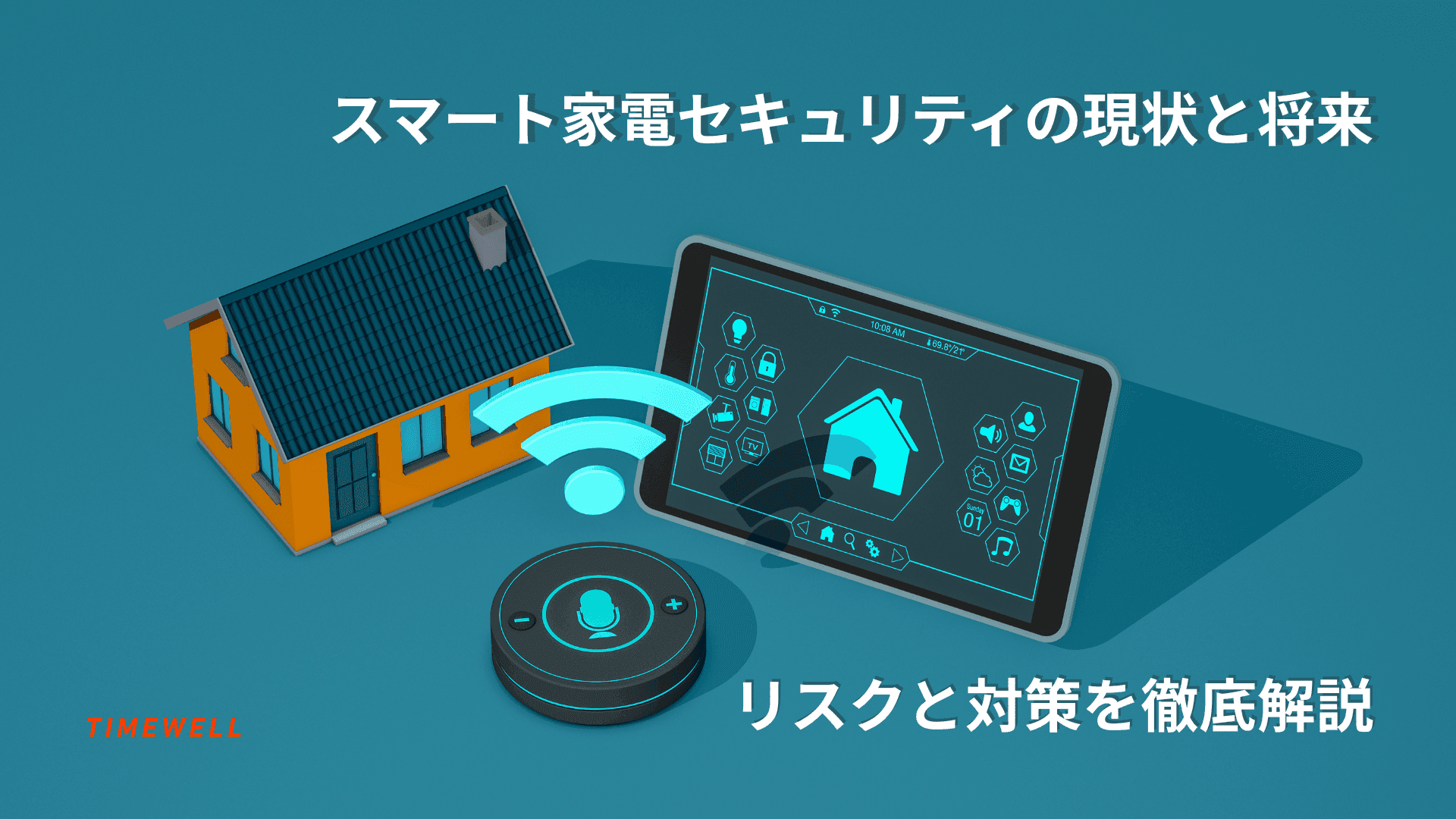
There are approximately 19 billion smart devices in use worldwide. Robot vacuums, smart refrigerators, security cameras, baby monitors, smart speakers, internet-connected air fryers — devices that seemed futuristic 10 years ago are now standard household items. Each one is a potential entry point into your home network and your personal data.
Security Risks by Device Category
Robot Vacuums
Modern robot vacuums don't just clean — they build detailed maps of your home. This data is used to plan efficient cleaning routes, but it's also stored and, in many cases, transmitted to manufacturer servers.
The reported incidents: At least one manufacturer was found to have transmitted images from inside customers' homes to third-party servers, including images of private spaces. The data was apparently used for AI training purposes. Users had no knowledge this was happening.
The structural issue: Floor maps and room layout data reveal a lot about a household — the size of the space, where people spend time, potentially valuables or security equipment locations. This information has value beyond cleaning optimization.
What's changing: Some newer models are transitioning to LiDAR (Light Detection and Ranging) instead of cameras. LiDAR maps spatial dimensions without capturing visual images, significantly reducing the privacy risk while maintaining mapping capability.
Smart TVs and ACR
Smart TVs have evolved from display devices into data collection platforms. The mechanism: Automatic Content Recognition (ACR) technology takes frequent screenshots of whatever is displayed on screen — streaming content, cable, external device input — and sends that data to the manufacturer.
This builds a profile of viewing habits used to target advertising. The data collected goes beyond what streaming platforms know, because ACR captures everything displayed on the screen regardless of source.
The consent problem: Most users don't know ACR is enabled by default. The option to disable it is often buried in settings menus with non-obvious labeling. Research consistently shows that the majority of smart TV users have never reviewed these settings.
What to do: Go into your smart TV's privacy or data settings and look for "Automatic Content Recognition," "Samba TV," "ACR," or similar options. Disable data sharing for advertising purposes. This doesn't affect TV functionality.
Smart Locks
Digital locks have genuine advantages — remote access, temporary codes for guests, activity logs. But the security properties depend entirely on implementation quality.
What to verify before purchasing:
- End-to-end encryption of lock commands
- Two-factor authentication availability
- History and frequency of security update releases
- Whether the manufacturer has a documented vulnerability disclosure process
- What happens to the lock if the cloud service is discontinued
The physical lock model has predictable failure modes. Smart locks add new failure modes (software vulnerabilities, cloud dependencies, Bluetooth/WiFi interception) that require ongoing manufacturer support to address.
Smart Speakers and Always-On Microphones
Smart speakers listen continuously for wake words. The tradeoff is well-understood: the convenience of voice commands requires always-on listening capability.
The risk: Accidental activation records audio beyond the intended command. The extent to which these recordings are reviewed by humans at manufacturers varies by company and has changed over time.
For business environments: Any device with an always-on microphone in a meeting room, executive office, or space where confidential conversations occur creates potential exposure. The risk isn't theoretical — devices have been documented capturing conversations beyond the intended activation.
Baby Monitors and Security Cameras
Multiple documented incidents involve unauthorized third-party access to baby monitor and security camera feeds. In several cases, attackers accessed cameras and communicated through them.
The common vulnerability: Default passwords not changed after installation. Most cameras ship with a standard default password, and many users never change it. Attackers systematically scan for devices using these defaults.
Minimum security steps:
- Change the default password immediately on setup
- Enable two-factor authentication if available
- Check that the manufacturer provides regular firmware updates
- Verify the camera transmits over encrypted connections
Looking for AI training and consulting?
Learn about WARP training programs and consulting services in our materials.
AI Features in Smart Home Devices
Manufacturers are actively deploying AI capabilities that create new functionality alongside new risks.
Google Nest products with Gemini integration can now recognize specific delivery services, identify individuals by appearance, and analyze what visitors are wearing to determine organizational affiliation. The practical utility is real — "Did FedEx come today?" becomes a query the camera can answer.
The data requirements for this capability: continuous video analysis, facial recognition, and behavioral pattern learning. This data lives somewhere — on device, in cloud, or distributed between them. If that data is accessed by unauthorized parties, the exposure is substantially more sensitive than typical device data.
Robot vacuums with AI-equipped arms can now pick up objects from floors. LLM-equipped thermostats can infer household routines from temperature patterns. Each capability adds value; each also expands the dataset being collected about household occupants.
Network Security: The Foundation
Every smart device connects through your router. A compromised router means potential access to all connected devices simultaneously.
Critical router security steps:
| Step | Priority |
|---|---|
| Change default admin password | Immediate |
| Create separate network for IoT devices | High |
| Enable automatic firmware updates | High |
| Use WPA3 encryption if supported | High |
| Audit connected devices regularly | Ongoing |
The segmentation principle: IoT devices should not be on the same network segment as computers, phones, and devices containing sensitive information. Most modern routers support creating a separate SSID (network name) for IoT devices. This limits the damage if any single IoT device is compromised.
Corporate Responsibility and What to Look For
Before purchasing connected devices, the questions worth asking:
- Does this device receive regular security updates, and for how long?
- What data does it collect, where is it stored, and who has access?
- Does the manufacturer have a disclosed vulnerability response process?
- What happens to the device's functionality if the company's cloud service is shut down?
- Has the device received third-party security certification?
Industry-wide need: Cross-company security information sharing and standardized certification would significantly improve baseline security. A device that has passed independent security audit provides meaningfully stronger assurances than self-certified claims. Regulatory frameworks in several countries are moving toward mandatory security standards for IoT devices; compliance with these standards is a reasonable baseline criterion for purchasing decisions.
Summary
Smart home devices provide genuine value — convenience, monitoring capability, automation. The security tradeoffs are real and require active management rather than passive acceptance.
For users:
- Review privacy settings on every device you own
- Create a separate network for IoT devices
- Change default passwords immediately
- Enable automatic updates
- Research manufacturer security track records before purchasing
For businesses:
- Establish formal IoT security policy
- Prohibit always-on microphone devices in spaces where confidential conversations occur
- Conduct regular network audits to identify connected devices
- Require security certification for devices procured for business use
The convenience of connected devices is real. So is the security management responsibility that comes with them.
Reference: https://www.youtube.com/watch?v=afeeThWQj6I
TIMEWELL AI Consulting
TIMEWELL supports business transformation in the AI agent era.
Services:
- AI Agent Implementation: Business automation using GPT-5.2, Claude Opus 4.5, and Gemini 3
- GEO Strategy Consulting: Content marketing strategy for the AI search era
- DX Promotion and New Business Development: Business model transformation through AI
Schedule a free consultation →
Related Articles
- The Reality of a Part-Time Employee Who Took Two Maternity Leaves and How Her View of Work Changed | TIMEWELL
- Before Taking Parental Leave — Three Things You Absolutely Must Do, Even During the Busiest Season
- Committed to Hands-On Work: How a Fifth-Generation Builder Found His Own Path at Fujita Construction