This is Hamamoto from TIMEWELL.
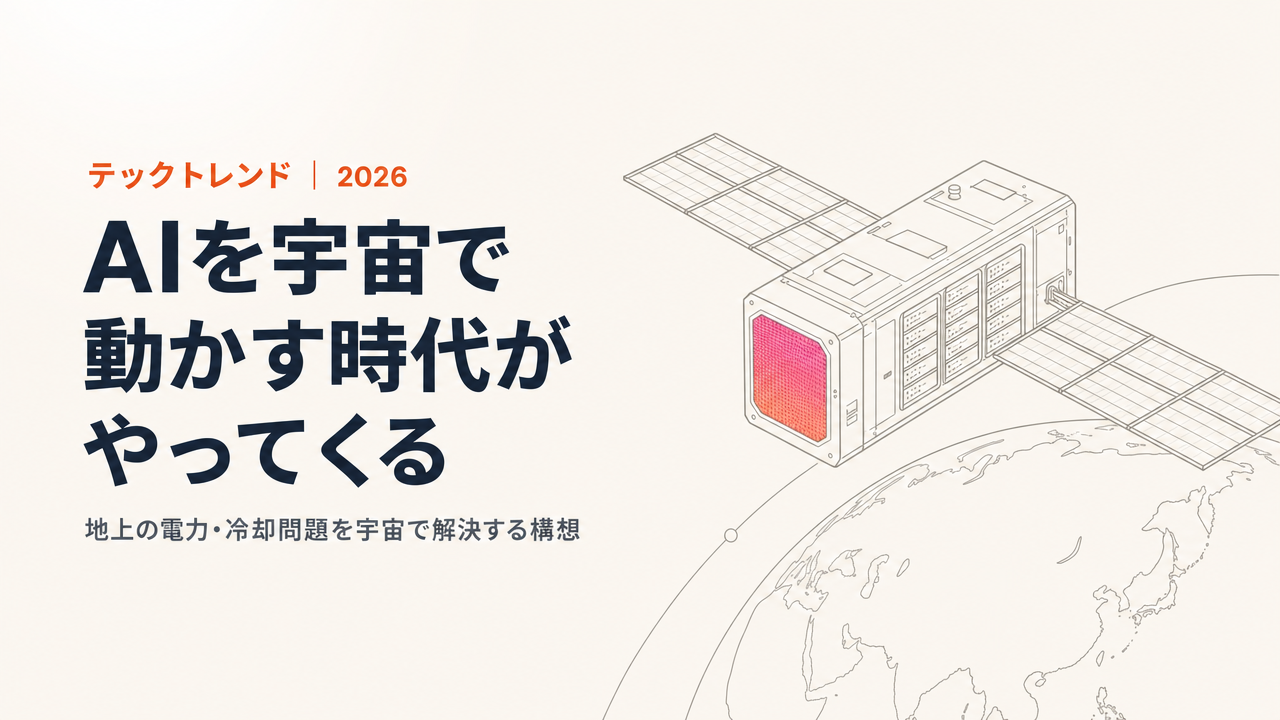
"Building a data center in space" — this is not the plot of a science fiction film.
At the end of 2025, Elon Musk declared on X (formerly Twitter): "SpaceX will be doing this," revealing plans for an orbital data center using Starlink V3 satellites. He also noted that "deploying 100GW per year of AI compute in space is a difficult path, but we know what needs to be done" — pointing to large-scale space-based solar power generation as the energy source.
This article explains SpaceX's orbital data center vision, Starlink V3's technical evolution, and the potential of space-based solar power.
SpaceX Space Data Center: 2026 Latest Information
| Item | Details |
|---|---|
| Launch start | 2026 (using Starship) |
| Satellite | Starlink V3 (1Tbps comms, GPU-capable) |
| Per launch | ~60 V3 satellites |
| Power target | 100GW/year (space-based solar) |
| Competitors | Starcloud, Blue Origin, Relativity Space |
Why Build Data Centers in Space?
The Limits of Ground-Based Data Centers
AI's rapid development has caused data center power consumption to explode.
Challenges facing ground-based data centers:
- Power shortages: AI compute requires enormous power (tens of MW for GPT-4-class training)
- Cooling costs: 30-40% of total power consumed by cooling alone
- Land constraints: Securing power, water, and land is increasingly difficult
- Regulatory pressure: Stricter environmental and water-use regulations
The Advantages of Space
Space has the potential to fundamentally solve each of these problems.
| Factor | Ground Data Center | Space Data Center |
|---|---|---|
| Power | Dependent on grid, constrained | 24-hour solar, unlimited |
| Cooling | Air conditioning and water cooling required | Vacuum radiative cooling, no power needed |
| Land | Difficult to secure | Infinite space |
| Solar efficiency | Affected by weather and night | 7-10x ground efficiency |
According to JinkoSolar chairman Li Xiande: "The same solar panel generates 7 to 10 times more power in space than on the ground." Without the intermittency and degradation bottlenecks of terrestrial systems, continuous operation is theoretically achievable.
Looking for AI training and consulting?
Learn about WARP training programs and consulting services in our materials.
Starlink V3: The Foundation Technology
Evolution from V2 to V3
Starlink V3 is designed not merely as a communications satellite but as "space computing infrastructure."
| Specification | Starlink V2 mini | Starlink V3 |
|---|---|---|
| Downlink speed | Up to 100Gbps | Up to 1Tbps (10x) |
| Laser links | Basic | High-speed optical communication links |
| GPU/ASIC | None | Modular, installable |
| Solar panels | Standard size | Enlarged |
| Thermal control | Basic | Enhanced heat dissipation system |
| Launch vehicle | Falcon 9 | Starship required |
2026 Launch Plan
SpaceX plans to begin launching Starlink V3 using Starship in 2026.
Launch plan details:
- ~60 V3 satellites deployed per Starship flight
- V3 satellites cannot be launched on Falcon 9 (too large)
- Satellite separation hardware testing already underway
- Edge inference modules to be included alongside communications
The 100GW/Year Space Solar Power Vision
Musk's Ambitious Goals
Elon Musk has set a bold target of 100GW per year for space data center power generation.
Musk's statements (X posts):
"Deploying 100GW/year of AI to space is a difficult path, but we know what needs to be done."
"Starship could potentially deliver 100GW to high orbit within 4-5 years — if we can solve the other parts of the equation."
Longer term, he has also sketched a vision of "producing AI satellites on the lunar surface and launching them with mass drivers to enable 100TW (terawatts) per year."
Technical Challenges
However, significant challenges remain.
Key technical obstacles:
- Extreme temperature swings: Must withstand temperature differentials of 300°C
- Space radiation: Strong radiation causes equipment degradation
- Atomic oxygen: Affects battery lifespan
- Cost: At 100GW/year scale, component costs alone run into hundreds of billions of dollars
- Maintenance: On-orbit servicing remains extremely difficult
The Space Data Center Race
Starcloud: World's First Orbital GPU Operation
In November 2025, startup Starcloud achieved a historic milestone.
Starcloud's achievements:
- Launched a satellite carrying the most powerful GPU ever operated in space (NVIDIA H100)
- 100x the performance of previous space-grade GPUs
- World's first: Successful LLM training in space
- World's first: Running Gemini in orbit
This success demonstrated that advanced AI computing functions beyond Earth's atmosphere, significantly increasing confidence in the viability of orbital data centers.
Bezos and Schmidt Enter the Race
Other tech billionaires have also joined the competition.
Jeff Bezos (Amazon/Blue Origin):
- "In more than 10 years, there will be gigawatt-scale data centers in space"
- Pursuing space infrastructure development through Blue Origin
Eric Schmidt (former Google CEO):
- Acquired rocket company Relativity Space
- With the explicit goal of building orbital data centers
Then vs. Now: The Evolution of the Space Data Center Concept
| Item | Then (2024) | Now (January 2026) |
|---|---|---|
| SpaceX's stance | No mention | Official "we're doing it" declaration |
| Starlink | V2 mini as primary | V3 planned for 2026 launch |
| Space GPU | Experimental | H100 operating (Starcloud) |
| Competition | Limited | Bezos and Schmidt both involved |
| Solar target | Conceptual | Specific 100GW/year goal |
| LLM operation | Considered impossible | Gemini running in space |
Business Implications: Preparing for the Space AI Infrastructure Era
Rethinking Data Center Strategy
The realization of orbital data centers could significantly affect corporate IT strategy.
Near-term impact (2026-2028):
- Ultra-fast, low-latency connectivity via Starlink V3
- AI utilization possible in remote and maritime locations
- Significant drop in satellite communication costs
Medium-term impact (2028-2030):
- Commercial orbital edge computing
- Real-time AI processing of Earth observation data
- Use as backup infrastructure during disasters
Long-term impact (2030+):
- Full-scale orbital data center operations
- Freedom from ground data center power constraints
- Dramatic expansion of AI compute capacity
Implications for Japanese Companies
For Japanese enterprises, this trend matters in several ways:
- Space investment opportunities: Investment in SpaceX and Starlink-related ventures
- Technology partnerships: Collaboration potential in space-grade semiconductors and thermal management
- Service adoption: Communication infrastructure renewal via Starlink V3
- AI strategy: Planning that accounts for future space AI infrastructure
Summary
SpaceX's space data center vision is a harbinger of a new industrial revolution at the intersection of AI and space development.
Key points from this article:
- SpaceX will begin launching Starlink V3 from 2026
- V3 is "space computing infrastructure" with 1Tbps communication and GPU capability
- Musk targets 100GW/year of space-based solar power generation
- Starcloud has achieved H100 operation and LLM training in orbit
- Bezos and Schmidt have both entered the space data center race
As ground data centers face increasingly severe power and cooling constraints, space offers the potential for "unlimited power and cooling." The day when science fiction becomes reality may be closer than we imagine.
Companies should monitor these developments closely and begin considering strategies that account for the coming era of space AI infrastructure.