This is Hamamoto from TIMEWELL.
The SXSW Session I Was Most Excited to See
Among all the AI-related sessions at SXSW, this was the one I was watching most closely. Here is a full account of what was discussed.
In recent years, AI agents are being deployed in enterprise environments at an accelerating pace. Unlike traditional chatbots that handle a single, narrow task, AI agents integrate across multiple tasks and operate autonomously on behalf of humans.
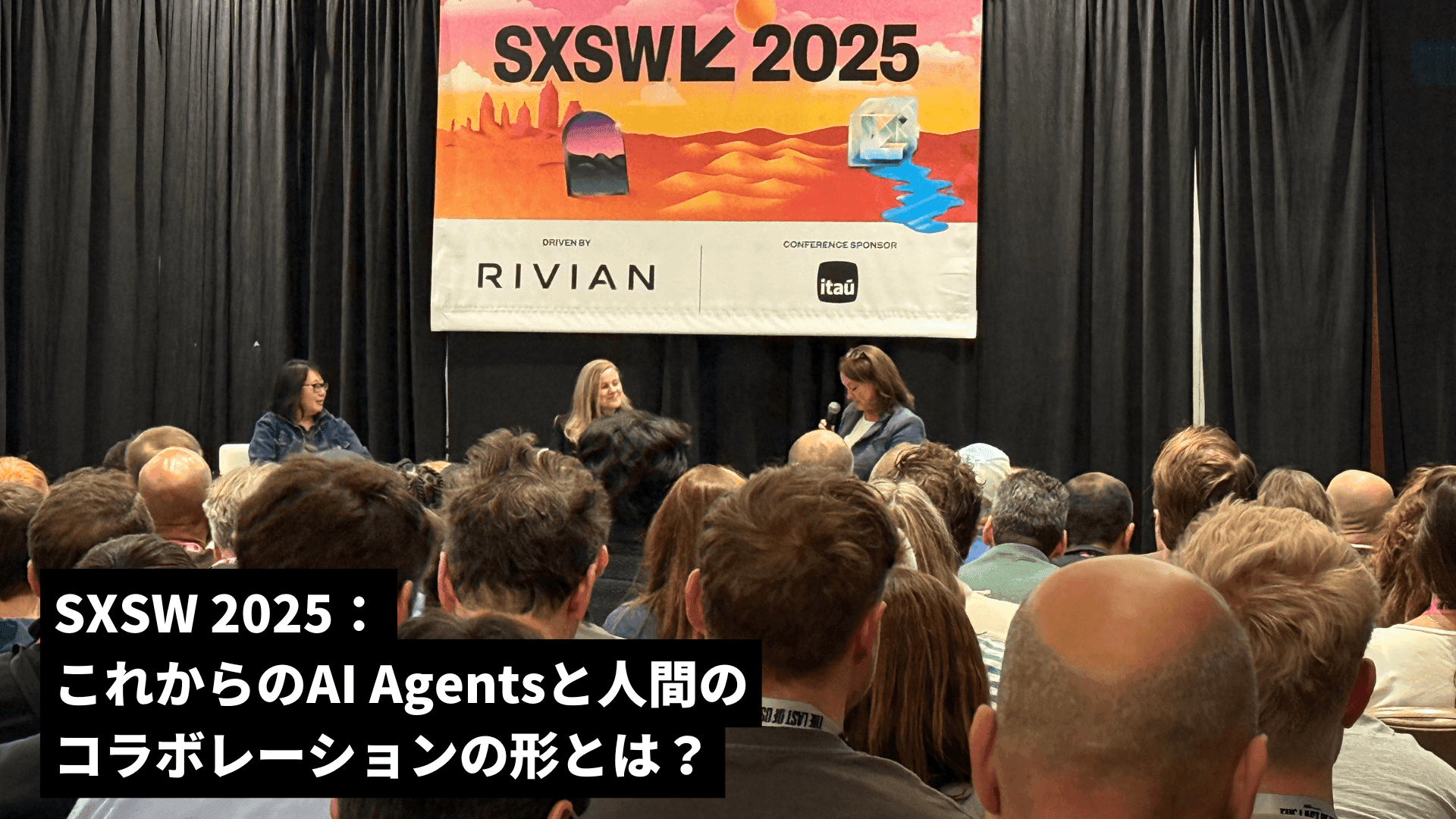
The panel session "AI Agents and the Future of Human Collaboration" brought together executives from Adobe and IBM to discuss real-world agent deployments, enterprise adoption strategies, and a new model of human-AI collaboration. This article recaps the session in detail, including the audience Q&A.
The session centered on how AI agents automate business processes while complementing human creativity and judgment. Unlike single-task AI chatbots, agents function as an "orchestration layer" — bridging multiple systems and tools. This frees employees from repetitive, administrative work and creates space for strategic decision-making and creative thinking. For executives, it is a path to new competitive advantage; for engineers, it is a new frontier for system design.
Struggling with AI adoption?
We have prepared materials covering ZEROCK case studies and implementation methods.
Speakers
Hannah Elsakkar — Adobe
Hannah Elsakkar is Adobe's Global Head of New Business and the founder of "Adobe Firefly," the company's generative AI initiative. She has led CEO-directed teams within Adobe's strategy division and driven business development at some of the world's leading companies. Under Adobe's mission of "Creativity for All," she is driving the adoption of AI in creative work. Firefly generates high-quality images and designs from text prompts alone, dramatically speeding up creative work that was previously laborious.
Nickle LaMoreaux — IBM
Nickle LaMoreaux serves as IBM's Chief Human Resources Officer (CHRO), overseeing HR strategy for approximately 275,000 employees worldwide. She has led HR transformation across IBM's business units for years, improving employee skill development and organizational efficiency. Under her leadership, IBM deploys AI agents to automate routine HR work while enabling more strategic decision-making — with agent-driven improvements in employee inquiry handling and promotion processes delivering significant efficiency gains.
Jenna McGregor moderated the panel, drawing on her work in executive content strategy and event programming to facilitate a sharp, wide-ranging discussion.
Adobe Firefly: Generative AI for Creative Work
Adobe Firefly is a generative AI tool that automatically creates high-quality images and designs from text input. It dramatically shortens design production timelines that previously required extensive manual work, enabling creators to bring more ideas to life faster.
What sets Firefly apart is its customizability: companies can build generation models aligned with their own brand guidelines. By incorporating their design assets into Firefly, companies can automatically generate content in their own style — fundamentally transforming marketing and product development workflows while powerfully supporting creative ideation.
In practice, Firefly-powered projects have completed visual production in a fraction of the time that used to take months. In advertising campaigns and design projects, teams can generate hundreds of variations instantly — freeing creators to select the best options and focus on refinement.
IBM's AI HR Strategy: Agents in the Field
IBM has been actively deploying AI in its HR operations to improve process efficiency and organizational performance. Two agents are at the center of this work: "AskHR" and "HiRo."
AskHR is IBM's AI agent for employee HR inquiries. Employees approach it first through a chat interface, receiving fast, accurate information and process guidance. Adoption was slow initially, but a mandate for manager-level use drove widespread uptake — today it is used routinely by managers worldwide.
HiRo is a digital worker that supports IBM's promotion and compensation review processes. It collects and integrates large volumes of data from across the organization, automating the creation and communication of promotion candidate lists. This eliminated tens of thousands of hours of administrative work annually, freeing managers to focus on strategic decisions and employee development.
IBM also invests heavily in retraining and reskilling employees to maximize the value of AI agents. The company encourages all employees to complete 80+ hours of learning per year, building the skills needed for the digital era and helping each employee evolve as a digital worker.
Q&A: Practical Questions from the Audience
Q1: Change management and training time
"As digital workers are deployed, how are you driving adoption and ensuring effective training?"
Elsakkar emphasized that senior leaders must first champion new tools themselves and build a culture that embraces experimentation without fear of failure. She also stressed that reskilling and continuous learning need to be embedded in performance and reward systems. IBM's 80+ hours of annual learning encouragement, combined with systematic training on AI agents and new tools, has reduced resistance to change and elevated employee capability.
Q2: Which AI tools are you using and how do you measure ROI?
Elsakkar explained that Adobe uses Firefly as its core generative AI tool, with a standout example being a large-scale marketing campaign (Black Friday) where the team generated 15,000+ creative assets in half the usual time — dramatically improving marketing velocity. LaMoreaux noted that IBM's deployment of AskHR and HiRo has automated tens of thousands of hours of routine work annually, which serves as a primary ROI metric.
Q3: How will technologies like MCP and memory layers shape the future of AI agents?
Elsakkar predicted a shift away from large monolithic language models toward smaller models optimized for specific tasks and domains — improving processing speed and cost efficiency. She also expects MCP (Model Context Protocol) and memory layer technologies to enhance agents' task execution capabilities and enable more flexible systems for complex work.
Q4: Will personal AI agents become mainstream in daily life?
LaMoreaux noted that enterprise AI agents are tightly coupled to the organization's systems and data, so they do not transfer when an employee leaves. Task-specific personal AI assistants, however, could become widely used by individuals to improve their own productivity and support creative work. The key distinction is that enterprise-integrated systems and personal agents serve different purposes and must be designed and operated differently.
The Road Ahead: AI Agents as Collaborative Partners
The session made clear — through concrete examples like Adobe Firefly and IBM's HR systems — that AI agents are not simply automation tools. They are becoming collaborative partners. By automating routine work, agents create environments where employees can focus on the creative and strategic work that matters most, driving productivity and innovation across entire organizations.
As agents continue to evolve, personal AI assistants will proliferate and task-specialized models will grow more sophisticated. For companies, this means paying close attention to ethics and data governance during deployment, and ensuring that humans retain final decision-making authority at all times.
The session "AI Agents and the Future of Human Collaboration" offered a rich set of real-world examples and forward-looking perspectives. For executives, it surfaced paths to operational efficiency and new business opportunity; for engineers, it pointed toward new challenges in system design and ethical implementation. The future of human-AI collaboration holds enormous potential — not just for automation, but for driving innovation and lifting performance across the entire organization.
I hope this report helps inform your own AI development and adoption strategies going forward.