This is Hamamoto from TIMEWELL.
SXSW Pitch — Student Finals
SXSW Pitch is an entrepreneurship pitch contest held within the South by Southwest music, film, and technology festival. It is one of the most important platforms for founders to present innovative ideas to investors and industry leaders.
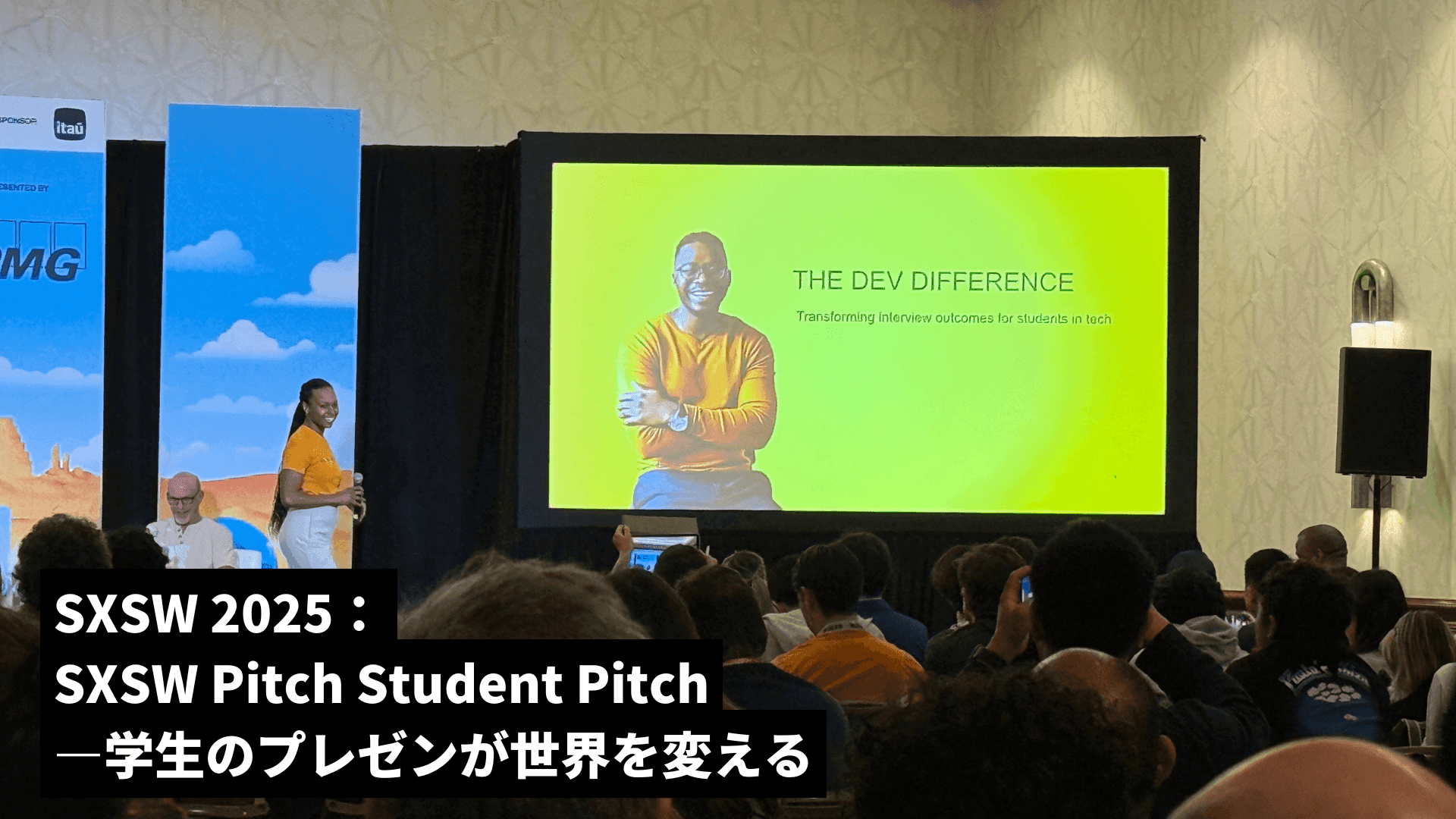
At the Student Pitch Finals on March 9, 2025, five finalists were selected — MabLab, My Endoscope, Dev Difference, The Flossy Organization, and Vocadian. This article covers the three pitches I was able to watch in full.
These companies are applying AI and digital tools to challenges in hiring, civic participation, and workplace safety. Here is a detailed breakdown of each — covering business overview, the problem they solve, their model, team background, and the judge Q&A.
Looking for AI training and consulting?
Learn about WARP training programs and consulting services in our materials.
Dev Difference — Revolutionizing the Hiring Process
What they do: Dev Difference was co-founded by Joe Renee Carter, a former Google recruiter. Their platform provides AI-powered mock interviews to help candidates improve both soft skills (communication, teamwork) and technical skills. On the employer side, it gives companies an efficient tool to evaluate technical fit, soft skills, and cultural alignment.
The problem: Hiring is expensive, and failed hires generate enormous losses. Joe has reviewed more than 20,000 candidates and has seen firsthand how many arrive underprepared for interviews. Employers can spend over $200,000 on a single hire — with productivity and business losses when it doesn't work out.
Business model:
- Universities: License fee — e.g., a fixed cost for a license covering 1,000 students.
- Employers: 20% of candidate's first-year salary as a placement fee on successful hires — standard agency model.
- Future: API integration with employer applicant tracking systems and SaaS revenue.
Team: Joe and co-founders Moyo and Jesse bring recruiting and engineering backgrounds from Google and Markup. All three have gone through technical interview processes themselves and understand the hiring challenge from both sides.
Q&A highlights:
- Target audience: Initially early-career tech professionals; also useful for business majors seeking data analysis roles.
- Revenue model: Judges expressed interest in the platform's differentiation across diverse industries.
The Flossy Organization — Rebuilding Civic Participation
What they do: The Flossy Organization is a nonprofit founded by Jala (likely Jabari Jala), with the mission of revolutionizing civic engagement in America. The organization was born from the story of a teenager killed by gun violence — and led to securing $1.6 million in community investment and a measurable reduction in violence.
The problem: Civic participation in America is broken. The economic cost is $12.39 billion; an estimated 410 million hours of effort are wasted annually. Underserved communities lack the tools and support structures to make their voices heard effectively.
Business model:
- Currently a nonprofit, leveraging partnerships with the Obama Foundation and Columbia University.
- Future: transition to a subscription-based platform delivering mobile access to millions of users; government contracts with municipalities in scope.
- AI-powered advocacy platform that helps communities lead policy change from the ground up.
Team: Experience across the Obama Foundation and Wabu Foundation. 600 volunteers trained, 1,000+ people educated, 10,000+ engaged. Currently recruiting a technical co-founder.
Q&A highlights:
- Sustainability: Platform scale-up and subscription revenue will fund long-term sustainability; city contracts planned.
- Impact measurement: Judges stressed the importance of measuring grant-funded outcomes. Jala pointed to $1.6M secured for the community and concrete facility outcomes as evidence.
Vocadian — Voice AI for Workplace Safety
What they do: Vocadian uses voice technology and AI to improve workplace safety in high-risk industries — transportation, mining, and construction. The platform analyzes workers' voices to predict fatigue and risk, enabling accident prevention before incidents occur.
The problem: High-risk industries see frequent worker accidents and injuries, imposing major costs on companies. Traditional approaches are reactive — focused on response after accidents happen rather than prevention.
Market and results:
- Market size: $11 billion in the US and Latin America; global expansion in scope.
- Pilot results: 10% improvement in risk prediction accuracy; 26% reduction in accident risk; 90% improvement in productivity.
Business model: Expanding customer base through partnerships with insurers and technology vendors.
Team: MIT and commercial sector expertise; solutions serving 100,000+ workers. New contracts being signed on the strength of pilot results.
Q&A highlights:
- Worker privacy: Voice analysis is non-invasive; workers have responded with high satisfaction scores.
- Long-shift workers: The platform optimizes existing fatigue management procedures rather than replacing them — improving safety without creating new friction.
Takeaways
These three companies represent innovation in hiring efficiency, community empowerment, and worker safety. Dev Difference streamlines talent acquisition, The Flossy Organization gives underserved communities a voice, and Vocadian protects high-risk workers before accidents happen.
The SXSW Pitch Student Finals make clear that the convergence of technology and social challenges is a defining business trend. For business leaders, these innovations point to AI and digital tools as key enablers of solutions to deep societal problems — and strong grounds for both investment interest and corporate social responsibility.
References: