This is Hamamoto from TIMEWELL.
The Most Exciting Pitch Session at SXSW 2025
I've been covering SXSW sessions live from Austin every day. Today's focus was the Robotics, Web3, Voice, and Extended Reality pitch category — personally, my favorite session of the entire event.
SXSW Pitch gives startups from around the world three minutes to pitch their product or service to industry experts and investors, followed by six minutes of Q&A. The 2025 Robotics, Web3, Voice, and XR category offered a window into the cutting edge of applied AI and hardware innovation.
Here is a detailed breakdown of all five finalists — what each company does, what problem they solve, their traction, team, and how they handled the judge questions.
Airtrek Robotics — Autonomous Debris Removal for Airport Runways
What they do: Airtrek Robotics has built a robot that autonomously detects and removes Foreign Object Debris (FOD) from airport runways and taxiways. Founder Chris opened with a real example from Houston airport: a piece of bubble wrap struck an aircraft on the runway and caused an incident. Their robot is designed to prevent exactly that.
The problem: Screws, plastic fragments, and other debris on runways can cause serious aircraft damage. With 30 million operations annually, manual inspection is slow, costly, and inefficient. Airtrek's robot drives autonomously, uses cameras and AI to identify and remove debris at exactly the points it is needed.
Business model: Subscription-based service for airports. Monthly fee; targeting the $10M airport inspection market annually — part of an $800M industry overall. The robot covers 400,000 square feet per hour and is designed for nighttime operation (roughly 1–4am).
Traction: Third-generation robot currently in development; three or more pilot tests scheduled at airports of different sizes and complexity this year.
Team: Deep experience in autonomous robotics for aviation, with an advisory board that includes Frontier Airlines and other industry leaders.
Q&A highlights:
- Beyond airports: "Can it be used for urban street cleaning?" Chris: "Our core strength is camera-based debris identification. It could work on city streets at night when traffic is absent — but we're focused on airports. The robot weighs 200 lbs to withstand 40 mph winds, which is an airport-specific design requirement."
- Competitive advantage: "Competitors retrofit general-purpose robots. We designed for airports — durability and wind resistance are where we win."
- Coverage time: "Depending on airport size, typically 2–3 hours per runway. Nighttime operation is the standard."
Looking for AI training and consulting?
Learn about WARP training programs and consulting services in our materials.
Contoro — AI Robots for Dangerous Container Unloading
What they do: Contoro automates container unloading using AI-driven robotics. Their pitch showed footage of workers manually moving 50-pound boxes in 150-degree-plus heat for eight-hour shifts — conditions Contoro is designed to eliminate.
The problem: 25 million containers are imported into the US annually, and unloading still relies heavily on manual labor — dangerous, inhumane, and inefficient. Contoro's robots combine AI and human intelligence to automate unloading at 99.5%+ reliability, with the goal of moving workers into higher-value warehouse roles.
Business model: Robot-as-a-Service at $150–250 per container (varies by region). US market: $10B; global: $50B. Amazon's safety team is in active discussions.
Traction: Revenue since Q3 of last year; seven customers currently. Robot fully built and in service since Q3 2024.
Team: AI and robotics experts; CEO previously founded and scaled a leading stroke rehabilitation robotics company.
Q&A highlights:
- Human involvement: "Our target is 1 person managing 20 robots. Humans handle exception cases; the robot learns from them and handles those cases on its own next time."
- Scaling barriers: "Manufacturing scale and cost reduction are key. Engineers are assembling robots in Austin; manufacturing engineer hiring is underway."
- vs. human efficiency: "Robots automate the simple repetitive work; workers shift to higher-value tasks like palletizing. We replace the work people don't want to do."
- Manufacturing time: "Currently 3 months per robot; targeting 1 month by year end. Some components sourced from Asia — tariffs are a factor we're watching."
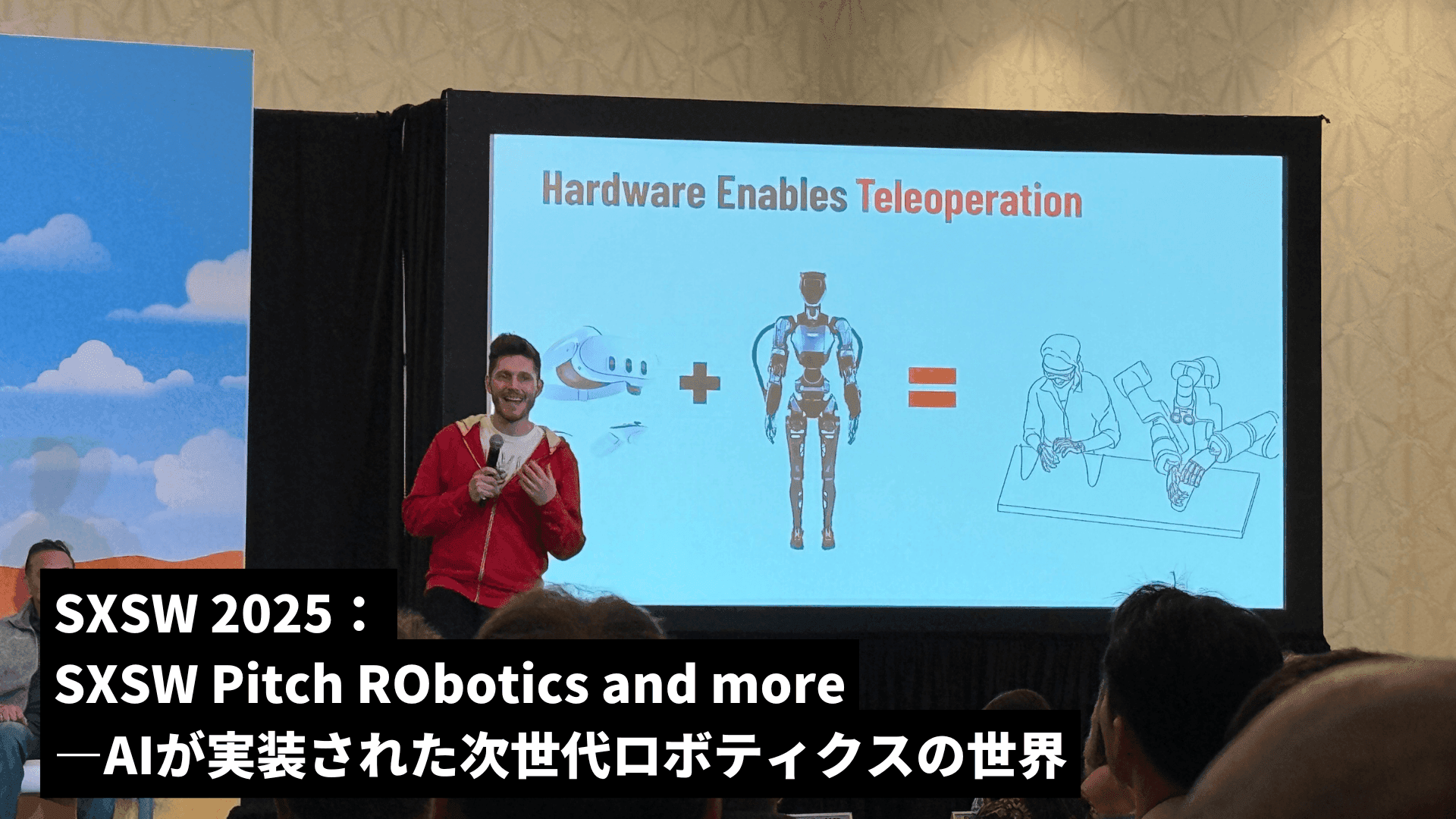
Fluid Reality — Haptic Gloves for VR and Telerobotics
What they do: Fluid Reality has developed hardware that delivers tactile sensation to fingertips, enabling the sense of touch in VR environments and remote robotic operation. Co-founder Joe used the example of remotely handing a glass of water to a grandparent living far away — illustrating the real-world utility.
The problem: VR headsets provide vision but not touch. Over 98% of human work requires haptic feedback. Fluid Reality's haptic gloves make it possible to "feel" in VR and remote operation, opening up eldercare, medical, and industrial applications. Their solution is 100x cheaper and lighter than existing alternatives.
Business model: Partnerships with VR headset makers and robotics companies; revenue from hardware sales and technology licensing. Revenue currently exceeds invested capital.
Traction: Multiple prototype projects with major technology companies in progress; demo at GTC the following week. First contract with a humanoid robotics company signed.
Team: Co-founders Joe and Greg have 10+ years each in advanced hardware development; both hold PhDs. Advisors include specialists who have scaled hardware to 1.5 billion devices.
Q&A highlights:
- Use cases: "Remote eldercare — handing water; infectious disease treatment; remote maintenance. ROI is immediate."
- vs. braille readers: "Existing braille readers cost $5,000 and are heavy. We're 100x cheaper and lighter, using a new actuation technology."
- Revenue timing: "Telerobotics is happening right now — faster adoption than VR was a few years ago. Partnerships are accelerating growth."
- B2B or B2C: "Currently enterprise. Long-term vision: empower individuals in a global labor market."
MUSE — Retail Shelf Management Automation
What they do: MUSE provides a robotic platform that automates retail shelf management — scanning inventory, identifying gaps, and enabling restocking, with the ability to interact with shoppers.
The problem: Retail has 4 million stores. Out-of-stock items cause 5% revenue loss; 57% of customers report dissatisfaction from stockouts. MUSE's robots automate shelf scanning, inventory verification, and restocking, freeing employees and improving the customer experience.
Business model: Robots sold at $5,000 with ongoing subscription service. 30% cost reduction promised. $54B global market. Modular design allows capability expansion.
Traction: A top Japanese retailer is a paying customer — 10 stores currently running. Three years of development behind the product.
Team: Expertise in robotics and retail; US business development team driving market expansion. Focus on augmenting humans, not replacing them.
Q&A highlights:
- Adoption level: "Three companies, 10 stores in Japan — high satisfaction, additional features being considered."
- Customer response: "Morning scan gives managers inventory data before the peak period, so they can restock proactively."
- Setup time: "Upload the store layout to the cloud and it's done in minutes. No traditional programming required."
- Why retail first? "In-store navigation is genuinely difficult — harder than most domains. If we crack it here, we can take it anywhere."
Wubble — AI-Powered Custom Music Generation for Business
What they do: Wubble (presented by Emmy-nominated Anna Roy) is an AI platform that generates custom music for business use. Founded in May 2024, it has already attracted significant attention.
The problem: Commercial music licensing is expensive, slow, and governed by a 150-year-old process. Wubble generates music from text or images in 10 seconds via a 4-step process, at a fraction of the cost. Targeting a $70B market.
Business model: Subscription tiers for different use cases plus API integration. Integrated with Microsoft Copilot for rollout to 300M+ M365 users.
Traction: Contracts and pilots across five continents; targeting $5M ARR by end of 2025. $2.2M revenue recorded in Q3 2024.
Team: Anna has a Disney background; co-founder is a NASA alumnus with two patents. The combination of entertainment pedigree and deep technical capability is a genuine differentiator.
Q&A highlights:
- Copyright: "We use ethically licensed datasets, avoiding legal exposure. Generated music is owned by us and licensed to customers."
- B2B or B2C: "Currently B2B. B2C is in the long-term vision."
- Usage frequency: "Social media clients use it frequently; retail ambient music clients update seasonally. Depends on the use case."
- Competition: "Music libraries and AI companies are competitors, but our approach — staying clear of legal issues — is the key differentiator."
My Observations as an AI Startup Watcher
This was personally the most exciting pitch session across two full days of SXSW Pitch.
A few things struck me from an AI startup perspective:
The breadth of AI application is stunning. Airtrek and Contoro fuse physical robotics with AI to solve concrete industrial problems. Fluid Reality applies AI to digital sensory experience. Wubble applies it to creative music generation. This diversity demonstrates that AI isn't just a tool — it's the foundation of cross-industry innovation.
Ethical design matters. Wubble's insistence on ethically licensed datasets shows real foresight about the legal and social challenges AI startups face. In an environment where copyright disputes are intensifying, this kind of positioning could translate into durable competitive advantage.
Hardware-software hybrids face a common challenge. Contoro and MUSE both flagged manufacturing cost and scale as key hurdles. AI-hardware combinations require not just technical development but production capability. Wubble, as a software-first company, demonstrates how strategic partnerships — the Microsoft Copilot integration — can accelerate market expansion dramatically.
Human-AI collaboration is the shared narrative. Contoro's human-in-the-loop model, Fluid Reality's remote operation support — each in its own way is about AI augmenting human capability rather than replacing humans. This framing matters for social acceptance, and it will continue to be essential as these companies grow.
What impressed me most across all five pitches: each company is pursuing genuine human-centered value creation — not just chasing technology for its own sake. That's what gives them a real shot at leading their respective industries.