Hello, this is Hamamoto from TIMEWELL.
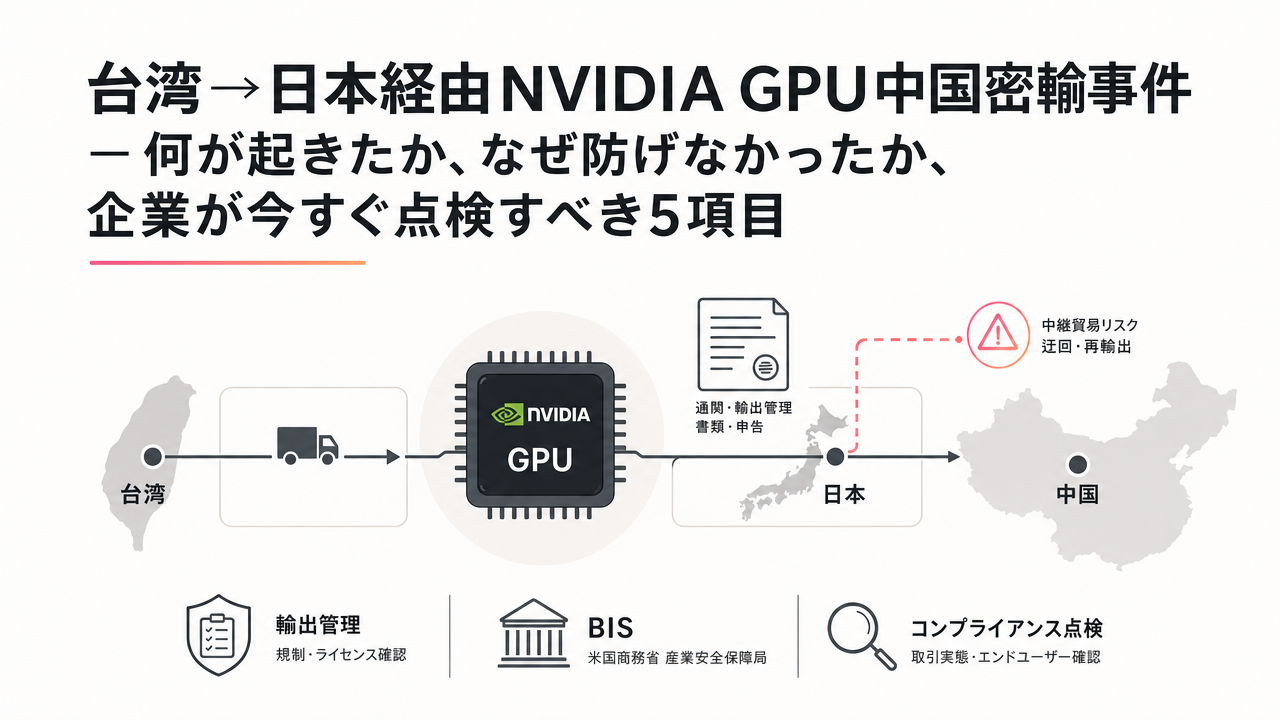
In May 2026, the Keelung District Prosecutors Office in Taiwan detained three people on suspicion of diverting servers equipped with NVIDIA's advanced AI chips through Japan to mainland China, and conducted simultaneous searches at 12 locations. Bloomberg reports that the seized goods included roughly 50 servers worth more than USD 15 million. This is the first major criminal enforcement action by Taiwan targeting AI-chip diversion.123
I first heard about this from Bloomberg's follow-up coverage on May 27, 2026. The actual enforcement action happened earlier, between May 21 and 22, but the fact that "Japan was used as part of the route" only surfaced later. As someone building an export control AI in Japan, I genuinely had to stop for a moment when I read that sentence.
In this article (written as of May 28, 2026), I want to lay out the confirmed facts as carefully as possible, cross-checking against government primary sources wherever available — the U.S. Department of Justice, U.S. BIS, the U.S. Federal Register, and Japan's METI. Where only media reports are available and there is no official government statement to back them up, I will clearly label the material as "reported." From there, I will unpack why the "Taiwan → Japan → China" route worked, and how it sits inside the three-layer structure of U.S. BIS controls, Japan's FEFTA, and Taiwan's Strategic High-Tech Commodities (SHTC) regime. At the end, I will summarise five items that Japanese companies should re-check now. By the end, I think you will see why diversion cannot be stopped by looking only at "your direct counterparty."
Overview of the case — when, who, what, where, how
To start, let me split the publicly available facts into "government statements" and "press reports," and explicitly mark anything unreported as "not yet disclosed" or "under investigation."
U.S. side: formal indictment in March 2026 (government primary source available)
According to a press release from the U.S. Department of Justice Office of Public Affairs dated March 19, 2026,4 the U.S. Attorney's Office for the Southern District of New York charged the following three individuals with conspiracy to violate the Export Controls Reform Act (ECRA) and related offences.
| Full name | Role (per DOJ release) | Citizenship | Status |
|---|---|---|---|
| Yih-Shyan "Wally" Liaw | Co-founder of Super Micro; SVP, Business Development | U.S. citizen | Detained, then released on USD 5 million bail; pleaded not guilty5 |
| Ruei-Tsang "Steven" Chang | General Manager, Super Micro Taiwan | Taiwan | At large |
| Ting-Wei "Willy" Sun | Third-party broker | Taiwan | Detained |
The indictment lists three counts: conspiracy to violate ECRA, conspiracy to smuggle goods from the United States, and conspiracy to defraud the United States. ECRA violations carry a maximum penalty of up to 20 years' imprisonment.4 According to the DOJ indictment, the scheme involved purchasing approximately USD 2.5 billion worth of servers through pass-through companies in Southeast Asia, of which approximately USD 510 million were actually re-shipped to customers in China.
Taiwan side: enforcement in May 2026 (press-based)
Taiwan's actions are primarily reported through Bloomberg, Taipei Times, Nikkei, and Tom's Hardware. As of writing, no official English-language press release from Taiwan's Bureau of International Trade or the Keelung District Prosecutors Office has been confirmed. Press-based facts can be summarised as follows.
| Item | Content (press-based) |
|---|---|
| Date of enforcement | May 21–22, 2026 |
| Investigating authority | Keelung District Prosecutors Office; joint investigation with related agencies |
| Search locations | 12 locations across Taiwan |
| Seized goods | Approximately 50 Super Micro Computer servers |
| Estimated value | More than USD 15 million |
| Chips on board | NVIDIA Hopper-generation AI accelerators |
| Allegations | Export-document falsification, false customs declarations |
| Suspects in Taiwan | Three (only surnames published: Yu, Wang, Chen; full names not disclosed) |
Sources include Bloomberg,1 Taipei Times,2 Nikkei,3 and Tom's Hardware.6
A note of caution. Whether the three Taiwanese suspects (Yu, Wang, Chen, surnames only) are the same individuals as the three indicted by the U.S. DOJ (Liaw, Chang, Sun) cannot be confirmed because no official statement from Taiwan's prosecutors has been verified. The reporting describes the two efforts as "related to the U.S. investigation," but Taiwan's criminal proceedings may be running independently.
Route
According to Bloomberg, Taiwan prosecutors believe that at least one shipment cleared Taiwan customs, was exported to Japan, and ultimately reached Hong Kong.1 Hong Kong has frequently been cited as a transshipment node for mainland China. Prosecutors also state that the suspects were planning additional re-export shipments through Japan, and a second shipment was reportedly stopped before leaving port.6
Chips on board
Press reports describe the chips only as "Hopper generation"; whether they were H100, H200, or a mix has not been publicly disclosed.6 The Hopper generation is the core of NVIDIA's advanced AI accelerator lineup, and is heavily controlled by U.S. BIS for exports to China.
Super Micro's position and the market reaction
Super Micro has stated that "the company itself was not involved in any unlawful export." Following this string of enforcement actions, however, its share price fell 33% in a single day and the company lost USD 6 billion in market value.5 On May 23, 2026, NVIDIA CEO Jensen Huang told reporters in Taipei that "I hope Super Micro will tighten up its compliance and that this kind of thing will not happen again,"7 an unusually pointed public comment about a key partner. NVIDIA naming a major partner in this way is rare, and the industry read it as a signal of how serious the situation is.
That is the outline of the facts that can be confirmed at this point.
Why "Taiwan → Japan → China"? The structural blind spot of transshipment
Now let me get to the structural side. Why was "via Japan" chosen as the diversion route? This is an especially important question for Japan.
First, Japan is a U.S. ally and one of the major hubs for semiconductor logistics. Exports from Taiwan to Japan are one of the most natural flows in the region commercially, so customs filters do not easily flag them as high risk. If servers with Hopper-generation chips are declared as destined for a Japanese data centre, the Taiwan-side export authorisation also tends to be relatively easy to obtain. That is the first thin layer.
Second, the time window for swapping documents after arrival in Japan. Using bonded warehouses and forwarder-to-forwarder transfer schemes in Japan to rewrite the final destination to Hong Kong or mainland China is a pattern that has been reported repeatedly in past Singapore and Malaysia cases.89 In this case as well, Bloomberg writes that the goods "reached Hong Kong via Japan," but at which stage inside Japan the route was switched is still under investigation.
Third, the use of substantive dummy transactions as cover. According to the U.S. DOJ indictment, the suspects allegedly used "pass-through companies in Southeast Asia" to resell NVIDIA servers to customers in China, falsifying the destination on export documents and disguising the contents of the boxes (dummy shells) — a two-layer concealment strategy.46 Press reports also describe a technique where serial-number stickers were removed with heat guns and swapped onto non-functional dummy units, while the real servers were sent to China by another route.5
Fourth — and this is the most uncomfortable part for Japanese companies — the structural reality that you cannot detect this by looking only at your direct counterparty. At the moment goods enter Japan from Taiwan, on paper they are destined for "Japanese company A." For company A, it is hard to see where the goods then flow. Even if company A is a bona-fide customs broker, warehouse operator or forwarder, if it gets pulled into the chain of falsified documents, its own operation can end up as part of the diversion.
In past Singapore and Malaysia cases as well, many of the local warehouse operators and forwarders only knew that "the goods arrived and then left," and did not substantively verify who the end user was.9 Japan faces the same structural problem.
Replace siloed classification work with AI.
METI's FY2024 data shows 52% of foreign exchange law violations stem from classification errors. Download the TRAFEED product catalog covering features and rollout.
The structure of U.S. BIS rules — mapping controls on H100/H200/A100 to China
Let me also lay out the U.S. rules from primary sources. Some readers may be tempted to skip this, but it is essential to making sense of this case.
The basic framework
Under the Export Administration Regulations (EAR), the U.S. Bureau of Industry and Security (BIS) has placed NVIDIA's high-performance AI accelerators such as A100 and H100 on the China export control list, treating exports to China, Hong Kong, and Macau under a "presumption of denial" in principle.10 NVIDIA introduced China-market variants such as A800, H800, and H20 with reduced performance, but these were later added to the controlled scope as well.
The BIS final rule of January 15, 2026 (Federal Register FR Doc. 2026-00789)
On January 15, 2026, BIS published a final rule titled "Revision to License Review Policy for Advanced Computing Commodities" in the Federal Register, effective immediately.1112 The core of the rule is that for items with Total Processing Performance (TPP) below 21,000 and total DRAM bandwidth below 6,500 GB/s, BIS shifts the review policy from "presumption of denial" to "case-by-case review," provided certain conditions are met. BIS itself names NVIDIA H200 and AMD MI325X as examples of items that meet this threshold.1112
The main conditions are roughly as follows.111213
- (a) Exports to China must not crowd out U.S. foundry capacity for U.S. customers.
- (b) The Chinese purchaser must adopt export compliance procedures, including customer screening.
- (c) The item must be tested by an independent third-party testing laboratory in the United States to verify performance and security.
- (d) Before shipment, the exporter must submit a certification from the third-party testing laboratory to BIS.
On December 8, 2025, the President announced that "H200 and similar products may be exported to China for approved customers," and the January final rule implements that announcement.13 In parallel, on January 14, 2026, the White House announced a 25% tariff on semiconductors in the same performance band, presenting a conditional export scheme under which "25% of the revenue from H200 exports must be paid back to the United States."14
Status as of May 2026
H200 is in a state of "conditionally legal exports having resumed." Exports to China through routes that do not satisfy the conditions remain criminally punishable under ECRA. The Taiwan case shows that this "non-compliant route" was being used for active diversion.
There is a point I want to flag here. Once a legal channel opens, the economic logic of diversion temporarily weakens, because more Chinese customers can buy legally. At the same time, however, the incentive to "appear legal while selling illegally" rises. The label of "a customer with a licence" becomes easier to use as cover. The simultaneous timing of this enforcement action and the January BIS rule revision is not a coincidence; structurally, they have to be read as a set.
Where Japan's FEFTA and Catch-All Controls meet this case
So how does Japan's export control side connect to this? Again, primary sources from METI.
FEFTA and List Controls
Japan's export controls are built on the Foreign Exchange and Foreign Trade Act (FEFTA) and the Export Trade Control Order, with two pillars: List Controls (items meeting certain specifications require authorisation) and Complementary Export Controls (so-called Catch-All Controls, applying to non-listed items where there is concern about diversion to military use).15 For advanced semiconductors, a ministerial ordinance amendment that came into force on July 23, 2023 substantially expanded List Controls, and the scope has continued to be revisited.16
Complementary Export Controls (in force October 9, 2025) — per METI's official materials
METI promulgated the relevant Cabinet Orders, ministerial ordinances, notifications, and circulars on April 9, 2025, and the revised Complementary Export Controls took effect on October 9, 2025.1718 According to METI's official materials, the framework is as follows.
- Item 16 of Appendix 1 of the Export Trade Control Order (goods other than List-Controlled items) is split into 16(1) and 16(2), and 16(1) is explicitly designated as "specified items."
- The items covered by 16(1) are (1) machine tools, (2) radar / navigation radio equipment / radio remote-control equipment, (3) integrated circuits, (4) aircraft / spacecraft and their components, (5) navigation equipment, and (6) inspection equipment (those corresponding to Article 14-2 of the goods ministerial ordinance, by HS code).
- The objective requirements and inform requirements applied to specified items have been strengthened.
The explicit positioning of integrated circuits as "specified items" is the key linkage to this case. Even chips that fall outside List Controls can be brought under authorisation through Complementary Export Controls when the destination or end user raises concerns about military diversion.
Transshipment (intermediary trade) controls
Under FEFTA Article 25, paragraph 4, intermediary-trade transactions — sale-and-purchase that involves the movement of goods between foreign countries — require prior authorisation from the Minister of Economy, Trade and Industry in certain cases.15 If a Japanese company is involved in a "Taiwan → Japan → Hong Kong" flow like this case, it can fall within the scope of regulation even if its only role was as a logistics waypoint.
Where Japanese-side issues sit
As of writing, there is no publicly confirmed announcement of action from Japan's METI, customs, or the National Police Agency. The investigation is being led by Taiwan and the United States. Even so, if Japanese bonded warehouses, forwarders, or transfer operators were brought into the chain of diversion, they would be subject to investigation under both FEFTA and the Customs Act. "We were only a transit point" will not be a complete defence. That is the legislative intent embedded in the Complementary Export Controls.
Comparison with past diversion cases
Let me zoom out for a moment and place this alongside earlier cases. The pattern of "via Japan" is new, but "via a third country" itself has been repeating since 2024.
| Transit country | Main method | Main enforcement / press dates | Scale |
|---|---|---|---|
| Singapore | Bulk purchases via Chinese-capital Singapore entities (Megaspeed case) | March 2025 | Reported around USD 2 billion in H100 / H800 servers19 |
| Malaysia | Purchases under data-centre names; unopened NVIDIA servers held locally | Late 2024 – 2025 | Months with year-on-year GPU imports up 3,400%8 |
| Inside the United States (front companies) | ALX Solutions in California and others shipping under spoofed end-customer names | 2025 | Single invoices of USD 28.4 million, etc.20 |
| United States / Hong Kong (Operation Gatekeeper) | Alan Hao Hsu and others convicted; H100/H200 forwarded to China and Hong Kong | October 2024 – May 2025 | USD 160 million in goods21 |
| Thailand | Shipments reported under a government-related entity name (recipient under investigation, unconfirmed) | 2025–2026 | Press-based, under investigation22 |
| Japan (this case) | Document falsification routing from Taiwan via Japan to Hong Kong / mainland China | May 2026 | More than USD 15 million seized in a single action (press-based)16 |
Reading this list, what stands out is that diversion routes choose "countries with thick logistics," not "countries with weak controls." Singapore, Malaysia, Thailand, and Japan are all trade hubs in East Asia. The very depth of their logistics flows makes it easier to "blend in." Japan was chosen here not because its rules are loose, but because the very reliability of its logistics tends to cause filters to default to "this is probably legitimate." The case turns that strength into a vulnerability.
What the simultaneous timing of conditional H200 access (January 2026) and this diversion case really means
Let me take one more step back.
In January 2026, BIS opened conditional exports of H200 to China. In May, Taiwan exposed a diversion case via Japan. On the surface these two events point in opposite directions, but they are two sides of the same phenomenon.
When the line between legal and illegal is moving, compliance becomes hardest. "Routes that were illegal yesterday" and "routes that became conditionally legal today" run at the same time, and "illegal activity dressed as legal" multiplies. For an export control practitioner, the list of "customers with a licence" and "customers without one" needs to be updated daily. On top of that, you have to spot "disguised customers pretending to have a licence." Paper-based screening alone cannot keep up.
That is the gap that has been driving TRAFEED's development. The U.S. Federal Register, Japan's METI notifications, Taiwan SHTC amendments, China's Export Control Law and counter-sanctions law are all moving in parallel. Manual classification cannot keep up at that pace.
Five items companies should re-check right now
From here, this is the practical side — what Manager Tanaka should do once he gets back to his desk today.
Item 1: depth of counterparty screening (KYC)
"We know the company name and address" is not enough. Can you actually verify ultimate beneficial owners (UBOs), parent and affiliated companies, past shipping history, and physical presence on the ground (offices, employee count)? Trading companies that were incorporated only 1–2 years ago, purchasers operating under data-centre names, and purchasers using government-related entity names have repeatedly been abused in past cases.81922
Item 2: operation of end-use declarations
Are you collecting end-user and end-use declarations as a substantive process, not a checklist? Do the addressees on the declarations keep changing? Is the same declaration being reused across multiple deals? Under U.S. BIS rules, obtaining a declaration is treated as a precondition for "reasonable care"; failing to do so exposes the company itself to liability.
Item 3: logistics tracking (cross-checking bills of lading and customs data)
Can you confirm from logistics data that the goods you shipped actually arrived at the declared final destination? Without a process to periodically reconcile bills of lading (B/L), air waybills (AWB), and customs data, you cannot detect "the documents were rewritten after arrival in Japan." To avoid being drawn into transshipment schemes, you need visibility not just into the legs you handle directly, but into what happens beyond them.
Item 4: detection of nominee arrangements and shell companies
Are you mechanically screening for indicators like recently incorporated companies, registered addresses at virtual offices, or representatives connected to other compliance incidents? In the Megaspeed case, a Singapore-registered company placed large orders for H100 within a short period, and the mismatch between its incorporation date and order size was flagged as a risk signal.19
Item 5: payment flow (does the remitter match the ultimate beneficiary?)
Cases where the goods are "destined for company A in Singapore" but the payment comes "from company B in Hong Kong" have appeared repeatedly.20 Do the invoice addressee and the actual remitter match? Does the payment route go through multiple offshore entities in an unnatural way? Accounting/finance and export control need to be wired together, not siloed.
Free download: Transshipment Risk Checklist
We are distributing a five-item checklist for export control practitioners to assess transshipment risk through third countries (Taiwan, Japan, Malaysia, Singapore, UAE, etc.).
How TRAFEED helps with early detection of transshipment risk
Trying to do all five of these items manually does not scale. For mid-sized companies with one or two export control officers, running UBO checks, declaration reconciliations, logistics tracking, nominee detection, and payment-flow verification across hundreds of monthly transactions is simply not realistic.
TRAFEED is the world's first export control AI agent, built so that AI handles the groundwork for all five items and humans only judge the cases that the system flags as abnormal.
Specifically, TRAFEED (1) continuously updates a machine-readable corpus of U.S. BIS Federal Register entries, Japanese METI notifications, EU Council regulations, Taiwan SHTC, and China's Export Control Law; (2) runs integrated screening against counterparty registration records, parent/subsidiary relationships, and past shipping history; and (3) escalates only the transactions where a risk signal fires to a human export control officer. It runs on Japanese servers in the AWS Tokyo Region, so customer data does not leave Japan.
Looking only at "your direct counterparty" will not catch a Japan-transit diversion route. A deeper layer of visibility that includes your counterparty's counterparties is becoming the baseline expectation for compliance.
If you are reviewing export-control operations or classification workflows, download the TRAFEED product catalog (PDF) or contact us.
Summary
The take-aways from this case.
- On March 19, 2026, the U.S. Department of Justice charged Super Micro co-founder Yih-Shyan "Wally" Liaw, Super Micro Taiwan GM Ruei-Tsang "Steven" Chang, and third-party broker Ting-Wei "Willy" Sun with conspiracy to violate ECRA and related offences (government primary source).4
- On May 21–22, 2026, the Keelung District Prosecutors Office in Taiwan seized around 50 servers with NVIDIA Hopper-generation AI chips, valued at more than USD 15 million. Three suspects, identified only as Yu, Wang, and Chen, were detained on suspicion of export-document falsification (press-based).126
- At least one shipment is believed by Taiwan prosecutors to have cleared Taiwan customs, transited Japan, and reached Hong Kong (press-based).1
- NVIDIA CEO Jensen Huang made an unusual public comment naming Super Micro, asking the company to tighten compliance.7
- BIS published a final rule (FR Doc. 2026-00789) effective January 15, 2026, shifting items below 21,000 TPP and below 6,500 GB/s total DRAM bandwidth to conditional case-by-case review. An era of legal and illegal channels running in parallel has begun (government primary source).1112
- Japan brought revised Complementary Export Controls into force on October 9, 2025, and explicitly designated Item 16(1) of Appendix 1 of the Export Trade Control Order (including integrated circuits) as "specified items," strengthening controls (government primary source).1718
- Unlike earlier cases via Singapore, Malaysia, and Thailand, this is the first time the U.S. ally Japan has been targeted as the transit point. That is what is new.
- For Japanese companies, the five items to re-check are counterparty screening, end-use declarations, logistics tracking, nominee detection, and payment flows. All five require a layer of visibility deeper than "your direct counterparty."
I treat this case as a warning sign for Japanese business as a whole. "Thick logistics, deep trust" — what is normally a strength — becomes, from the perspective of a diversion actor, the very reason to choose Japan: "if we route through here, no one will look twice." Closing that asymmetry is not possible without making the rules machine-readable and extending visibility to the counterparty of your counterparty.
Want to assess your own transshipment risk?
Diversion through third countries cannot be detected by looking only at your direct counterparty. TRAFEED is the world's first export control AI agent. It performs integrated screening of counterparty parent/subsidiary relationships, affiliates, and past shipping history, and makes the blind spots of transshipment visible. Operated on Japanese servers in the AWS Tokyo Region.
See TRAFEED in detail Book a 30-minute consultation
Footnotes
-
Bloomberg, "Taiwan Said to Suspect Nvidia Chips Smuggled to China Via Japan," May 27, 2026. https://www.bloomberg.com/news/articles/2026-05-27/taiwan-said-to-suspect-nvidia-chips-smuggled-to-china-via-japan ↩ ↩2 ↩3 ↩4 ↩5 ↩6
-
Taipei Times, "Taiwan said to suspect Nvidia chips Smuggled to China via Japan," May 28, 2026. https://www.taipeitimes.com/News/biz/archives/2026/05/28/2003858087 ↩ ↩2 ↩3
-
Nikkei, "NVIDIA semiconductors may have flowed into China via Japan; reported by Taiwan authorities and U.S. media," May 27, 2026. https://www.nikkei.com/article/DGXZQOGM2762P0X20C26A5000000/ ↩ ↩2
-
U.S. Department of Justice, Office of Public Affairs, "Three Charged with Conspiring to Unlawfully Divert Cutting Edge U.S. Artificial Intelligence Technology to China," March 19, 2026. https://www.justice.gov/opa/pr/three-charged-conspiring-unlawfully-divert-cutting-edge-us-artificial-intelligence ↩ ↩2 ↩3 ↩4
-
Tom's Hardware, "Supermicro co-founder pleads not guilty to smuggling billions of dollars of Nvidia servers to China — suspected smuggler released on $5 million bond," 2026. https://www.tomshardware.com/tech-industry/super-micro-co-founder-wally-liaw-pleads-not-guilty-to-nvidia-smuggling-charges ↩ ↩2 ↩3
-
Tom's Hardware, "Taiwan authorities arrest three on suspicion of smuggling Nvidia chips to China — operation allegedly used Japan as transshipment point before forwarding banned Supermicro servers to Hong Kong," May 2026. https://www.tomshardware.com/tech-industry/artificial-intelligence/taiwan-authorities-arrest-three-on-suspicion-of-smuggling-nvidia-chips-to-china-operation-allegedly-used-japan-as-transshipment-point-before-forwarding-banned-supermicro-servers-to-hong-kong ↩ ↩2 ↩3 ↩4 ↩5 ↩6
-
Bloomberg, "Nvidia CEO Urges Super Micro to Tighten Up Amid Taiwan Crackdown," May 23, 2026. https://www.bloomberg.com/news/articles/2026-05-23/nvidia-ceo-urges-super-micro-to-tighten-up-amid-taiwan-crackdown ↩ ↩2
-
Tom's Hardware, "GPU imports to Malaysia surge by 3,400% in 2025, raising alarm amid smuggling investigations," 2025. https://www.tomshardware.com/pc-components/gpus/gpu-imports-to-malaysia-surge-by-3-400-percent-in-2025-raising-alarm-amid-smuggling-investigations ↩ ↩2 ↩3
-
Dataconomy, "How Singapore Became A Hotspot For Smuggled Nvidia AI Chips," March 2025. https://dataconomy.com/2025/03/04/how-singapore-became-a-hotspot-for-smuggled-nvidia-ai-chips/ ↩ ↩2
-
Congressional Research Service, "U.S. Export Controls and China: Advanced Semiconductors," R48642. https://www.congress.gov/crs-product/R48642 ↩
-
Federal Register, "Revision to License Review Policy for Advanced Computing Commodities," FR Doc. 2026-00789, effective January 15, 2026. https://www.federalregister.gov/documents/2026/01/15/2026-00789/revision-to-license-review-policy-for-advanced-computing-commodities ↩ ↩2 ↩3 ↩4
-
Bureau of Industry and Security (BIS), "Department of Commerce Revises License Review Policy for Semiconductors Exported to China." https://www.bis.gov/press-release/department-commerce-revises-license-review-policy-semiconductors-exported-china ↩ ↩2 ↩3 ↩4
-
Mayer Brown, "Administration Policies on Advanced AI Chips Codified, with Reverberations Across AI Ecosystem," January 2026. https://www.mayerbrown.com/en/insights/publications/2026/01/administration-policies-on-advanced-ai-chips-codified ↩ ↩2
-
Morgan Lewis, "BIS Revises Export Review Policy for Advanced AI Chips Destined for China and Macau," January 2026. https://www.morganlewis.com/pubs/2026/01/bis-revises-export-review-policy-for-advanced-ai-chips-destined-for-china-and-macau ↩
-
Center for Information on Security Trade Control (CISTEC), "Basics of Export Control." https://www.cistec.or.jp/export/yukan_kiso/anpo_gaiyou/index.html ↩ ↩2
-
Nikkei, "Export controls on advanced semiconductors in force from July 23; METI ministerial ordinance revision." https://www.nikkei.com/article/DGXZQOUA233FD0T20C23A5000000/ ↩
-
Ministry of Economy, Trade and Industry (METI), "Revision of Complementary Export Controls (in force October 9, 2025)." https://www.meti.go.jp/policy/anpo/apply-01/20251009_catchminaoshi/20251009catchall.html ↩ ↩2
-
Ministry of Economy, Trade and Industry (METI), "Revision of Complementary Export Controls — effective October 9, 2025" (PDF). https://www.meti.go.jp/policy/anpo/law_document/20250409_catchallshiryou.pdf ↩ ↩2
-
Tom's Hardware, "Singapore company allegedly helped China smuggle $2 billion worth of Nvidia AI processors, report claims." https://www.tomshardware.com/tech-industry/artificial-intelligence/singapore-company-alleged-to-have-helped-china-get-usd2-billion-worth-of-nvidia-ai-processors-report-claims-nvidia-denies-that-the-accused-has-any-china-ties-but-a-u-s-investigation-is-underway ↩ ↩2 ↩3
-
CNBC, "Nvidia's unofficial exports to China face scrutiny after arrest of silicon smugglers in Singapore," March 3, 2025. https://www.cnbc.com/2025/03/03/nvidia-unofficial-exports-to-china-face-scrutiny-after-singapore-arrests.html ↩ ↩2
-
Introl, "First AI Chip Smuggling Conviction — Operation Gatekeeper," December 2025. https://introl.com/blog/nvidia-160m-smuggling-operation-gatekeeper-december-2025 ↩
-
Tom's Hardware, report on Nvidia AI GPUs shipped to China via a Thai government-related entity (a recipient was reported, but any involvement by the company in question is unconfirmed), 2025–2026. https://www.tomshardware.com/tech-industry/artificial-intelligence/supermicro-tied-execs-used-thailand-government-entity-to-ship-nvidia-ai-gpus-to-china ↩ ↩2