This is Hamamoto from TIMEWELL.
A Delivery Unlike Any Before
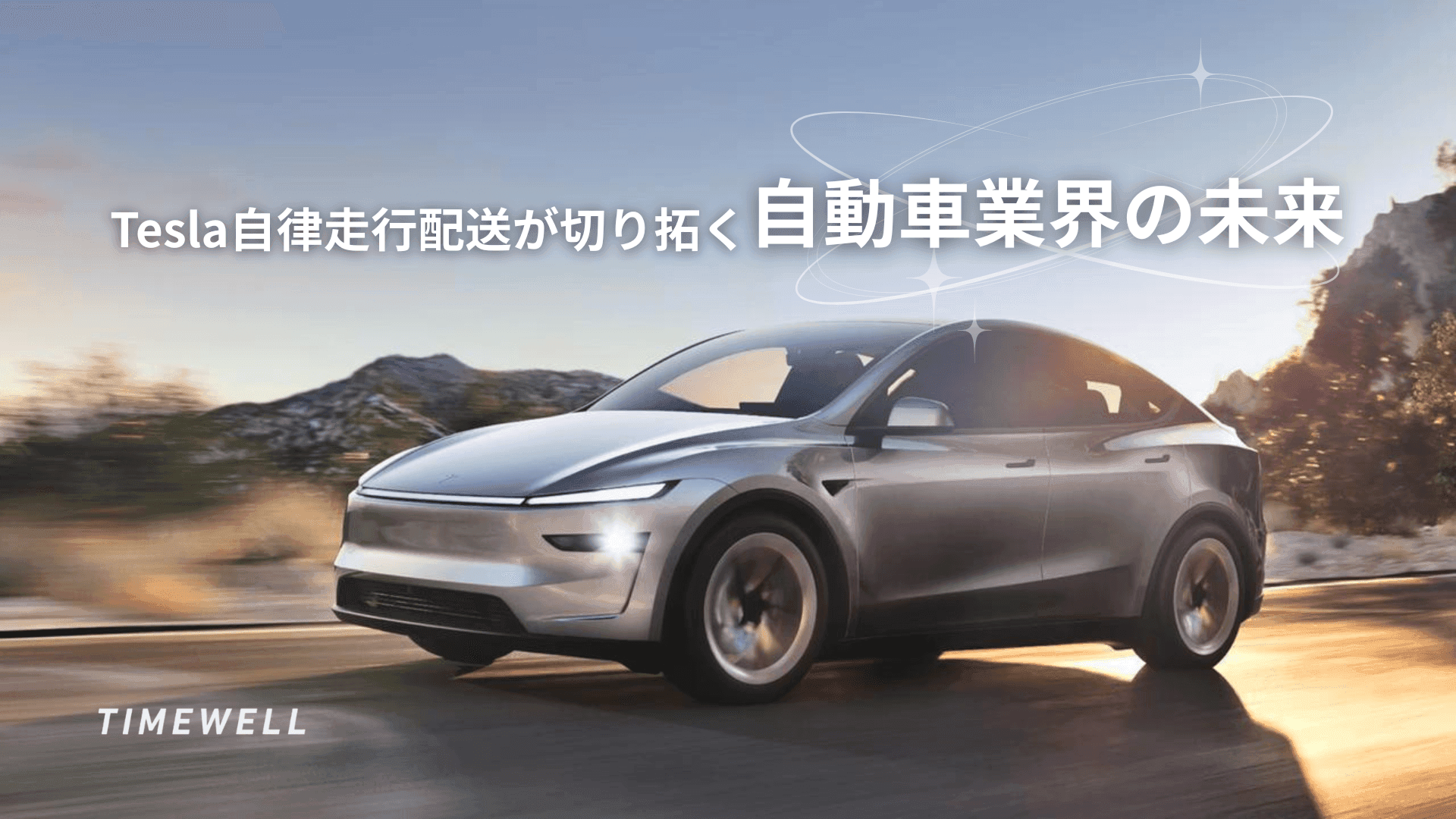
On June 28, 2025, Tesla completed a vehicle delivery in Austin, Texas that had no human driver at the wheel and no Tesla employee present at handoff. The customer ordered the vehicle through Tesla's smartphone app, tracked its progress in real time, and received it fully autonomously.
It was a single delivery. But its implications extend well beyond one transaction.
Looking for AI training and consulting?
Learn about WARP training programs and consulting services in our materials.
What Actually Happened
The process worked like this:
- Customer places an order via the Tesla app
- Tesla prepares and configures the vehicle at its facility
- The vehicle departs autonomously — no safety driver
- The customer tracks the vehicle's route in real time on their phone
- The vehicle arrives at the customer's location
- Handoff is completed without any Tesla representative present
This is a direct-to-consumer delivery model taken to its logical extreme. No test drive at a dealership. No negotiation with a sales representative. No waiting in a showroom. The entire transaction — from order to keys in hand — happens through software.
The Dealership Model Is Already Under Pressure
Tesla has never used traditional dealerships. Since its founding, the company has operated a direct-sales model — selling through its own stores and website. This put it in regulatory conflict with many US states that have dealer protection laws requiring automakers to sell through licensed dealers.
The autonomous delivery milestone accelerates a trend that was already underway: the progressive elimination of physical touchpoints in the vehicle purchase process. If a car can be delivered to your door autonomously, the need for any physical retail infrastructure — showrooms, lots, service centers that double as sales points — diminishes further.
For traditional automakers with deep franchise dealer networks, this creates a competitive disadvantage that is structural, not just operational. Rebuilding a direct-sales model while managing franchise relationships is extremely difficult. Tesla has no such conflict.
Implications for the Robotaxi Strategy
Tesla's robotaxi ambitions — the Cybercab, the full-self-driving robotaxi service — have been discussed for years. The autonomous delivery milestone matters for the robotaxi strategy for a specific reason: it demonstrates that Tesla's autonomy stack can handle real-world urban driving without human supervision, in a commercially meaningful context.
Robotaxis and vehicle deliveries share the same underlying technical requirement: a car that can navigate city streets, respond to traffic and pedestrians, and arrive at a destination reliably — without a human in the loop. The June 28 delivery is evidence that Tesla's software is approaching that threshold in at least one market.
Service Centers and the Post-Ownership Model
One underappreciated aspect of Tesla's autonomous delivery: it hints at a future where the relationship between manufacturer and customer is continuous, not transactional.
If a vehicle can drive itself to a service center for maintenance and return autonomously, the ownership experience changes fundamentally. Scheduled maintenance becomes invisible to the owner — the car simply disappears overnight and returns in the morning. Software updates already happen over-the-air. Hardware upgrades could follow a similar pattern.
Tesla has described a future where customers participate in the robotaxi fleet when they are not using their vehicles — earning revenue while the car works autonomously. The autonomous delivery capability is a prerequisite for that model. A car that cannot drive itself cannot participate in a robotaxi network.
What This Means for Competitors
Every major automaker is working on autonomous driving. None has demonstrated autonomous commercial delivery at the level Tesla showed in Austin.
The gap matters not because autonomous delivery is immediately a large revenue line — it is not — but because it demonstrates organizational capability. Tesla has built the software, the mapping, the customer interface, the regulatory approvals, and the operational processes to make autonomous delivery work. That is a multi-year head start in a capability that will matter enormously for the next decade of mobility.
For investors evaluating Tesla: autonomous delivery is a concrete milestone in a long list of promises. For competitors: it is a signal that the timeline for autonomous capability is shorter than comfortable.