This is Hamamoto from TIMEWELL.
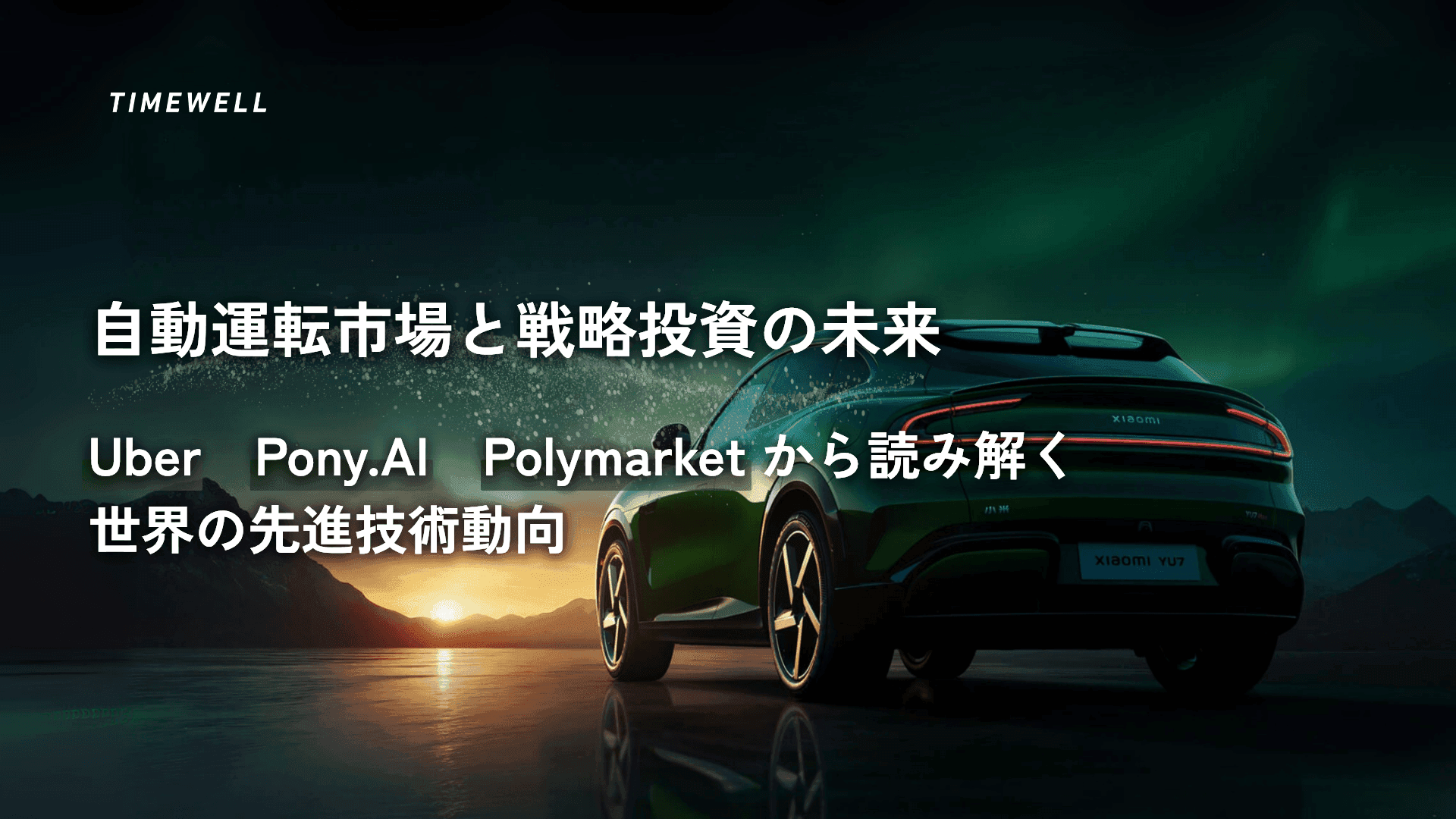
The Future of Autonomous Driving and Strategic Investment
Today's business environment is transforming rapidly through technological innovation and global market disruption. Autonomous driving, AI development, strategic partnerships, and prediction markets — these themes are no longer optional considerations for business leaders. They are the terrain on which competitive strategy is being decided.
This article covers: the Uber-Pony.AI strategic situation; Travis Kalanick's potential return; Polymarket as a business forecasting tool; the OpenAI-Microsoft AGI contract conflict; and the implications of Xiaomi's EV quality for global tariff policy.
Topics:
- Autonomous driving and global market dynamics: manufacturing quality, tariff wars, and what Xiaomi's new cars reveal
- Strategic partnerships and market restructuring: Uber, Pony.AI, and the cloud kitchen era
- Prediction markets and AI strategy conflicts: OpenAI vs. Microsoft, Polymarket, and the entrepreneur's view
Looking for AI training and consulting?
Learn about WARP training programs and consulting services in our materials.
Part 1: Manufacturing Quality, Tariff Wars, and Xiaomi's New EV
Xiaomi YU7 Ultra: A Quality Statement
Xiaomi's YU7 Ultra has drawn attention for its premium interior, approximately 400-mile range, and competitive pricing that puts it in direct competition with Tesla and European brands. The vehicle's manufacturing quality — judged from real-world demonstrations and video content — has surprised observers expecting compromises.
This matters beyond the car itself. When a Chinese technology company produces an EV that matches or exceeds Western build quality at a competitive price point, it directly challenges the rationale for tariff protection in the US and EU.
The Tariff Policy Collision
Major economies are tightening their regulatory and tariff postures toward Chinese EVs. The US, EU, and others have implemented or proposed significant tariffs, citing fair competition concerns and, in some cases, safety and quality standards.
The core tension: tariff policy assumes a quality gap that may be narrowing or disappearing. When a Xiaomi YU7 Ultra or BYD Han EV meets the build quality standards of established brands, the justification for elevated tariffs shifts from "quality protection" to "industrial protection" — a politically defensible but economically messier position.
The Korea precedent is relevant: products failing domestic safety and quality standards have been import-restricted, which is unambiguous. But restricting products that meet quality standards on competitive grounds requires different policy framing.
Autonomous Vehicles as Platform Infrastructure
Beyond passenger transport, discussion in this space increasingly focuses on autonomous vehicles as delivery and logistics infrastructure. DoorDash and Zipline are actively developing autonomous last-mile delivery using both ground and aerial vehicles. When this infrastructure matures, it will reshape local logistics economics in ways that affect every business that relies on delivery.
Businesses that anticipate this shift — and build operations flexible enough to integrate autonomous delivery — will have significant cost and speed advantages over those that do not.
Part 2: Uber, Pony.AI, and the Strategic Partnership Landscape
Travis Kalanick's Potential Return
Travis Kalanick, Uber's founding CEO, may be re-engaging with the company. The specifics remain unclear, but his potential involvement coincides with Uber's reported interest in Pony.AI's US autonomous vehicle operations.
Uber + Pony.AI: What the Acquisition Would Mean
Pony.AI is a leading Chinese autonomous driving company with significant US operations. Uber acquiring Pony.AI's US autonomous vehicle segment would do several things:
First, it would give Uber direct control over the autonomous driving technology that will ultimately define whether Uber's driver network is an asset or a liability. The long-term strategic threat to Uber's business model is clear: if autonomous vehicles can do what human drivers do at lower cost, Uber needs to own that capability rather than be disrupted by it.
Second, the Cloud Kitchen connection is relevant. If autonomous vehicles handle last-mile delivery and Uber operates the restaurant infrastructure through its cloud kitchen investments, the combination creates an end-to-end food production and delivery system with structural cost advantages over any competitor relying on human drivers.
Third, the investment de-risks Uber's positioning. By funding Pony.AI's US operations — even as a minority investor rather than acquirer — Uber gains option value on the outcome without committing to full acquisition economics.
Broader Competitive Dynamic
DoorDash, Volkswagen, and Zipline are all active in adjacent parts of this space. The competitive dynamics suggest we are in an early consolidation phase: companies that establish autonomous delivery positions in the next two to three years will have significant structural advantages in the following decade.
Travis Kalanick's Cloud Kitchen has been positioning exactly for this future. The combination of kitchen infrastructure, delivery technology, and brand-as-a-service creates a model that traditional restaurant operators cannot easily replicate.
Part 3: Prediction Markets, OpenAI vs. Microsoft, and Strategic Implications
Polymarket as Business Intelligence
Polymarket and Kalshi are prediction markets — platforms where participants bet real money on the outcome of future events. This creates a price signal that aggregates distributed information in ways that traditional expert forecasting does not.
A striking example: before the opening weekend of a major F1 film, prediction market prices implied higher box office revenue than the entertainment industry's own consensus forecasts. The crowd was right.
For business intelligence applications, this matters. Prediction markets reflect the aggregated judgment of participants with financial skin in the game — a different information set than surveys, analyst reports, or expert opinion. Forward-thinking strategists are beginning to incorporate prediction market prices as one input among many in their decision frameworks.
The OpenAI-Microsoft AGI Contract Dispute
OpenAI and Microsoft have a contractual relationship built around significant capital investment in exchange for technology access. The dispute involves the definition of AGI — Artificial General Intelligence — and what happens to the contract terms if OpenAI achieves it.
OpenAI defines AGI as: human-level intelligence, or the capacity to generate more than $100 billion in profit. Microsoft's position: AGI has not been achieved; existing contract terms apply; significant control mechanisms remain in place.
The dispute reflects a structural tension embedded in the original deal. Microsoft invested at a time when AGI felt distant and theoretical. As OpenAI's capabilities have advanced, the economic and strategic stakes of that contractual definition have become enormous. If OpenAI declares AGI achieved under its definition, it potentially changes the terms of one of the most consequential technology partnerships in history.
For entrepreneurs: this dynamic illustrates why AGI definitions in investor and partnership contracts deserve precise attention from the outset. Ambiguous technical thresholds create the conditions for exactly these disputes.
OpenAI's PBC Transition
OpenAI's move toward Public Benefit Corporation structure reflects an attempt to balance commercial interests with the original mission of beneficial AI development. The transition involves navigating relationships with existing investors, board governance, and regulatory scrutiny — while maintaining the operational focus required to stay at the frontier.
The dynamics are instructive for any organization attempting to scale while managing a complex multi-stakeholder mission. The challenges OpenAI faces — and how it resolves them — will set precedents for how frontier AI companies govern themselves going forward.
Summary
Key takeaways from these intersecting themes:
- Autonomous driving is transitioning from technology demonstration to strategic infrastructure investment. Companies positioned early in ownership or partnership with autonomous driving capability will have durable advantages.
- Chinese EV quality is advancing faster than Western tariff policy is adapting. The basis for protection-oriented tariffs is becoming harder to defend on quality grounds.
- Prediction markets represent an underutilized business intelligence tool for scenarios where distributed information matters.
- Large-scale AI partnerships require precise contractual definition of capability thresholds — ambiguity creates conflict as capabilities advance.
- Platform convergence — cloud kitchens + autonomous delivery + logistics software — is creating new economic structures that will disrupt large portions of the food and logistics industry.
Reference: https://www.youtube.com/watch?v=2H7x8tqntIA
TIMEWELL AI Consulting
TIMEWELL supports business transformation in the age of AI agents.