This is Hamamoto from TIMEWELL.
The Event That Made Autonomous Driving Real
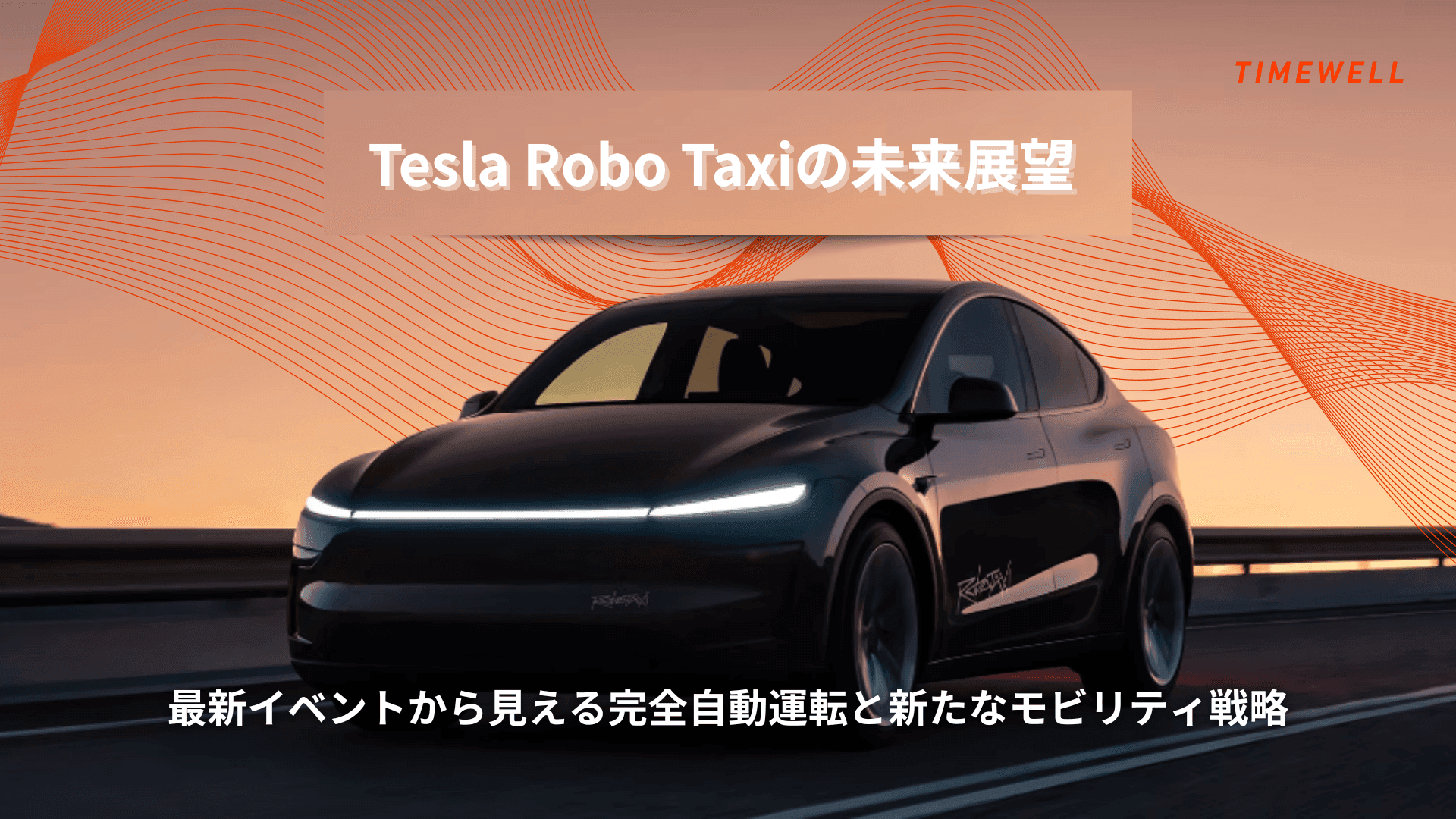
On June 22, 2025, Tesla hosted a robotaxi launch event in Austin, Texas. Twenty-plus influencers and Tesla supporters were invited for rides in autonomous Tesla vehicles — the first time most participants had experienced a vehicle operating without meaningful human involvement.
John, president of Tesla Owners Silicon Valley and a Tesla enthusiast since his first Model 3 ride in 2018, shared his experience in detail. He had participated in FSD beta testing and has tracked the technology through multiple generations. For him, the Austin launch was the moment a seven-year wait became concrete.
This article synthesizes the event experience, the economics that make robotaxi transformative, and what Tesla's mobility vision means in practice.
Topics:
- The ride experience: what it's actually like
- Economics and technology: the competitive case
- The bigger picture: what autonomous mobility changes
Looking for AI training and consulting?
Learn about WARP training programs and consulting services in our materials.
Part 1: What the Ride Was Like
Getting Started
Rides were booked through a TestFlight app — a pre-production build distributed via Apple's developer testing platform. The app shows a geofenced service area; riders input a destination keyword (hotel names, restaurants, intersections) rather than a full address. Security authentication is integrated at pickup.
The ride structure mirrors Uber or Lyft on the surface — request, match, pickup, ride, drop-off. The difference is what happens in the vehicle.
The In-Vehicle Experience
The cabin display shows the current route, upcoming turns, and a real-time visualization of how the FSD system perceives the surrounding environment. When the vehicle changes lanes, the turn signal activates before the maneuver — exactly as a human driver would. Navigation updates continuously.
Entertainment is integrated: music, video content, and app controls are available throughout the ride. The white interior selected for the robotaxi fleet amplifies the visual impact of the autonomous environment. Tesla's design choices for the robotaxi experience are deliberate — this is a product, not a prototype.
John's sessions covered 7–10 rides across diverse Austin environments: residential streets, office areas, commercial zones, and winding hill terrain. He saw the vehicle maintain 40–45 mph on direct routes and handle a variety of conditions.
Handling the Unexpected
One particularly telling moment: the vehicle encountered an A-frame sign on the road and an approaching emergency vehicle during the same session. Both were detected and navigated around without human intervention. The system adapted to scenarios that weren't in any training scenario playbook — it encountered them in real-time and responded.
This kind of edge-case handling is the most meaningful signal of FSD maturity. Controlled demos can be staged for success; real-world operation cannot.
The flat fare was $4.20 per ride. The number is a Musk-flavored choice, but the pricing structure is meaningful: simple, transparent, predictable.
Part 2: The Economics and Technology
Why the Cost Model Changes Everything
Current ride-hailing pricing runs $2–4 per mile, heavily weighted by driver compensation. Tesla's projected robotaxi cost structure targets approximately $0.25 per mile — a roughly 90% reduction in operating cost.
This is not a marginal efficiency gain. It's a structural shift in the economics of transportation. Services, delivery, and commuting decisions made based on current ride-sharing prices would be made very differently at $0.25/mile.
The Model Y Juniper's 50% reduction in component count versus the previous generation is part of how that unit economics becomes achievable at scale. Fewer parts means lower production cost, lower maintenance cost, and higher reliability.
Tesla vs. Waymo: A Different Thesis
The comparison with Waymo is frequently framed as a technology comparison (camera vs. LiDAR). The more meaningful framing is an economic one.
Waymo's vehicle cost — including its multi-sensor array — is estimated at $150,000+. Tesla's production vehicle costs are orders of magnitude lower. At 1,000 Waymo vehicles currently deployed, that cost structure limits how quickly the fleet can scale. Tesla's manufacturing capacity can produce more vehicles in a day than Waymo has deployed in total.
If FSD reaches unsupervised performance at Tesla's claimed level, the fleet economics of large-scale robotaxi deployment favor Tesla enormously. Waymo has an operational head start; Tesla has a manufacturing and cost structure advantage.
Continuous Improvement at Software Speed
Every ride generates data. Every edge case encountered gets incorporated. The improvement velocity of a software-driven system is categorically different from hardware cycles. Waymo has to manufacture and deploy new sensor hardware to implement certain improvements. Tesla pushes a software update to its entire deployed fleet overnight.
John compared the competitive dynamics to the early smartphone era: rapid iteration, aggressive competition, and a rate of change that makes last quarter's product feel dated.
Part 3: Tesla's Mobility Vision
Beyond Transportation
Tesla frames the robotaxi not as a taxi replacement but as a redefinition of what vehicle ownership means. The Tesla Network — once fully operational — allows vehicle owners to contribute their car to the fleet during idle hours. The vehicle earns money while parked at work. The economics of vehicle ownership shift from pure cost to potential income-generation.
This changes the conversation about EV purchase decisions. A vehicle that can generate $20–50/day during idle hours offsets a significant portion of the ownership cost. The math affects how people value and finance vehicles.
Cities and Infrastructure
At scale, autonomous vehicle fleets change urban planning calculations. Parking demand decreases when vehicles are in continuous use rather than sitting idle. Traffic flow improves when routing is coordinated algorithmically. The surface area required for parking in city centers could be repurposed.
These are second-order effects, but they compound. Tesla's vision extends past the vehicle to the systems it enables.
The Regulatory Path
Texas has a more permissive regulatory environment for autonomous vehicles than California or most other states. Austin was chosen in part for this reason. As Tesla accumulates operational data and safety records in Texas, the regulatory case in other states becomes easier to make.
NHTSA approval, FMVSS exemptions for Cybercab (which lacks a steering wheel and pedals), and state-by-state regulatory engagement are all in progress. The regulatory path is real work — it doesn't happen automatically — but Tesla's approach reflects a methodical effort rather than a fight.
Summary
The June 22 Austin launch was not a demonstration or a concept. It was a commercial service — real rides, real payment, real autonomous operation on real city streets.
Key points:
- App-based booking, flat $4.20 fare, entertainment-integrated cabin experience
- Real-time adaptive handling of unexpected scenarios (signs, emergency vehicles)
- Target cost model: ~$0.25/mile — a structural shift in transportation economics
- Model Y Juniper's 50% component reduction enables the unit economics
- Tesla Network will allow owners to monetize idle vehicle time
- Manufacturing scale is the asymmetric advantage vs. Waymo
The question was always whether autonomous driving would actually arrive. In Austin, in June 2025, it did.
Reference: https://www.youtube.com/watch?v=OSgtPA9b_yY
TIMEWELL AI Consulting
TIMEWELL supports business transformation in the age of AI agents.