This is Hamamoto from TIMEWELL.
GPT-5: The Full Picture of What It Can Do
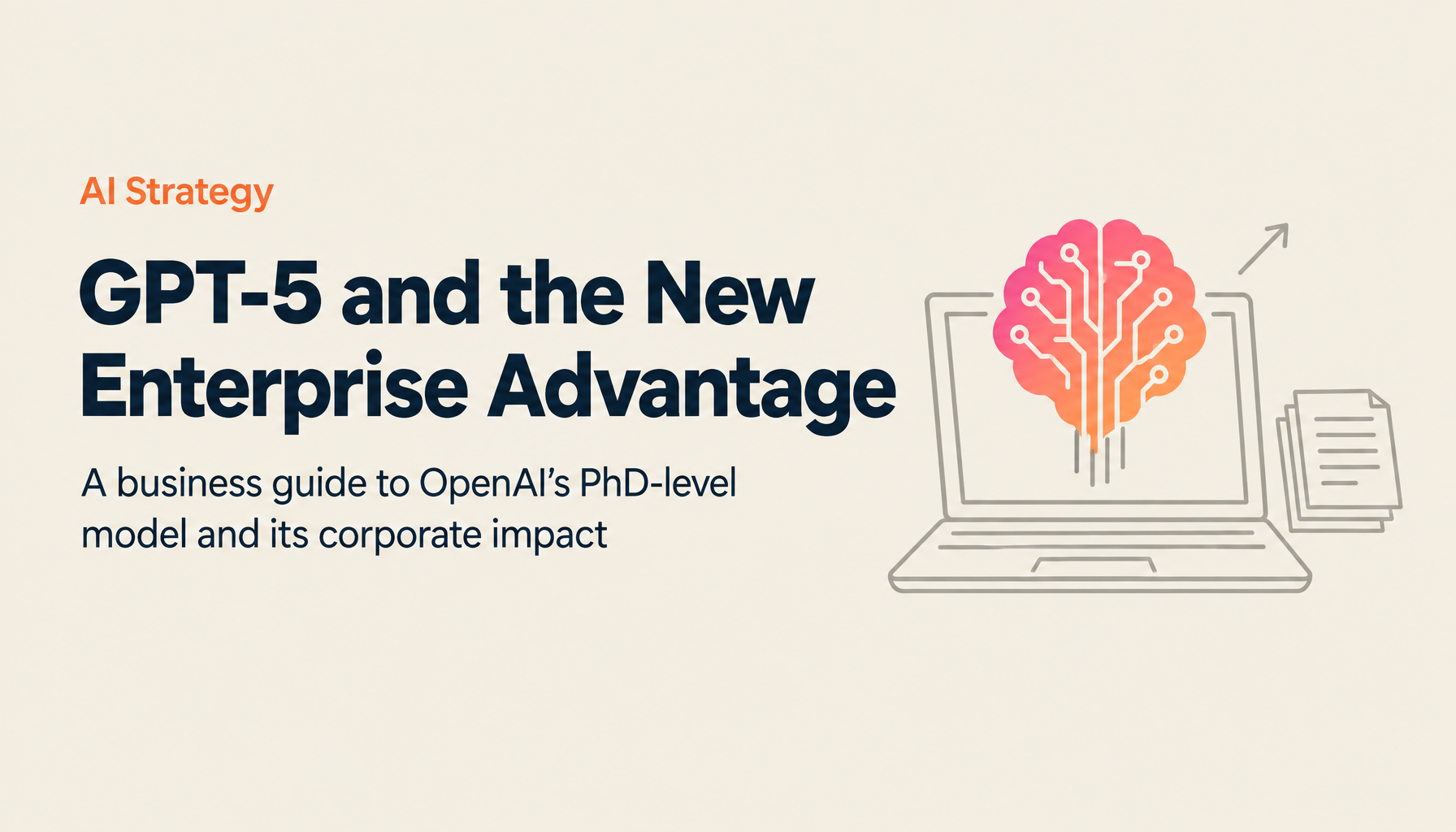
AI advancement is accelerating, and GPT-5 represents the current frontier. Unlike previous generations where users had to manually select between GPT-4, O-series models, and specialized tools, GPT-5 integrates these capabilities — automatically routing each prompt to the appropriate model tier based on the task's complexity, reasoning requirements, and tool usage needs.
This article covers GPT-5's architecture, benchmark performance, detailed comparisons with Gemini 2.5 Pro and Claude, live demo results across multiple task types, and what the performance data means for practical business deployment.
Topics:
- GPT-5 features and architecture — the integrated model system
- Detailed performance comparison — GPT-5 vs. Gemini 2.5 Pro and Claude
- Live demos and practical applications — real-world outputs and business implications
Looking for AI training and consulting?
Learn about WARP training programs and consulting services in our materials.
Part 1: GPT-5 Architecture — Integrated Model Selection
Automatic Model Routing
Previous GPT versions required users to choose: GPT-4 for general tasks, O3 for reasoning, O3 Pro for highest difficulty. This created friction and required users to know which model suited each task.
GPT-5 eliminates this decision. When a prompt is submitted, GPT-5 analyzes:
- Content and topic
- Task complexity
- Whether tool usage is needed
- User intent
Based on this analysis, it automatically selects among three internal model tiers:
- Standard GPT-5: fast, general-purpose, handles most everyday tasks
- Thinking model: deep logical reasoning, mathematical analysis, scenario modeling
- GPT-5 Pro: highest accuracy, parallel processing, complex multi-step analysis
Performance by Tier
In live demonstrations, Standard GPT-5 responded to a simple greeting in under one second. The Thinking model, when activated for a complex prompt, completed tasks that previously required 12 minutes in under 5 minutes. GPT-5 Pro achieved perfect scores on Harvard/MIT-level mathematics problems.
Pricing:
- Free tier: limited usage with core features
- ChatGPT Plus (¥3,000/month): expanded usage, access to all tiers
- ChatGPT Pro (¥30,000/month): unlimited usage
Part 2: Performance Comparison — GPT-5 vs. Gemini 2.5 Pro and Claude
Mathematics
GPT-5 was tested against the same math problems used to challenge Gemini 2.5 Pro and Claude. GPT-5 Pro achieved a perfect score on Harvard and MIT-level problems — including problems where Gemini 2.5 Pro struggled.
Gemini 2.5 Pro reached correct answers on some problems but tended to simplify intermediate steps, making the reasoning harder to verify. Claude produced incorrect answers on certain advanced problems.
Fermi Estimation
Task: estimate the number of convenience stores in Tokyo.
GPT-5's approach: set explicit premises (Tokyo population, area, density, national store ratio), calculated from multiple angles, arrived at 7,000–9,000 stores with detailed supporting arithmetic.
Gemini 2.5 Pro: produced a similar 7,000–8,000 estimate, but with less detailed reasoning — functional but less auditable.
Business Strategy Analysis
Scenario: a small manufacturer (20 employees, ¥8 million cash on hand) choosing between three strategies: raise prices for existing customers by 10%, enter a new market, or implement internal reform.
GPT-5 analyzed each strategy with detailed P&L projections, cash flow modeling, failure risk assessment, and week-by-week action plans. It concluded that Strategy A (price increase for existing customers) was most viable and explained why with concrete numbers.
Gemini 2.5 Pro provided success/failure scenario comparisons but without the same depth of numerical support. Claude produced insufficient analysis on several of the strategy dimensions.
Long Document Extraction
Task: from a ~50,000-token text, identify the name of a character's pet hamster.
GPT-5 returned the correct answer ("Mint") in approximately one second. Gemini 2.5 Pro completed the task but was noticeably slower. On speed for long-context retrieval, GPT-5 showed a clear advantage.
Image Analysis
Task: solve a maze by drawing the optimal path from start to finish in red.
GPT-5 identified the correct path quickly and accurately — routes through blocked sections were correctly avoided. The previous-generation reasoning model struggled with similar tasks.
Gemini 2.5 Pro, on a comparable image analysis task, failed to render the attached image correctly in some cases, routing users to an external link instead.
Summary Comparison
| Task | GPT-5 | Gemini 2.5 Pro | Claude |
|---|---|---|---|
| Advanced math | Perfect score | Partial | Errors on some |
| Fermi estimation | Detailed + explained | Functional | Not tested |
| Business strategy | Detailed + numbered | Simpler | Insufficient |
| Long doc retrieval | ~1 second | Slower | Not tested |
| Image analysis | Accurate, fast | Display issues | Not tested |
Part 3: Live Demos and Practical Applications
Everyday Queries
GPT-5 standard model handles routine queries — greetings, basic factual questions, simple instructions — with near-instant response times. The automatic model selection means users never experience the delay of a reasoning model being invoked for a task that doesn't require it.
2030 Government AI Deployment Scenario
A complex prompt: analyze how Japanese municipal governments will use generative AI by 2030. GPT-5 segmented municipalities by adoption type (fully integrated vs. superficially compliant), modeled the driving factors, and produced a structured analysis with quantified assumptions.
This kind of nuanced scenario modeling — which requires holding multiple variables in context simultaneously — is where the Thinking model tier activates and where GPT-5's reasoning advantage over previous models is most visible.
HTML and Application Generation
GPT-5 generated a functional single-page typing speed racing game from a plain-language description. The code was clean, the UI was polished, and the application ran correctly on first generation.
Gemini 2.5 Pro and Claude also demonstrated code generation capability in this domain, but GPT-5 was rated higher on UI quality and code accuracy in direct comparisons.
The Prompt Quality Effect
A consistent theme across all demo tasks: the quality of GPT-5's output scales with the precision of the prompt. GPT-5 takes instructions more literally than previous models — which means well-crafted prompts yield excellent results, while ambiguous prompts reveal the ambiguity clearly.
The practical implication: investing in prompt design quality produces proportional returns in output quality. This is more true with GPT-5 than with any previous model.
Summary
GPT-5's integrated model selection system removes the need for users to choose between model variants. The standard tier handles most tasks quickly; the Thinking model handles reasoning tasks; Pro handles the hardest problems.
In comparative testing:
- GPT-5 outperformed Gemini 2.5 Pro and Claude on advanced mathematics, business strategy depth, and long-context retrieval speed
- Gemini 2.5 Pro performed reasonably on Fermi estimation but with less explanatory depth
- Claude had difficulty on some advanced analysis tasks
For business users:
- Business strategy modeling: GPT-5's numerical depth is a practical advantage
- Long document analysis: GPT-5's speed and accuracy make it the strongest current option
- Code generation: all three models are viable; GPT-5 leads on UI quality
- Everyday tasks: the automatic tier selection makes GPT-5 faster and easier to use than manually managing multiple models
The era of prompt quality as a primary competency is here. GPT-5 amplifies both good and poor prompt craft — organizations that develop systematic prompt design practices will extract materially more value from the technology.
Reference: https://www.youtube.com/watch?v=UW9V91UmxKo
TIMEWELL AI Consulting
TIMEWELL supports business transformation in the age of AI agents.