From TIMEWELL
This is Hamamoto from TIMEWELL.
Looking for AI training and consulting?
Learn about WARP training programs and consulting services in our materials.
Tackling Pet Health Challenges
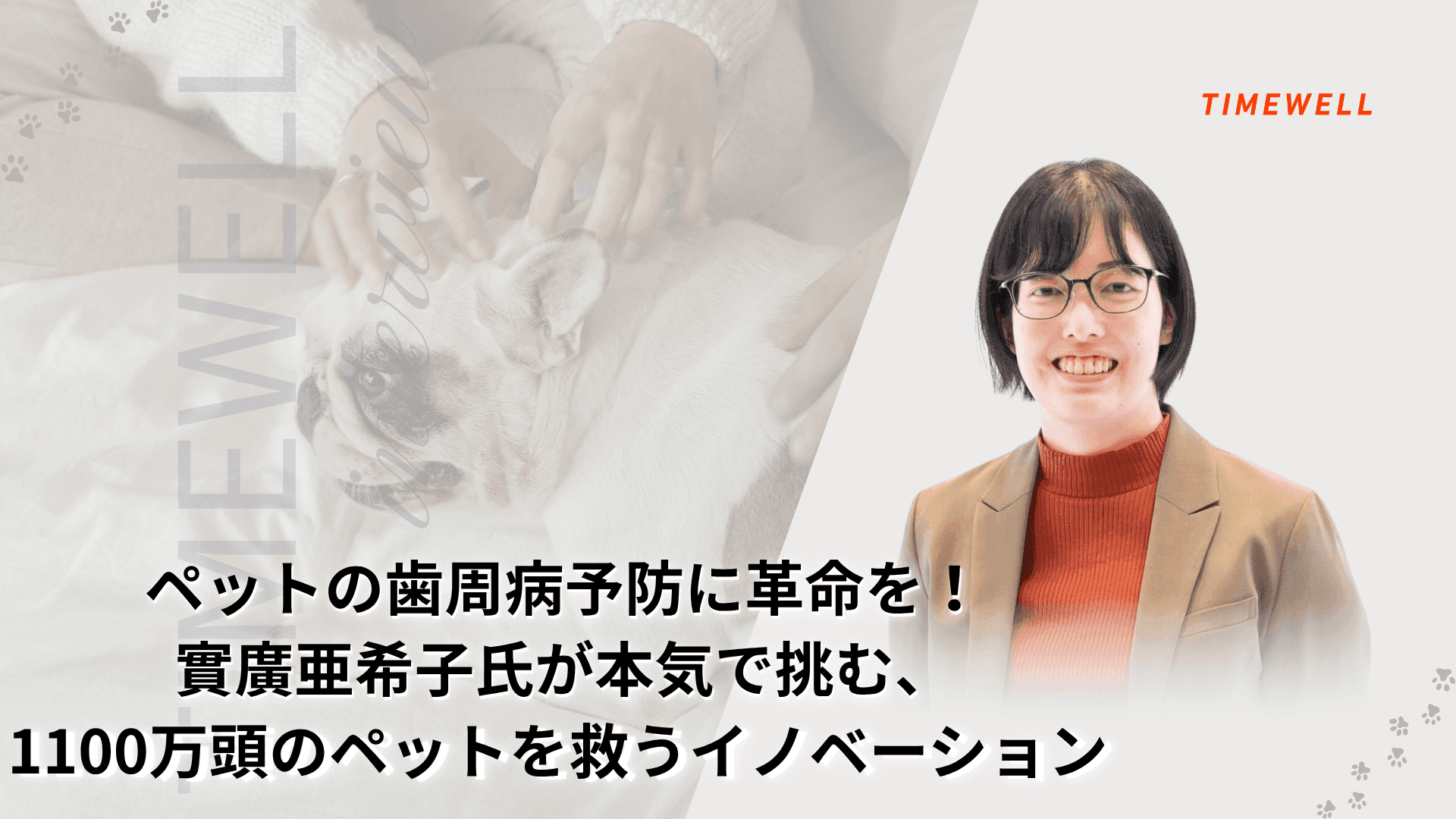
Working in IP strategy at a major beverage company while simultaneously launching a pet dental care startup — Akiko Jitsuhiro's journey is one of determination and innovation. She surpassed her crowdfunding goal in record time and has captured the attention of pet owners across Japan. We sat down with her to hear about her passion for the business and the path that led her here.
[Still accepting support toward the next goal!] Check out Jitsuhiro's crowdfunding campaign here!
Representative Director, Ani-lience Co., Ltd.
While working in IP strategy at a major beverage company, she founded Ani-lience Co., Ltd. in May 2024. She is currently developing a saliva test kit for periodontal disease prevention in pets. Based on interviews with over 200 pet owners and patented technology, her kit achieves a 90%+ success rate compared to the 20% success rate of competing products. She has won numerous awards including the Grand Prize at the Women's Entrepreneurship Challenge and the Best Award at the Yokohama Idea Challenge. Through her side-business venture, she is working to save the estimated 11 million pets in Japan at risk of periodontal disease.
Instagram: https://www.instagram.com/pepregum/
Profile:
- From Researcher to Entrepreneur — How Losing an Internal Business Contest Opened a New Path
- The "90% Success" Test Kit Born from 200 Pet Owner Interviews
- How AI Technology Made Color Analysis Automation a Reality
- Overcoming Setbacks — Balancing "Never Give Up" and "Knowing When to Pivot"
- Summary
From Researcher to Entrepreneur — How Losing an Internal Business Contest Opened a New Path
— Could you start with a brief introduction of yourself?
Jitsuhiro: I founded a company called Ani-lience. In my day job, I work in the IP strategy department at a beverage manufacturer. I joined the company straight out of university in 2017, so I'm now in my eighth year. I started out as a researcher in the lab, then spent about two years on secondment to a cosmetics manufacturer working on product development. After returning, I spent another year in the lab before moving to my current department.
As for Ani-lience, we just passed our one-year mark — I registered the company in May 2024. Our business focuses on early detection and preventive care for periodontal disease in dogs and cats, as well as colic in horses.
— You're currently running a crowdfunding campaign for Ani-lience and you hit your first milestone very quickly. How does that feel?
Jitsuhiro: I'm truly grateful. It's a product-based crowdfunding campaign, and the product isn't even finished yet — we're still in R&D with plans to sell in the spring. Seeing that people are excited and placing their trust in something that doesn't exist yet means a great deal to me.
— What drew you to pet oral health in the first place?
Jitsuhiro: The idea came to me when I was working at the cosmetics manufacturer. I was initially thinking about whether skincare products could help with allergies in humans. There was a product called a barrier gel oil designed for people with allergies, and I thought — if it works for people, why not for dogs? So I started interviewing pet owners.
But when I spoke to veterinarians, I found that cosmetic products like shampoos hadn't really shown much benefit, and similar products already existed on the market, so I pivoted.
During those owner interviews, I heard a lot about skin concerns, but I also kept hearing people say, "I can't get my dog to let me brush their teeth." That led me to think about how to solve that problem, and I ended up focusing on oral care.
— What made you decide to start a side business?
Jitsuhiro: My company holds an internal business contest once a year, and I actually entered twice with essentially the same idea. Getting rejected both times was the biggest catalyst.
Being rejected meant the leadership didn't see enough value in it. And honestly, thinking about the market size, it wasn't going to be a billion-dollar business — not the kind of thing a large corporation would typically pursue.
But through my research and interviews, I became fairly convinced that there was a real problem around pet dental health and that our solution had potential. The research costs were relatively low, so I thought, why not try it as an individual? I started it as a personal hobby project. At some point, I needed to pursue a joint research project with a university, and that's when I formally incorporated.
The "90% Success" Test Kit Born from 200 Pet Owner Interviews
— What insights came out of speaking with over 200 pet owners?
Jitsuhiro: I noticed that people's concerns fell into a fairly consistent set of patterns. Many said they struggled with brushing, which is an important issue. But the bigger underlying problem was that owners weren't detecting the risk of periodontal disease early — they were missing the signs without realizing it.
Without regular dental care or preventive measures, dogs and cats were developing serious periodontal disease. That structural problem was the biggest finding.
Among the approaches we considered, our kit allows owners to measure their pet's oral health at home, giving them a tangible sense of how their pet's oral hygiene is deteriorating. After having over 70 owners use the kit, we saw a clear behavioral change once they could see the numbers. That's what convinced us the kit had real potential in prevention.
— Early detection must be critical for pet oral disease, right?
Jitsuhiro: Absolutely. If caught early and treated appropriately, it can be reversed. But in severe cases — when tartar has built up heavily and the tooth is badly damaged — the only option is extraction. So catching it before it gets to that point is incredibly important.
— How often would you recommend using the kit?
Jitsuhiro: We're currently planning for once a month. Sending kits out monthly works best both logistically and cost-wise — we'd ship a batch at once for owners to use one per month.
— You have a patent-pending technology. What makes this kit stand out?
Jitsuhiro: The biggest advantage is how easy it is to use — for both the owner and the pet. Competing products currently on the market require opening the pet's mouth to collect dental plaque, either with a swab for lab testing or a test strip to read color changes on the spot. Dogs really resist having their mouths opened.
Our kit uses saliva, which can be collected in a much more dog-friendly way — for example, letting the dog chew a dental chew and then using the saliva on that for the test. We've found that dogs accept this much more readily.
In concrete numbers, about 20% of owners can successfully use competing products correctly. With our kit, over 90% achieved correct test results on the same dogs and cats. That makes the usability difference quite clear.
— Is that ease of use something you personally focused on developing?
Jitsuhiro: Yes. I had friends with pets use it many, many times and give me feedback, and I revised the design based on that feedback. That's definitely the area I put the most effort into.
— What kind of world do you ultimately want to create through this business?
Jitsuhiro: There are about 16 million dogs and cats kept as pets in Japan, and approximately 11 million of them are estimated to already have mild to severe periodontal disease.
My mission is to prevent the mild-to-moderate cases — the ones with lower risk — from progressing to serious disease. I want to reduce the number of pets that develop severe periodontal disease, and ideally bring that number as close to zero as possible.
How AI Technology Made Color Analysis Automation a Reality
— You participated in TIMEWELL's technical entrepreneur training program, WARP. How did you first hear about it?
Jitsuhiro: I believe it was from one of Mr. Hamamoto's Facebook posts.
— What was the biggest change you experienced through participating in WARP?
Jitsuhiro: The oral health check kit I had envisioned worked by dipping a test strip in saliva and watching the color change — from white to dark purple, for example — and using the position on a color chart to determine the risk level for periodontal disease. I wanted to automate that color analysis.
I had the idea that AI could do this, and when I consulted with an AWS representative at a WARP session, I learned it was actually feasible. That conversation gave me the push I needed to pursue it. Without that consultation, I don't think I would have gotten there on my own.
— Were there other aspects of WARP you found valuable?
Jitsuhiro: The mentoring — the instructors from TIMEWELL would do 30-minute to one-hour sessions, where we'd get assignments and could ask questions. And the consultation sessions with AWS representatives were particularly useful. I could share my concept and they'd help me think through how to make it work, often coming up with answers right there in the session. The speed of problem-solving on the technical side was really impressive.
Overcoming Setbacks — Balancing "Never Give Up" and "Knowing When to Pivot"
— Finally, do you have a message for people who are currently taking on a challenge?
Jitsuhiro: I want to start by talking about setbacks. There was a period during the development of the oral health check kit when I thought it might really be over. I actually paused development and considered stopping entirely. Looking back now, I think that pause was actually a good thing — it gave me time to clear my head.
When I was seriously considering quitting, I reminded myself: this is important work. So I thought about how to approach it differently, and that's what brought me to where I am today.
Even if you feel your spirit breaking at some point, if you don't give up completely, a way forward can appear. If it's something you truly want to do, you can keep at it.
That said, I also think it's important to set a line in advance — something like, "If I've tried this hard and it still hasn't worked, I'll let it go."
That might sound contradictory — but I think having both perspectives is valuable. There are many routes to a goal, so keep looking for what you genuinely want to do and keep moving toward it.
— I'm curious — when you hit that low point, how did you manage to push through?
Jitsuhiro: I knew the kit was something important to develop. So I kept asking: what would make this work? When multiple paths kept hitting dead ends, I found a way to add new options and expand the possibilities.
I'd been on Path A, but I found a Path B. Being able to see that — and try something new — is what helped me recover.
That's what I've come to believe: continuing to work toward a goal means that even if one path closes, a new one can come into view.
Jitsuhiro exemplifies the spirit of modern entrepreneurship — tackling a genuine social challenge with deep empathy, patent-backed technology, and relentless determination. Despite working full-time and running her startup on the side, her commitment to solving a problem that affects millions of pets — and the people who love them — is both impressive and inspiring.
What stood out most was her resilience: she paused development when things looked uncertain, but returned with a refined approach and new possibilities opened through her work with WARP and AI technology.
Her message to fellow challengers strikes a powerful balance — "Keep going if it truly matters to you, but know your stopping point too." It's realistic without being discouraging. We look forward to watching Jitsuhiro's work bring peace of mind to pet owners across Japan.
Register for the WARP program waiting list and learn more here.