From TIMEWELL
This is Hamamoto from TIMEWELL.
Looking for AI training and consulting?
Learn about WARP training programs and consulting services in our materials.
How Environment Shapes Who We Become
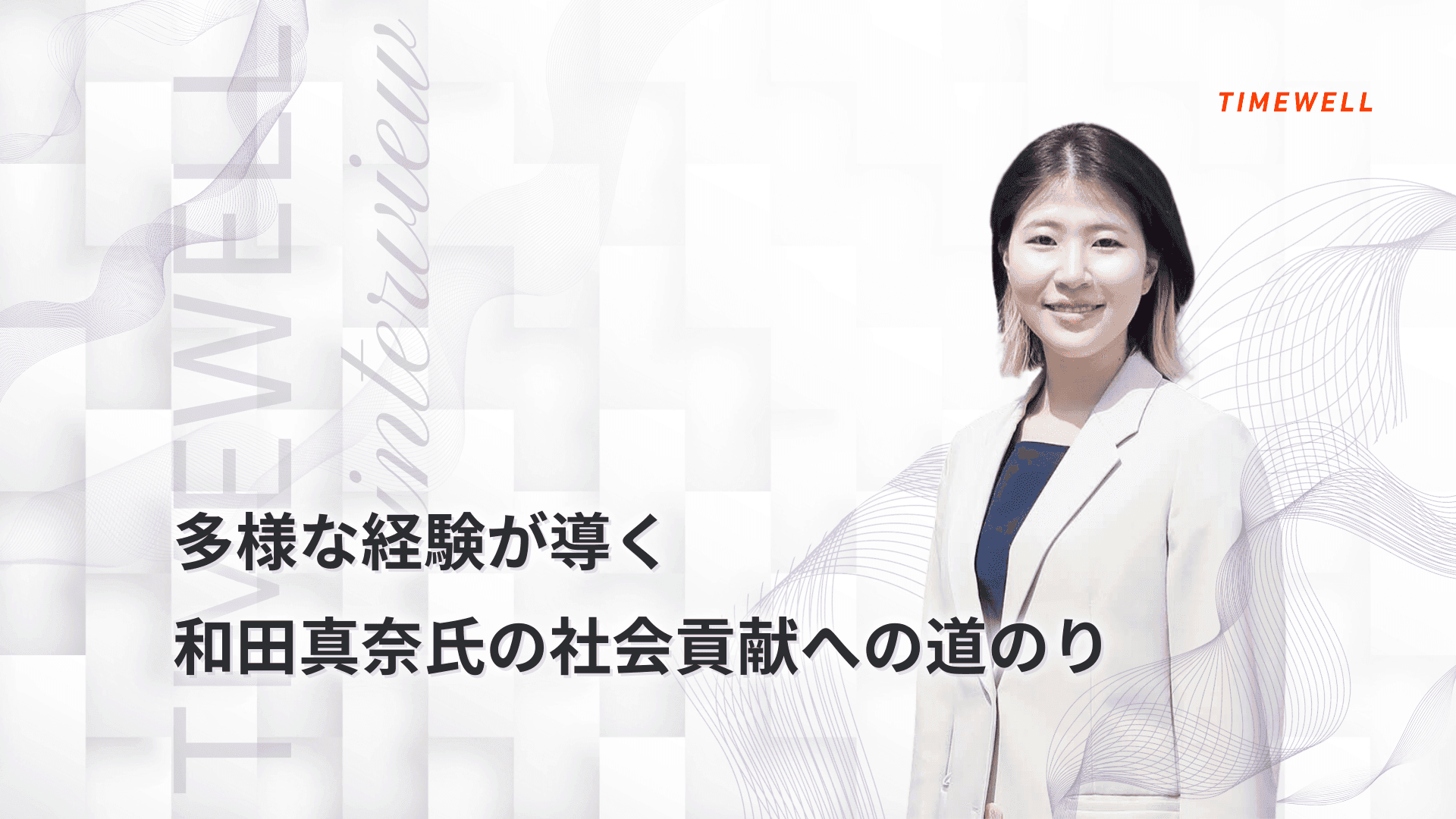
Have you ever thought about how our environment shapes who we become? Mana Wada grew up in Malaysia and attended international school in Hong Kong, and through exposure to diverse cultures she developed a deep interest in the relationship between people and their environments. She now works in corporate planning at an electronics manufacturer while developing an AI-powered web service for mental wellness through WARP. Drawing on her own experiences and driven by a deep desire to contribute to society, we spoke with Wada about her journey and her vision.
Affiliation: Seimi Denki Seisakusho Co., Ltd. — Visionary Lab
After a childhood in Malaysia and secondary education at an international school in Hong Kong, she studied educational psychology at a Japanese university. Having aspired to become an entrepreneur since her university days, she now works in corporate planning at an electronics manufacturer. Through WARP, she is developing a web service for mental wellness using AI. Her privileged upbringing gave rise to a strong desire to give back to society. She also practices coaching, with a mission to help individuals unlock their potential.
Profile:
- A Diverse Background That Built a Global Perspective
- Behind the Development of a Web Service for Mental Healing
- The Power of Community to Support Challenge and Growth
- A Vision for Social Contribution Through Making Things — Born from an Experience at Age 14
- Summary
A Diverse Background That Built a Global Perspective
— What does your work involve on a daily basis?
Wada: I'm responsible for corporate planning at an electronics manufacturer. My work spans from back-office functions to IT strategy and management strategy planning — a wide range of responsibilities.
— What does corporate planning involve specifically?
Wada: It covers everything from defensive work like labor management, general affairs, accounting, and legal affairs, to more proactive areas like funding and recruitment strategy. It's work that looks toward the company's future.
— What's the background that led you to this kind of work?
Wada: Since university, I've been drawn to entrepreneurship, partly due to my father's influence. I studied educational psychology in university — I was interested in how people come to aspire to become entrepreneurs based on their environments. I joined WARP with the goal of growing as an entrepreneur by building a new service. But I recognized my own shortcomings as a business leader, so I chose my current company because it would let me do work closely connected to management and back-office operations. There are no fixed right answers in this kind of work — which is exactly what makes it genuinely interesting.
Another reason I gravitated toward educational psychology was my roots abroad. I spent my early childhood in Malaysia and my middle and high school years at an international school in Hong Kong, growing up surrounded by people from many different backgrounds. Those experiences gave me a strong interest in the process by which people change under the influence of their environments, and in fields like organizational development.
— Thank you — that's fascinating. What do you do outside of work?
Wada: I continue coaching as a side business. My mission is to support individuals who have hit a wall or can't fully express their abilities — to help them bloom. I want to become someone who can see both the individual and the organization in balance.
— What brought you to WARP?
Wada: Around February of last year, when I was forming my business concept, I was studying entrepreneurship and programming as a first-cohort student in G's Academy's women's entrepreneur course. After that, I left my job in July and was participating in another program in Kanagawa Prefecture when I learned about WARP — a program where I could further develop my building skills using AI. That's what led me to join.
— What did you build through WARP?
Wada: I built a web service to deliver healing journeys for the mind. My thinking was: before entrepreneurs break down mentally and abandon their ventures, could we prevent that by offering healing travel experiences tailored to each person?
Behind the Development of a Web Service for Mental Healing
— What challenges came up in the development, and how did you work through them?
Wada: The hardest part was balancing diagnostic accuracy with usability. I worked with AI in a dialogue process to narrow down the question items and reduce friction for users answering them. Rather than building everything from scratch, I made a conscious effort to incorporate existing knowledge and best practices. When you try to do everything yourself, you hit limits — so I learned to delegate to AI what AI can handle.
— What became clearer through the process?
Wada: One thing I can say with certainty is that generative AI has excellent language processing capabilities, but non-verbal communication — the things it can't yet pick up on — is still a significant gap. The kind of sixth-sense reading that humans do — "something about this person seems a little darker than last time" — that kind of tacit knowledge is still very hard for current AI to accumulate.
At a previous job working for a company that offered coaching for individual career transitions, I felt a sense of urgency that dialogue-based coaching might be replaced by generative AI. That pushed me to think hard about what only humans can do versus what can be delegated to AI, and to explore how to use AI effectively. Through WARP, I got closer to an answer.
— What did you find most appealing about WARP?
Wada: I appreciated that it wasn't just development — there were also business-side lectures covering service value and branding. During development, I could ask mentors questions and work through things step by step, so even when I hit a problem, I could resolve it quickly.
— Who would you recommend WARP to?
Wada: Especially to people who think programming looks difficult, or that system development is beyond them. I say: please try it anyway. I came in with some programming experience, but in today's world I feel it's essential to remove resistance to technology and AI. It may seem difficult at first, but in a community like WARP, you can definitely grow.
A Vision for Social Contribution Through Making Things — Born from an Experience at Age 14
— What's your vision for the future?
Wada: The company I currently work for — Seimi Denki — is a company that values not just manufacturing, but the people who do it, working with integrity and beauty. I want to contribute to society through manufacturing that lets individuals express their creativity.
When I was 14, living in Hong Kong, a close friend was going through a very difficult home situation. As a middle schooler, the most I could do was be there to listen. But that experience made me acutely aware of how fortunate my own circumstances were. From that realization grew the desire to give something back to society.
I believe Japan's manufacturing sector is indispensable to the country's development, and I want to contribute to it in whatever way I can.
— Finally, a message for people who are thinking about taking on a challenge.
Wada: I believe there is something beautiful about a person who tries something, fails, and learns from it. No one gets everything right from the start. Trying something you love and failing can be frightening. But that's precisely what makes us human — and what makes us admirable.
In communities like WARP, there are many others who keep trying and failing and trying again. Let's push each other forward and chase our dreams together.
The interview with Mana Wada reinforced how powerfully diverse environments shape a person's growth and sense of identity.
Her unique perspective on engaging with AI — and her approach to social problem-solving — emerged from deeply personal experiences. The way her own life's journey connects directly to her drive for social contribution was genuinely thought-provoking.
It was an interview that moved us — hearing the passion of someone who, because they have been given so much, feels a responsibility to give back.
Inquiries and details about WARP, the program Wada participated in, are here.
Would you like your life story turned into an article? Inquiries and details are here.