From TIMEWELL
This is Hamamoto from TIMEWELL.
Looking for AI training and consulting?
Learn about WARP training programs and consulting services in our materials.
A Business World in Rapid Transformation
The modern business environment is transforming rapidly under the forces of technological innovation and global market shifts. The evolution of autonomous driving, the rise of AI, and new business models emerging through strategic partnerships and prediction markets are themes no business leader, investor, or tech-minded professional can afford to ignore.
This article examines the full picture of cutting-edge autonomous vehicle markets and AI strategy from multiple angles: the restructuring moves around Uber and Pony.AI, the strategic return of former Uber CEO Travis Kalanick, and market forecasting via Polymarket. Along the way, we also touch on manufacturing quality concerns around Xiaomi's newest vehicle, the impact of tariff policy on international trade, and the conflict between OpenAI and Microsoft over AGI (artificial general intelligence). Each of these threads plays a significant role in shaping the outlook for the future as technology evolves and markets reorganize.
- Autonomous Driving Technology and the Impact of Quality and Regulation in Global Markets — What Manufacturing Quality, Trade Wars, and Xiaomi's New Vehicle Tell Us
- Strategic Partnerships and Market Reorganization — Uber, Pony.AI, and the New Era of Cloud Kitchens
- Prediction Markets and the Clash of AI Strategies — OpenAI vs. Microsoft, Polymarket Trends, and the Entrepreneur's Perspective
- Summary
Autonomous Driving Technology and the Impact of Quality and Regulation in Global Markets
In recent years, the rapid evolution of autonomous driving technology has exerted major influence not only on vehicles themselves but on supply chains, international trade, safety standards, and tariff policy around the world. The opening of this discussion centered on the manufacturing quality of Xiaomi's newest vehicle and the observation that its high quality connects directly to the real-world challenge of trade wars. Major jurisdictions including the EU and the United States may impose strict tariff measures out of concern that vehicles lacking quality assurance could enter domestic markets. As the South Korean case illustrates, restrictions on importing products that fail to meet safety and quality standards are a concrete reality — and understanding this competitive dynamic in the global market is essential.
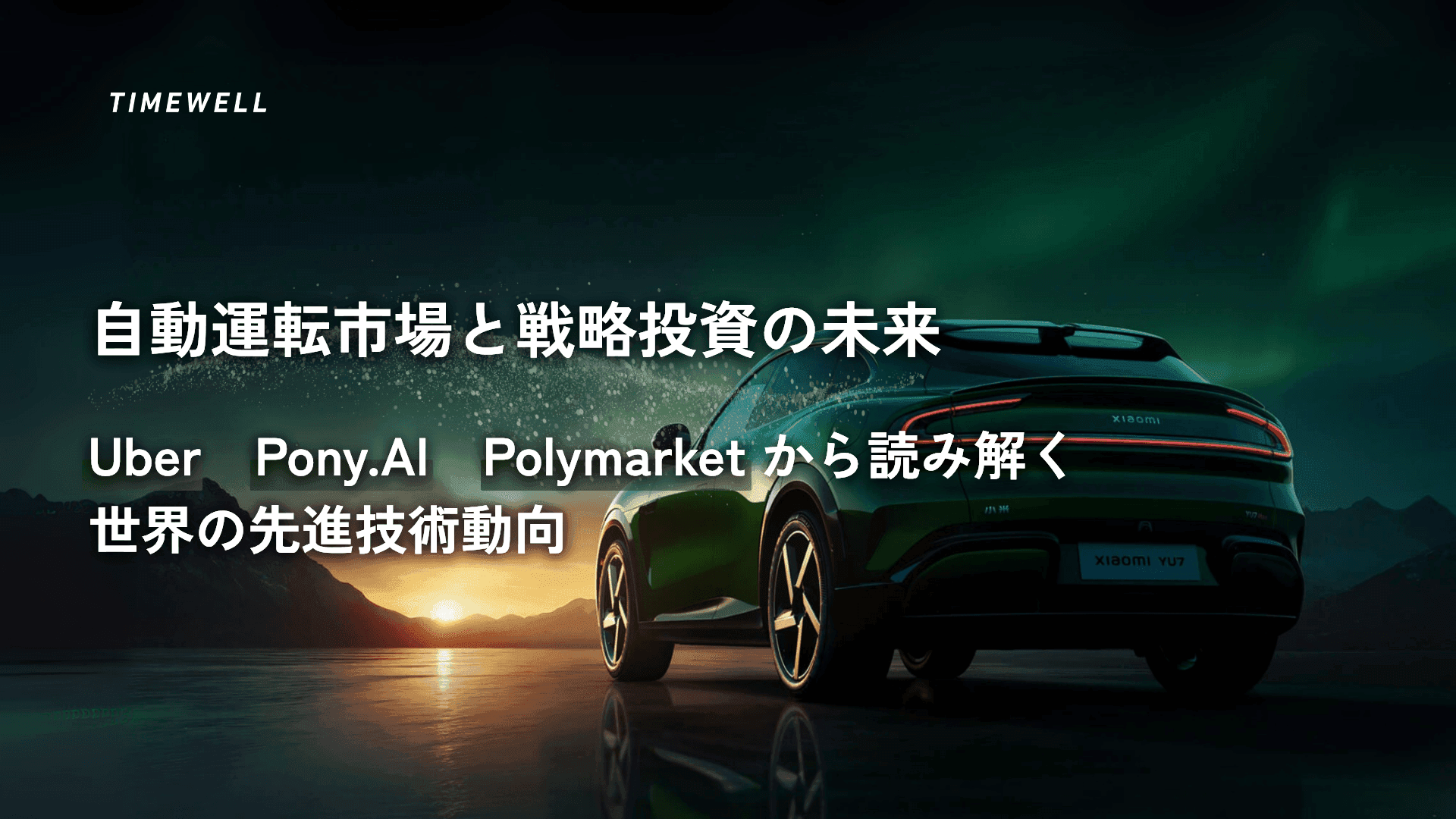
Xiaomi's latest vehicle, the YU7 Ultra, has attracted attention for its premium interior, a range of approximately 400 miles, and competitive pricing. Footage and live demonstrations detailed the front body design, cockpit, and cargo area usability, reconfirming the excellence of its build quality. With price competition intensifying, Xiaomi is now squarely competing with Tesla and other Western brands, and its pricing and quality control approach is expected to become a point of collision with tariff policy. These vehicles are not merely transportation tools — they are becoming emblematic of the mobility revolution and the business model transformation that technological innovation brings. Behind this lies a convergence of rising international competitive consciousness as foreign manufacturers grow stronger, and the intentions of Western markets to protect their domestic automotive industries.
Specifically, within international trade frameworks like ICH and NAFTA, governments tend to prioritize protecting domestic industries — tightening tariffs and imposing stricter safety standards. This makes establishing systems that can guarantee high quality a matter of urgency for companies seeking to introduce new technology and expand globally.
The discussion further explored how autonomous vehicles are evolving from mere transportation into platforms capable of reshaping the entire living environment. For example, companies like DoorDash and Zipline are actively envisioning the use of autonomous vehicles for food and daily goods delivery, suggesting major innovation ahead for local economies and logistics systems. If autonomous driving becomes widespread, the very foundations of transportation infrastructure and the logistics industry will be rethought from the ground up — particularly in urban areas, where transportation efficiency improvements and cost reductions are expected.
The conversation also examined the advanced sensor technologies and AI-powered safety monitoring systems being deployed in vehicles for safe driving — how they contribute to quality assurance and safety improvements. There was particular focus on how small specification differences that tended to be overlooked at the prototype stage can have a significant impact in actual driving conditions, and how those differences are evaluated in international competition. Companies must not only push forward with technological innovation but also work actively on legal frameworks and industry standard-setting to protect their advances.
Strategic Partnerships and Market Reorganization — Uber, Pony.AI, and the New Era of Cloud Kitchens
As waves of technological innovation sweep through the industry, strategic partnerships are being reorganized across the sector. This discussion explored the possibility of former Uber CEO Travis Kalanick re-engaging with Uber, developments around the potential acquisition of Pony.AI's US operations, and the convergence of cloud kitchens with autonomous driving technology. In particular, reports that Uber may be involved in acquiring the US division of Chinese autonomous driving company Pony.AI carry the potential to fundamentally transform Uber's existing business model.
This move carries meaning beyond a simple change in corporate leadership. Platform companies like Uber and DoorDash are pursuing business models that go beyond traditional ridesharing and food delivery by building new logistics and delivery services using cloud kitchens and autonomous vehicles. Uber's access to Pony.AI's technology and market position would allow it to innovate its existing delivery systems and lay the groundwork for a new market where digital platforms and physical infrastructure converge. As a result, the food delivery system centered on cloud kitchens could pivot significantly from human-dependent operations to more efficient, lower-cost autonomous delivery.
In the discussion, the possibility of Uber providing funding for the Pony.AI acquisition was flagged as an exceptionally clever move — one that functions both as strategic investment and risk hedging. Uber aims to reduce uncertainty about its future market position by integrating cloud kitchens with autonomous driving, thereby gaining overwhelming advantage in the delivery business.
This partnership dynamic could also accelerate other platform companies like DoorDash in the development of autonomous driving technology and drone delivery. Competition between companies will intensify, ultimately driving technological innovation and improved profitability across the entire market. The discussion noted that in addition to Uber, multiple large companies — Volkswagen, DoorDash, Zipline, and others — are already leading this space, and the dynamics of their technological development and shifting partnerships are likely to bring major market transformation over the coming years. Companies are working to gradually improve the reliability and efficiency of autonomous systems while temporarily relying on human drivers for safe operations — all while seeking to substantially transform their revenue models in the marketplace.
At the same time, concerns were raised both internally and externally about the risks of strategic partnerships, friction during integration processes, and broader market disruption. Organizational restructuring, cultural clashes, and the need to manage relationships with investors and governments all represent substantial pending challenges. In this complex environment, companies are required to respond carefully and quickly. The track record of companies and the presence of experienced leaders like Travis Kalanick will be critical factors in navigating these difficulties.
The developments also suggest that the cloud kitchen and autonomous delivery market is not merely a trend — it may form the foundation of a future economic ecosystem. Companies are trying to establish competitive advantage by breaking away from traditional delivery systems and building new logistics systems powered by AI and autonomous driving technology. This represents not merely technological innovation but a fundamental transformation at the core of corporate strategy.
Taken together, this reorganization of strategic partnerships is becoming an event that symbolizes broader industry trends extending well beyond any single company. How Uber and its related companies will face these challenges and ride the wave of market reorganization is a topic that deserves very close attention.
Prediction Markets and the Clash of AI Strategies — OpenAI vs. Microsoft, Polymarket Trends, and the Entrepreneur's Perspective
Amid a storm of technological innovation, prediction markets and AI strategy are attracting more attention than ever. The latter half of the discussion detailed Polymarket's approach to market forecasting and the conflict between OpenAI and Microsoft over AGI, with implications extending beyond the tech industry to finance, market forecasting, and entrepreneurship. These topics are positioned as inflection points within the broader themes of advancing technology and market reorganization.
Prediction markets such as Polymarket and Kalshi are emerging as a new form of intelligence gathering that goes beyond the frameworks of traditional expert prediction and journalism — one where investors directly bet on future outcomes. For example, prediction market results for the opening weekend box office of the F1 film showed that investors were forecasting higher box office revenue than the prevailing view within the industry itself — a surprising result. These trends are promoting the decentralization of information and improved market transparency, revealing the limitations of traditional media-driven information distribution.
Between OpenAI and Microsoft, contractual ambiguities around the definition of AGI are becoming a flashpoint for strategic conflict. As OpenAI's AI technology advances, the company defines AGI as a system capable of "human-level intelligence" or "generating over $100 billion in profit," a definition that has implications for its contractual arrangements with Microsoft. Microsoft, backed by its enormous investment and technical collaboration, is approaching AGI determination cautiously and applying contractual conditions strictly. This conflict represents a critical turning point in who gains market dominance first in strategic negotiations between the two companies.
For entrepreneurs and investors, this kind of conflict between large corporations provides valuable insight into the macro market environment and the direction of technological innovation. The discussion detailed the background of OpenAI's attempt to transition to a public benefit corporation (PBC), the internal power struggles this process generates, and the negotiations with investors and government entities. These elements highlight the many challenges companies face in balancing technological innovation with social responsibility, providing important lessons for entrepreneurs about how to manage risk and formulate strategy across both technology and business dimensions.
The entire market has become one large competitive field, with the results of advanced technology directly affecting corporate strategy, investment decisions, and the visions of individual entrepreneurs. Microsoft is trying to capture OpenAI's technological innovation as a stepping stone for its own investment strategy and market share expansion, while maintaining rigorous oversight to absorb those results. The maneuvering between these large companies will significantly shape the direction of technological innovation and the market environment over the coming years — and will certainly serve as a valuable case study for investors, executives, and technologists alike.
Taken as a whole, the use of prediction markets and the strategic conflict around AI technology can be understood as a microcosm of today's global business environment. Entrepreneurs need to approach this situation not as a mere crisis but as an opportunity for new growth, building strategies to leverage it for competitive advantage. In the market ahead, flexible thinking, rapid decision-making, and the insight to assess risk will undoubtedly be the keys to success.
This article has covered a wide range of themes: the evolution of autonomous driving technology and the impact of manufacturing quality and tariff policy in global markets; strategic partnerships and market reorganization around Uber, Pony.AI, and cloud kitchens; and the intense maneuvering between prediction markets and the OpenAI-Microsoft rivalry. Technological innovation doesn't just create new products and services — it profoundly affects the strategies of individual companies, the international trade environment, and investor decision-making. Each of these topics provides important insight for interpreting how AI and autonomous driving technology will shape the future market, and the substance of these discussions will certainly serve as a major guide for future corporate strategy and investment decisions.
Furthermore, the challenges that individual entrepreneurs face — for example, the reality of having excellent products or services but struggling to build effective sales processes — also reinforce the importance of strategic thinking and market forecasting, just as much as the dynamics between major corporations. Companies and entrepreneurs alike must respond flexibly to a constantly changing market environment, driving further growth on the twin wheels of technological innovation and talent development.
Ultimately, in the global business environment, technological innovation, strategic partnerships, and market transparency will gradually become established as the driving forces of new value creation. In this period of transformation, companies and entrepreneurs are called to maximize the benefits of advanced technology and take confident steps toward the future. Each of the themes covered in this article will serve as an important keyword that significantly influences future management strategy and market investment decisions.
Reference: https://www.youtube.com/watch?v=2H7x8tqntIA