From TIMEWELL
This is Hamamoto from TIMEWELL Inc.
In New Business Development, Design Concept Is a Strategic Element That Determines Users' First Impressions
In new business development, design concept is a strategic element that determines users' first impressions and decides the success or failure of a service. This article introduces a lecture that systematically explains how to think about design concepts and the steps for developing them.
Something I notice frequently is that many people tend to underestimate design when building applications or services. Yet design is a critical factor that determines the user's first impression and is one of the major drivers of service success. I've broken the process into several steps so that even those unfamiliar with design can think about design concepts systematically.
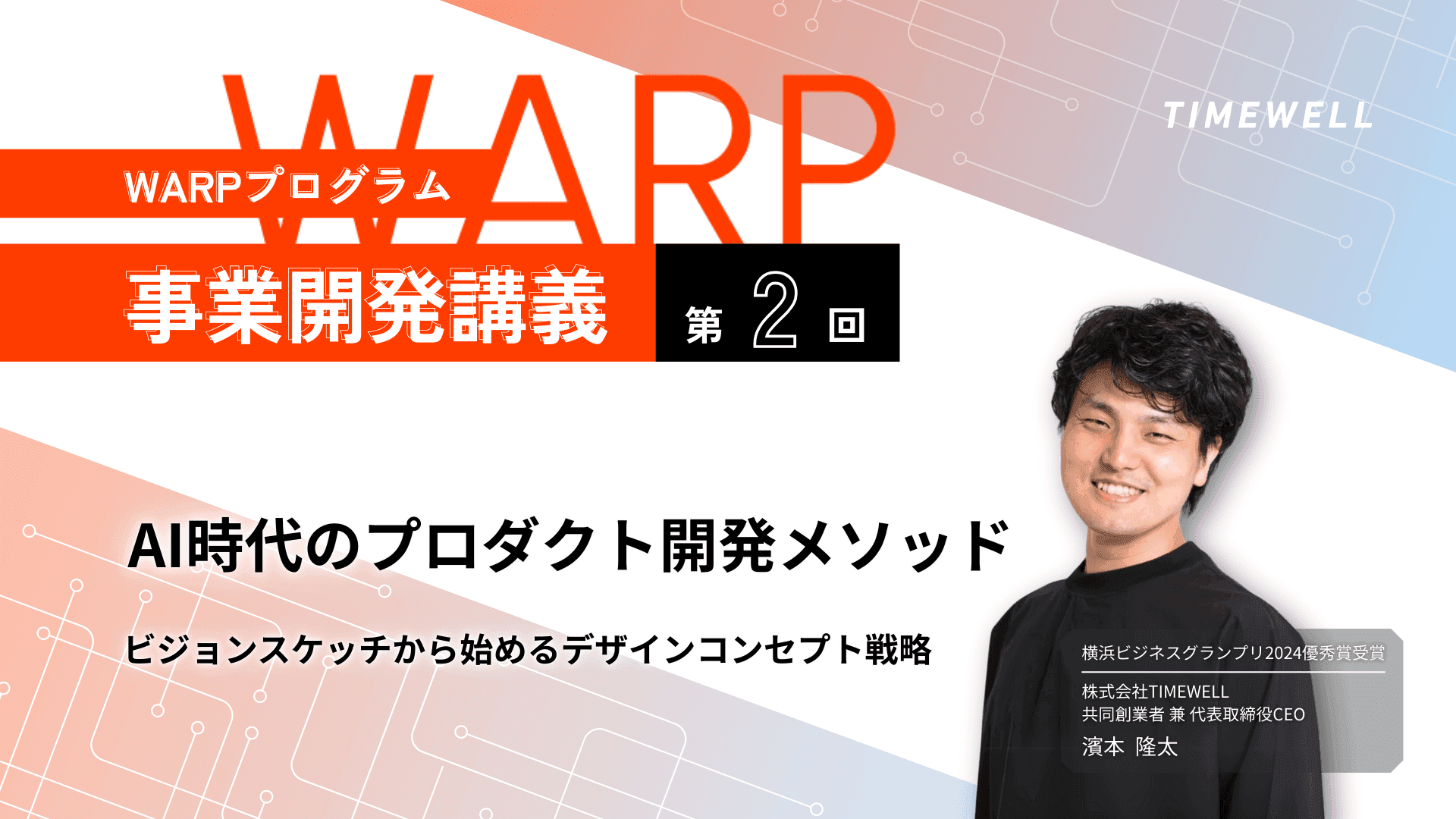
Affiliation: TIMEWELL Inc., Co-founder and Representative Director/CEO
ONE JAPAN Large Enterprise Challenger Support Program CHANGE Lead
Profile: Originally from Okayama Prefecture
Originally from Okayama Prefecture. In April 2020, founded ONE X, a general incorporated association, and assumed the role of co-representative director. Subsequently promoted regional support in Shiojiri City, Ota Ward, and other areas. Two consecutive years of Work Story Award W recognition; winner of the Freelance Partnership Award 2023 Grand Prize.
In November 2022, founded TIMEWELL Inc. Operating under the vision of creating the world's No. 1 challenge infrastructure through the power of technology and community, he drives new business development support and the development of the autonomous AI agent "ZEROCK." He has given more than 100 lectures on generative AI and is also engaged in advancing AI-driven development. The company's program "SHIFT" has received Ministry of Economy, Trade and Industry certification, and the program "WARP" was adopted by the Tokyo Metropolitan Government SUTEAM program. Winner of the Yokohama Business Grand Prix 2024 Excellence Award. Selected for Ministry of Economy, Trade and Industry J-StarX, SMRJ FASTAR, and Kanagawa Prefecture KSAP.
Lecturer
- Drawing Your Ideal Future With a Vision Sketch
- Five Questions to Articulate Your Values and Convictions
- Deciding the Three Elements of a Design Concept
- How to Use the Latest Trends and Tools
- Why You Must Never Forget to Dialogue With Users
- Summary
Looking for AI training and consulting?
Learn about WARP training programs and consulting services in our materials.
Drawing Your Ideal Future With a Vision Sketch
The first step involves a piece of work called a "Vision Sketch." This asks participants to draw a picture of what a happy customer looks like after using the service they want to create.
No Artistic Ability Required
No artistic ability is required at all. I can only draw people as circles and triangles — and that is entirely sufficient. What matters is to vividly imagine the specific scene: what kind of space, what kinds of people, what objects are present, and what the customer is saying and thinking.
For example, for an inbound tourism service, draw the ideal scene where a tourist is enjoying a delicious meal and a good conversation with the owner of a traditional restaurant. For an agricultural matching service, draw a scene where someone is delighted to have made a connection. The key is to draw not the act of using the app, but the outcome of having used it.
When you complete this vision sketch, the resolution of the service rises dramatically. When building the app, you become able to judge for yourself when something "feels a bit off from the concept."
The next step involves questions designed to clarify your values and convictions. You work through questions such as: "What is happening in that world?", "What conversations are being had, and what emotions are being created?", and "What must never exist in that world?"
The Question I Consider Most Important: "What Must Not Exist in This World?"
The question I consider most important is: "What must not exist in this world?" Clearly defining the things that are non-negotiable — the things you absolutely do not want — in your service prevents the service from drifting off its axis.
Next comes confronting the fundamental question: "Why should users choose your service?" Clearly defining the differentiation factors — the reasons why your service succeeds where others have completely failed to satisfy — is critical. In particular, with the emergence of generative AI, things that were previously unsolvable are now becoming solvable.
My previous employer was actually Panasonic, where I once tried to build a service that would calculate the calories in a meal from a photo. Recently, I learned that a similar service in the United States, built using generative AI, was sold for approximately 4.5 billion yen. This illustrates how the emergence of generative AI is making previously impossible approaches possible.
Differentiation from Competitors Is Also a Critical Point
Differentiation from competitors is also a critical point. Large enterprises in particular often hold back on releasing generative AI-based services, meaning that simply releasing something can be a differentiator. The fact that you are thinking about services right now is an opportunity: new technology is coming in, and differentiation is comparatively easy.
Where your brand should be noticed also requires consideration. For bridal services, the setting might be a bridal planner's recommendation; for business services, it might be an executive-focused medium like Harvard Business Review. The appropriate touchpoint must be considered based on the nature of the service.
The characteristics and qualities you want users to feel also deserve deep exploration. Do you want to be seen as cool? Charmingly awkward? Locally flavored? Sustainably minded? The appropriate direction changes dramatically depending on the target user.
For gaming services, a neon-lit, flashy look that resonates with gamers is probably best. For women's services, a soft, gentle color tone tends to be well received. For children's services, pop-style fonts work better.
Working Through These Questions to Arrive at Design Concept Words
Working through these questions, you eventually select your design concept words. Choosing from a range of words — approachable, premium, refined, warm, innovative, delicate, energetic, dynamic, elegant, rich, harmonious, original, natural, unique, human, calm, stable, high-quality — you pick those that suit your service.
For a healthcare service, for example, an energetic, dynamic, innovative impression might come across as slightly alarming. A stable quality, warm, enveloping image is probably more appropriate.
Font selection is also important — just the font alone can completely change the atmosphere. Using a sophisticated font like Hiragino Mincho for a kindergarten app would create an incongruous impression. Conversely, using too playful a font for a premium service is equally inappropriate.
Choosing fonts that support both Japanese and English, or specifying one font for English and another for Japanese, is also important. With tools like Canva and Figma now offering a wide range of fonts, carefully choosing a font that matches your service concept is essential.
Concept Color Selection Is Equally Important
Concept color selection is equally important. A service's image changes dramatically depending on the color chosen. Understanding the impression carried by each color — olive green, deep forest, lilac, smoky rose — and choosing accordingly is necessary. Gradient-style colors are increasingly used in recent services, and deciding which colors to include is important.
Even with white or black, the impression differs: ordinary white versus slightly cream-leaning off-white; jet black versus a slightly gray-tinted black. I personally like blue-tinted gray — using that color alone creates an impression of refinement without being heavy.
Check the latest design trends as well. Glassmorphism — a glass-like effect — and grid-and-border layout techniques are among recent trends. One reason grid-and-border is increasing is that it is relatively easy to design with. It accommodates both smartphone and PC versions easily and is now used across all types of services.
Incorporating these latest design trends creates an impression of being sophisticated and fresh.
When Actually Building an Application, the Tool V0 Allows You to Produce a Full-Featured Product Rapidly
When actually building an application, the tool V0 allows you to produce a full-featured product rapidly simply by entering requirements in a chat. Using its Enhance feature automatically generates a more detailed prompt, making it possible for even beginners to build serious applications.
However, be careful not to become so focused on building that you end up ignoring customer feedback and creating a service that serves no one. Actively conduct customer interviews, run surveys, or just have casual conversations. Insufficient dialogue with customers risks missing the value that is truly needed and creating a service that nobody uses.
Design is an element that must never be underestimated. Once the font, color, and concept words are decided, it is no exaggeration to say that the image of a service is largely determined. Through this workshop, I hope participants find the optimal design concept for their service and put it to use in actual product development.
The design concept building introduced here forms the foundation of successful product development. The methodology presented is not about pursuing mere visual beauty. It is a strategic approach for resonating with users and achieving business goals.
Start With a Vision Sketch, Then Work Backward to Determine Design Direction
Start with a vision sketch to draw the ideal future image of the service, then work backward from there to determine the design direction. Maintaining this order produces a consistent product. As you verbalize your values and convictions and systematically select concept words, fonts, and colors, your service will inevitably become a differentiated offering.
In particular, right now, the spread of generative AI is making previously impossible ideas realizable. But more important than technological progress is understanding users' true needs. Avoid becoming so absorbed in building that you lose touch with users — actively engage in regular dialogue with them.
By leveraging tools like V0 and Canva, you can build a fully featured product even without specialized design knowledge. But tools are merely a means. What matters is the strategic thinking behind why you chose that design, and what experience you want to provide to users.
Many products that fail in design pursue only surface-level beauty, without considering users' emotions and behaviors. By practicing the methodology presented here, I hope participants avoid such pitfalls and develop products that users truly love.
Related Articles
- The Reality of a Working Mother Returning from Two Maternity Leaves — And How Her Work Philosophy Changed | TIMEWELL
- Before Taking Paternity Leave (Part 2): Three Absolute Must-Dos for Taking Leave During a Busy Season
- A First-Class Architect Who Stays Close to the Job Site — Finding My Own Path as the Fifth-Generation Leader of a Construction Company