From TIMEWELL
This is Hamamoto from TIMEWELL Inc.
Business Ideas Are Endless — So Why Do So Many Startups Fail?
Business ideas are endless — so why do so many startups fail? Repeated customer interviews, finished products, and yet the competition wins in the end. Many entrepreneurs carry exactly this frustration.
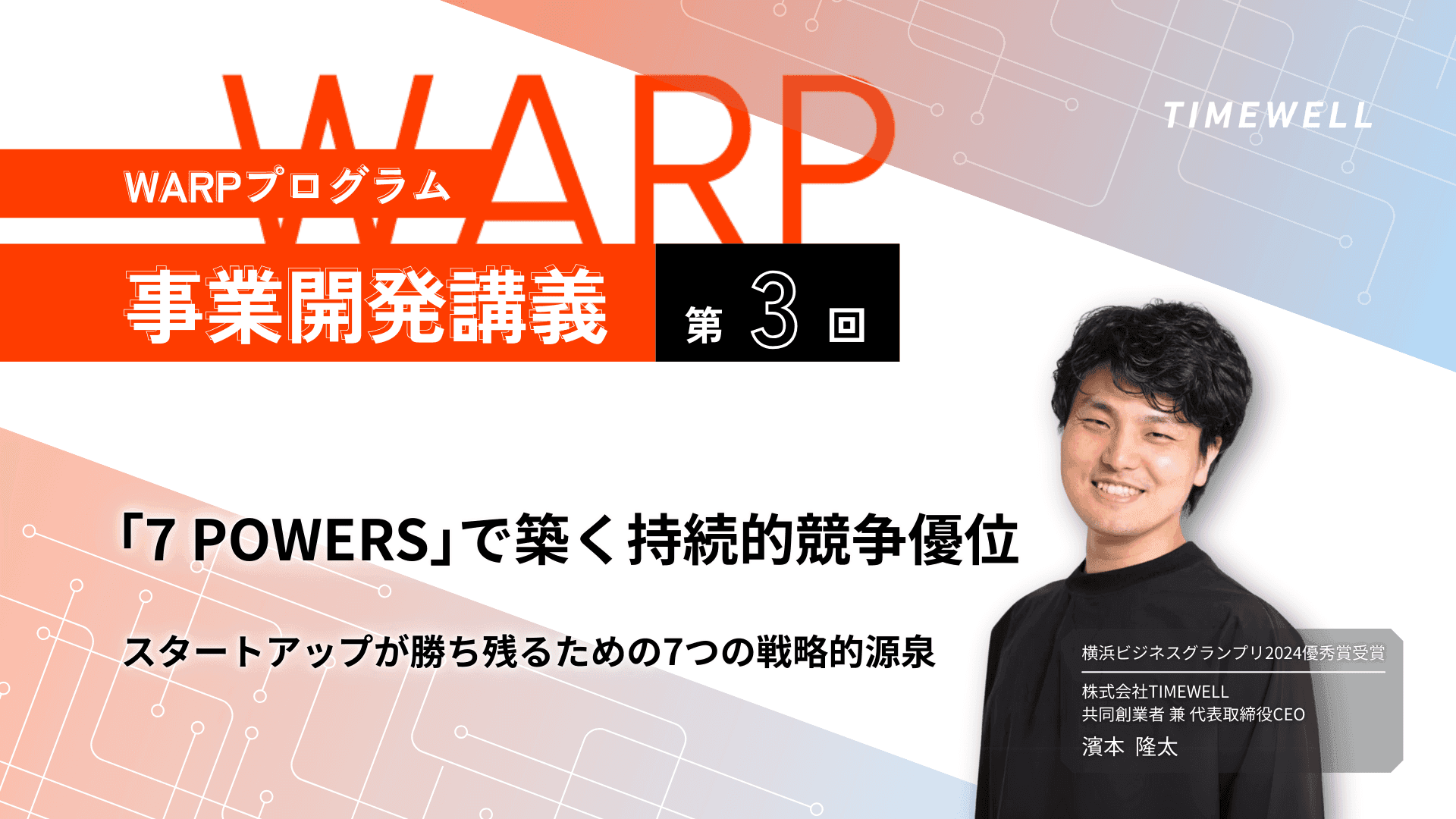
WARP Program Business Course Lecture 3 covers the "7 Powers" framework for generating competitive advantage. This is a methodology developed by Hamilton Helmer, who shaped the strategy of Airbnb, systematizing seven sources through which startups can build sustainable competitive advantage.
The "7 Powers" competitive advantage framework provides a clear answer to this problem. Reviewing your business through the seven sources — Scale Economies, Network Economies, Counter-Positioning, Switching Costs, Branding, Cornered Resource, and Process Power — a path to building sustainable competitive advantage becomes visible.
Affiliation: TIMEWELL Inc., Co-founder and Representative Director/CEO
ONE JAPAN Large Enterprise Challenger Support Program CHANGE Lead
Profile: Originally from Okayama Prefecture. In April 2020, founded ONE X, a general incorporated association, and assumed the role of co-representative director. Subsequently promoted regional support in Shiojiri City, Ota Ward, and other areas. Two consecutive years of Work Story Award W recognition; winner of the Freelance Partnership Award 2023 Grand Prize.
Looking for AI training and consulting?
Learn about WARP training programs and consulting services in our materials.
Founded TIMEWELL Inc. in November 2022
Founded TIMEWELL Inc. in November 2022. Operating under the vision of creating the world's No. 1 challenge infrastructure through the power of technology and community, he drives new business development support and the development of the autonomous AI agent "ZEROCK." He has given more than 100 lectures on generative AI and is also engaged in advancing AI-driven development. The company's program "SHIFT" has received Ministry of Economy, Trade and Industry certification, and the program "WARP" was adopted by the Tokyo Metropolitan Government SUTEAM program. Winner of the Yokohama Business Grand Prix 2024 Excellence Award. Selected for Ministry of Economy, Trade and Industry J-StarX, SMRJ FASTAR, and Kanagawa Prefecture KSAP.
Lecturer
- The Seven Sources of Competitive Advantage
- Switching Costs and Branding
- Cornered Resource and Process Power
- Using ChatGPT for Strategic Thinking
- Summary
The Seven Sources of Competitive Advantage
The first is "Scale Economies." Representative of manufacturers, this refers to the situation where average costs decrease as production volume increases — or competitive advantage strengthens with scale-up. For application-based services, infrastructure costs such as AWS and GCP are a classic example. There are always costs regardless of usage, but the per-user cost decreases as the user count grows. For those who want to combine hardware with their offering, the more hardware deployed, the more scale economies apply.
Note, However, That Labor-Intensive Business Models
Note, however, that falling into a labor-intensive business model can lead to a situation where no matter how hard you work, profit margins refuse to rise. Business process outsourcing tends to fall into this situation, so awareness of the dynamics is important.
The second is "Network Economies." Like telephones and social media, this is the state where the value of a product or service increases as more users or participants join. The value of the connection between just two people is small, but as a third, fourth person joins, the connection value rises exponentially.
Apple, for example, applies a model that leverages both the user network effect and the app provider network effect. Recently, the network effect in AI-based services — where value increases as more data accumulates — is also attracting attention.
The Third Is "Counter-Positioning"
The third is "Counter-Positioning": constructing a business model or strategy that existing competitors cannot easily imitate or follow. Consider Muji and Don Quijote — Muji cannot pursue Don Quijote's strategy. The brand atmosphere is completely different. The same applies to the relationship between Daiso and Seria. Deliberately taking a position that is not easily copied creates a barrier to entry.
The fourth is "Switching Costs." Once a customer becomes locked into a product or service, creating a state where switching to another product is difficult.
I personally have paid an enormous amount of money to Apple — but once you become accustomed to iOS and macOS, there is no going back to Windows. Once you have used an OS or application and become familiar with it, the thought of learning something else is unappealing. Hardware tends to generate particularly high switching costs. Once a fiber optic connection is installed, switching becomes troublesome and eventually feels impossible. Data, community, and accumulated expertise are also important factors. For AI-based services, the more you use them, the more personalized they become — or the data itself becomes trained to you.
The Fifth Is "Branding"
The fifth is "Branding." This may be difficult to achieve quickly for startups, but competing on trust, recognition, and empathy with the company's vision. The goal is to create a state where customers value the brand itself and find it difficult to switch to a competitor.
What matters here is whether the brand story and marketing strategy have captured the customers' mental capital. The state where "this service's story aligns with my values." Muji, for example, is extremely skilled at brand storytelling — the reason people buy from them even though prices are a little higher is often because the brand story is solid. What is your brand story? Think about a story that only you can tell.
The sixth is "Cornered Resource." Exclusively or preferentially possessing unique human resources, intellectual property, or supply chains that are difficult for other companies to obtain. Patents are a classic example, and if you sign an exclusive contract with the authority figure in an industry — the only person in their field — competitors cannot use them.
A Somewhat Extreme Example, But Mercari's Strategy
A somewhat extreme example, but Mercari's strategy was to receive investment from all the major VCs, preventing competitors from receiving investment from them. By concentrating all domestic, limited VC resources on Mercari, they created a situation where other companies couldn't raise funding — and won. There are also business deals resembling a "municipal territory grab" — connect first with a portion of Japan's 1,700 municipalities, and competing companies basically cannot get in.
The final and seventh is "Process Power." Having proprietary know-how and operational processes that enable sustained cost reduction and quality improvement. Toyota's production system and Tesla's automation know-how are examples.
Whether you have proprietary business processes, quality management methods, and operational optimization know-how that competitors would find difficult to imitate is the key question. These are areas that deepen as the business progresses, and if you have already built this kind of process power in a previous role, you may be able to apply it directly when launching a startup or small business.
For Example, Having Learned Security Thoroughly
For example, perhaps you have studied security so intensively that you are confident that nobody can beat you at building security-related products. Or perhaps you have an extraordinarily strong ability to communicate with businesses handling traditional crafts — that too is process power. Communication know-how with customers, stakeholders, and related businesses might also count as process power.
When doing this kind of exercise, I recommend having ChatGPT open and progressing through dialogue. Using it in a conversational way — "I threw this question out there — what do you think?" — deepens the discussion. Even if you have not noticed something, ChatGPT might say "Actually, data will accumulate here."
Always proceed through exercises with ChatGPT, Claude, or Gemini at hand. In today's era, there is no need to think alone. There is a wonderful assistant available — in my view, it is like having a teacher — so make full use of this teacher.
Finally, Organize These Ideas and Find the Best Domain for Your Business
Finally, organize these ideas, consider technical priority and ease of execution, and look for the domain within the "7 Powers" that is likely to have the best positive impact on your business. Some participants may find they cannot think of all seven, but one or two is more than sufficient at the initial stage. Even zero is fine — you can build them. ChatGPT can help you come up with ideas for "this might at least work."
Use this "7 Powers" framework to consider which power to strengthen first, and build the competitive advantage of your business.
The "7 Powers" framework is not mere theory — it shows a path to building practical competitive advantage. The seven sources — Scale Economies, Network Economies, Counter-Positioning, Switching Costs, Branding, Cornered Resource, and Process Power — appear independent but are in fact interrelated and mutually reinforcing.
The Important Point Is That You Do Not Need All Seven From the Start
The important point is that you do not need all seven from the start. A realistic approach is to first build solid advantage in one or two areas, then strengthen other elements as the business grows. While being careful not to fall into a labor-intensive business model, identifying where your company's strengths lie — or where they can be built — is the first step toward success.
When thinking through these competitive advantages, I strongly recommend always using AI tools such as ChatGPT. Through dialogue with AI, rather than thinking alone, you should be able to discover new perspectives and overlooked possibilities.
"7 Powers" provides answers to the fundamental questions of "why can we win?" and "how can we keep winning?" Use this framework as your compass to build sustainable competitive advantage.
Related Articles
- The Reality of a Working Mother Returning from Two Maternity Leaves — And How Her Work Philosophy Changed | TIMEWELL
- Before Taking Paternity Leave (Part 2): Three Absolute Must-Dos for Taking Leave During a Busy Season
- A First-Class Architect Who Stays Close to the Job Site — Finding My Own Path as the Fifth-Generation Leader of a Construction Company