This is Hamamoto from TIMEWELL.
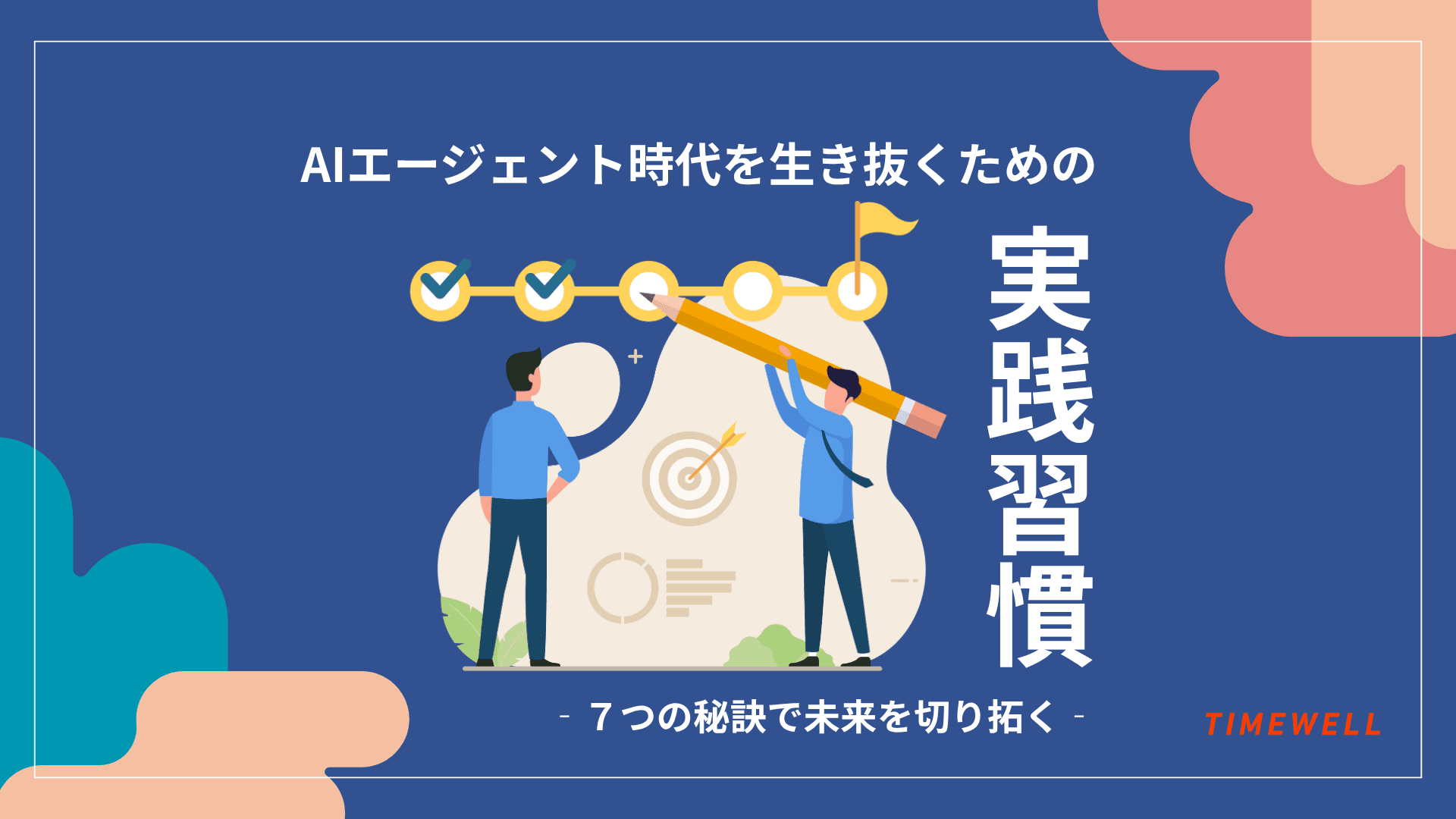
Working in the AI Agent Era
AI tools are proliferating faster than most people can evaluate them. New models, new features, new integrations arrive weekly. The question has shifted from "should I use AI?" to "how do I build sustainable habits around AI that actually improve the quality of my work?"
A practitioner who has built a substantial track record running an AI-focused media channel observed that the gap between people who benefit from AI and those who don't is not a gap in intelligence or access — it is a gap in habits. This article distills seven habits that distinguish effective AI users from passive ones.
- Habits 1–2: Trial and delegation
- Habits 3–5: Instruction quality and output verification
- Habits 6–7: Tool diversity and the human-first principle
- The compounding effect and the warning
- Summary
Habit 1: Try the Tool, Don't Just Read About It
The most common failure mode in AI adoption is consuming information about AI tools without actually using them. Reading about a tool's capabilities is not the same as discovering where it works well and where it fails.
The concrete approach: when a new tool or feature is released, build a routine — weekly, if possible — to run an actual test with it on real work. Not a toy task. A real deliverable.
A documented example: testing Claude Skills by loading the practitioner's own company PowerPoint template and asking the AI to generate presentation slides from a news article. The output — text quantity, layout decisions, sectioning — was handled automatically and produced a usable draft. The discovery: the tool's actual capabilities, and its actual limitations, only become clear through this kind of hands-on test.
The payoff: one well-established survey of large enterprise AI adoption found that employees who regularly use multiple AI tools save approximately 43 hours per person per month. The distinguishing factor was not which tools they used — it was whether they had developed the habit of using them regularly.
Looking for AI training and consulting?
Learn about WARP training programs and consulting services in our materials.
Habit 2: Delegate to AI, Systematically
Knowing that AI can help is different from building the discipline to actually delegate to it. Many people, including experienced executives, tend to do tasks themselves when they encounter friction — rather than spending the upfront cost to set up the AI delegation properly.
The "AI muscle training" approach: treat AI delegation as a skill that requires daily practice. The cost of formulating a clear AI request decreases with repetition. In early use, the delegation cost is high. With practice, it becomes lower than doing the task manually.
The organizational parallel: a manager who always does the work themselves doesn't develop their team. An executive who learns to delegate to AI in the same way — clearly, with appropriate context, with a follow-up verification step — frees their time for decision-making that requires human judgment.
What needs to be clear before delegating:
- What specific output is required
- What format and length
- What examples of good outputs look like
- What constraints apply
A vague "write something about our seminar" produces worse output than "write a seminar introduction with three sections: title, two-sentence overview, and three-bullet agenda. Use this example as format reference."
Habit 3: Give Specific Instructions with Examples
AI tools do not read minds. Ambiguous instructions produce ambiguous outputs. The most consistent improvement in output quality comes from prompt specificity — and the single highest-leverage element of specificity is concrete examples.
What happens without examples: uploading a file and asking "write according to the guidelines" often produces output that misses the target, because the AI cannot reliably infer the specific meaning of "guidelines" from a document alone without additional context.
What works: provide the structural template, name the specific output components (e.g., "title: 10 words max; overview: 2 sentences; agenda: 3 bullets with 15-word descriptions"), and include a completed example of what "good" looks like.
The additional benefit: being forced to write down what you actually want from the AI clarifies your own thinking. The act of specifying the prompt is itself a structured thinking exercise.
Habit 4: Verify. Always.
AI outputs should not be used without review. This is not a hedge — it is a fundamental operational principle for anyone using AI for professional deliverables.
The specific risks:
- Hallucination: AI models generate plausible-sounding text that may not be factually accurate. Modern models have improved through web search integration and expanded pretraining data, but the risk has not been eliminated.
- Context loss: the model may not have processed the full context of an uploaded file or conversation history
- Nuance gaps: specific terminology, organizational conventions, or implied meanings are often missed
The medical AI illustration: if an AI diagnostic tool claims 80% accuracy, that accuracy must be interpreted in context — against the accuracy of an experienced human physician, on the same case type, under the same conditions. The reported number is often measured in a narrow test scenario that does not reflect the complexity of actual deployment. Human verification is still required.
The habit: treat every AI output as a first draft that needs review, not a finished deliverable. Develop a checklist of what to verify — facts, tone, accuracy to requirements, appropriate format — and apply it consistently.
Habit 5: Rewrite the Output in Your Own Words
There is a subtler problem with AI delegation: if you use AI outputs without engaging deeply with the content, you stop building the knowledge and judgment that makes the work valuable.
The habit: after reviewing AI output, rewrite at least the key sections in your own words before finalizing. This serves two purposes:
- It forces genuine comprehension — you cannot paraphrase what you do not understand
- It adds authentic perspective — the output reflects your judgment, not just the AI's synthesis
The risk of skipping this step is not immediately visible. But over time, consistently outsourcing content generation without re-engaging with it produces a gradual erosion of the thinking habits that generate valuable work in the first place.
Habit 6: Combine Rules-Based and Generative AI
Generative AI (ChatGPT, Claude, Gemini) produces flexible, creative output from natural language. Rules-based systems execute deterministic logic reliably. Neither is superior — they are complementary.
The combination approach: use rules-based systems for tasks that require consistency and compliance (data processing, form validation, routing logic), and use generative AI for tasks that require flexibility and judgment (drafting, synthesis, creative variation). Building a workflow that applies each type of tool to the tasks it handles best produces better outcomes than relying entirely on one approach.
The practical example: for meeting documentation, a rules-based system handles speaker identification, timestamp tagging, and section categorization; a generative AI handles summary writing and action item extraction. The combination produces reliable structure plus readable synthesis.
Habit 7: Human-First, Not AI-First
The most important operating principle: AI is a tool that amplifies human judgment. It does not replace it.
What "human-first" means in practice:
- The final decision on any output remains with the human
- Critical judgment — what is accurate, what is appropriate, what serves the goal — is exercised by the human, not delegated to the AI
- The human "Human in the loop" step is built into every workflow before output is used
Organizations that have benefited most from AI adoption are not those where AI makes the decisions — they are those where AI handles the time-consuming execution work and humans focus on judgment, strategy, and quality review.
The Compounding Effect and the Warning
When these seven habits compound, the output is measurable: more work completed per hour, at higher quality, with more of the human's attention focused on the decisions that require human judgment.
The data point: enterprises with employees who use multiple AI tools regularly see approximately 43 hours per month in time savings per person. This is not a marginal efficiency gain — it is the equivalent of reclaiming more than a full work week per month.
The warning: over-reliance on AI without maintaining personal intellectual engagement creates a different kind of risk. Multiple research contexts have found that when humans delegate cognitive tasks entirely to AI — without engaging with the content — memory performance and analytical capability can decline over time. The seven habits above are designed to prevent this by keeping the human engaged, critical, and learning throughout the process.
AI handles the execution. Humans provide the judgment. That division is the habit that makes all the others sustainable.
Summary
| Habit | Core Practice |
|---|---|
| 1. Try the tool | Weekly hands-on testing of new tools on real deliverables |
| 2. Delegate systematically | Build AI delegation as a practiced skill, not an occasional experiment |
| 3. Give specific instructions | Concrete requirements + examples produce dramatically better output |
| 4. Verify always | Every AI output is a draft — review before use |
| 5. Rewrite in your own words | Engaging with content prevents cognitive atrophy |
| 6. Combine tool types | Rules-based for consistency; generative for flexibility |
| 7. Human-first | Final judgment, quality control, and decision-making remain with the human |
The AI agent era does not reward passive observers. It rewards the people who have built disciplined habits around AI use — habits that make them faster, more capable, and better informed without substituting AI judgment for human judgment on the decisions that matter.
Reference: https://www.youtube.com/watch?v=847eGg-X7Us