What Is Enterprise AI? Differences from Consumer AI, Use Cases & Key Considerations (2026)
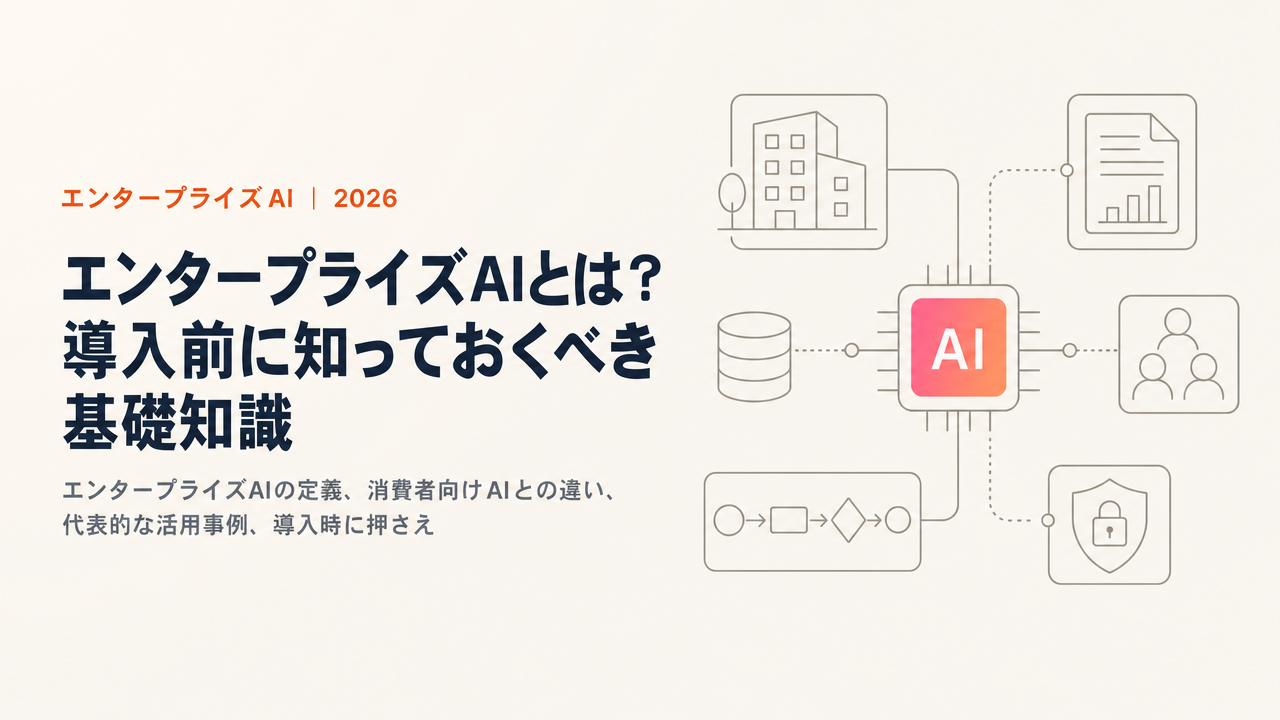
Generative AI like ChatGPT is genuinely useful. The problem is you cannot paste a confidential drawing or a customer list into it and ask questions. Yet the field will not wait. A designer types part of a drawing into a personal AI account; a salesperson drops in a client name to draft a proposal. Before the company sets any policy, this unsanctioned use quietly spreads. This is shadow AI. Enterprise AI is the idea that resolves the dilemma, and this article lays out the full picture along with the points that keep a deployment from failing.
What This Article Covers
For readers who want the takeaways first, here is the shape of it.
| Question | Answer |
|---|---|
| What is enterprise AI | An AI platform built to run business work, with internal-data connectivity, permissions, and governance |
| How it differs from consumer AI | Whether your data is kept out of training, plus role-based permissions, audit logs, and industry specialization |
| The story of 2026 | Beyond search and automation, toward agentic AI that executes autonomously |
| What it can do | Knowledge search, data analysis, routine-task automation, industry-specific processing |
| Non-negotiable considerations | Data sovereignty, permissions and governance, system integration, and ROI |
We will move from the definition through concrete use cases to the governance and cost issues that inevitably surface in 2026.
What Is Enterprise AI?
Enterprise AI refers to an AI setup built to actually run a company's work, equipped with internal-data connectivity, permission management, security, and governance. It is not a legally defined term. In practice it carries the sense of "an operational platform that meets company-specific requirements a general-purpose consumer AI cannot reach."
Why is it needed now? There are three main reasons. The first is labor shortages and skills transfer. In manufacturing and elsewhere, know-how for quoting and cost estimation retires along with veteran staff. The second is the shadow AI from the opening: when employees feed internal information into personal consumer-AI accounts, that becomes the entry point for a leak. The third is that generative AI has moved from the "let's try it" phase to the "embed it in the work" phase. Turning pilots into results takes a platform with permissions and data connectivity, not a side-tool used off to the side.
Keep the technology arc in mind too. Enterprise AI use began with "search" across internal documents, expanded to "analysis" of data, and then to "automation" of routine tasks. The central theme of 2026 is the next step: "autonomous execution." Agentic AI that plans and carries out a task on a person's behalf is finally becoming the main character of the work.
Differences from Consumer AI
"Why not just use ChatGPT internally?" is still a common question. The quickest way to answer is to line up what each side protects and assumes.
| Aspect | Consumer AI | Enterprise AI |
|---|---|---|
| Data handling | Mostly general-purpose data | Safe connectivity with internal data |
| Use for training | Input may be used for training | Not using input for retraining is standard |
| Security | Basic encryption | Layered defense, access control, audit logs |
| Permissions | Per individual | Controlled by department and role |
| Data residency | Often overseas servers | Domestic servers can be selected |
| Customization | Limited | Configured to the business and industry |
Here it helps to clarify the relationship with "business plans" such as ChatGPT Enterprise and Microsoft 365 Copilot. These add safeguards to the consumer version, such as keeping input out of training and giving administrators oversight, and they are excellent general-purpose assistants. What is out of scope is connecting deeply with your drawings and core systems and enforcing department-level permissions to run the work itself. Enterprise AI points to the operational platform one layer above, and a business chat plan is one of its components. Seeing it that way avoids confusion.
What Enterprise AI Can Do
Listing abstract task names does not make it real. Here are the representative uses as of 2026, each tied to a concrete scene.
Internal Knowledge Search (RAG and GraphRAG)
Policy manuals, procedure guides, past meeting minutes, design standards. This searches documents scattered across the company by meaning rather than by keyword. Even a vague question like "where is the basis for that quote" gets an answer that points to the source document. When you want answers that account for how documents relate to each other, GraphRAG, which combines a knowledge graph with RAG, is effective.
Business Data Analysis and Visualization
AI reads sales, customer, and manufacturing-log data and surfaces trends and anomalies. Aggregation that once took a specialist several days can now be tried on the spot by frontline staff. The entry point to analysis shifts from "requesting a specialist team" to "asking your own question."
Automation of Routine Tasks and Workflows
First-line inquiry handling, document drafting, data entry. Handing off repetitive work lets people spend their time on judgment-heavy tasks. This is the territory people have discussed since around 2024.
Autonomous Execution by Agentic AI
This is the new axis for 2026. Where earlier AI was a tool that "answers," agentic AI takes an objective, plans the necessary steps itself, and executes them in order. The research firm Gartner predicts that by 2028 at least 33 percent of enterprise software applications will include agentic AI (up from less than 1 percent in 2024), and that a meaningful share of day-to-day work decisions will be made autonomously by AI agents. Because expectations run high, warnings about overheating are also being sounded, as noted below.
An Industry-Specific Example: Drawing AI for Manufacturing
Enterprise AI's power is clearest in industry-specific uses. Take the design and sales floor of a manufacturer.
The "before" scene looks like this. A warehouse holds a mountain of paper drawings; CAD conversion is outsourced at real cost and delay. Returning a quote to a customer inquiry takes two or three days of manual extraction. Cost estimation lives in a veteran's head, and when that person leaves, pricing stalls.
Add drawing AI and the picture changes. TIMEWELL's ZEROCK is an AI agent for manufacturing design and sales teams. It converts scanned paper drawings and 2D image PDFs into DXF data you can edit in CAD, and it generates 3D STEP files from 2D drawings. It reads a drawing and produces a first-draft quote that reflects the machining involved, and it supports cost estimation by building up material and processing costs. The more you register past quotes and your own price tables as knowledge, the closer it gets to your pricing sense. Capturing a veteran's judgment as knowledge turns the tool itself into a mechanism for skills transfer. Because errors are unacceptable here, the design has AI produce the draft and a person do the final check. It is a clear example of enterprise AI that combines multimodal handling of drawings and images with industry specialization.
The Technology Behind Enterprise AI
A quick peek under the hood. The core is RAG (retrieval-augmented generation). Before the AI answers, it searches your internal data and hands it over as grounding, drawing out fact-based responses. Layering a knowledge graph on top gives you GraphRAG, which can answer with an understanding of how documents connect. Add agents that execute multiple steps autonomously, plus MCP (Model Context Protocol), an emerging standard for connecting AI to internal data and tools, and you have the shape of 2026 implementations. For the mechanics, see An Introduction to RAG and Knowledge Graphs.
Key Considerations for Deployment
Some decisions come before technology. Here are the considerations you cannot skip in 2026.
Security and Data Sovereignty
Once you hand confidential information to an AI, settle first where it is stored, who can touch it, and whether it is used for retraining. Encrypted storage in a domestic region and a contract that keeps input out of training are now table stakes. For details, see The Basics of AI Security for Business.
Permissions, Governance, and Audit
Role-based access control such as "sales data for the sales team only," together with audit logs that record who asked what, is the foundation for preventing leaks. Watch the regulatory movement too. The EU AI Act is phasing in: obligations for general-purpose AI models apply from August 2025, and rules for high-risk uses follow across 2026 and 2027. In Japan, the Ministry of Economy, Trade and Industry and the Ministry of Internal Affairs and Communications have issued "AI Business Operator Guidelines." The practical side of governance design is covered in AI Data Governance.
Integration with Existing Systems
How naturally does it connect with your file servers, groupware, and core systems? Without integration, AI ends up as one more isolated tool. Confirming a track record of API integration during selection reduces post-deployment stumbles.
Scalability and Company-Wide Adoption
Succeed in one department and you will be asked to roll out across the company. Beyond withstanding growth in users and data volume, you need to plan the operations that make it stick on the floor. For how to drive adoption, Success Patterns for Enterprise AI is a useful reference.
ROI and Cost
Often overlooked, and the most painful. A 2025 study from MIT's Project NANDA reported that roughly 95 percent of generative AI pilots delivered no measurable profit-and-loss impact, and it drew wide attention. McKinsey's research likewise finds that while around 80 percent of organizations now use AI in some business function, the contribution to company-wide earnings remains limited. To avoid the "pilot valley of death," where experiments pile up without reaching results, the rule is to start in a small scope where you can measure return on investment. The way to think about cost is detailed in Cost Optimization for Enterprise AI.
Common Misconceptions
Three assumptions worth correcting.
The first is "enterprise AI is only for large companies." In fact, smaller companies with severe labor shortages often see faster returns, and department-level monthly cloud adoption has become the norm. The second is "deploy it and the value appears on its own." As that 95 percent figure shows, installing it without deciding goals and measurement produces no result. The third is "it is unusable unless accuracy is 100 percent." For error-intolerant work such as drawing conversion or quoting, the right pattern is AI drafting and a person finishing, and designing the division of labor beats waiting for a perfect score.
Deployment Steps
The path is simple. Start small on one department's specific problem, then measure the effect, such as time saved or errors reduced. If you see traction, set operating rules, make it stick, and expand company-wide from there. Skip this order and roll out everywhere at once, and it usually fails to take hold. How to judge the right product for your company is covered in the Enterprise AI Vendor Selection Guide, and how to put accumulated knowledge to work is in Knowledge Management with AI.
Choosing by Industry Fit
Rather than installing one general-purpose AI, choosing a product that speaks directly to your industry's pain points delivers results faster. If your manufacturing design and sales teams struggle with drawing conversion, quoting, cost estimation, and skills transfer, ZEROCK, built around drawing AI, is a candidate. It offers encrypted storage on AWS in Japan, a configuration that keeps input out of retraining, and an ISMS-compliant setup, with a 14-day free trial so you can test your own real drawings.
To understand where you stand today, start with the free AI Readiness Check. If you want to discuss whether it fits your specific drawings and workflows, a one-on-one consultation walks through your actual data.
Frequently Asked Questions
How is enterprise AI different from a plan like ChatGPT Enterprise?
A business chat plan adds safeguards to the consumer product, such as keeping input out of training and giving administrators controls. It is a strong general-purpose assistant, but it is not designed to connect deeply with your drawings, core data, and role-based permissions to run the work. Enterprise AI points to that whole operational platform, and a business chat plan is one part of it.
Is on-premises mandatory, or is a domestic cloud enough?
In most cases, a domestic region with encrypted storage and a contract that keeps input out of retraining meets the requirements. On-premises is required only in narrow cases, such as when law or a customer contract forbids moving the data outside your walls. Deciding your data's confidentiality classification first is the shortcut.
How accurate is it?
It depends on the task. Summaries and search drafts reach a usable level quickly, while error-intolerant work such as drawing conversion or quoting is built around AI drafting and a person doing the final check. Pilot it on your own data and confirm it clears your business threshold before scaling.
Will our internal data be used for training?
For enterprise use, keeping input out of retraining is the standard configuration. Always confirm this is stated in the contract. With ZEROCK, it uses Azure OpenAI and Vertex AI so that customer drawings and documents are not retrained on the provider side, combined with encrypted storage on AWS in Japan and an ISMS-compliant setup.
Summary
Enterprise AI is the platform for running the work itself, crossing the "internal data, permissions, and governance" wall that consumer AI cannot. In 2026 the axis moved beyond search and automation toward agentic AI that executes autonomously. Yet the more expectations run ahead, the more projects fall short of results.
Two next steps to close on. First, decide governance and data sovereignty at the outset. Leave where data is stored and whether it is kept out of training vague, and you will pay for it in rework later. Second, start small and judge by ROI. Rather than a company-wide rollout, begin with one problem and confirm the effect in numbers. Do just these two things and you land on the side that gets results, not the 95 percent that fail.
References (Primary Sources)
- Ministry of Internal Affairs and Communications, "White Paper on Information and Communications" (enterprise generative AI adoption in Japan; latest edition) https://www.soumu.go.jp/johotsusintokei/whitepaper/
- Ministry of Economy, Trade and Industry / Ministry of Internal Affairs and Communications, "AI Business Operator Guidelines" (primary source on Japan's AI governance) https://www.meti.go.jp/shingikai/mono_info_service/ai_shakai_jisso/index.html
- European Commission, "AI Act" (EU AI regulation and phased application schedule) https://digital-strategy.ec.europa.eu/en/policies/regulatory-framework-ai
- Gartner Newsroom (predictions on agentic AI) https://www.gartner.com/en/newsroom
- McKinsey, "The State of AI" (the gap between AI adoption and earnings contribution) https://www.mckinsey.com/capabilities/quantumblack/our-insights/the-state-of-ai
- MIT Project NANDA, "The State of AI in Business 2025 (The GenAI Divide)" (study on outcomes of generative AI pilots) https://nanda.media.mit.edu/
This article was produced with the help of AI. A human verified the primary sources and edited the text before publication.
More Articles in This Category
RAG, Knowledge Graphs, and GraphRAG: How Internal Search Works and How to Choose
A clear guide to RAG (Retrieval-Augmented Generation), knowledge graphs, and GraphRAG, using manufacturing examples such as drawing search and quoting. Learn the limits of vector search, why GraphRAG excels at multi-hop questions, the agentic RAG of 2026, and permission control at deployment, so you can choose the right internal AI search.
Enterprise AI Security Guide: Data Leakage Risks of Generative AI and How to Prevent Them
A practical, end-to-end guide to the security challenges enterprises face when using generative AI at work. Covers generative-AI-specific risks such as shadow AI and prompt injection, the fundamentals of data residency and access control, and how to align with Japan's AI Business Operator Guidelines, with concrete measures to prevent data leakage.
Enterprise AI Chatbot Implementation Guide: Types, Selection Criteria, and Operations (2026)
A practical guide to the four types of internal AI chatbots (scenario-based, generative AI, hybrid, and AI agent), how to choose between them, and how to handle security, hallucination, deployment, and ROI, with examples from manufacturing drawings and quotations.