Export Control FundamentalsTRAFEED
GATT and the IMF Agreement: The International Framework for Trade and Currency, and Japan's Export Controls
TIMEWELL Editorial2026-07-19
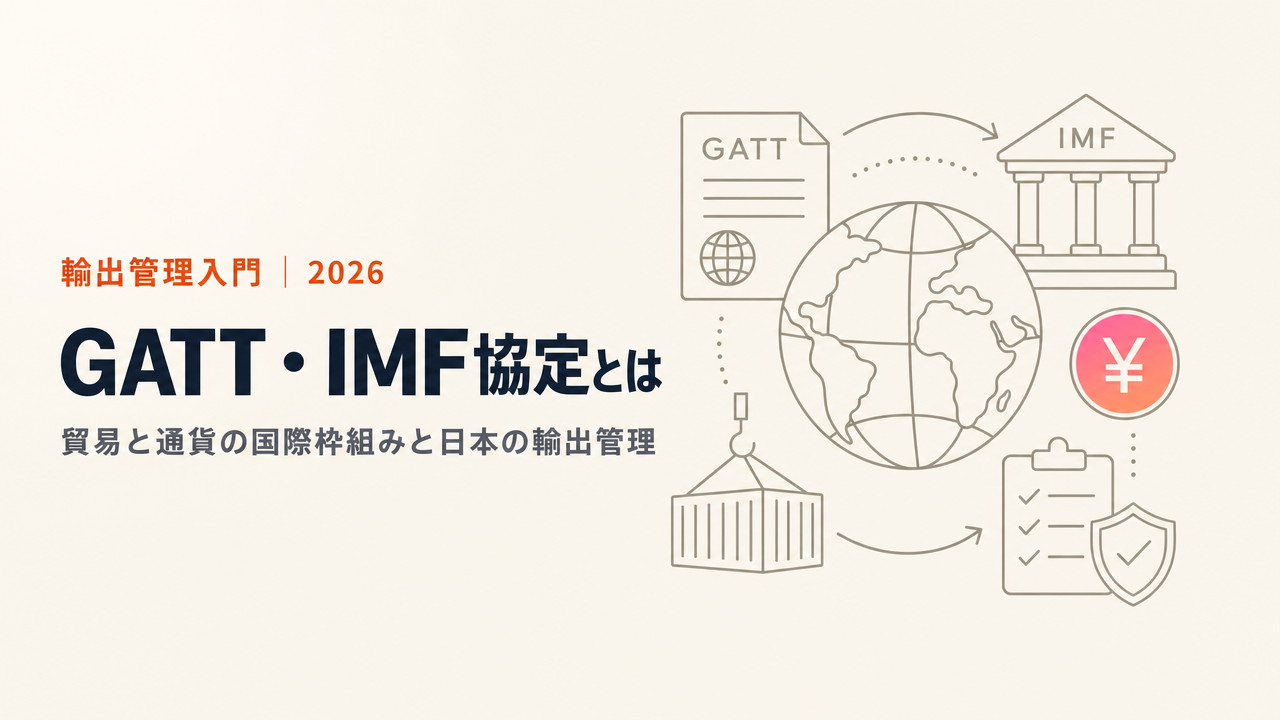
Step into the practical work of export control and, sooner or later, you run into a single question. The world is supposed to operate on the principle of free trade, so why can Japan use FEFTA to block the export of particular goods or technologies? At the root of this structure -- where "freedom" and "regulation" live side by side -- are two international agreements built after the war: GATT and the IMF Agreement. Once you have a grip on both, you can see exactly where FEFTA and the Export Trade Control Order plug into the wider body of international rules.
This article uses GATT (now the WTO), which carries the rules for trade, and the IMF Agreement, which carries the rules for currency and foreign exchange, as its two axes, and lays out -- with article numbers -- where Japan's export controls fit within them.
GATT and the IMF Agreement: The Two Pillars of the Postwar Economic Order
The postwar international economic order traces its starting point to the United Nations Monetary and Financial Conference held in July 1944 at Bretton Woods, New Hampshire, in the United States. At that conference, 44 nations signed the IMF Agreement (the Articles of Agreement of the International Monetary Fund), giving rise to a framework charged with the stability of currency and foreign exchange. The IMF (International Monetary Fund) itself was formally established in December 1945. On the trade side, the General Agreement on Tariffs and Trade (GATT) was drawn up in 1947 and came into effect in 1948. GATT aimed for a free and non-discriminatory world trading system through lower tariffs and trade without discrimination.
These two stand together as pillars of the postwar international economic order, which is often referred to collectively as the "Bretton Woods system." The division of labor is clear. The IMF Agreement handles the flow of money -- currency, foreign exchange, and the balance of payments -- while GATT handles the movement of goods -- trade, tariffs, and commercial rules. They are like twins born around the same time, but their remits are entirely different.
| Item | GATT / WTO (trade framework) | IMF Agreement (currency and foreign exchange framework) |
|---|---|---|
| Field covered | Trade, tariffs, commercial rules (movement of goods) | Currency, foreign exchange, balance of payments |
| Establishment | GATT: drawn up 1947, in force 1948 → WTO: established 1995 | Signed at Bretton Woods in 1944; IMF established December 1945 |
| Basic principles | Most-favored-nation treatment (GATT Art. I) / national treatment (Art. III) / general elimination of quantitative restrictions (Art. XI) | Freedom of current payments (Art. VIII) / exchange stability |
| Japan's involvement | Joined GATT September 1955 / a member from the WTO's establishment in 1995 | Joined the IMF August 1952 / moved to "IMF Article VIII" status in 1964 |
| Main related domestic laws | Customs Tariff Act, Customs Act, and others | Foreign Exchange and Foreign Trade Act (FEFTA) |
| Japanese jurisdiction | Ministry of Economy, Trade and Industry; Ministry of Foreign Affairs (tariffs: Ministry of Finance and Customs) | Ministry of Finance |
| Exception / security | GATT Art. XXI (security exception) | Art. XIV (transitional exchange restrictions) |
Japan's own involvement began at different times for the two. It joined the IMF in August 1952 as the 53rd member, and joined GATT in September 1955. From then on, Japan was woven into the postwar international rules on both the trade and the currency side. For export-control practitioners, the four points this article covers are the ones worth keeping in mind: GATT's two great principles of most-favored-nation and national treatment, the transition from GATT to the WTO, the liberalization of current transactions that connects the IMF Agreement to FEFTA, and the security exception of GATT Article XXI that lets free trade and export controls coexist.
GATT's Two Great Principles: Most-Favored-Nation and National Treatment
The core of GATT boils down to a single point: do not discriminate. Two pillars support it. One is most-favored-nation treatment (GATT Article I); the other is national treatment (GATT Article III).
Most-favored-nation treatment is the principle that the most favorable treatment granted to any one member must be extended equally to all other members. If you allow low tariffs on imports from Country A, for example, you must extend the same treatment to like products from every other member. The name alone can make it sound like a system that favors particular countries, but the reality is the opposite: it is a mechanism that forces members to be treated on an equal footing. It becomes easier to grasp if you understand it as a principle that removes discrimination on the outside of the border -- that is, discrimination by the counterpart country.
National treatment is the principle that once a product has been imported, it must not be treated less favorably than a like domestic product. It prohibits singling out imports in domestic taxes or sales regulations. If most-favored-nation treatment is the rule against "discriminating between foreign countries," national treatment is the rule against "discriminating between imports and domestic goods." Its setting of application is the inside of the border.
To these two, add GATT Article XI, which provides for the general elimination of quantitative restrictions. Article XI provides that no prohibitions or restrictions other than duties, taxes, or other charges shall be instituted or maintained, in principle banning restrictions that squeeze by volume, such as import quotas. Adjustment through the price mechanism of tariffs is permitted, but regulation that constrains quantity itself is ruled out. These three build the skeleton of a free and non-discriminatory trading system. In my own view, the more someone is learning export control, the more it helps to have this foundation of "non-discrimination as the default" in mind first; it makes the place of the security exception that comes up later much easier to accept.
From GATT to the WTO: The Big Picture of the Multilateral Trading System
GATT sat at the center of the multilateral trading system for a long time, but as its name suggests, it was originally an "agreement," not an "organization." Without a permanent body to run it, members advanced tariff cuts and rulemaking through successive rounds of negotiation.
The turning point was the Uruguay Round, conducted from 1986 to 1994. As a result of that multilateral negotiation, the Marrakesh Agreement Establishing the World Trade Organization entered into force in 1995. The WTO extended its remit beyond trade in goods to cover trade in services and intellectual property, and, as a permanent international organization equipped with dispute-settlement procedures, it took over GATT's multilateral trading system.
The relationship between GATT and the WTO is where confusion easily creeps in. The WTO's establishment did not make GATT disappear. GATT, as the body of rules for trade in goods, was incorporated into the WTO agreements as "GATT 1994," and it lives on today. To put it in order: the institution that administers trade rules is the WTO, and the core body of basic rules for trade in goods within it is GATT. The understanding that "it's the WTO now, so GATT is a thing of the past" is not accurate. GATT Article XXI, which you cite when reaching for the text in an export-control context, also remains in force as part of this GATT 1994.
The IMF Agreement and FEFTA: Liberalizing Current Transactions and the Move to "IMF Article VIII" Status
Now turn to the currency and foreign-exchange side. IMF Agreement Article VIII sets out the general obligations of members and contains material that is closely relevant to export-control practitioners as well. Article VIII, Section 2 provides that no member shall, without the Fund's approval, impose restrictions on payments and transfers for current international transactions. Section 3 requires members to avoid discriminatory currency arrangements or multiple currency practices, and Section 4 requires convertibility of foreign-held balances of a member's own currency. In short, it is an obligation to make current payments of money -- such as consideration for trade -- free as a matter of principle.
That said, imposing this obligation on all members immediately after the war was not realistic. So IMF Agreement Article XIV provides transitional measures. Its design allows members to maintain or adapt restrictions on current payments during the postwar transitional period, while requiring them to respect the Fund's purposes and imposing a best-efforts obligation to withdraw restrictions as soon as possible. A country that stays under Article XIV is called an "IMF Article XIV country," and one that has fully assumed the obligations of Article VIII is called an "IMF Article VIII country."
The watershed year for Japan was 1964. That year, Japan moved to IMF Article VIII status and was obligated to liberalize foreign exchange for current transactions. In that same year, 1964, Japan also joined the OECD (Organisation for Economic Co-operation and Development) as its 21st member and abolished the foreign exchange budget system. It was the pivot from an era in which imports required an allocation of foreign currency to a stage in which foreign exchange for current transactions was free.
The basic statute that absorbs this international obligation domestically is FEFTA (the Foreign Exchange and Foreign Trade Act, Act No. 228 of 1949). FEFTA was enacted in 1949, initially under the name "Foreign Exchange and Foreign Trade Control Act," as a system that prohibited external transactions in principle. The 1980 amendment then switched it to a design that treats external transactions as free in principle, and the 1998 amendment abolished, in principle, the prior licensing and notification system and struck the word "Control" from the statute's name. The demands of liberalization as an IMF Article VIII country pushed FEFTA's character from "control" toward "minimal adjustment on a foundation of freedom." The structure of FEFTA itself is laid out in detail in FEFTA fundamentals.
The current Article 1 of FEFTA (Purpose) states this shift plainly in the words of the text. It provides that the purpose is, "based on the principle that foreign exchange, foreign trade, and other external transactions are conducted freely, to enable the proper development of external transactions and to maintain peace and security in Japan and the international community by carrying out the minimum necessary management or adjustment of external transactions, and thereby to achieve equilibrium in the balance of payments and stability of the currency, as well as to contribute to the sound development of the Japanese economy." Freedom is the default; management is the minimum necessary. This single sentence is the foundation on which the liberalization required by the IMF Agreement and GATT, and regulation for the sake of security, coexist within one and the same law.
Reconciling Free Trade and Security: The Security Exception of GATT Article XXI
Here we return to the question we opened with. Under GATT, which flies the banner of free trade, why is export regulation under FEFTA permitted? The answer lies in GATT Article XXI. Article XXI sets out the "security exception" and recognizes the following three as exceptions. The first is that no member shall be required to furnish information the disclosure of which it considers contrary to its essential security interests. The second is that a member may take any action it considers necessary for the protection of its essential security interests. The third is the discharge of obligations under the UN Charter -- for example, measures based on UN Security Council resolutions.
In other words, GATT's principles, such as most-favored-nation treatment and the ban on quantitative restrictions, have a separate track of exceptions -- security -- built in from the start. Measures that stop the transfer of particular goods or technologies in order to prevent the proliferation of weapons of mass destruction, or to implement sanctions based on UN Security Council resolutions, are understood to fall within the scope of this Article XXI. Japan's security-focused trade controls, too, are positioned as operating within this exception, based on FEFTA and its subordinate orders. The free-trade regime and export controls are not in opposition; they coexist within the same rulebook, dividing the roles between them.
One qualification is in order. Because Article XXI contains language to the effect that a member acts on what "it considers" necessary, countries interpret differently just how far the acting country's self-judgment extends, and how far a panel in the WTO dispute-settlement procedure may review it. Against the position that a panel can confirm only the fact that the measure-taking country invoked Article XXI, there are also panel decisions that have gone further and engaged in review, and the debate continues today. In practice, rather than thinking that anything goes because a security exception exists, I believe the realistic stance is to carry out classification screening and transaction review steadily in accordance with the framework of FEFTA and its cabinet and ministerial orders.
Implications for Export-Control Practice: Placing FEFTA Within the International Framework
Day-to-day classification screening and transaction review center on detailed cross-referencing against the item numbers in Appended Table 1 of the Export Trade Control Order and the control values in the ministerial ordinance on goods and technologies. For that reason, international frameworks such as GATT and the IMF Agreement may feel like a distant matter. Yet the full picture of Japan's export controls only comes into clean order when you place it within this international layered structure.
Japan's security-focused trade controls take FEFTA as their enabling law and adopt a three-layer structure: exports of goods are regulated by the Export Trade Control Order (Cabinet Order No. 378 of 1949), provisions of technology (services) are regulated by the Foreign Exchange Order (Cabinet Order No. 260 of 1980), and the specific control values and specifications are set by the ministerial ordinance on goods and technologies. The licensing basis for provisions of technology is FEFTA Article 25(1) and Foreign Exchange Order Article 17(2). The content of the regulation comes in two broad types. List-controlled items falling under Items 1 through 15 of Appended Table 1 of the Export Trade Control Order or the Appended Table of the Foreign Exchange Order require the prior license of the Minister of Economy, Trade and Industry for all destinations. Even off the list, where there is a risk that goods will be used for the development of weapons of mass destruction or conventional weapons, a license is required under catch-all controls. For catch-all controls, exports to the 27 regions listed in Appended Table 3 of the Export Trade Control Order, such as OECD member states, are in principle outside the scope.
Above this domestic three-layer structure sits the security exception of GATT Article XXI, and outside that lie the free-trade regime of GATT and the WTO and the exchange liberalization of the IMF Agreement. Once you grasp export control as an activity that presumes the "freedom by default" of this topmost layer while imposing regulation exceptionally in the limited domain of security, it becomes clear why FEFTA Article 1 is phrased as "freedom by default, minimum necessary management." International rules and domestic law are not cut off from one another; they are connected in a single line from the top down.
In practice, building a self-management system that reflects this framework is indispensable. Discerning where your company's transactions plug into the international framework, and which list and which regulation they might fall under, is a process that tends to depend heavily on the individual staff member's experience. If you would first like to grasp the weak points of your company's export controls in a short time, the easiest place to start is the export compliance self-assessment. As a means of lowering the burden of classification screening and transaction review themselves, there is TIMEWELL's export-control AI agent TRAFEED. Conforming to the standards of the Ministry of Economy, Trade and Industry, TRAFEED is a multilingual tool that supports cross-referencing against the text of the ministerial ordinance on goods and technologies with clear grounds, helping to reduce the concentration of screening work in a single person. If you would like to consult individually on everything from system design to building an internal structure, please make use of our individual consultation on export control.
Common Misconceptions About GATT and the IMF Agreement
In the course of learning the big picture of the system, there are several misconceptions that practitioners tend to stumble over.
First is the assumption that "GATT and the IMF are the same organization." Both are pillars of the Bretton Woods system, but GATT (now the WTO) handles trade and the IMF handles currency and foreign exchange; they are separate frameworks. Their jurisdictions in Japan are also divided: trade rules fall mainly to the Ministry of Economy, Trade and Industry and the Ministry of Foreign Affairs (with tariffs under the Ministry of Finance and Customs), and currency and foreign exchange fall to the Ministry of Finance.
Next, the understanding that "GATT is an international organization still in existence" is also inaccurate. GATT was originally an agreement, and its role as an institution was taken over by the WTO, established in 1995. The agreement itself lives on, incorporated into the WTO agreements as GATT 1994.
The misconception that "most-favored-nation treatment means giving special treatment to a particular country" is stubbornly persistent, too. In fact, it is a principle of treating members without discrimination and on equal terms, meaning that favorable treatment granted to one country is extended to all other members.
The view that "FEFTA is a law for export control" is also too narrow. FEFTA is the basic statute for external transactions in general, including foreign exchange and capital transactions, and security-focused trade controls are only one part of it. Conversely, the understanding that "regulation of exports is impossible because we have a free-trade regime" is mistaken as well; the security exception of GATT Article XXI underpins regulation based on FEFTA.
Finally, there is the misconception that "the move to IMF Article VIII status made all external transactions free." What Article VIII status requires is mainly the liberalization of current transactions; the full liberalization of capital transactions proceeded in stages up to the 1998 amendment of FEFTA. Distinguishing between current transactions and capital transactions is the key to understanding the liberalization of this era accurately.
Frequently Asked Questions
What is the difference between GATT and the IMF Agreement?
GATT (now the WTO) governs trade, tariffs, and commercial rules -- the movement of goods -- while the IMF Agreement governs currency, foreign exchange, and the balance of payments -- the flow of money. Both trace back to the 1944 Bretton Woods system and are positioned as pillars of the postwar world economy, but the fields they cover differ. Within Japan, trade rules fall mainly to the Ministry of Economy, Trade and Industry and the Ministry of Foreign Affairs (with tariffs under the Ministry of Finance and Customs), while currency and foreign exchange fall to the Ministry of Finance.
What is the difference between most-favored-nation treatment and national treatment?
Most-favored-nation treatment (GATT Article I) is a principle of non-discrimination on the outside of the border: the most favorable treatment granted to any one country must be extended equally to all other members. National treatment (GATT Article III) is a principle of non-discrimination on the inside of the border: imported products must not be treated less favorably than like domestic products. The two are the twin pillars that uphold non-discrimination in the free-trade system; they share the same aim but apply in different settings.
How does the IMF Agreement relate to FEFTA?
Japan moved to IMF Article VIII status in 1964 and was thereby obligated to liberalize foreign exchange for current transactions (IMF Agreement Article VIII). Article 1 of FEFTA establishes that external transactions are to be conducted freely as a basic principle, with management kept to the minimum necessary, so the law functions as the domestic basic statute that secures the freedom of current transactions the IMF Agreement requires. The amendments of 1980 and 1998 established the system in which freedom is the default.
Do security-focused trade controls violate GATT's free-trade regime?
They do not. GATT Article XXI sets out a security exception, allowing measures a member considers necessary to protect its essential security interests, as well as the discharge of obligations under the UN Charter such as UN Security Council resolutions. Japan's security-focused trade controls, based on FEFTA, the Export Trade Control Order, and the Foreign Exchange Order, are understood to operate within the scope of this exception.
Which is currently in force, GATT or the WTO?
The WTO (World Trade Organization) was established in 1995 and took over GATT's multilateral trading system. GATT itself was never an international organization but an agreement, and it survives today as GATT 1994, which forms part of the WTO agreements. Accordingly, the institution that administers trade rules is the WTO, while GATT is the core body of basic rules for trade in goods within it.
Summary
GATT and the IMF Agreement are not a distant matter of diplomatic history; they are the blueprint that supports Japan's export controls at the root. GATT (now the WTO) holds up the principle of non-discriminatory free trade, and its Article XXI recognizes a security exception. The IMF Agreement requires the liberalization of foreign exchange for current transactions, and Japan, having moved to IMF Article VIII status in 1964, has reshaped FEFTA into a law of "freedom by default, minimum necessary management." When you reach for the text of list controls or catch-all controls in export-control practice, recalling that one layer above sits the principle of free trade, and that your country's regulation is placed as an exception to it, keeps the axis of your judgment from wavering. As a next step, I recommend taking stock, at least once, of where your company's flagship products and technologies might plug into this framework.
References (Primary Sources)
- Ministry of Foreign Affairs, "General Agreement on Tariffs and Trade (GATT)"
- National Diet Library, Research Navi, "WTO / GATT"
- Ministry of Finance, "The Purpose and Evolution of FEFTA"
- Ministry of Finance, "Overview of the Foreign Exchange and Foreign Trade Act (FEFTA)"
- Ministry of Finance, "Overview of the IMF"
- Japanese Law Translation Database System, "Foreign Exchange and Foreign Trade Act" (text of Article 1, Act No. 228 of 1949)
- IMF, "Articles of Agreement of the International Monetary Fund" (Japanese-language text PDF; Articles I, VIII, and XIV)
- Ministry of Economy, Trade and Industry, "Overview of Security Export Control"
- JETRO, "Controlled Items and How to Confirm Classification in Security Export Control: Japan"
- e-Gov Law Search, "Export Trade Control Order" (Cabinet Order No. 378 of 1949, law ID 324CO0000000378)
- e-Gov Law Search, "Foreign Exchange Order" (Cabinet Order No. 260 of 1980, law ID 355CO0000000260)
- CISTEC, "On Security Export Control and GATT Article XXI (the WTO Security Exception Clause)"
- Ministry of Foreign Affairs, "The 50th Anniversary of Japan's OECD Membership"
This article was produced with the help of AI. A human verified the primary sources and edited the text before publication.
More Articles in This Category
1
Export Control Fundamentals - Why Classification Screening Matters
An introduction to export control fundamentals: the regulatory framework, the necessity of classification screening, the difference between list-based and catch-all controls, and the penalties for violations.
2
Catch-All Controls Explained in Plain Terms
A clear explanation of catch-all controls: how they work, when they apply, and the practical steps for compliance. Includes a comparison with list-based controls.
3
Practical Guide to Classification Screening - Procedures and Common Challenges
A hands-on guide to the classification screening process, covering each step in detail along with the most common challenges companies face and how to address them.
課題解決ソリューション
輸出管理コンプライアンスを強化複雑な輸出規制への対応を効率化