Hello, this is Hamamoto from TIMEWELL.
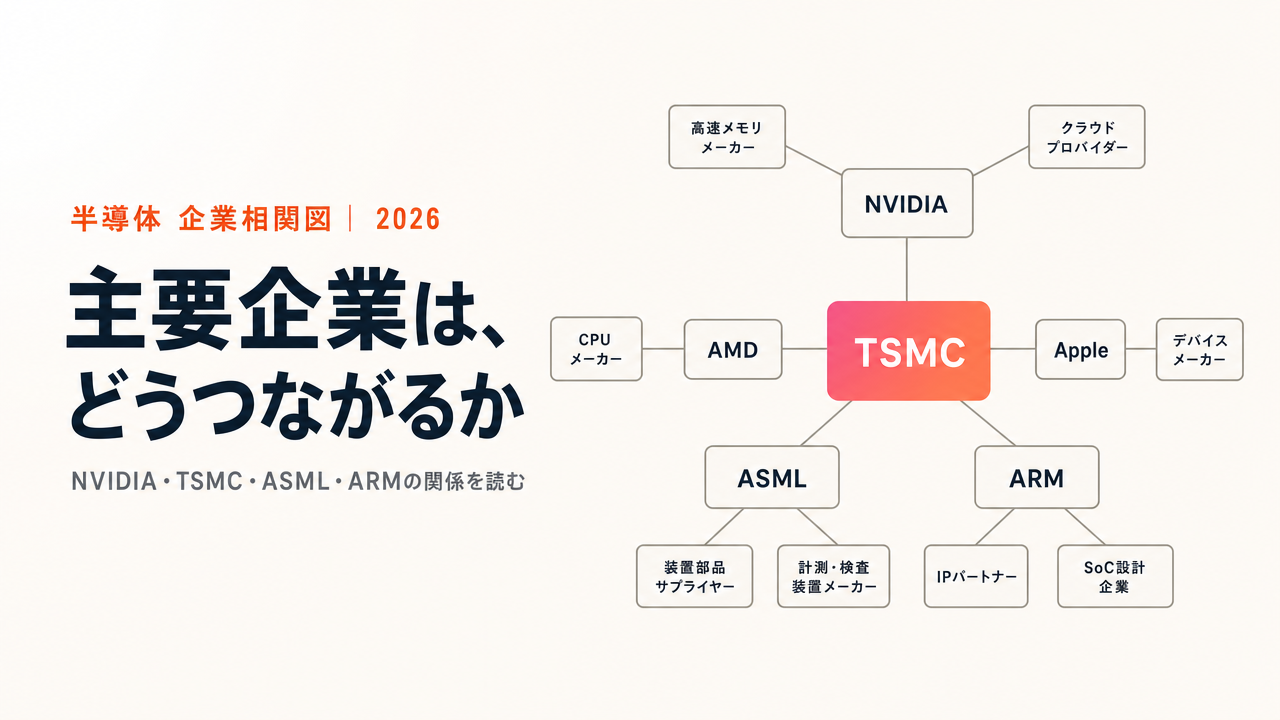
"Investment in AI infrastructure will exceed expectations again in 2026" — as prominent analyst Gene Munster puts it, the AI semiconductor market continues to grow beyond projections. Just as TSMC's CEO described AI demand as "voracious," the company's high-performance computing segment has grown to account for 55% of its total revenue.
This article explains the latest developments in the semiconductor industry as of January 2026, the strategies of TSMC and NVIDIA, and advances in inference technology such as Test-Time Scaling — in a way that's easy to understand even for newcomers.
January 2026: Latest Trends in the AI Semiconductor Market
TSMC's Bullish Outlook Signals Market Momentum
In Q1 2026, TSMC forecast revenues of $34.6 billion to $35.8 billion — significantly exceeding Wall Street's estimate of $33.2 billion. The company also announced it would raise its capital expenditure budget to $52–56 billion for 2026.
Notably, 10–20% of this investment is earmarked for advanced packaging technology (such as CoWoS). Advanced packaging accounted for about 8% of revenue in 2025, and is expected to exceed 10% in 2026.
NVIDIA's Overwhelming Market Dominance
According to Morgan Stanley estimates, NVIDIA has secured approximately 60% of TSMC's total CoWoS (Chip-on-Wafer-on-Substrate) production capacity for 2026.
This figure reflects NVIDIA's dominant position in the AI accelerator market for data centers. Strong investment from cloud providers is expected to continue through 2026.
Why Supply Constraints Persist
TSMC has told key customers that it "cannot fully meet surging demand for advanced AI processors." Production capacity at the most advanced manufacturing nodes remains tight.
The gap between demand and supply is expected to continue at least through the first half of 2026.
Looking to optimize community management?
We have prepared materials on BASE best practices and success stories.
Advances in Inference Technology: Latest Developments in Test-Time Scaling
What Is Test-Time Scaling?
Test-Time Scaling is a technique that improves the accuracy and output quality of AI models by allocating additional computational resources at inference time.
Traditionally, improving AI model performance relied primarily on "training-time scaling" — larger models and more data. Test-Time Scaling offers a new approach: "inference-time scaling."
Four Key Approaches
Test-Time Scaling encompasses four major categories:
| Approach | Description | Characteristics |
|---|---|---|
| Parallel Scaling | Generate multiple candidate outputs in parallel and select the best | Fast but high compute cost |
| Sequential Scaling | Model progressively refines its thinking and output | Prioritizes accuracy, takes more time |
| Hybrid Scaling | Combines parallel and sequential | Balanced approach |
| Internal Scaling | Leverages the model's internal computation mechanisms | Used in DeepSeek-R1, OpenAI o1/o3, Gemini Flash Thinking, etc. |
Latest Research as of January 2026
TTT-E2E method: Achieved 2.7x faster processing than Full-Attention Transformers on Nvidia H100 hardware with a 128k token context length. In experiments with a 3B parameter model, it maintained lower perplexity (better performance) than Full Attention across the entire context window.
TEX method: A new approach that transforms individual large language models into collaborating software engineering agents. It leverages execution-based cross-validation and incorporates peer-review mechanisms.
These technologies have the potential to improve accuracy while reducing inference costs, and are expected to further influence AI semiconductor demand.
Geopolitical Risks and the Importance of Domestic Demand
Continued US-China Trade Friction
The semiconductor industry continues to be affected by US-China trade tensions. While export restrictions on the Chinese market remain a concern, data center investment within the United States is accelerating.
Major tech companies such as Microsoft, Amazon, and Google continue to invest aggressively in data centers through 2026, supporting domestic semiconductor demand.
Expansion into New Application Areas
AI adoption in new fields such as autonomous driving, robotics, and medical diagnostics is also pushing semiconductor demand higher. In particular, the proliferation of edge AI — AI processing on devices — is increasing semiconductor demand outside of data centers.
TIMEWELL's AI Solutions and Semiconductor Technology
To fully leverage the benefits of AI semiconductors, organizations need the right AI infrastructure and software choices.
ZEROCK is an enterprise AI platform that operates on AWS domestic servers and offers knowledge control capabilities powered by GraphRAG technology. It's designed to safely manage and utilize company-specific data while harnessing the computational power of high-performance AI semiconductors.
WARP provides AI consulting services to help businesses select the optimal infrastructure for AI adoption, including investment planning informed by semiconductor market trends.
Summary: Outlook for the AI Semiconductor Market in 2026
Key Points
- TSMC's bullish outlook: Q1 2026 revenue forecast of $34.6–35.8 billion; capex raised to $52–56 billion
- NVIDIA's market dominance: Secured approximately 60% of TSMC's CoWoS production capacity
- Persistent supply constraints: Demand for advanced manufacturing nodes continues to outpace supply
- Advances in Test-Time Scaling: New methods like TTT-E2E and TEX have emerged, improving inference performance
- Response to geopolitical risks: Securing US domestic demand is increasingly important
What to Watch Next
The AI semiconductor market is expected to continue growing beyond expectations through 2026. Advances in inference technology such as Test-Time Scaling may expand semiconductor demand further.
By planning procurement carefully and selecting the right AI infrastructure, companies can maximize the benefits of this growth market. Developments in the semiconductor industry remain a critical area to watch.
References
- 2026年の半導体市場の動向予測 - aconnect
- Gene Munster Warns Wall Street Is Underestimating 2026 AI Demand As Nvidia And TSMC Signal Strong Upside
- TSMC Just Gave Investors a Glimpse of What's Ahead for Nvidia in 2026
- New 'Test-Time Training' method lets AI keep learning without exploding inference costs