This is Hamamoto from TIMEWELL.
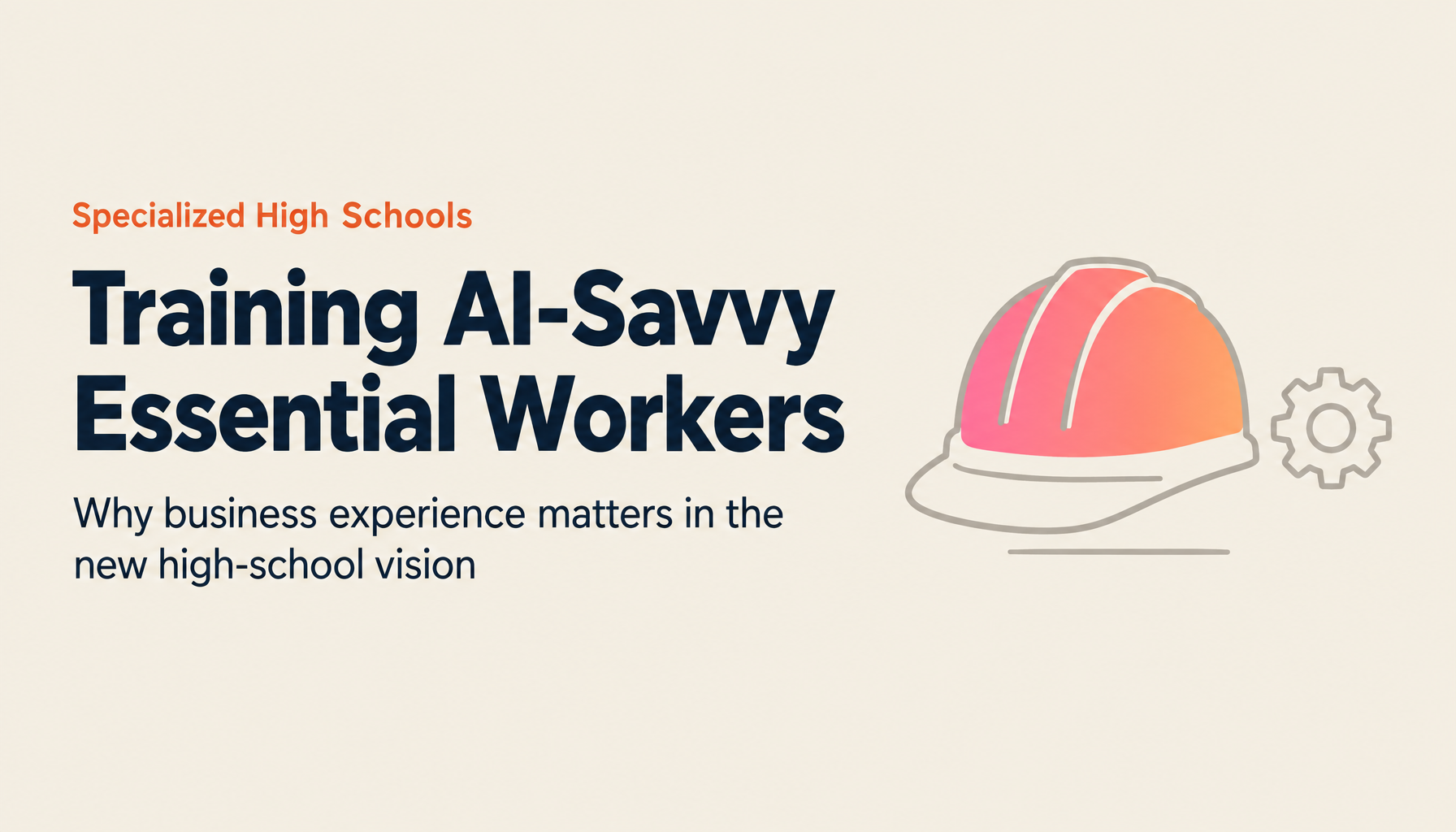
An Advanced Essential Worker is a term for someone who can solve the challenges of local industry and society while making full use of AI and digital technology. Japan's Ministry of Education, Culture, Sports, Science and Technology (MEXT) put the term forward in February 2026 as a goal for strengthening and advancing specialized high schools, in the grand design for its N-E.X.T. High School vision1.
It is an unfamiliar phrase, but it becomes easier to picture once you break it down. Essential workers are the people on the front lines who keep society running: manufacturing, agriculture, logistics, healthcare and welfare. Add "advanced" to that, and it means someone who knows those front lines and can change them with AI and digital tools. In this article, I want to lay out what developing these people actually involves, and how companies can be part of it. For background on the vision as a whole, see my explainer on the N-E.X.T. High School vision.
Why specialized high schools take center stage
The reason the grand design places its emphasis on specialized high schools comes down to labor-market projections. If current trends in the talent supply continue, clerical jobs are expected to be in surplus, while there will be a shortage of the people needed to make use of AI, robotics, and other tools that raise labor productivity1. In other words, a shortage of people who can support local industrial front lines while mastering technology, which is exactly what an Advanced Essential Worker is.
The numerical targets are clear, too. For 2040, the vision calls for 100% of specialized high schools to run practical, year-round learning in partnership with industry and universities, and for enrollment at specialized high schools to be maintained at current levels even amid the declining birthrate. If that is achieved, the share of specialized high school students among all students would rise from 20.2% to around 30%1. Becoming a country that educates three out of ten students at specialized high schools is, in my read, a considerable shift in policy.
Looking for AI training and consulting?
Learn about WARP training programs and consulting services in our materials.
Three pillars of development, and the grant-eligible examples
The grand design gives three examples of activities that would be eligible for grants and similar funding under the strengthening and advancing of specialized high schools1.
| Initiative | What it involves |
|---|---|
| Making business experience mandatory | Through collaboration with industry, students regularly carry out concrete work at companies and other organizations. This clarifies their picture of post-graduation work and income, and deepens learning by moving between theory and practice |
| Integrated learning from making to distribution | Carrying out the entire process at the high school, from producing and cultivating raw materials to manufacturing products and on to distribution and sales. Cross-disciplinary learning that spans departments, such as combining agricultural and commercial perspectives |
| High-school corporate endowed courses | Setting up school-designated subjects and similar courses where students learn advanced, practical content in fields that draw on local strengths, under ongoing guidance from corporate experts. Linked to securing opportunities for further study and employment |
What the three have in common is that companies become co-operators of education rather than "places to visit." Making business experience mandatory means year-round hands-on work, and endowed courses have corporate experts involved in the very design of the subject. The relationship between schools and companies is being raised from one-off workplace visits to an ongoing partnership.
In fact, of the 75 reform pilot schools selected on June 30, 2026, 22 industrial schools and 14 agricultural schools fall within the context of this Type 12. I have summarized the detailed tendencies among the selected schools in my explainer on the reform pilot schools.
How to implement the "while making full use of AI" part
The part of the Advanced Essential Worker definition that tends to get overlooked is the opening condition: "while making full use of AI and digital technology"1. Drop that, and it becomes no different from an expanded version of a conventional internship.
Translating what implementation looks like on the ground, from what we have seen supporting companies with AI adoption, it comes out something like this. At an agricultural high school, students turn cultivation records into data, have generative AI analyze them, and form hypotheses for the next planting. At an industrial high school, they make drawings and inspection records searchable and comparable with AI, and learn how veteran workers make judgments. At a commercial high school, they actually improve a local company's e-commerce or customer acquisition using AI tools. In every case, it is the combination of "a real front-line challenge × AI as a tool," and none of it can be completed within a textbook.
That is precisely why, in this type, how companies engage will determine the outcome. And for companies, this is not only a matter of social contribution. Making business experience mandatory and running endowed courses are also mechanisms for building long-term contact with future recruitment candidates. The grand design itself lists industry activities linked to outcomes, such as presenting job content and career paths at companies, and repaying scholarships on students' behalf1.
At TIMEWELL, we take on that "while making full use of AI" part through our WARP program for schools and educational institutions. It is a hands-on program in which students use generative AI to tackle challenges in their community or school, and reach the point of building products and outputs that actually work. If you are at a school or board of education that wants to build an AI-utilization perspective into the design of mandatory business experience or corporate endowed courses at a specialized high school, please feel free to reach out.
Summary
- An Advanced Essential Worker is the profile of someone who can solve challenges in local industry and society while making full use of AI and digital technology
- Behind it lies a labor-market projection of surplus clerical jobs and a shortage of people who can put AI to use
- The three pillars of development are making business experience mandatory, integrated learning from making to distribution, and high-school corporate endowed courses
- The 2040 targets are practical learning at 100% of specialized high schools, and maintaining specialized high school enrollment at current levels (raising the share to around 30%)
- The key is implementing the "while making full use of AI" part. It assumes companies engage as co-operators of education
References
Related Articles
- What Is the N-E.X.T. High School Vision? A Clear Guide to MEXT's Grand Design for High School Reform
- What Are Reform Pilot Schools? The Three Types and Trends Among the 75 Selected Schools
- What Are the "Abilities AI Cannot Replace"? How AI Education in High Schools Is Changing
- High School Inquiry-Based Learning × Generative AI: Practical Steps to Empower Students
Footnotes
-
MEXT, "Basic Policy on High School Education Reform (Grand Design): The 'N-E.X.T. High School Vision' Toward 2040" (February 13, 2026) ↩ ↩2 ↩3 ↩4 ↩5 ↩6
-
MEXT, "Public Call for the FY2025 Project to Promote High School and Related Education Reform Contributing to the Development of Industrial Innovation Talent" (selection announced June 30, 2026; 75 schools across 38 municipalities) ↩

![High School Inquiry-Based Learning × Generative AI: Practical Steps to Empower Students [The N-E.X.T. High School Era]](/images/columns/highschool-inquiry-based-learning-ai/cover.en.png?dpl=dpl_FTx9dW3PCZpyy8WxThA4hsvCMeGU)