
This is Hamamoto from TIMEWELL.
Reform pilot schools are the pilot schools that put MEXT's N-E.X.T. High School Vision into practice ahead of the rest of the system. In the Grand Design itself, they are defined as "high schools that build a leading model of learning as a pilot case"1. Following an open call from February to May 2026 and review by outside experts, 75 schools across 38 local governments were selected on June 30 of the same year2.
Following on from my previous overview of the N-E.X.T. High School Vision as a whole, this article narrows in on the reform pilot schools that serve as the "delivery force." What people at boards of education and schools want to know, I think, is what the types actually involve, how the money flows, the selection trends, and "how should our school move?" — so I lay it out in that order.
The three types: which one fits your school
Reform pilot schools are created under the following three types1.
| Type | Name | Picture of the school |
|---|---|---|
| Type 1 | Support for developing Advanced Essential Workers and similar talent | Specialized high schools that cultivate people who can solve local industry's problems by making full use of AI and digital technology. Making business experience compulsory, high-school versions of corporate endowed courses, and so on |
| Type 2 | Support for developing science and mathematics talent | General-course reform that cultivates a well-rounded grounding and scientific thinking unbound by the humanities-sciences divide. Building science-and-math inquiry hubs centered on DX labs, and so on |
| Type 3 | Securing educational opportunities that respond to diverse learning needs | An environment where students can learn regardless of geographic conditions or individual circumstances, through distance learning and inter-school collaboration. Made-to-order timetables, and so on |
What to keep in mind is that these three are not mutually exclusive. It is stated at the footnote level, but the Grand Design explicitly notes that "combining elements of Types 1 through 3 is also conceivable"1. In practice, for a specialized high school in a rural area, a design like "built around Type 1, combined with distance learning (Type 3)" would be the realistic one.
The eligible institutions are public high schools, the upper divisions of secondary schools, and the high school divisions of special-needs schools; municipally run schools may also be included at a prefecture's discretion1.
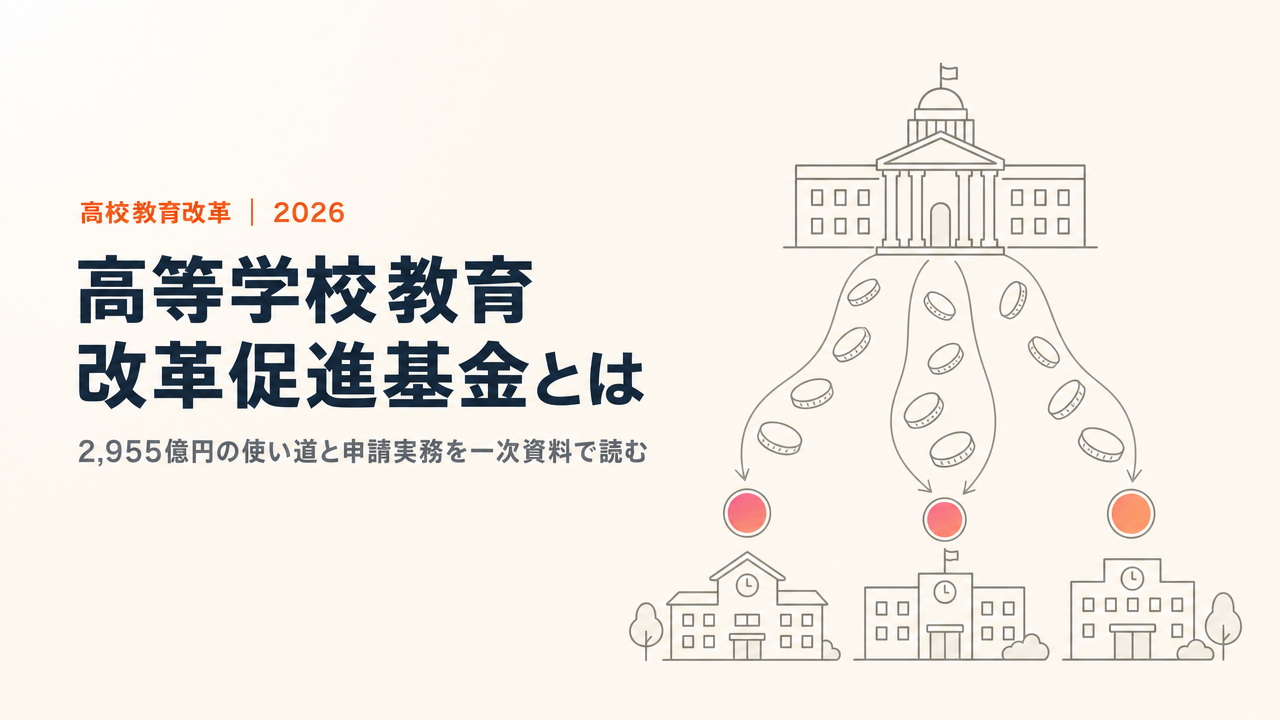
How the money flows: a three-layer structure of fund, grants, and project bonds
The financial mechanism supporting reform pilot schools has three layers.
The first is the "High School Education Reform Promotion Fund." This is a fund established in the prefectures through the FY2025 supplementary budget, with its management and operation guidelines set out as a decision by the Director-General of the Elementary and Secondary Education Bureau on December 26, 20253. This round of 75 selected schools is the result of the open call for the "Project to Promote High School Education Reform Contributing to Industrial Innovation Talent Development and More," which draws on this fund2.
The second is the "High School Education Reform Grant (provisional name)." As a new form of financial support for the High School Education Reform Implementation Plans that prefectures formulate, it is being considered during the FY2027 budget process1. In other words, the fund comes first, and the grant arrives later as the main event.
The third is the "High School Education Reform Promotion Project Bond (provisional name)" for facility development. Its project period runs from FY2026 through FY2031, and local allocation tax measures are slated to be applied to principal and interest repayments1. Developing advanced experimental and information environments, such as DX labs, is expected to draw on this project bond.
Speaking from a sense of what happens on the ground, it has been a long time since a high school policy had this clear a path for funding lined up. Put the other way around, initiatives that do not get written into an implementation plan cannot ride this wave. Whether you can bring your school's vision to the table from the earliest stage of plan-making is the decisive point.
Looking for AI training and consulting?
Learn about WARP training programs and consulting services in our materials.
Reading the trends among the 75 selected schools
The selection results announced on June 30, 2026, have three notable points2.
- 75 schools across 38 local governments. This is a start with the local governments that raised their hands first, not all prefectures.
- By department, the mix is centered on 34 general-course schools, 22 industrial schools, and 14 agricultural schools. This is often assumed to be "a vision for specialized high schools," but in fact general-course schools are the most numerous.
- Some local governments had multiple schools selected; according to news reports, Yamanashi, Shizuoka, and Tokushima each had four4.
The fact that general-course schools are the most numerous captures the character of this vision well. Science-and-math inquiry and crossing the humanities-sciences divide belong to the context of general-course reform, which means the N-E.X.T. High School Vision is not a vocational education policy — it is a transformation of high school education as a whole.
For schools that were not selected, or that did not apply, this is not the end either. The Grand Design calls for the initiatives and outcomes of reform pilot schools to be "shared and disseminated across high schools within the region, rather than confined to a single school," and for their creation to be considered in every prefecture1. The practices of the pilot schools are the kind of thing that will become your school's "standard" within a few years.
Three things schools that act from here should keep in mind
Drawing on the "points to note" section of the Grand Design, here are the elements that matter in practice1.
- Connect to the implementation plan. Reform pilot schools' initiatives are required to be written into the implementation plan. Because the framework has the prefectural board of education at its center, working with the governor's office, universities, and industry through bodies such as the Comprehensive Education Council, a proposal from a single school on its own will not get through. You need a vision tied to projections of the region's employment structure and population.
- Make use of deliberative bodies. It is explicitly stated that you should use regional talent-development vision councils, regional vision-promotion platforms, and community schools (the school management council system) to clearly divide roles among industry, the mayor's or governor's office, universities, and local organizations. The depth of your list of partners is the proof of your ability to execute.
- Link to the exit. Do not stop at enriching education; link it to initiatives with industry and universities that keep post-graduation paths (further study, employment) in view. Presenting the actual work and career paths at companies, regional-quota slots in university admissions, and subsidized repayment of student loans are given as examples.
What the three have in common is "building partnerships with the world outside the school into the plan from the vision stage." We at TIMEWELL also take part, from the corporate side, in supporting high schools' inquiry-based learning and use of AI. We offer the design of problem-solving projects using generative AI, and the experience of having students actually build products, through our WARP program for schools and educational institutions, so if you are at a school or board of education looking for a partner, please take a look.
Summary
- Reform pilot schools are the pilot schools of the N-E.X.T. High School Vision; on June 30, 2026, 75 schools across 38 local governments were selected.
- There are three types (developing Advanced Essential Workers, developing science and mathematics talent, responding to diverse learning needs), and combinations are allowed.
- The finances have a three-layer structure: the fund (already established), grants (under consideration in the FY2027 budget), and project bonds (FY2026–FY2031).
- General-course schools are the most numerous among those selected. This is a transformation of high school education as a whole, not just specialized high schools.
- Schools not selected should also prepare for the next wave by keeping the three points in mind: the implementation plan, deliberative bodies, and linking to the exit.
I dig into "abilities AI cannot replace," the core theme of the reform pilot schools, in this article, and into Advanced Essential Workers, the pillar of Type 1, in this one.
References
Related articles
- What Is the N-E.X.T. High School Vision? A Clear Guide to MEXT's Grand Design for High School Reform
- What Are "Abilities AI Cannot Replace"? How High School AI Education Will Change
- What Is an Advanced Essential Worker? Explaining the Strengthening of Specialized High Schools
- High School Inquiry-Based Learning × Generative AI: Practical Steps to Empower Students
Footnotes
-
MEXT, "Basic Policy on High School Education Reform (Grand Design) — The 'N-E.X.T. High School Vision' Toward 2040" (February 13, 2026) ↩ ↩2 ↩3 ↩4 ↩5 ↩6 ↩7 ↩8
-
MEXT, "On the Public Call for the FY2025 Project to Promote High School Education Reform Contributing to Industrial Innovation Talent Development and More" (selection announced June 30, 2026) ↩ ↩2 ↩3
-
MEXT, "Guidelines for the Management and Operation of the High School Education Reform Promotion Fund" (Decided by the Director-General of the Elementary and Secondary Education Bureau, December 26, 2025) ↩
-
ReseEd, "MEXT Selects 75 Schools to Lead High School Education Reform… Yamanashi, Shizuoka, and Tokushima Each Have Four Selected" (June 30, 2026) ↩

![High School Inquiry-Based Learning × Generative AI: Practical Steps to Empower Students [The N-E.X.T. High School Era]](/images/columns/highschool-inquiry-based-learning-ai/cover.en.png?dpl=dpl_FTx9dW3PCZpyy8WxThA4hsvCMeGU)