This is Hamamoto from TIMEWELL.
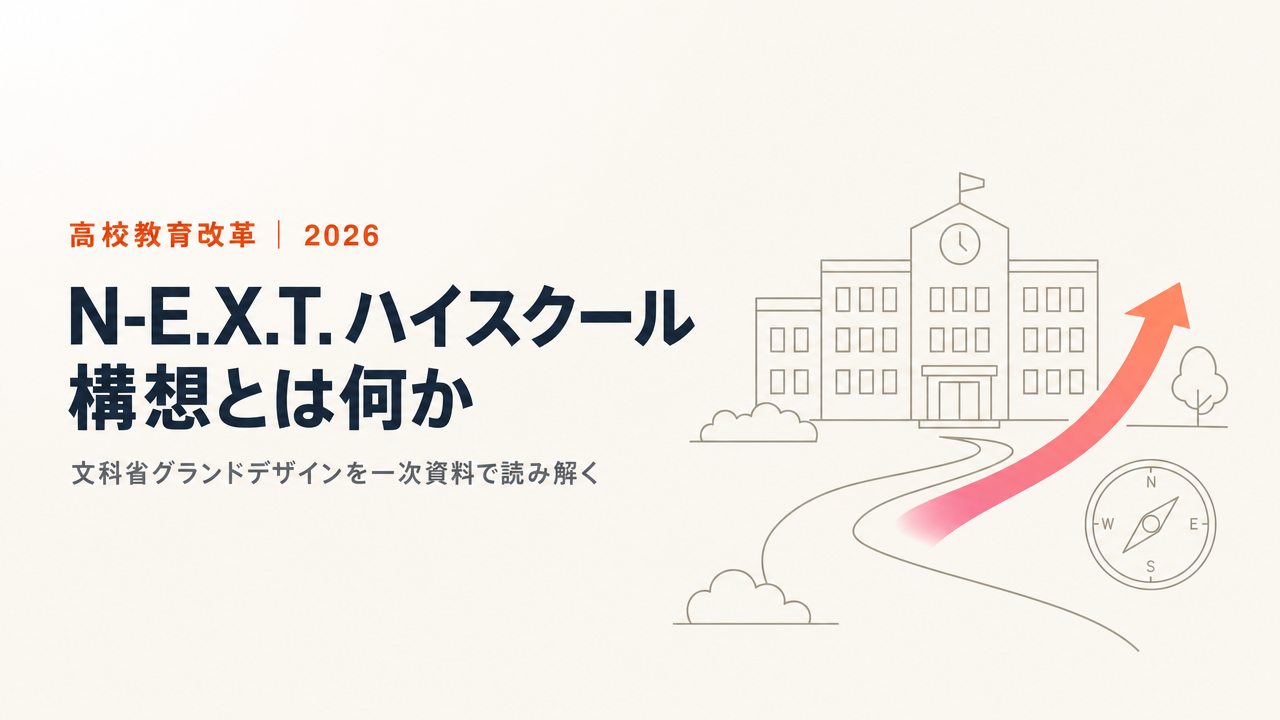
The N-E.X.T. High School Vision is the common name for the "Basic Policy on High School Education Reform (Grand Design)" that Japan's Ministry of Education, Culture, Sports, Science and Technology (MEXT) released on February 13, 20261. Its formal title is "The N-E.X.T. High School Vision — New Education, New Excellence, New Transformation of High Schools." Looking ahead to 2040, it is the national government's overall vision for transforming both the content and the structure of high school education.
Our core business at TIMEWELL is hands-on AI support for companies, but lately I have noticed a clear increase in inquiries from boards of education and high school teachers asking, "In light of the N-E.X.T. High School Vision, how should we bring generative AI into learning?" When I looked into it, I found plenty of fragmentary commentary, but surprisingly little that reads MEXT's primary documents from cover to cover and pulls them together. In this article, I lay out the full picture of the vision using only the Grand Design itself and its related materials as the basis.
Let me start with three key points.
- The N-E.X.T. High School Vision is a blueprint for high school reform toward 2040, built around three perspectives: "nurturing abilities AI cannot replace," "developing the talent that supports the economy and society," and "responding to diverse learning needs."
- The delivery mechanism combines each prefecture's implementation plan, a fund and grants, and pilot schools (reform pilot schools). On June 30, 2026, 75 schools across 38 local governments had already been selected.
- This is not just about specialized high schools. There is an explicit target that, by 2040, 100% of general-course high schools will engage in learning that crosses the humanities-sciences divide.
Why high school reform, and why now? The "2040 problem" behind it
The opening of the Grand Design states plainly the sense of urgency that underpins the whole vision.
| Figure | What it means |
|---|---|
| Approx. 1.06 million → approx. 700,000 | Projected population of 15-year-olds. A roughly 30% drop from 2024 to 20391 |
| Approx. 64% | The share of municipalities that have zero or only one public high school located within them1 |
| Supply-demand gap | If current trends continue, clerical jobs are projected to be in surplus while there is a shortage of people who can put AI, robotics, and the like to work1 |
In other words, if the number of students falls by 30% and all we do is consolidate and close schools, regional educational opportunity and the talent pipeline will simply wither. That is precisely why the vision starts from "not mere consolidation, but changing the substance of high school education."
There is one more passage I personally consider the single most important in the document. It poses the question of whether, in an age when AI processes information, "the volume of knowledge you have memorized and your ability to answer quickly and accurately" should remain the yardstick for evaluation. The Grand Design states unequivocally that what should be valued from here on is "the ability to pose your own questions" and "the ability to create value together with others"1. From education that raises test scores to education that raises questions. Frankly, I find it groundbreaking that a national basic policy has gone this far in its language.
The backbone of the vision: three perspectives
The Grand Design organizes the direction of high school reform around three perspectives.
| Perspective | Content | Keywords |
|---|---|---|
| Perspective 1 | As sovereign citizens who live independently in an uncertain age, nurturing abilities and individuality that AI cannot replace | Language ability, information-use ability, problem-finding and problem-solving ability, ability to collaborate |
| Perspective 2 | Developing the talent that supports the economic and social development of Japan and its regions | Advancing specialized high schools, science and mathematics talent, collaboration with industry |
| Perspective 3 | Securing educational opportunity and access that responds to each individual's diverse learning needs | Distance learning, made-to-order timetables, support for students who avoid attending |
What stands out in Perspective 1 is how AI is positioned. Rather than "shutting AI out," it takes a two-stage approach: first cultivate the foundational abilities AI cannot replace, then build "the groundwork for using AI to create new value"1. The debate over whether to ban generative AI is already a thing of the past; the national policy has moved on to "how do we develop the human side, on the assumption that people will master these tools?" I go into what Perspective 1 actually contains in a separate article that digs into what "abilities AI cannot replace" really means.
As concrete measures for Perspectives 2 and 3, the initiatives eligible for grants are presented as three pillars: strengthening and advancing the functions of specialized high schools (making business experience compulsory, high-school versions of corporate endowed courses, and so on), general-course reform (science-and-math inquiry hubs centered on DX labs, inquiry-style teaching training, and so on), and securing geographic access (inter-school collaboration, distance learning, and so on). I have summarized the development of Advanced Essential Workers, one of the aims raised under the specialized-high-school pillar, in a separate article.
Looking for AI training and consulting?
Learn about WARP training programs and consulting services in our materials.
How it gets delivered: implementation plans, the fund, and reform pilot schools
Three mechanisms are in place so the vision does not stay a picture painted on paper.
First, each prefecture formulates a "High School Education Reform Implementation Plan." Formulation is expected to take up to about a year, with the assumption that reform will then be driven intensively over the following five years1. Plan-making is required to involve the governor's office, universities, industry, and local stakeholders — by design, it cannot be completed by the board of education alone.
Next, the flow of money. The FY2025 supplementary budget established a "High School Education Reform Promotion Fund" in the prefectures2, and a new form of financial support, the "High School Education Reform Grant (provisional name)," is being considered during the FY2027 budget process1. For facility development, a "High School Education Reform Promotion Project Bond (provisional name)" is also slated for creation, running from FY2026 through FY2031, with local allocation tax measures applied to principal and interest repayments1.
And the pilot schools that lead the reform are the "reform pilot schools." Following an open call from February to May 2026, 75 schools across 38 local governments were selected on June 303. By department, the mix is centered on 34 general-course schools, 22 industrial schools, and 14 agricultural schools. I cover the types and the selection trends in detail in the article on reform pilot schools.
The 2040 targets: the destination in numbers
The Grand Design sets out the targets it aims to reach by 2040 in concrete numbers1.
| Area | Target |
|---|---|
| Specialized high schools | 100% of specialized high schools carry out practical learning in partnership with industry and universities throughout the year |
| Scale of specialized high schools | Maintain the number of specialized high school students at current levels even amid a declining birthrate (their share of all students is projected to rise from 20.2% to around 30%) |
| General-course schools | 100% of general-course high schools engage in learning that crosses the humanities-sciences divide |
| Humanities-sciences balance | By 2040, bring the share of humanities-track and sciences-track students in general courses to roughly the same level (currently 51.4% humanities, 30.8% sciences) |
| Post-graduation paths | Halve the share of students whose path is undecided at graduation |
To anyone with a feel for how career guidance works on the ground, the target of bringing "the humanities and sciences shares to roughly the same level" is fairly ambitious. The document even states that the longer-term aim is to eliminate the humanities-sciences division itself, so it is best to assume that general-course curriculum design will change considerably over the next decade.
Where should schools and communities start?
Reading the Grand Design closely, the actions expected of high schools and boards of education fall into three broad groups.
- Lay the groundwork for the implementation plan. Whether your school's initiatives are written into the prefecture's implementation plan will change your access to grants and other support. Clarifying your school mission and school policy is a prerequisite for that.
- Secure partners in industry and academia. Whichever of the three pillars you take, "in partnership and collaboration with industry, universities, and the like" is a condition. Deliberative bodies such as regional talent-development vision councils and regional vision-promotion platforms are also getting underway1.
- Build up inquiry and digital as two wheels of the same cart. Shifting to an inquiry-based, practice-oriented view of learning and advancing school DX are at the core of Perspective 1. You need a clear policy on how to position digital technologies, generative AI included, as "tools for learning."
Honestly, none of these three can be completed by a school on its own. From the corporate side, too, the entry points for industry to take part in education — high-school versions of corporate endowed courses, making business experience compulsory, and so on — are wider than ever before. Through our WARP program for schools and educational institutions, we help design inquiry-based learning that uses generative AI and provide hands-on support in which students actually build products themselves. The aim is not only to teach AI-driven development skills, but to deliver the experience itself of "posing your own question and giving it form." If you work at a school and this interests you, I invite you to take a look.
Summary
- The N-E.X.T. High School Vision is the grand design for high school reform toward 2040 that MEXT released on February 13, 2026.
- Behind it lies the "2040 problem": a 30% drop in the 15-year-old population and a labor supply-demand gap.
- It pairs three perspectives (abilities AI cannot replace, talent development, securing educational opportunity) with a delivery mechanism of implementation plans, a fund, and reform pilot schools.
- On June 30, 2026, 75 reform pilot schools were selected, and the vision has already entered its implementation phase.
- The 2040 targets — such as 100% of general-course schools crossing the humanities-sciences divide — include numbers that concern every high school.
That covers the policy explanation, but the real question on the ground is "so what do we do come Monday morning?" I write concretely about how to combine inquiry-based learning with generative AI in the practical companion article, so please read on.
References
I also referred to MEXT, "High School Education Reform Promotion Fund" and to the Talent Development Subcommittee of Japan's Growth Strategy Council, "A Vision for Reforming the Talent-Development System from High School Through University and Graduate School" (April 28, 2026).
Related articles
- What Are Reform Pilot Schools? The Three Types and the Trends Among the 75 Selected Schools
- What Are "Abilities AI Cannot Replace"? How High School AI Education Will Change
- What Is an Advanced Essential Worker? Explaining the Strengthening of Specialized High Schools
- High School Inquiry-Based Learning × Generative AI: Practical Steps to Empower Students
Footnotes
-
MEXT, "Basic Policy on High School Education Reform (Grand Design) — The 'N-E.X.T. High School Vision' Toward 2040" (February 13, 2026) ↩ ↩2 ↩3 ↩4 ↩5 ↩6 ↩7 ↩8 ↩9 ↩10 ↩11
-
MEXT, "Guidelines for the Management and Operation of the High School Education Reform Promotion Fund" (Decided by the Director-General of the Elementary and Secondary Education Bureau, December 26, 2025) ↩
-
MEXT, "On the Public Call for the FY2025 Project to Promote High School Education Reform Contributing to Industrial Innovation Talent Development and More" (selection announced June 30, 2026; 75 schools across 38 local governments) ↩
![High School Inquiry-Based Learning × Generative AI: Practical Steps to Empower Students [The N-E.X.T. High School Era]](/images/columns/highschool-inquiry-based-learning-ai/cover.en.png?dpl=dpl_FTx9dW3PCZpyy8WxThA4hsvCMeGU)
![A “Third Path” for High School Careers in the AI Era: Rethinking White-Collar Competition and Skilled Trades [Part 1]](/images/columns/highschool-ai-skilled-trades-part1-2026/cover.en.png?dpl=dpl_FTx9dW3PCZpyy8WxThA4hsvCMeGU)