Hello, this is Ryuta Hamamoto from TIMEWELL.
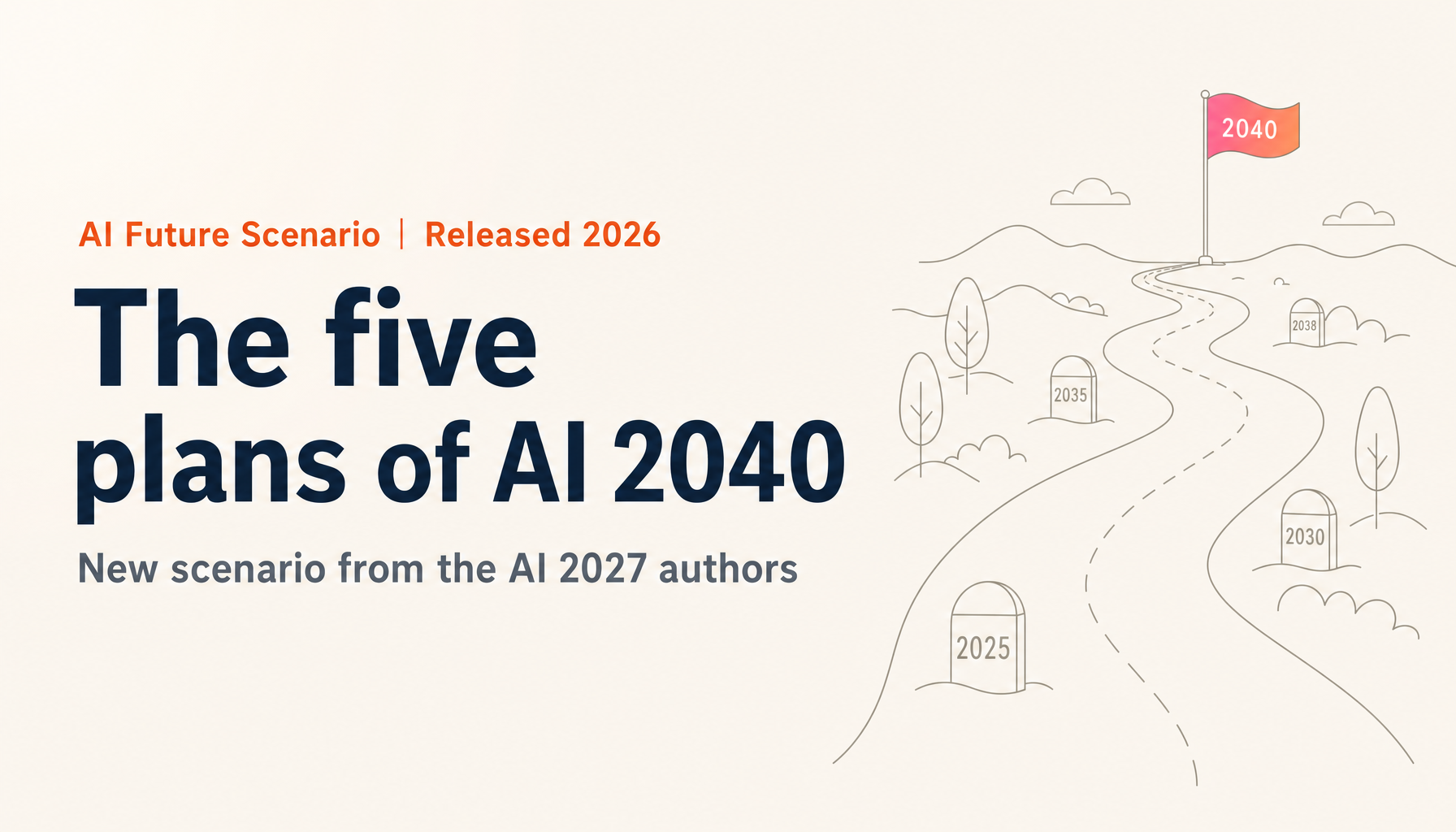
"AI 2027," released in April 2025, was read all over the world. It told, year by year, how superintelligence (AI that outperforms the best human experts in every field) might show up within a few years and how a US-China race could spin out of control. But it was a forecast: here is what could happen if things keep going. On July 9, 2026, the same team published the follow-up question, "so what should we do instead?" That document is "AI 2040: Plan A." Its subtitle is "The least bad plan we currently know of." Not exactly a confident slogan, is it?
Here is the short version first.
- AI 2040: Plan A is a policy scenario released on July 9, 2026 by the AI Futures Project, a US nonprofit. The PDF edition runs to 90 pages
- It shows, year by year from 2027 to 2040, how superintelligence that could otherwise arrive around 2030 is held back until 2040 through a US-China deal and a verification regime
- Alongside the recommended Plan A, it sketches Plan B (sabotage China), Plan C (burn some of the lead on safety), Plan D (race at full speed) and Plan S (an indefinite halt)
- The authors say outright that it is a recommendation, not a prediction. Their own estimates put the chance of Plan A actually happening at 3 to 15 percent, and the most likely path is Plan D, at 25 to 50 percent
- Since launch, the team has published tentative domestic-regulation proposals (August) and a one-page policy summary (September), and executive director Daniel Kokotajlo testified before a US Senate subcommittee on September 30
I don't think the value of this document for executives lies in learning more about geopolitics. Do you choose speed or safety? Do you run alone or keep pace with others? The questions AI 2040 puts to governments have the same shape as the questions a CEO faces when deciding how to bring AI into the business. I reread the original text and its supplements as of October 4, 2026 and updated the figures and facts in this article. If you want a quick read on where your own organization stands first, our free AI literacy self-check will make the second half of this piece more concrete.
What AI 2040 is, who wrote it, and why
AI 2040 comes from the AI Futures Project, a US 501(c)(3) research nonprofit1. It says its funding comes mainly from the Survival and Flourishing Fund and a major individual donor. This is the group's third major release, after AI 2027 and the AI Futures Model, its quantitative model for forecasting AI progress2. There are six authors, listed on the site in this order: Thomas Larsen, Romeo Dean, Brendan Halstead, Eli Lifland, Ryan Greenblatt and Daniel Kokotajlo3.
Press coverage tends to lead with Kokotajlo, the former OpenAI researcher, but the credits tell a slightly different story. According to the About page, Larsen started the project and had final say on its content2. He previously founded the Center for AI Policy, an AI safety advocacy organization. Kokotajlo is the executive director and previously worked at OpenAI as a governance researcher on scenario planning1. He came up with many of the core ideas and wrote a large share of the main scenario. Dean led the verification research and the compute and economics modeling, Halstead led the covert-project modeling, and Lifland ran project management and wrote several supplements. Scott Alexander, a co-author of AI 2027, rewrote some sections this time but, by his own account, is not listed as a co-author4.
The scenario went live on July 9, 2026 (US time), announced on the team's blog5. You can read it on the web or download a 90-page PDF (the version I pulled on October 4, 2026). It keeps being revised, and the changelog on the About page records corrections and supplement updates as late as September 232. If you quote numbers from it, note which version you used.
The most important thing to understand is what kind of document this is. On the front page the authors write that "Plan A is primarily a recommendation, not a prediction," and that the scenario "is not our best guess as to what the future will actually look like"3. They are careful about the boundary: implementing Plan A is the recommendation, while the effects that follow are their predictions. The team page describes Larsen as the lead author of "a scenario illustrating our recommendation to US policymakers"1. In other words, the intended reader sits in Washington.
Why write a policy proposal as a story? The authors point to what they call "scenario scrutiny." Most AI policy proposals, they argue, fall apart once you try to write down a detailed, plausible scenario in which they succeed; the plan turns out less likely to work, or messier, than its backers admitted. So they put their own proposal through that test first3. They open with Eisenhower: "Plans are worthless, but planning is everything." Keep that line in mind, because it is exactly how I suggest using the document later on.
How it differs from AI 2027
AI 2027 (April 3, 2025) was a forecast6. AI fully automates the process of building smarter AI in 2027, triggering an intelligence explosion and superintelligence within the year. From there it branches into a race ending, where the US-China competition loses control, and a slowdown ending. I looked at the AGI timeline debate around that scenario in this piece on how realistic AGI by 2027 really is, and if some of the vocabulary is new to you, our primer on basic AI and DX terms may help.
AI 2040 changes two things3. First, the default timeline: the year in which AI R&D would be fully automated without intervention moves from 2027 to 2030. The "2027" in AI 2027 was the year by which Kokotajlo, when they started writing, put roughly even odds on things going that fast or faster; "2030" plays the same role for Larsen at the time Plan A was started. The point is to spread their scenarios across their uncertainty. Second, the governance choices, which changed simply because this one is a recommendation.
The authors do not agree among themselves on timelines. The site notes that Kokotajlo "currently thinks things will probably go somewhat faster than depicted in this scenario," and that when AI 2027 was finished his AGI median was 2028 while the other authors' medians ran from 2031 to 20353. The front page also states that "AI companies will probably succeed at their stated goal of building smarter-than-human AI systems within the next 1 to 10 years." The urgency of the first scenario has not gone anywhere.
Not the same as SoftBank's "2040"
If you search "AI 2040," you will probably also run into Masayoshi Son's 2040 vision from SoftBank World 2026 on July 14. That one is a corporate outlook in which AI accounts for about 20 percent of world GDP, roughly 7,000 trillion yen a year, in an "ASI Economy" by 20407. The AI 2040 covered here is a policy scenario from a US nonprofit, a different thing entirely. Still, I find it telling that two stories aimed at the same year ask opposite questions: one asks how to profit when we get there, the other how to slow down on the way.
If you want to map the scenario onto your own planning horizon as you read, the Roadmap & Self-Assessment for Becoming an AI-Driven Organization (2026) is a useful companion for the last section of this article.
Plan A's timeline and four principles, 2027 to 2040
The scenario is organized into yearly chapters. Here are the main ones. Everything below happens inside the scenario; none of it is settled fact or a firm forecast.
| Year | Chapter title | What happens in the scenario |
|---|---|---|
| 2027 | The Writing on the Wall | America has two workforces, people and AI agents. Congress passes an AI Transparency Act that doesn't fundamentally change the situation |
| 2028 | AI on the Ballot | AI is the biggest election issue. Datacenters under construction cost twice the entire US military budget |
| 2029 | Choose a Path | The US proposes international cooperation and China accepts. Compute declarations and a training pause lead to a multilateral "Consortium" |
| 2030 | Plan A is Established | R&D restarts, transparently, under four principles |
| 2032 | Controlled Explosive Growth | Real GDP growth hits about 50 percent and robot production takes off |
| 2033 | The Citizen's Dividend | Compute and robot permit fees fund a citizen's dividend |
| 2034 | Mutually Assured Compute Destruction | World compute reaches 60 billion H100-equivalents, under a regime of mutually assured compute destruction |
| 2035 | Pause at Top Expert AI | AI matches top human experts in every field, and capability scaling pauses |
| 2040 | Passing the Torch to AIs | Regulators loosen requirements and a careful scale-up toward superintelligence resumes |
The hinge is 2029, and the chapter opens with Reagan's "Trust, but verify." The president declares that "this mad race toward superintelligence must end" and proposes international cooperation, and China says yes. In the scenario, Beijing had been debating the same problems, social destabilization, job loss, rogue superintelligence, and was also worried about what the US might do to it if America reached superintelligence first3. The two sides don't trust each other. Plan A is designed so they don't have to.
The first year is deliberately crude but easy to verify. Major datacenter owners and their upstream suppliers, chip fabs included, publicly declare their big purchases and sales. Analysts from many countries pore over the lists, and each side sends inspectors to the other's infrastructure. By year end, each is confident the other isn't hiding more than about 1 percent of AI compute. Meanwhile, all new training runs are paused. Running existing models (inference) can continue, but both sides retrofit each other's datacenters with devices that verify no new training is happening. The deal then goes multilateral, and by the end of the year most of the world has joined what is now called the Consortium.
In 2030 the Consortium settles on four principles3. The first is Buy Time: slow down whenever needed to have high confidence in safety. Nobody yet knows how to tell whether an AI is trustworthy or how to regulate superintelligence, and solving that will take years, so the intelligence explosion is slowed to make room. The second is Total Research Transparency: almost all AI research is made fully visible, while inference stays private. If everyone can see how each frontier model is trained, rival labs and outside auditors can raise the alarm, and it becomes very hard to slip hidden loyalties or agendas into a model. The third is Diffuse AI Broadly. With algorithms public and progress throttled, dozens of companies in many countries catch up to the frontier, the polar opposite of the 2020s nightmare of a few labs racing in secret. The fourth is Reversibility. The Consortium steers progress toward bigger training compute rather than algorithmic breakthroughs. Why? An algorithm, once leaked, can't be recalled. A giant datacenter can be switched off.
From 2030 to 2035, AI is scaled within the human range, up to roughly the level of top human experts. In 2035, once AI equals or surpasses top experts in every field, capability scaling pauses. AIs from different lineages monitor one another, and red teams constantly try to break the setup. Even so, control-based safety cases start to hit their limits, and the next chapters are titled "AI Alignment Is Now a Science" (2038) and "Beginning to Trust AIs" (2039). Alignment means getting an AI's goals and behavior to match what people actually want. The old story of the genie who grants your wish to the letter while ignoring what you meant is the usual analogy: the more powerful the system, the more it matters that it follows intent rather than wording. The 2035 pause is the time set aside for that work.
Then comes 2040. The best AIs are aligned to publicly visible values, and power over them is spread far more evenly than in 2026. Regulators gradually loosen the requirements that had held progress back. More and more institutions and equipment are handed over to AIs, to the point where humans could no longer shut it all down if they wanted to, and a careful scale-up to superintelligence resumes3. Even in this success story, the authors say Plan A works "albeit imperfectly and only in the nick of time." The good ending is not drawn as a comfortable one.
Looking for AI training and consulting?
Learn about WARP training programs and consulting services in our materials.
Verification without trust, and the economy the scenario describes
What sets Plan A apart is that it never asks one government to take another's word for anything. The foundation is compute governance: regulate the hardware AI runs on rather than the AI itself. Software can be copied across borders in seconds, but training a frontier model takes enormous numbers of specialized chips, packed into datacenters big enough to see from space and hungry enough to need conspicuous power infrastructure. New AI chips come from a handful of fabs, mostly in Taiwan, South Korea, the US and China, and the EUV lithography machines needed for frontier chips come from a single Dutch company, as the text points out3. Hard to hide, and hard to scale quickly. Get a grip on the chips and the facilities, the argument goes, and you have a grip on AI progress.
The level of detail is one of the document's strengths. Declarations start with companies that bought more than 10,000 H100-equivalents (about $100 million). Within a year, every company holding more than 0.001 percent of world compute (about 2,800 H100-equivalents, or roughly $18 million) has its holdings accounted for. About 1 percent of compute sales can't be traced to an end location, mostly because of smugglers who didn't record their customers and decommissioned chips. Half of that turns up later in datacenters identified through satellite imagery, and for the remaining 0.5 percent both governments offer cash incentives and legal amnesty to anyone who comes forward3.
You will often see the claim that "98.5 percent of existing chips can be tracked." That figure comes from Scott Alexander's own blog post introducing the plan4. He describes the verification scheme in three steps: establish joint control over the supply of new chips, locate all existing chips, and move every chip into mutually audited licensed datacenters he calls "whitesites." The main text frames it differently (no more than about 1 percent hidden), so it is cleaner to cite the two separately. To be honest, I didn't make that distinction in the first version of this article.
The backstop is "mutually assured compute destruction"3. It borrows the Cold War logic of mutually assured destruction, where firing first means your own annihilation, so nobody fires, and applies it to compute. The mechanism is surprisingly concrete. The US and China agree to build their new datacenters in the third countries least secure against the rival's military: China's in Canada, America's in Mongolia. If the deal collapses, the US and Canada would move to seize China's datacenters in Canada, and China would destroy that compute rather than let it fall into American hands, and vice versa. Defect, and you lose your own compute; the geography makes sure of it. What gets destroyed is hardware, not people, which is a big part of the idea's appeal.
The economics are the boldest part of the document and the part that drew the most fire. In the 2032 chapter, real GDP grows about 50 percent in a single year; a footnote reminds readers that US growth is usually around 3 percent3. The share of labor done by AIs and robots, weighted by economic value, rises from about 20 percent in 2032 to about 85 percent in 2035. Filling that gap is the Citizen's Dividend, which distributes most compute and robot permit fees to every American adult. It starts at $45,000 per person in 2032 and climbs to about $1 million by 2035, and by 2040 the income floor is $10 million, all in real 2025 dollars. Dividends for people outside the US average only $1,200 and $9,000 in those same years, which the authors flag as "a concession to political reality," not what they consider fair. Meanwhile the dashboard's employment rate falls from 52 percent in 2033 to 17 percent in 2038.
Before getting excited about the zeros, read two caveats. One: these numbers come from the authors' own economics model, and they say they are uncertain about them. What they are confident in is the broad picture of AI being economically transformative, letting governments build massive sovereign-wealth-fund equivalents. Two: prices. A footnote explains that automation makes cognitive labor and physical goods very cheap while things like land, whose supply can't be expanded, get more expensive. The dollar figures only make sense alongside that assumption.
Neither all-out acceleration nor waiting on the sidelines, but steering deliberately somewhere in between: that design instinct applies to countries and companies alike. It is also, at root, the question we work through with executives in our AI consulting program WARP.
Plans B, C, D and S, compared with the authors' own odds
AI 2040 isn't a one-plan document. At the 2029 fork it lays out the main ways the US could respond, and then argues for Plan A3. The web version's branching diagram has five buttons: Plan D "Race to ASI," Plan C "Burn the Lead," Plan B "Fight China," Plan A "Verified Slowdown," and Plan S "Shut it all down." In the PDF appendix the chapter titles differ slightly: Plan B is "Sabotage," Plan C is "The Slowdown," Plan D is "The Race," and Plan S is "Shutdown." Knowing that each plan has two names saves some confusion when you read coverage elsewhere.
The head-to-head comparison lives in the "Comparing Possible Plans" supplement8. Eli Lifland wrote it, and he is upfront that he is "very much not confident" in the precise estimates but "confident in the conclusion that Plan A is substantially better than Plans B-D." The takeoff length and the two outcome probabilities in the table are his medians across implementations, assuming each plan is attempted from early 2029.
| Plan | What it is (supplement's definition, summarized) | Takeoff, automated coder to takeover-capable AI | Chance of avoiding misaligned takeover | Chance of a great future | Authors' odds that it actually happens |
|---|---|---|---|---|---|
| A Verified slowdown | Verified international slowdown deal plus total research transparency | ~6 years | 72% | 42% | 3–15% |
| B Sabotage China | Sabotage China to widen the lead and spend it on safety; a kinetic variant and a cyber-only variant | ~3 years (kinetic), ~2 years (cyber) | 50% | 25% | 8–15% |
| C+ Domestic regulation | No sabotage; buy time with domestic regulation and measures like export controls | ~1.5 years | 45% | 25% | 8–25% |
| C Burn the lead | Leading lab burns some of its lead on safety; no domestic regulation | ~1.1 years | 40% | 20% | 10–20% |
| D Race | Near-max-speed race through the intelligence explosion, at least 1% of resources on safety | ~1 year | 25% | 10% | 25–50% |
| S Indefinite halt | Halt frontier capability progress for at least a few years | Not in the table | Not in the table | Not in the table | Counted under "Other" |
Takeoff and the two outcome probabilities are Lifland's estimates; the last column is the range across five authors, Lifland, Kokotajlo, Larsen, Dean and Greenblatt8.
Plan B (Fight China): sabotage China's program and spend the lead on safety
In the PDF appendix, Plan B opens with the president announcing a US-led coalition: "Nations that join us and play by the rules will have access to frontier AI, and share in the benefits. Nations that don't will become our adversaries"3. Labor, compute and algorithms from the major US labs are merged into one project ultimately controlled by the president. Other countries ask how they can verify US compliance and get no satisfying answer, since letting foreign inspectors into US datacenters is a nonstarter. The rivalry escalates from cyberattacks to physical sabotage, and by 2031 the president is being pushed to choose between two bad options: hand off to the AIs, or escalate toward war.
The authors write that they have "complicated feelings" about Plan B. Done well, it might buy a longer slowdown than Plan C. But the risk of war is high, and even a well-executed Plan B is "significantly worse than Plan A or Plan S." Worse, it is easy to distort into the sabotage without the slowdown, which would combine all the downsides of the status quo (Plan D) with extra power concentration and early escalation3. The supplement scores a kinetic variant (B-kinetic) and a cyber and supply-chain variant (B-cyber) separately8. The scenario doesn't cast either country as the villain; both sides escalate because each fears the other getting there first. A footnote even notes that militaries would be preparing offensive options under any plan, Plan A included.
Plan C (Burn the Lead): the leading lab spends part of its lead on safety
In Plan C, the president promises strong regulation and spends a year talking to CEOs, China and other governments3. One detail caught my eye as a Japanese reader: a coalition of middle powers, the UK, France, India, Australia, Japan and South Korea, is shown pushing hard for a deal that prevents an intelligence explosion and lets countries like them field their own frontier projects. As far as I could find by searching the full PDF, that is the only place Japan appears in all 90 pages.
The deal founders on verification. China insists on verifying compliance itself; the US won't let Chinese inspectors into American datacenters. On the cusp of full automation, the leading US lab grudgingly pauses, but it doesn't last. Competitors catch up, China closes in, and the companies tell the president they "can spend 20% of our compute on safety research and still move comfortably faster than China." Recursive self-improvement, AI building smarter AI, resumes, and from there the authors point readers to AI 2027's slowdown ending.
Their verdict: "better than Plan D, but still a bad plan"3. A few months of slowdown, they argue, isn't enough for safety teams that are too small, too rushed and too optimistic about their own work. The authors disagree sharply on the odds of misaligned takeover here: Larsen and Kokotajlo say roughly 70 percent, Lifland and Dean about 50/50, Halstead about a third, Greenblatt about 20 percent. The supplement also splits off "C+," which uses domestic regulation for a slowdown of at least two months without sabotaging China, from plain "C," a lab-led slowdown of at least a month with no domestic regulation8.
Plan D (Race to ASI): keep racing at full speed, as we are now
If you arrived here by searching for Plan D, this is the section you came for. The supplement defines it as frontier AI projects racing through the intelligence explosion at nearly maximum speed while devoting "a nonzero but small percentage of resources to safety (at least 1%)." Anything below 1 percent counts as an even worse "Plan E"8. ASI stands for artificial superintelligence.
The PDF chapter opens with the president promising "light-touch AI regulation to prioritize AI innovation"3. The big labs don't slow down; they automate AI R&D, race one another through the intelligence explosion, and call it "responsible scaling." Transparency amounts to crumbs, long model cards plus briefings for the executive branch and third-party auditors, and the China policy is simply "we must beat them to ASI." The resulting timeline, with multipliers showing AI software R&D speed relative to today, looks like this:
- Early 2030: automated coder (5x)
- Mid 2030: superhuman AI researcher (25x)
- Late 2030: top-expert-dominating AI (250x) and superintelligent AI researcher (2,000x)
- Early 2031: artificial superintelligence (10,000x)
That is roughly a year from automation to superintelligence. The authors say the strategic situation from there is close enough to AI 2027 that readers should go read that scenario and pick the race ending at the branch point.
They call Plan D "atrocious" for three reasons3. First, they don't expect the labs to keep control of their AIs through an intelligence explosion run at close to full speed. Second, even if the resulting superintelligences were robustly aligned, there is still the question of who they are aligned to, and the opportunities for a CEO or president to become an AI-enabled dictator are too tempting. Third, the risk of World War III is too high: China, Russia, India, Europe and Brazil would all eventually realize the US is about to run an intelligence explosion and fear economic and military domination. There is a note of dissent on the first point: one of the six authors puts the chance of losing control in those circumstances at more like 40 percent.
The supplement's numbers make the gap with Plan A stark8. Takeoff from automated coder to takeover-capable AI is about one year (Plan A: about six). Safety compute is 500,000 H100-equivalent-years (Plan A: 100 billion). Safety-researcher-years total 200 (Plan A: one million). The chance of avoiding misaligned takeover is 25 percent, and the chance of a great future is 10 percent. When the authors' individual views are aggregated under looser assumptions, their odds of avoiding takeover under Plan D range from 10 percent (Kokotajlo) to 55 percent (Greenblatt).
The detail that matters most is this: all five authors who gave estimates rate Plan D as the most likely path. Larsen puts it at 50 percent, Kokotajlo and Dean at 30, Greenblatt at 28, Lifland at 25. The front page describes the alternatives as "the main ways the US could respond (or not)," and Plan D is the "or not." It isn't a villain's plan so much as the default. Given that countries and companies are still competing hard while spending relatively little on safety, I'd say today's reality sits closest to Plan D.
Plan S (Shut it all down): stop frontier development indefinitely
In Plan S, a new president declares, "We do not need to build god... What we need is for nobody to build god," and seeks a global moratorium. China agrees3. Most existing AI chips are tracked and verified not to be running large training jobs, and research into better algorithms is banned. Existing datacenters and models keep running; with compute shifted from training to inference, available usage roughly doubles. By the end of 2030, the Consortium covers 99 percent of global AI compute and 100 percent of advanced chip fabrication capacity. Covert projects pop up everywhere, but AI research becomes as taboo among computer scientists as human cloning is among biologists, talent dries up, and progress runs at least ten times slower than before the moratorium.
In the first version of this article I called Plan S an "extreme" option, and that misread the authors' tone. They write that they are "sympathetic to Plan S and think that it might be better than Plan A," and the supplement lists it first among "plans that might be competitive with Plan A"8. They still recommend Plan A because they expect a shutdown deal to break down eventually9. While capabilities are frozen, alignment research has less to work with, so when the race restarts, it restarts with less safety progress banked than under Plan A. Their bottom line is that a well-implemented Plan A probably avoids loss of control and extreme power concentration, whereas even a well-implemented Plan S "would plausibly collapse within a decade or so into another dangerous race to ASI"3. They also grant Plan S a real advantage: it is simpler, so it is harder for well-meaning but inexpert regulators to botch. Which plan you prefer, they conclude, comes down to how durable you think a US-China deal is and how hard you think alignment is.
Line the five up and the axis becomes clear. Plan D goes all in on speed; Plan S gives speed up entirely. In between sit B, which buys time through sabotage; C+ and C, which slow down a little through regulation or lab decisions; and A, which slows down in step through international cooperation. Every option trades something away. That the authors' favorite, Plan A, gets only 3 to 15 percent odds of happening while the one they most want to avoid, Plan D, gets 25 to 50 percent tells you both where they want to end up and how far away that is.
What has changed in the three months since launch
I wrote the first version of this article on July 25, 2026, a little over two weeks after launch. A lot has moved since, both in the authors' own output and in the wider debate.
| Date | What happened |
|---|---|
| July 9, 2026 | AI 2040: Plan A is published5 |
| Late July 2026 | More than 1,000 frontier AI employees sign the "Pacing the Frontier" open letter asking the US government to support an international effort to deliberately pace the frontier of automated AI development (as described on the AI Futures Project blog)10 |
| August 5, 2026 | The team publishes "How to pace the US frontier," tentative proposals for domestic AI regulation10 |
| August 16, 2026 | Timelines update: forecasts get slightly shorter, and reality appears to be moving about 70 to 90 percent as fast as AI 2027 predicted11 |
| September 9, 2026 | A one-page "Summary of Plan A" for policymakers is added to the site212 |
| September 12, 2026 | Anthropic CEO Dario Amodei publishes the essay "We Must Pace the Frontier" (our summary and commentary) |
| September 30, 2026 | Kokotajlo testifies before a US Senate subcommittee13 |
The biggest shift in the authors' own thinking, to my eye, is the August 5 post10. They write that in AI 2040 international coordination comes before serious domestic regulation, but "in reality, it may be good to start with domestic regulation and then aim to expand that into international coordination." Pacing US labs at home also slows China, they argue, because there would be less capable US models to distill from (distillation means training a model on a stronger model's outputs) and fewer advanced algorithms to leak. They offer four options: a temporary pause on improving frontier capabilities, internal models included; minimum allocations of compute to external inference (say 70 percent) and to transparent safety work (say 25 percent); a cap on the capability level that can be used to automate AI R&D, for example only models that finished training at least nine months earlier; and a maximum risk threshold enforced by third-party risk assessors. None of these, they admit, is as polished as AI 2040. I read it as the "domestic-first Plan A" alternative from the supplement starting to take concrete shape.
The September 9 summary restates the principles for policymakers12. Reversibility becomes "maintain self-destruct switches on datacenters, so that if the agreement breaks down we avoid a catastrophe." Implementation is boiled down to three steps: track down the world's AI-relevant compute, temporarily pause training while better verification is developed, and resume R&D under safety-case-based regulation with total research transparency. The recommended near-term actions are transparency to the public and government, more AI talent in government, compute tracking, enforcing existing export controls, and verification R&D.
At the September 30 hearing, Kokotajlo made two recommendations13. One was to dramatically improve transparency into the AI industry. The other was to redirect compute away from the race to automate AI research: citing estimates that the leading labs spend around half their compute on AI R&D, he argued that cutting that to something like 10 percent would significantly slow the race while freeing compute for useful deployments, safety research and lower prices. On when the whole research process might be automated, his personal guess was about a 50 percent chance by the end of 2028. AI 2040's default year was 2030, so the executive director's own clock is running ahead of the scenario. I unpacked the "70 percent" figure he has cited in interviews in a separate article.
Corrections to the first version
After rereading the original and its supplements, I corrected the following:
| Item | First version (July 25, 2026) | What I found on October 4, 2026 |
|---|---|---|
| Release date | Around spring 2026 | July 9, 2026 (US time) |
| Lead author | Presented Kokotajlo as the lead | Larsen is listed first and had final say on content; Kokotajlo is the executive director |
| "About 42%" | The team's estimated chance of success | Lifland's median chance of a great future in the comparison supplement. The odds of Plan A actually happening are a separate 3–15% |
| Citizen's Dividend | About $25,000 a year in 2033 and about $1.6 million in 2035 | In the current version, $45,000 in 2032 rising to about $1 million in 2035 (real 2025 dollars) |
| Jobs criticism | Unemployment reaching 12% | Criticism of the employment rate falling to around 12% |
| Plan S | An extreme option | The authors are sympathetic and say it might beat Plan A, but recommend A because a shutdown deal is unlikely to last |
| 98.5% | The authors' estimate | A figure from contributor Scott Alexander's explainer; the main text says no more than about 1% hidden |
| Audience | Five plans pitched to 2028 presidential candidates | A recommendation for US policymakers, told through a story about the 2028 election and the 2029 choice |
How much should you trust this plan?
Having walked through the content, I'd warn against reading the document as prophecy. The authors themselves are restrained, and outside critics have pushed back hard. Both deserve a hearing.
Start with the authors' own caveats. The comparison supplement says up front that "these estimates are all rough best guesses, and the specifics of them aren't load-bearing to our recommendation of Plan A (though the high-level takeaways are)"8. The individual authors put the chance of avoiding misaligned takeover under Plan A at 70 to 81 percent, which means even their preferred plan carries a 20 to 30 percent chance of losing control by their own numbers. The FAQ concedes that "even a good implementation will incur significant existential risk"9. This isn't a cheerful document.
Scott Alexander, who contributed to the writing, lists the weak points openly on his blog4, stressing that the post is his opinion only. The biggest risk he sees is going too slowly and having the deal fall apart. His precedent is arms control: START and New START held for decades but were suspended in 2023 and expired entirely in 2026, and the Iran nuclear deal barely made it two years. Next is the roughly 1.5 percent of compute that might escape tracking; the team calculates that turning it into a decisive advantage would take north of a decade, so the deal needs to achieve its goals before then. Third is the steady march of technology: once dangerous AI can be trained on academic-grade hardware, trustless deals stop working. He also calls the whole thing "a crazy thing to try releasing," says it's meant to be a floor for judging what politicians propose, and adds that the team asked him to stress that everything is provisional.
The sharpest outside criticism targeted the economics. In a July 15, 2026 commentary, James Pethokoukis of the American Enterprise Institute wrote that he seriously doubts there's a realistic scenario with 50 percent growth in a single year "that isn't really science fantasy," noting that even 50 percent cumulative growth over five years would be extraordinary for a rich economy like America's14. He also questioned whether people would accept an employment rate that plunges to 12 percent by the end of the decade, while acknowledging that the authors concede uncertainty about the economics. When one number looks implausible, the rest of the argument starts to look shaky too, and I think his warning not to take the dividend figures at face value is fair.
Others question the politics. One US commentator who covers AI in marketing summed it up as "sounds great, does not seem like a viable option," adding that "anything beyond 2028 is completely guesswork." The implication: which direction we step in now matters far more than arguing about 2040. And the document is being hit from both sides. People who weigh AI risk more heavily say Plan A doesn't go far enough and Plan S is what's needed; people who doubt the premise of superintelligence argue AI should be treated as a normal technology.
Boil it down and there are three points of contention. Can verification really work technically (untraceable compute, and the alignment assumptions)? Can a US-China arrangement survive for well over a decade? Is the economic picture grounded (50 percent growth in a year and a gigantic dividend)? Most critics accept the logic and question the premises; few reject the whole frame. I still think the document is worth reading. Not because its forecasts will come true, but because it takes an extreme possibility seriously, answers it with concrete tools like transparency, verification and the physical placement of compute, and puts its own proposal through the scrutiny it asks of others.
How executives can use this scenario
Finally, how to turn this into something useful for your own company.
A word from a Japanese vantage point first. As I mentioned, Japan appears exactly once in the 90-page PDF, in the Plan C middle-power coalition. In the main Plan A text, the US, China and the rest of the world agree to split compute and robots 35/20/45, with the rest-of-world share going "primarily to nuclear powers and countries with datacenters or semiconductor manufacturing," and the examples given are the UK, France, Germany, Israel, Russia, India, Pakistan, South Korea and Taiwan3. It's a list of examples in a footnote, and I don't read it as excluding Japan. But it is a reminder that no country is guaranteed a seat at that table. Japan's own policy horizon points at the same decade: its medium-to-long-term fiscal outlook looks out to fiscal 2040, as I covered in our explainer on the Basic Policies 2026, and the push of AI from screens into the physical world is the subject of our piece on Japan's physical AI strategy.
So what should a single company do? My suggestion is to borrow the way AI 2040 was built. Step one: write down your own Plan D. If nothing changes, what do your operations and your competitive position look like in three years, or five? The authors judged "do nothing" to be the most likely path, and for most companies the status quo is also the most realistic scenario. If you never put it into words, you have no baseline to compare your options against.
Step two: run your AI plan through scenario scrutiny. Write the story in which it succeeds, down to who does what, when, and which numbers move. Wherever you can't write the next line, you've found a weak spot. It's the same test the authors applied to their own policy, and it works just as well on an internal roadmap.
Step three: translate the four principles into rules for your own rollout.
| AI 2040 principle | What it means in the document | What it means for an internal AI rollout |
|---|---|---|
| Buy time | Slow down whenever needed to have high confidence in safety | Set explicit criteria for moving from pilot to department to company-wide, and don't advance until they're met |
| Total research transparency | Make nearly all R&D visible so others can check it | Log what data goes into AI tools, how they're used and what happens to the output, so you can see who uses AI for what |
| Diffuse AI broadly | Spread capability across many countries and firms to avoid concentration | Don't let AI skills pool in a few people or teams; train broadly and share what works |
| Reversibility | Favor compute so dangerous progress can be switched off | Avoid over-dependence on any single AI service; keep your data portable and keep a manual way to run the process |
Step four: pick the signals you will watch. AI 2040's timeline is anchored on a milestone, the arrival of AI that automates coding. A company's version might be: has any process become impossible to run without AI, and can a person still explain the decisions made in it? Whether the scenario's dates turn out right matters less than whether you're ready when your own milestone arrives.
The superintelligence AI 2040 describes isn't here yet, which is exactly why now is preparation time. Plan A uses its 2035 pause to firm up the footing for safety; for a company, the next few years are the window to firm up how you use AI before it gets dramatically more capable. Don't overrate or underrate what today's AI can do, and work out where it helps and where human judgment has to stay. If you're running a team in Japan and want help with that first step, talk to the WARP team. Specialists who led DX and data strategy at major companies work alongside clients month by month to put AI to work in management. AI won't solve everything on its own. Where does it help, and where do people decide? That's the place to start.
Summary
- AI 2040: Plan A is a policy scenario released on July 9, 2026 by the AI Futures Project, the team behind AI 2027. Thomas Larsen is the lead author; executive director Daniel Kokotajlo is one of six authors
- It delays superintelligence that could otherwise arrive around 2030 until 2040, via a 2029 US-China deal, compute declarations and a training pause, and a 2035 pause at top-expert-level AI, built on four principles and a verification regime that includes mutually assured compute destruction
- The alternatives are Plan B (sabotage China), Plan C (burn some lead on safety), Plan D (race at full speed) and Plan S (indefinite halt). Under Plan D, superintelligence arrives about a year after automation, with a 25 percent chance of avoiding misaligned takeover
- The authors put the odds of Plan A actually happening at 3 to 15 percent and Plan D at 25 to 50 percent. The path they want most is the least likely; the one they fear most is the most likely
- Since launch, the team has proposed starting with domestic regulation, and on September 30 Kokotajlo urged the Senate to improve transparency and redirect compute away from automating AI research
- For executives, the value isn't in the dates. Write your own Plan D, put your AI plan through scenario scrutiny, and use the four principles to check how you roll AI out
A future scenario isn't a betting slip. It's a tool for mapping the range of what could happen, laying out the options and thinking through your moves. The AI 2040 authors put their own plan under the microscope first. Try doing the same with yours: write it out as a concrete story, and pay attention to the line you can't write. That's where to start.
References and primary sources
Footnotes
-
AI Futures Project, "About" (organization and team bios) https://ai-futures.org/about ↩ ↩2 ↩3
-
AI 2040, "About" (contributions and changelog) https://ai-2040.com/about ↩ ↩2 ↩3 ↩4
-
AI Futures Project, "AI 2040: Plan A," official site (main text and 90-page PDF, accessed October 4, 2026) https://ai-2040.com/ ↩ ↩2 ↩3 ↩4 ↩5 ↩6 ↩7 ↩8 ↩9 ↩10 ↩11 ↩12 ↩13 ↩14 ↩15 ↩16 ↩17 ↩18 ↩19 ↩20 ↩21 ↩22
-
Scott Alexander, "Introducing Plan A," Astral Codex Ten (July 9, 2026) https://www.astralcodexten.com/p/introducing-plan-a ↩ ↩2 ↩3
-
AI Futures Project blog, "AI 2040: Plan A" (subtitle "The least bad plan we currently know of," July 9, 2026) https://blog.aifutures.org/p/ai-2040-plan-a ↩ ↩2
-
AI Futures Project, "AI 2027" (April 3, 2025) https://ai-2027.com/ ↩
-
SoftBank Business Blog, keynote report on Masayoshi Son's "ASI Economy" talk at SoftBank World 2026 (in Japanese, published July 16, 2026) ↩
-
Eli Lifland, "Comparing Possible Plans," AI 2040 supplement https://ai-2040.com/supplements/comparing-possible-plans ↩ ↩2 ↩3 ↩4 ↩5 ↩6 ↩7 ↩8
-
AI 2040, "FAQ" supplement https://ai-2040.com/supplements/faq ↩ ↩2
-
AI Futures Project, "How to pace the US frontier: Tentative proposals for domestic AI regulation" (August 5, 2026) https://blog.aifutures.org/p/how-to-pace-the-us-frontier ↩ ↩2 ↩3
-
AI Futures Project, "Q2.5 2026 Timelines Update: Uplift and Revenue" (August 16, 2026) https://blog.aifutures.org/p/q25-2026-timelines-update-uplift ↩
-
AI 2040, "Summary of Plan A" (added September 9, 2026) https://ai-2040.com/summary ↩ ↩2
-
Daniel Kokotajlo, "Senate Testimony Sept 2026" (posted October 2, 2026; testimony given September 30) https://blog.aifutures.org/p/senate-testimony-sept-2026 ↩ ↩2
-
James Pethokoukis, "Superintelligence Soon? How Seriously Should I Take The AI 2040 Scenario?," American Enterprise Institute (July 15, 2026) https://www.aei.org/commentary/superintelligence-soon-how-seriously-should-i-take-the-ai-2040-scenario/ ↩

![[2026-May Update] AI Operator Guideline Version 1.2 in Plain English: AI Agent Regulation, Human-in-the-Loop Mandate, and What It Means for Enterprises](/images/columns/ai-business-operator-guideline-v12-explained/cover.en.png?dpl=dpl_GTagW71VKjD4VDo3w4ymrXrCfn1y)