Hello, this is Ryuta Hamamoto from TIMEWELL.
On 21 July 2026, the government adopted the Basic Policies 2026 by Cabinet decision. Its formal name is the "Basic Policy on Economic and Fiscal Management and Reform 2026," and its subtitle declares the first year of "Responsible Proactive Fiscal Policy." The news covered it heavily as a turning point in fiscal policy, but the original runs to forty-two pages, it is thick with technical terms, and anyone who does not follow economic news for a living will find it a hard read.
This piece explains what the document actually says, written so that a reader with no background in policy or economics can follow it to the end. The biggest story, that the fiscal target changed, I will explain in plain, everyday words without taking the long way round. My aim is not to argue for or against the policy. It is to leave you able to understand, accurately, what changed and how. This runs long, but by the time you finish, economic headlines should read a little differently. If you are curious about how AI sits alongside your own management, checking your starting point first with our free AI literacy self-check will make the second half of this article more concrete.
What the "Basic Policies" actually are
Let me begin with what this document is, because getting that straight changes how you read the coverage.
The Basic Policies are formally titled the "Basic Policy on Economic and Fiscal Management and Reform." It is the document that sets the government's overall direction for the economy and public finances for the year, adopted each summer by Cabinet decision. Why "basic" or, in the Japanese nickname, "big-boned"? Because it is the backbone of the country's policy, the top-level steer above everything else. The direction settled here flows into the following year's budget, drafted from autumn into winter. That is why every summer the economic press gives this document so much room.
To understand the 2026 edition, you cannot separate it from two other documents adopted the same day. On 21 July 2026, alongside the Basic Policies 2026, the Cabinet also adopted the "Japan Growth Strategy" and the "Regional Future Strategy." The three form a set, in something like a parent, child and grandchild relationship. The Basic Policies are the country-wide direction for money and the economy; the Japan Growth Strategy answers "which industries to grow"; the Regional Future Strategy answers "how to carry that out in the regions." I cover the Regional Future Strategy, which handles the regional side, in a separate plain-language explainer, and reading the two together fills out the picture.
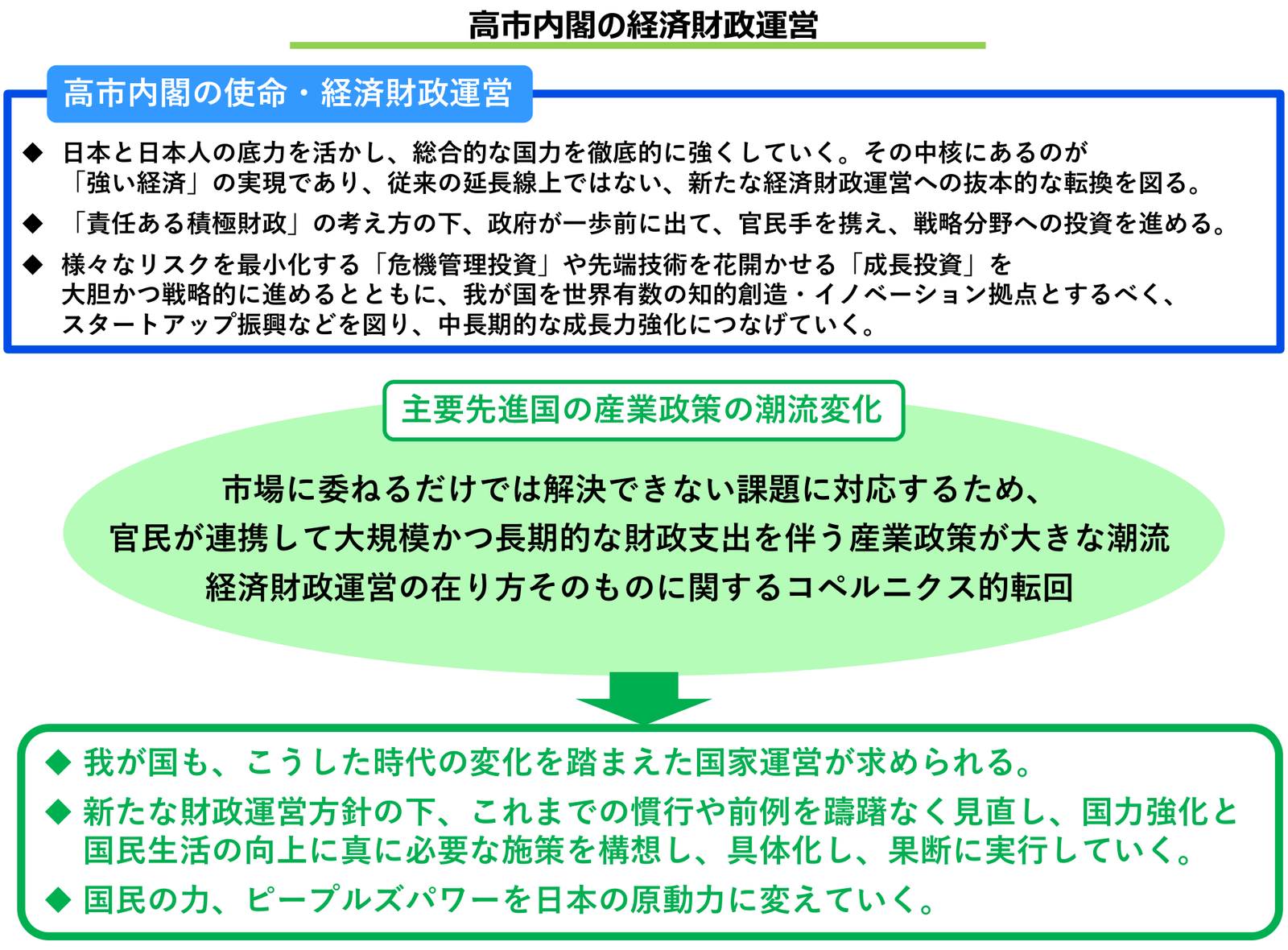
The document opens with a clear diagnosis. Japan's potential growth rate, the pace the economy is inherently capable of, has languished below other major advanced economies after years of under-investment. And around the world, industrial policy backed by large, long-term fiscal spending, coordinated between the public and private sectors, has become the mainstream way to tackle problems that markets alone cannot solve. The document frames this as a major shift in the very way economic and fiscal management is done. Everything in the 2026 edition is built on top of that reading.
The government presents the overall picture of "Responsible Proactive Fiscal Policy" in the figure below: the top band sets out the Takaichi cabinet's approach to economic and fiscal management, and the middle band describes the shift in the industrial-policy mainstream among major advanced economies. The figure is in Japanese.
Source: Cabinet Office, "Basic Policies for Economic and Fiscal Management and Reform 2026 — Policy File" (July 2026)
The headline story: the fiscal target changed
The most-noticed part of this document is that the fiscal target changed. The vocabulary is hard for anyone outside economics, so let me take it slowly.
Start with the old target, the Primary Balance. In Japanese it is the "basic fiscal balance," abbreviated PB. It compares a single year's government revenue and spending after setting aside the parts tied to borrowing. Put more plainly, it asks whether that year's tax revenue alone can cover that year's policy spending, leaving interest and debt repayment out of the picture. A surplus here means that, at least for that year, the government's own earnings can fund its policies. Until now, fiscal management centred on getting this PB into surplus within a single year.
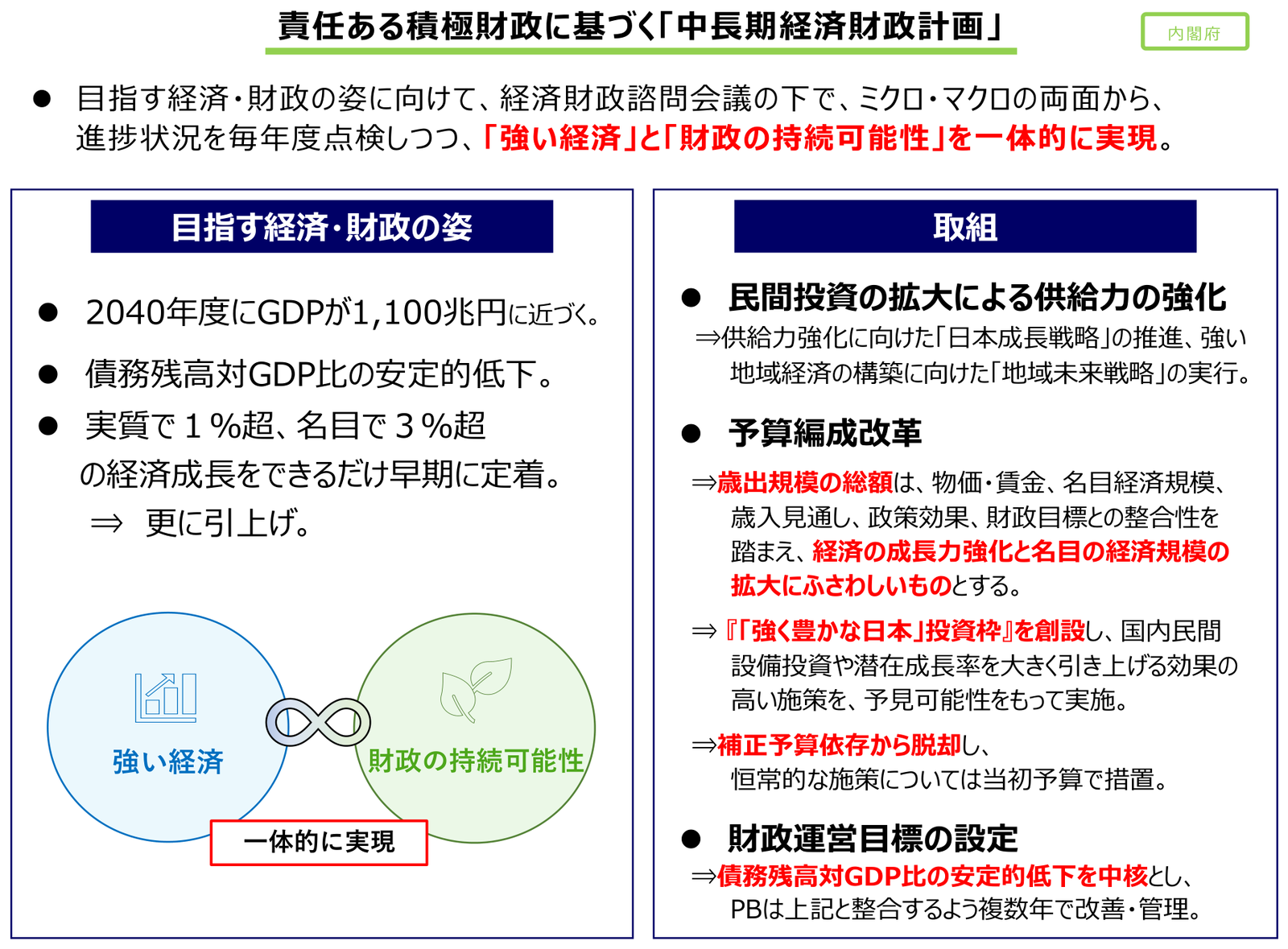
The 2026 edition swaps that centrepiece for a different measure: the debt-to-GDP ratio. This is the government's total outstanding debt divided by the size of the whole economy (GDP, the total value added produced within the country in a year, roughly the country's total earnings). A household analogy comes close. What matters is less the raw size of your mortgage balance than how heavy that mortgage is relative to your annual income. As income rises, the same balance weighs less. In the same way, even if the debt grows somewhat, a growing economy enlarges the GDP in the denominator and the ratio falls. The document places the stable decline of this ratio at the centre of fiscal management.
So what happened to the PB? It was not abolished. The document repositions the PB as an indicator used to confirm progress toward a declining debt-to-GDP ratio, managed over multiple years so as to stay consistent with that decline. And it states that rather than mechanically chasing the timing of a single-year surplus, it can allow temporary worsening depending on the business cycle and the need for crisis-management and growth investment.
That is the substance of the change. Before, a single-year goal ("get each year's balance into surplus") sat in the foreground. The 2026 edition moves a medium-to-long-term goal ("bring down the weight of debt relative to the size of the economy") into the foreground, and accepts that a single year's balance may temporarily worsen in service of it. The document calls this approach "Responsible Proactive Fiscal Policy." Invest actively, but keep discipline through the debt-to-GDP ratio. The claim is that fulfilling responsibility to future generations and pushing ahead with the investment needed now can be done together.
The government sets out this "target picture" and the change in the fiscal target on a single page. The left side shows the economy it aims for (GDP approaching 1,100 trillion yen in FY2040, a stable decline in the debt-to-GDP ratio), and the lower right states the fiscal target: "the stable decline of the debt-to-GDP ratio at the core, with the PB managed over multiple years." The figure is in Japanese.
Source: Cabinet Office, "Basic Policies for Economic and Fiscal Management and Reform 2026 — Policy File" (July 2026)
How to judge this shift is, naturally, contested. Some read it as a good opening to raise investment and reach for growth. Others are cautious, warning that loosening single-year discipline could weaken the brake on public finances, and that the market's confidence and the movement of interest rates need watching. The document itself says that, to secure market confidence, it will give a transparent and consistent account of fiscal management and analyse the situation from multiple angles using several economic and fiscal indicators. I am not here to settle that debate. But getting a clear grip on what this shift is aiming at and what to keep an eye on will serve you well as you read economic news from here on.
Looking for AI training and consulting?
Learn about WARP training programs and consulting services in our materials.
Changing how budgets are built
Beyond the fiscal target, the document tries to change how budgets themselves are put together. This part is also unfamiliar to newcomers, so let me break it down.
One of the document's keywords is "correcting the harm of single-year budgeting." Budgets have, as a rule, been drawn up one year at a time. But large investments usually take several years. To build a factory or to keep research and development going, a company needs a reasonable view that "this support will continue next year too" before it commits. So the document's aim is to rethink the year-by-year approach and move toward a budget mechanism that can be seen several years ahead.
At the centre of this is a newly created "Strong and Rich Japan" investment framework. This is a bracket separate from the ordinary budget, targeting measures that strongly raise the potential growth rate through domestic investment. What stands out is the explicit statement that it sets no request ceiling. Rather than being bound by the previous year's budget figure, agencies can request the amount needed if the investment support is genuinely effective. It helps to picture it as a mechanism that channels funding steadily into fields that shape the country's future, such as crisis-management investment and growth investment. For especially important economic-security fields, the framework draws on "bridge government bonds," with multi-year funding managed separately in a special account, following the approach already used for green transformation and for AI and semiconductors.
Alongside this, the document says it will move away from fiscal management that has leaned on large supplementary budgets. Supplementary budgets are to be limited to genuinely urgent items, and recurring measures are to be properly funded in the initial budget. In other words, it shifts away from relying on adding money after the fact and toward planning it in from the start. This "Medium- to Long-Term Economic and Fiscal Plan" runs from fiscal 2027 to fiscal 2040. It sets out to picture the economy and public finances over a fairly long horizon.
The "target picture" in numbers
The document also sets out the economy it aims for in concrete numbers. Keeping in mind that figures in a policy document are trial estimates built on assumptions, I will introduce them so you can gauge the scale.
By the Cabinet Office estimate the document cites, pushing ahead with crisis-management investment and growth investment implies more than 370 trillion yen in cumulative public and private investment by fiscal 2040 across sixty-two major products and technologies. And if the growth strategy fully bears fruit, the estimate projects that fiscal 2040 GDP could approach 1,100 trillion yen, with the debt-to-GDP ratio declining broadly stably under a certain level of additional fiscal spending. As a note, the fiscal spending in this estimate is not a budget ceiling; it is one illustrative case that assumes an additional real 10 trillion yen per year on top of the separately-managed budget.
On growth, the document says that under the 2 percent price stability goal, it will establish, as soon as possible, real growth above 1 percent and nominal growth above 3 percent, and raise them further from there. A figure closer to daily life is the goal of lifting the minimum wage to a national average of 1,500 yen, at the latest in the first half of the 2030s and as early as possible within that window.
What matters here is that these are not promises that things "will" turn out this way. They are goals, saying the government "aims for" this, and they are estimates resting on assumptions. Whether reality reaches them depends heavily on whether the investment truly translates into growth, and on how interest rates and prices move. Not letting the size of the numbers pull you along, and treating them as a statement of direction, is the healthy way to read them.
Growth, safety and daily life, drawn together
The Basic Policies 2026 are not a document about public finances alone. They cover the shape of the country broadly. Holding the whole picture keeps individual headlines from getting lost.
Chapter 2 lines up the measures for strengthening Japan's growth capacity: advancing the Japan Growth Strategy, strengthening the growth base, building a strong regional economy, and strengthening human resources and enabling everyone to play a full part. It sets out strong diplomacy and security, including strengthening diplomatic and intelligence capabilities and economic security. It also takes in measures tied to the public's safety and peace of mind, such as disaster prevention and mitigation, national resilience, recovery from earthquakes, public safety, and policy on foreign nationals.
That economic security is clearly positioned here overlaps with our own work. Themes like semiconductors, critical materials, and preventing the outflow of technology connect directly to the practical work of export control and checking counterparties. If this interests you, our plain-language explainer on what dual-use items are is worth a look alongside this piece.
Chapter 3 covers public finances and social security. It sets out building all-generation social security, with a policy of stopping and then lowering the rise in the working generation's insurance premiums. Alongside it stand measures for the falling birthrate and for children and young people, revitalising public education and research activity, developing social capital, and strengthening the administrative and fiscal base of local government. On revitalising research activity, the framework around university research has shifted a good deal in recent years, and anyone interested may find our complete guide to research integrity and research security a useful reference.
Reading this as a story about your own company
I have followed the policy this far. Let me close by putting it in terms of how you might take it personally.
The Basic Policies are a big, country-wide story. So it is natural to feel "this has nothing to do with my company." But read closely and the root of the document is one consistent message: change the economy into one that grows through investment. Support investment in growth fields such as AI and semiconductors in a way you can foresee over several years. Raise SME productivity and push reskilling. Lift wages. All of these will, in one form or another, eventually reach the management of individual companies.
Here is how I see it. In this moment when the country is turning its wheel toward investment and growth, whether you actually catch the tailwind will divide sharply on whether you can turn AI and digital tools into weapons of your own. The growth the document pictures does not hold together without gains in productivity. And for mid-sized and small companies, the most realistic entry point to raising productivity is, by now, putting AI to work. The companies that can translate the broad flow of policy into the one step in front of them are the ones best placed to receive the benefits of this era. That translation is exactly where we see the value in WARP, our AI consulting service, and why we sit down with executives to design where AI belongs.
If you are unsure where AI works in your own company, or what to do first, talk to the WARP team. Specialists who led DX and data strategy at major companies work alongside you month by month to embed AI into management. That said, dropping in AI does not solve everything. Let us start from working out where it works and where people should stay in the loop, and go from there together.
Summary
This ran long, so here are the key points.
- The Basic Policies set the government's overall direction for the economy and public finances for the year. The 2026 edition carries the banner of "Responsible Proactive Fiscal Policy" and was adopted by Cabinet decision on 21 July 2026
- The headline story is the change in the fiscal target. It shifts from centring on a single-year Primary Balance surplus to centring on the medium-to-long-term stable decline of the debt-to-GDP ratio
- The PB was not abolished. It becomes a confirming indicator, managed over multiple years to stay consistent with the debt-to-GDP decline, and it no longer mechanically chases the single-year timing of a surplus
- The way budgets are built also changes: creating the "Strong and Rich Japan" investment framework with no request ceiling, and moving away from reliance on supplementary budgets. The medium-to-long-term plan runs from fiscal 2027 to 2040
- As a target picture, it sets out goals and estimates such as more than 370 trillion yen in public and private investment by fiscal 2040, growth approaching 1,100 trillion yen in GDP, and nominal growth above 3 percent. But these are goals resting on assumptions
- Beyond public finances, it draws growth, diplomacy and security, economic security, social security, and daily life together as one
A shift in policy is the kind of thing people judge differently. This article did not step into the argument for or against, because what matters most, to my mind, is getting a clear grip on what changed and how. From there, you consider what it means for your own company. With the country turning its wheel toward investment and growth, now is not a bad time to start preparing to make AI a weapon of your management. Begin by working out where AI works in your own company, and move from there.