Hello, this is Ryuta Hamamoto from TIMEWELL.
Japan's Regional Future Strategy is the government's comprehensive plan for making regional economies stronger. The Cabinet decided it on 21 July 2026. The idea is to build industrial clusters across the country, grow the local industries that already exist, and have strong regional economies in place by FY20301.
Two and a half months have passed since then, and a lot has moved. National and local governments have put out 74 plans between them, the budget requests are in, and the minister in charge has changed. What was a policy statement in July now comes with place names, company names and yen figures attached.
The original document runs to 55 pages of dense administrative Japanese. So I will break it down for readers with no background in Japanese policy, then go through what has actually been decided as of 4 October and what companies and local governments can sensibly do now. If you are thinking about how AI fits into your own business, it helps to check where you stand first with our free AI literacy self-check. The AX part later on will feel more concrete once you have.
Key points (as of 4 October 2026)
- The Regional Future Strategy is a national comprehensive strategy under the Act on Overcoming Population Decline and Vitalizing Local Economy. It runs through FY2030 and was decided on 21 July, the same day as the Basic Policies 2026 and the Japan Growth Strategy
- Its core is three types of industrial cluster plan: A (strategic, state-led), B (regional, led by prefectures) and C (local industries). By 30 September, 14 Type A, 49 Type B and 11 Type C plans had been published or reported
- The money comes from a "Regional Future special allocation" inside the "Strong and Rich Japan" investment framework. The Cabinet Office has requested ¥200 billion plus unquantified items for the Regional Future Grant and related spending in FY2027
- AI adoption (AX) is a cross-cutting pillar, and the Ministry of Internal Affairs and Communications has requested ¥10.22 billion in new money for "regional AX"
What the Regional Future Strategy is: the government's blueprint for regional economies
Let me start with where this document sits, because once that is clear the rest stops feeling like a maze.
The Regional Future Strategy is a national comprehensive strategy under a law called the Act on Overcoming Population Decline and Vitalizing Local Economy. Put simply, it is the government's blueprint for reviving the regions. Formally, it amends the "Comprehensive Strategy for Regional Revitalisation" that the Cabinet decided on 23 December 20251. Rewriting a national strategy after only seven months is fast, even by the standards of a new administration.
The body driving it is the Headquarters for the Regional Future Strategy, set up inside the Cabinet by a decision of 11 November 2025. The Prime Minister chairs it, with the Chief Cabinet Secretary and the Minister for the Regional Future Strategy as deputies. The previous headquarters for regional revitalisation was abolished at the same time and its work handed over2. You could read that as a change of signboard. I read it differently: the founding decision writes "forming industrial clusters across the country" and "raising the value added and sales channels of local industries" into the headquarters' purpose, which tells you the economy now comes first.
The strategy does not stand alone. On the same day, the Cabinet also decided the higher-level Basic Policies 2026 and the Japan Growth Strategy, which sets out investment in growth fields3. The three work as a set. The Basic Policies set the overall direction for public money and the economy, the Growth Strategy decides which industries to grow, and the Regional Future Strategy deals with how to make that happen outside the big cities. I cover the top-level document in a beginner's guide to Basic Policies 2026 if you want the wider frame.
The goal is easy to state. Wherever you live in Japan's 47 prefectures, you should be able to live safely, get the healthcare, welfare and education you need, and find work. The strategy says the first condition for that is a strong regional economy. Its evidence is that the 39 prefectures outside the eight metropolitan prefectures of the Tokyo, Aichi and Kyoto-Osaka-Kobe areas produce roughly half of Japan's GDP. If those regions shrink, the whole country shrinks with them, so regional growth is treated as the engine for putting Japan back on a growth path. The target of making annual real wage growth of around 1% stick sits in the same frame.
What changed compared with earlier regional revitalisation policy is the centre of gravity. The strategy itself describes a shift to "efforts that put weight on the economy": less a list of defensive measures against population decline, more a plan to attract investment and build earning power. Daily life has not been dropped, though. The strategy is organised around three pillars, "a strong regional economy", "a rich living environment" and "regions people choose", each with numeric targets.
The heart of the strategy: three types of cluster plan and 17 strategic fields
The single most important idea in the strategy is the industrial cluster, so let me take it slowly.
An industrial cluster is what you get when related companies, universities and research institutes gather in one area and grow by leaning on each other. Think of a bunch of grapes. The company making parts, the one assembling them, the university doing the research and the college training the workforce all sit close together, and the area as a whole becomes competitive. Building bunches like that across Japan is the central idea.
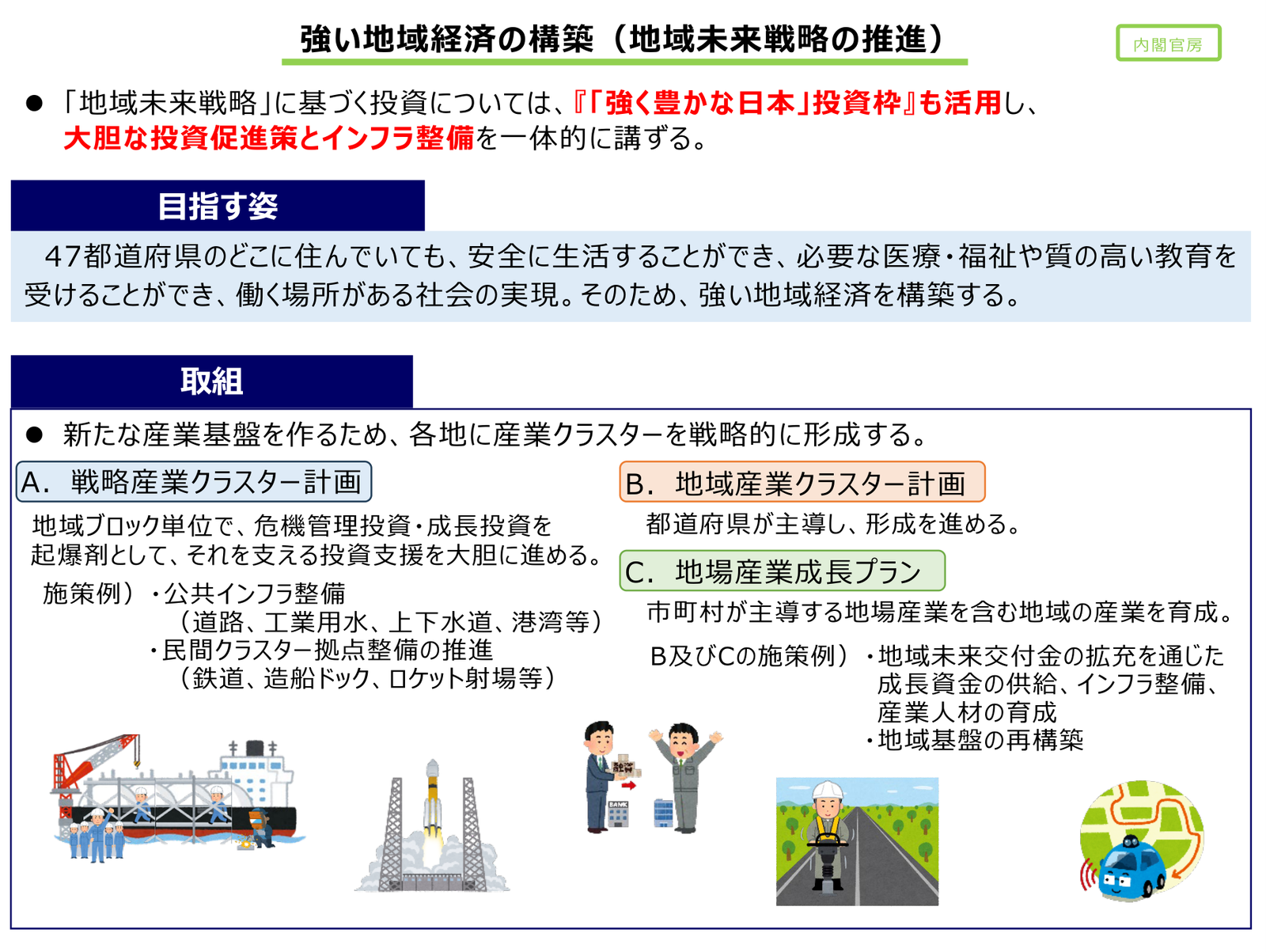
What I find sensible is that the strategy does not treat every cluster the same way. It splits them into three types by scale and by who leads.
| Type | Mainly led by | Target | Picture |
|---|---|---|---|
| A. Strategic Industrial Cluster Plan | National government (Cabinet Secretariat and METI) | Large investments linked to the 17 strategic fields | A major industrial base built around a chip plant |
| B. Regional Industrial Cluster Plan | Prefectural governors (designated-city mayors may also lead) | Industries aiming at export earnings or a top domestic share | A prefecture's chosen industry, concentrated |
| C. Local Industry Growth Plan | Municipalities or prefectures | Local resources: farming, fisheries, tourism, sport, traditional crafts, parts processing | Growing local specialities or tourism |
Type A is the biggest. Starting from large investments in fields such as AI and semiconductors, the national government steps in to plan everything around them, from roads and industrial water to workforce training. METI's regional bureaus convene expert panels for each region to draft the plans, prefectures put forward candidate projects, and the national government finalises the plan. The KGI, the key goal indicator that a plan ultimately has to hit, looks out to 2040 and must cover three numbers: public and private capital investment, the increase in value added, and the number of people trained1.
Type B is led by the prefectural governor. The prefecture picks industries that can earn foreign currency through exports or win a top share at home, and grows them intensively. Beyond backing individual firms, it can fund shared facilities or fill gaps in the local supply chain. The prefecture drafts the plan, the Cabinet Secretariat and METI check it in advance, the governor publishes it and then submits it formally.
Type C is the closest to home. Municipalities or prefectures grow industries rooted in the area: farming and fisheries, tourism, traditional crafts, parts processing and so on. Each is smaller than an A or B plan, but together they hold up the local economy across a wide area. Types B and C must set a KGI for the plan's final year, KPIs, and the point at which the plan will be dropped if the KPIs are missed. I like that last part. A plan that is not working is not supposed to limp on out of inertia.
The government summarises the three types in a single figure. It is in Japanese, but the three boxes map directly onto the table above.
Source: Cabinet Office, "Basic Policies for Economic and Fiscal Management and Reform 2026: Policy File" (July 2026)
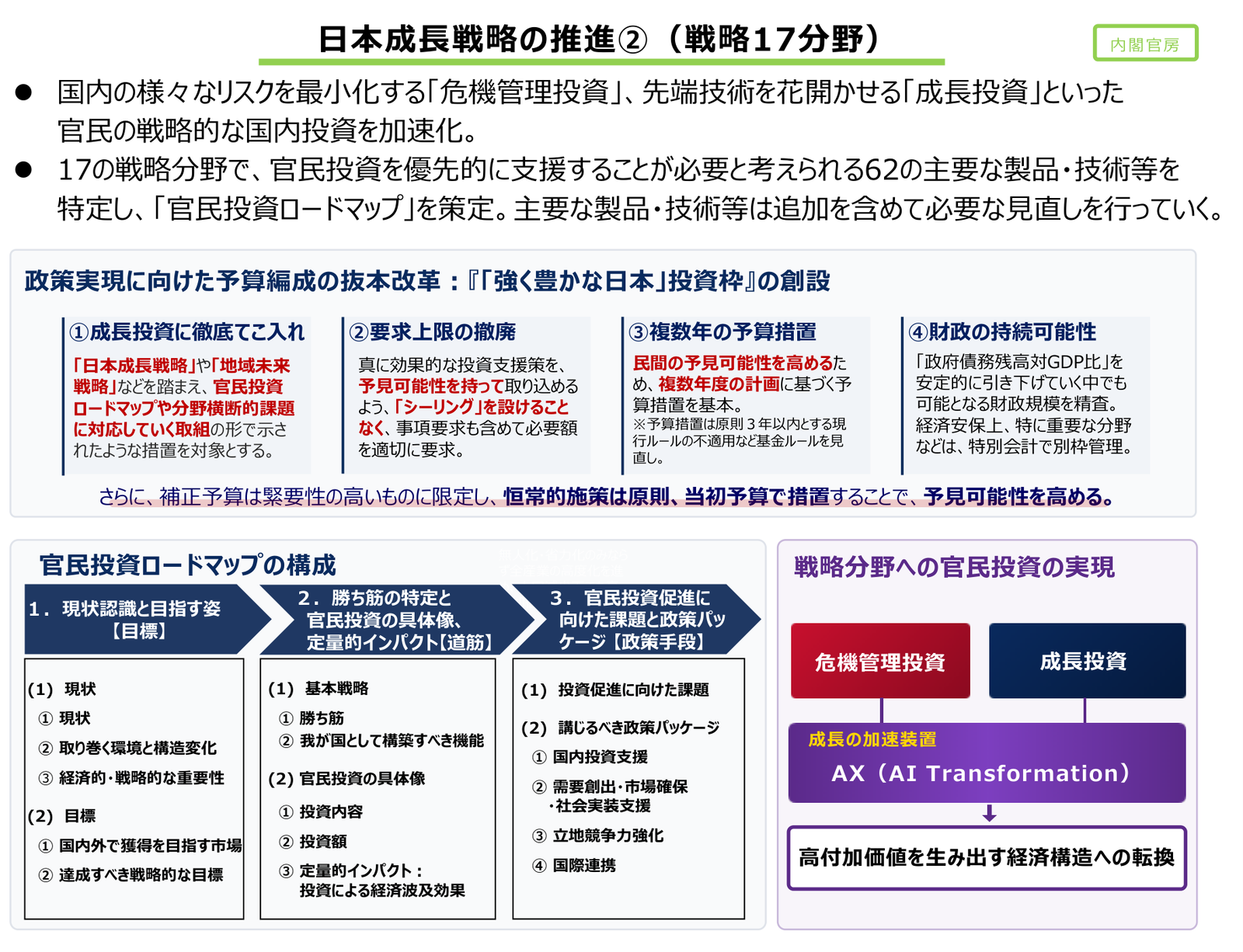
The 17 strategic fields that anchor Type A come from the Japan Growth Strategy. They are AI and semiconductors; digital and cybersecurity; information and communications; quantum; the defence industry; aviation and space; ocean; shipbuilding; materials (critical minerals and components); synthetic biology and bio; drug discovery and advanced medicine; resources, energy security and GX (green transformation); fusion energy; disaster prevention and national resilience; port logistics; food tech; and content. The range is wide, from frontier technology to disaster prevention, food and animation. What ties them together is that Japan can compete globally in them, or they bear on national security. Large investments in these areas carry a lot of uncertainty, so the state prepares subsidies and infrastructure to pull private money in. That posture of "the state stepping forward" runs through the whole strategy.
Source: Cabinet Office, "Basic Policies for Economic and Fiscal Management and Reform 2026: Policy File" (July 2026)
Several of these fields touch economic security, which is where they overlap with our own work. Semiconductors, materials and energy cannot be separated from export control and checking who your counterparties are. If that interests you, see a plain-language guide to dual-use items.
All three types share one way of writing a plan. You set out the goal (where things stand and where you want to be), the pathway (what the investment looks like and the expected numbers), and the policy means needed to get there. Then you fix KPIs, the yardsticks for whether you are getting closer, and a 5W1H (who does what, by when, and where it is discussed). Type A plans are reviewed roughly every six months, and if progress stalls the bottleneck is supposed to be found and fixed. That plan-do-check-act structure works just as well for a company writing its own AI adoption plan.
Want to write your own AI adoption plan in the same goal, pathway and KPI format? We offer a fill-in template that walks through four stages (assess, pilot, implement, embed) with a self-assessment checklist, a migration roadmap and a KPI sheet, based on government data such as IPA's "White Paper on DX 2023" and the "DX Promotion Indicators". Download the Roadmap & Self-Assessment for Becoming an AI-Driven Organization (2026) (Free; your company name and work email address are required.)
Looking for AI training and consulting?
Learn about WARP training programs and consulting services in our materials.
What has moved between the July decision and October
When I first wrote this article on 25 July, the strategy was at the "plans will now be drawn up" stage. Two and a half months later, things look quite different. Here is the sequence, based on what the Cabinet Secretariat has published4.
| Date | What happened |
|---|---|
| 11 Nov 2025 | Headquarters for the Regional Future Strategy set up in the Cabinet |
| 23 Dec 2025 | Comprehensive Strategy for Regional Revitalisation decided (the document now amended) |
| 24 Jun 2026 | Vice-ministerial meeting adopts the Regional Future Strategy policy package |
| 30 Jun 2026 | Draft strategy presented to the headquarters |
| 21 Jul 2026 | Regional Future Strategy decided by the Cabinet, alongside Basic Policies 2026 and the Japan Growth Strategy |
| 31 Jul 2026 | First round of plans: 13 Type A, 6 Type B, 4 Type C |
| 28 Aug 2026 | Second round (1 Type A, 25 Type B, 3 Type C) and the Regional Future Strategy budget package |
| Aug 2026 | FY2027 budget requests; the Cabinet Office asks for ¥200 billion plus unquantified items for the Regional Future Grant and related spending |
| 18 Sep 2026 | Cabinet reshuffle; Hisayuki Fujii becomes Minister for the Regional Future Strategy |
| 30 Sep 2026 | Third round (18 Type B, 4 Type C); Type B and C plans to be reported about monthly from now on |
Adding up the rounds gives 14 Type A, 49 Type B and 11 Type C plans, 74 in total as of 30 September (my own tally from each round's documents)56. The 14 Type A plans cover semiconductors (Hokkaido, Tohoku, Hiroshima, Kyushu), offshore wind (Hokkaido, Tohoku, Kyushu), rockets and launch sites (Hokkaido, Kinki), commercial aircraft maintenance (around Narita Airport in Chiba), flying cars (Kinki), bio and advanced medicine (Kinki), and next-generation ships (Setouchi, Kyushu). The Hokkaido semiconductor cluster, for example, is built around Rapidus and a research facility of the National Institute of Advanced Industrial Science and Technology, with 2040 KGIs of ¥7.027 trillion in public and private capital investment, ¥31.36 trillion in added value and 12,805 people trained. These are plan targets, not results, but they give you a sense of scale.
Foreign companies are part of the picture as well. The Hiroshima semiconductor cluster is anchored on Micron, and the Kyushu cluster on JASM and Sony. For overseas firms already operating in Japan, or weighing a regional site, the published plans are a useful map of where national and prefectural support is being concentrated.
The Type B and C plans carry much more local colour. Among them are "physical AI put into real-world use" in Kitakyushu, animation production in Niigata, batteries in Tokushima, disaster-prevention products in Kochi and tea in Kagoshima. On the Type C side you find metal tableware in Tsubame, sake brewing in Oga and farming and forestry in Chizu. Many Type B plans even come with a published list of participating companies5. If "physical AI" is a new term for you, our explainer on physical AI and Japan's position is a good starting point.
The people in charge changed too. Minister Hitoshi Kikawada chaired the July and August meetings. In the 18 September reshuffle, Hisayuki Fujii became Minister for Internal Affairs and Communications and also took on regional revitalisation and the Regional Future Strategy7. The 30 September meeting was attended by Hajime Sasaki as Special Advisor to the Prime Minister for the Regional Future Strategy, and by Eikei Suzuki as State Minister of the Cabinet Office for the Regional Future Strategy, a post he holds alongside that of State Minister for Internal Affairs and Communications6. With the minister who oversees local government finance now also in charge of the strategy, I expect grants and local fiscal measures to move more in step. For more on the new line-up, see my piece on the reshuffled Takaichi cabinet and economic security.
Here is the short version of what changed since the first edition.
| Item | First edition (25 July 2026) | Now (4 October 2026) |
|---|---|---|
| Plans | Framework of three types announced | 74 plans published or reported (14 A, 49 B, 11 C) |
| Budget | Considering a "Regional Future quota" in subsidies | Special allocation and extra selection points decided; budget requests submitted |
| Minister | Hitoshi Kikawada | Hisayuki Fujii (also Minister for Internal Affairs and Communications) |
How it is funded: the investment framework, the Regional Future Grant and extra selection points
In July, much of the funding was written as "will consider". The budget package of 28 August made it far more concrete8.
The foundation is the "Strong and Rich Japan" investment framework created in Basic Policies 2026, a budget line kept apart from the ordinary budget so that investment can be planned over several years. Inside it, the government will create a "Regional Future special allocation" that is separate from and additional to existing budgets. It also plans to draw up, by the end of the year, a "Regional Future Strategy implementation framework" (provisional name) that states multi-year project costs and budget sizes. A company deciding whether to build a plant needs to know the support will still be there next year and the year after, which is why the strategy keeps repeating the word "predictability".
For Type A, two new instruments are planned: a budget line for the public infrastructure the cluster plans need, and a subsidy for sites owned by companies. Eligible infrastructure goes beyond roads, industrial water and sewers to include water supply and ports, and the examples given include a shared semiconductor work facility and a shared training facility for shipbuilding and marine-equipment technicians. For Types B and C, the Regional Future Grant is being expanded with two new strands: an "industry promotion" strand that lets local governments support companies' capital investment, R&D and training, and an "industry-related infrastructure" strand for roads, ports and the like. A new "Regional Future promotion fund" will let the national government deal directly with shared problems such as hands-on support and overseas expansion.
The part SMEs should not miss is the "Regional Future portion". Subsidies for related investment by companies in the supply chains of large anchor investors, and for workforce development with universities and technical colleges, will give extra points or similar advantages at the selection stage to projects that serve the strategy. The strategy text itself says METI's subsidies for mid-sized companies and SMEs will take into account whether a company contributes strongly to the local economy and has been placed in a plan and supported by its local government1. In other words, being part of your area's plan is designed to make subsidies easier to win.
In the FY2027 budget requests submitted at the end of August, the Cabinet Office asked for ¥200 billion plus unquantified items for the Regional Future Grant and related spending on the three types of plan, up from ¥160 billion in the FY2026 initial budget. The new promotion fund was also requested as an unquantified item9. These are requests, not appropriations. The final numbers will be set in the government's draft budget at the end of the year and then by the Diet.
The strategy does not stop at the economy. It also covers closing transport gaps, wide-area cooperation on water and sewerage, keeping healthcare and nursing care running, and making regions attractive to families with children. One concrete target: reduce the "transport gap" areas, where residents still struggle with everyday mobility, from 2,740 in 2026 to zero by 20301. Jobs alone do not make people stay if the place is hard to live in, and the strategy now tracks that with numbers.
The hidden lead is AX, and now it has a budget
This is the part I have been watching most closely. The term AX, AI transformation, appears again and again in the document.
AX means rebuilding the way work is done on the assumption that AI is part of it. It is not just installing a tool. It means reorganising workflows and even the shape of the organisation. If DX was digital transformation, AX is its AI version.
Why does AI show up in a regional strategy? Because of the labour shortage. The strategy says both the local governments drafting and running the plans and the companies that make up the clusters and local industries are short of people, and that this could hold the plans back. It sees active use of AI as a chance to leap over that shortage, while admitting that AI is a frontier technology whose skills and know-how are hard to reach. So it declares the regions "the starting place of AX". The measures it lists include AX for municipalities, fire services and regional businesses, support for management reform at companies, data science and AI education at universities and technical colleges, and reskilling programmes so that SMEs can move forward with AX1.
In July, that was as far as it went. The budget requests have now put numbers on it. The Ministry of Internal Affairs and Communications has requested ¥10.22 billion in new money to push AI adoption "from mid-sized core companies through to regional businesses"10. Of that, ¥4.32 billion is for a new "regional AX" special track in the Local 10,000 Project, which subsidises new local businesses built on regional resources and funding, and ¥5.9 billion is for a "regional AX pilot" track that funds demonstration projects using AI to solve local problems. The first is a subsidy open to private companies, so it is a pot that regional firms might actually use. A further ¥720 million in new money is earmarked for municipal AX and DX. Across the whole economy, the Cabinet Office has also requested about ¥100.9 billion in new funding to promote the adoption and development of "vertical AI", meaning AI specialised for particular domains9.
The new minister has picked up the theme too. At his first press conference on 18 September, Minister Fujii said that information and communications "must aim for the world's cutting edge, including AX and the use of AI going forward" (my translation), and that he would tackle depopulation by advancing regional AX while dealing with financial and staffing constraints7. For a closer look at AI in local government, see why public servants should become AI-driven.
Honestly, this is also the kind of theme that easily stays on paper. You can issue the order, but nothing moves unless it reaches the shop floor in a usable form. How do you turn the government's push into a productivity gain for one specific company? The organisations that can answer that are the ones that will actually benefit. It is the reason we keep running WARP, our AI consulting programme for companies in Japan: working out with management where AI goes so that this company's this task actually gets easier. Bringing in AI does not make the labour shortage disappear, though. Judging where it helps and where it does not is the first fork in the road.
What companies and local governments can do now
So far I have followed the content of the policy. Let me finish with how to treat it as something that concerns your own company or town.
It helps to know what the government will measure success by. The top indicator for "a strong regional economy" is that labour productivity growth per worker outside the Tokyo area should match or exceed the Tokyo area's by 2030. The share of new business establishments opened outside the Tokyo area is meant to rise from 54% in 2025 to 59% in 2030. On skills, the target is about 5,000 regional business leaders a year going through reskilling, through 20291. The government is watching the earning power of each regional company, not the number of subsidies handed out.
The next question is whether this kind of policy works at all. Japan has a precedent: from 2001, METI ran an "Industrial Cluster Plan" that supported 19 clusters. An evaluation published by the Research Institute of Economy, Trade and Industry in 2015 found that the programme expanded firms' trading networks, especially with the Tokyo area, and significantly raised their employment and sales11. At the same time, economists have warned that spreading large sums around is pointless unless the conditions for success are identified and the results checked12. I agree. Requiring KPIs and exit criteria in every plan from the start looks like a lesson learned, but whether those exit criteria are ever used will only become clear over the next few years.
With that in mind, here are three things a business owner in Japan can do now.
- Check the plans for your area. The Cabinet Secretariat page on the three types of plan lists every published plan, many with the participating companies5. It is worth one look to see whether a plan covers your industry or your customers
- Talk to your prefecture or city early. The extra selection points and the favourable treatment in subsidy reviews only help companies that are in a plan. Type B and C plans will keep being reported roughly every month, so telling the relevant local office about your investment plans now is time well spent
- Take stock of the work AI could change. The regional AX budget exists to speed up AI adoption. A company that can say which tasks AI would take on and how many hours that frees up can put concrete numbers in both the plan and the subsidy application
For local governments, the quality of the plan itself is now under scrutiny. A format that demands goals, pathways and policy means also means plans without credible numbers will struggle to get through. Working out with local firms which investments create how much value added is unavoidable.
Whether a company actually catches this tailwind depends heavily, in my view, on whether it can turn AI and digital into a real advantage. Subsidies and grants work best for companies that are already ready to move. Waiting without knowing where to start means the schemes go past even though they exist. If you run a business in Japan and are unsure where AI should come in first or where your productivity bottleneck really is, please talk to the WARP team. Specialists who led DX and data strategy at major Japanese companies work alongside you month by month to bring AI into how you manage the business. The programme is delivered in Japanese.
To sum up
- The Regional Future Strategy is Japan's blueprint for rebuilding regional economies, decided on 21 July 2026 together with Basic Policies 2026 and the Japan Growth Strategy. It runs through FY2030
- Its core is three types of cluster plan: A (state-led, 17 fields), B (prefecture-led) and C (local industries). By 30 September, 74 plans had been published or reported
- Funding comes from a Regional Future special allocation inside the "Strong and Rich Japan" investment framework. The Cabinet Office has requested ¥200 billion plus unquantified items, and subsidies will add selection points for projects that serve the strategy
- AX is the hidden lead, now backed by a ¥10.22 billion request for regional AX that includes money regional companies can apply for
- After the 18 September reshuffle, the minister in charge is Hisayuki Fujii, who also runs the ministry overseeing local government finance
The next milestone is the end of the year, when the implementation framework and the draft budget should show how much multi-year money is really on the table. If I had to give one piece of advice, it would be this: do not wait for those numbers. Read the plan for your area once, and work out where AI would actually help your company. I will update this article when the year-end figures are out.
References and primary sources
Footnotes
-
"Regional Future Strategy" (地域未来戦略), Cabinet decision of 21 July 2026, Secretariat of the Headquarters for the Regional Future Strategy, Cabinet Secretariat. https://www.cas.go.jp/jp/seisaku/chiikimirai/pdf/20260721_honbun.pdf ↩ ↩2 ↩3 ↩4 ↩5 ↩6 ↩7
-
"On the Establishment of the Headquarters for the Regional Future Strategy," Cabinet decision of 11 November 2025. https://www.cas.go.jp/jp/seisaku/chiikimirai/pdf/20251111_1.pdf ↩
-
Cabinet Office, "On the Basic Policy on Economic and Fiscal Management and Reform 2026," Cabinet decision of 21 July 2026. https://www5.cao.go.jp/keizai-shimon/kaigi/cabinet/honebuto/2026/decision0721.html ↩
-
Cabinet Secretariat, "Headquarters for the Regional Future Strategy" (meetings of the headquarters and the vice-ministerial meeting, Cabinet decisions). https://www.cas.go.jp/jp/seisaku/chiikimirai/index.html ↩
-
Cabinet Secretariat, "Three types of plan under the Regional Future Strategy." https://www.cas.go.jp/jp/seisaku/chiikimirai2/sangyo-keikaku/index.html ; Vice-ministerial meeting on the Regional Future Strategy (5th, 31 July 2026), Document 1, "Overview of Strategic Industrial Cluster Plans." https://www.cas.go.jp/jp/seisaku/chiikimirai/kankei_fukudaijin/dai5/shiryo1.pdf ↩ ↩2 ↩3
-
Vice-ministerial meeting on the Regional Future Strategy (7th, 30 September 2026), Document 1, "Progress to date and next steps for the three types of plan"; Document 2, "Overview of Regional Industrial Cluster Plans and Local Industry Growth Plans"; list of attendees. https://www.cas.go.jp/jp/seisaku/chiikimirai/kankei_fukudaijin/dai7/gijishidai.html ↩ ↩2
-
Ministry of Internal Affairs and Communications, "Summary of Minister Fujii's inaugural press conference (18 September 2026)." https://www.soumu.go.jp/menu_news/kaiken/01koho01_02001574.html ↩ ↩2
-
Vice-ministerial meeting on the Regional Future Strategy (6th, 28 August 2026), Documents 3 and 4, "Regional Future Strategy Budget Package." https://www.cas.go.jp/jp/seisaku/chiikimirai/kankei_fukudaijin/dai6/shiryo4.pdf ↩
-
Cabinet Office, "Overview of the FY2027 Budget Request" (August 2026). https://www.cao.go.jp/yosan/soshiki/r09/gaiyou_r09.pdf ↩ ↩2
-
Ministry of Internal Affairs and Communications, "Overview of the FY2027 Budget Request" (August 2026). https://www.soumu.go.jp/main_content/001089630.pdf ; "MIC Priority Measures 2027." https://www.soumu.go.jp/main_content/001089257.pdf ↩
-
Toshihiro Okubo and Tetsuji Okazaki, 「産業政策と産業集積:『産業クラスター計画』の評価」 (Industrial policy and industrial agglomeration: an evaluation of the Industrial Cluster Plan), RIETI Discussion Paper, December 2015 (in Japanese). https://www.rieti.go.jp/jp/publications/summary/15120013.html ↩
-
Yasuhiro Sato, 「国の『地域未来戦略』は実現できるのか?」 (Can the government's Regional Future Strategy work?), Wedge ONLINE, 17 August 2026 (in Japanese). https://wedge.ismedia.jp/articles/-/40950 ↩