
Hello, this is Ryuta Hamamoto from TIMEWELL.
On 21 July 2026, the government adopted the "Regulatory Reform Implementation Plan" by Cabinet decision. It is the annual action plan for reviewing regulations and their operation that get in the way of the economy and daily life. This time it contains 57 items in total, and the range it covers, from farming and fishing to Company Law, ways of working, and foreign workers, is very wide.
I set out the whole picture of this plan in a beginner's guide to the overall shape of Regulatory Reform 2026, so if you first want to grasp the big frame, start there. In this article I narrow down to the fields of agriculture, forestry and fisheries and the regions, corporate matters such as Company Law and M&A, labour, and foreign workers, and work through the items one by one in plain language.
The original document uses a lot of phrasing peculiar to government writing, and it is a fairly tough read for anyone coming to it for the first time. Here I swap technical terms for everyday words as I go, and for each item I look at four points: what the underlying problem was, how it is being reviewed this time, what it means for businesses, and how it is likely to develop. It runs long, so feel free to pick out only the items that concern your own company. The labour and foreign-worker fields overlap a good deal with using AI, so if you are curious about where your company stands, it helps to first check with our free AI literacy self-check. The discussion in the second half will feel more concrete once you have.
For the record, the facts in this article are based on the government's published briefing material on the items of the Regulatory Reform Implementation Plan. I state figures, scheme names and timing within that scope, and I avoid asserting anything the material does not cover1.
Reforms in agriculture, forestry and fisheries and the regions
Let me start with the reviews touching primary industry in rural areas and the land. Behind them all is a shared intent: as labour shortages and ageing advance, reduce the burden on the ground and put dormant resources to work.
28. Reviewing the rules for patrolling traps (wildlife control)
First, the response to wildlife damage. The rules on the ground for catching wild animals such as wild boar, deer and bears with traps are the target here.
The original problem is a dilemma between labour shortage and safety. The number of people doing the catching is falling, and injuries and deaths caused by bears are rising; the material shows the number of deaths trending upward, hitting a record high. Even so, some prefectures require traps to be patrolled every day, and there are cases of people being injured by encountering a bear during a patrol. They want to press ahead with catching, yet the patrol itself has become a burden and a danger to the people who do it.
This reform clarifies a reasonable way to patrol where ICT equipment that lets you monitor traps remotely is used, meaning devices that let you check the situation from a distance over the internet and the like. If a camera or sensor can tell you the state of a trap from afar, the assumption that you must go to the site every day can be reconsidered. To make this happen, the plan says the basic guidelines on the protection and management of wildlife and the like will be amended and communicated. Common traps such as snares, box traps and enclosure traps are covered.
What it means for businesses is a lighter burden and lower risk on the ground. For operators who take on catching, and for farmers and foresters who want to protect fields and forests from wildlife damage, less patrolling makes it easier to set traps over a wider area or manage with fewer people. For those who supply the remote-monitoring devices and services, new demand may arise.
As for the outlook, the material lists measures and the like in 2026. The key to putting this into practice will be building the standard for exactly what equipment is enough to count as "having secured the patrol." Check the main text of the Regulatory Reform Implementation Plan and the guidelines to be amended for the detailed conditions.
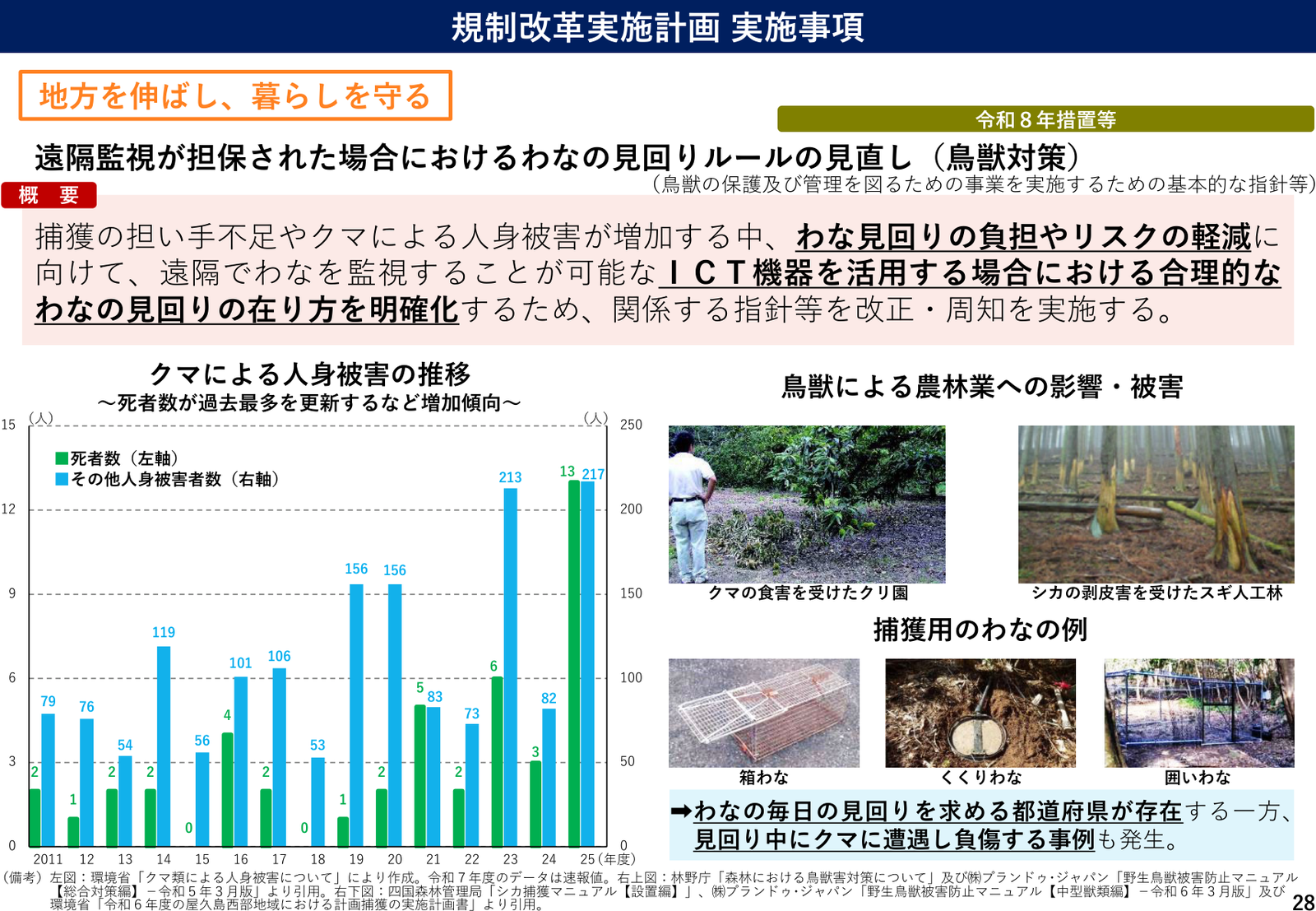
Source: Cabinet Office, "Regulatory Reform Implementation Plan" (Cabinet decision, July 21, 2026), Implementation Items briefing material
29. Using unused fishing grounds and relocating fishing grounds
Next, fisheries. This is a review to put unused fishing grounds to work so that new entrants can come in.
Behind it are the decline in the number of fishers and changes in the marine environment. When the sea changes, grounds that used to yield fish can become hard to use. Yet under the current arrangements it is hard to check from outside how a fishing ground is being used, so it is hard to see where grounds are not being used fully. The material lists voices from the ground: the district requirement for becoming a member of a fisheries cooperative (a condition requiring an address or place of business within a designated district) is not flexibly reviewed, so new entry and business expansion are difficult; when people consult a prefecture about a new fishery right they are simply told coordination is difficult, with no reason given; and the minutes of the sea-area fisheries adjustment commission are published only in summary form, which lacks transparency.
The direction of the review is greater transparency and spreading good examples. It includes surveying and publishing how the check sheets that record the use of fishing grounds are actually operated; notifying prefectures to review district requirements flexibly according to local realities; notifying them to also explain the reasons when a case ends in the conclusion that coordination is difficult; and notifying them to publish the full version of the sea-area fisheries adjustment commission minutes and materials rather than a summary. On top of that, good examples such as open recruitment of new entrants are to be spread around the country.
What it means for businesses is that the outlook for entry becomes easier to read. For people who want to start fishing, or fishers who want to grow, being able to see which grounds are open and why a consultation did not go through makes the next move easier to plan. Greater transparency also gives existing fishers a stronger sense that coordination is fair.
As for the outlook, the material lists measures and the like in 2026. Because how far district requirements are loosened is left to each region's judgment, actual operation may vary by region. Check the amendment of the comprehensive supervisory guidelines for fisheries cooperatives and the like for the specific operation.
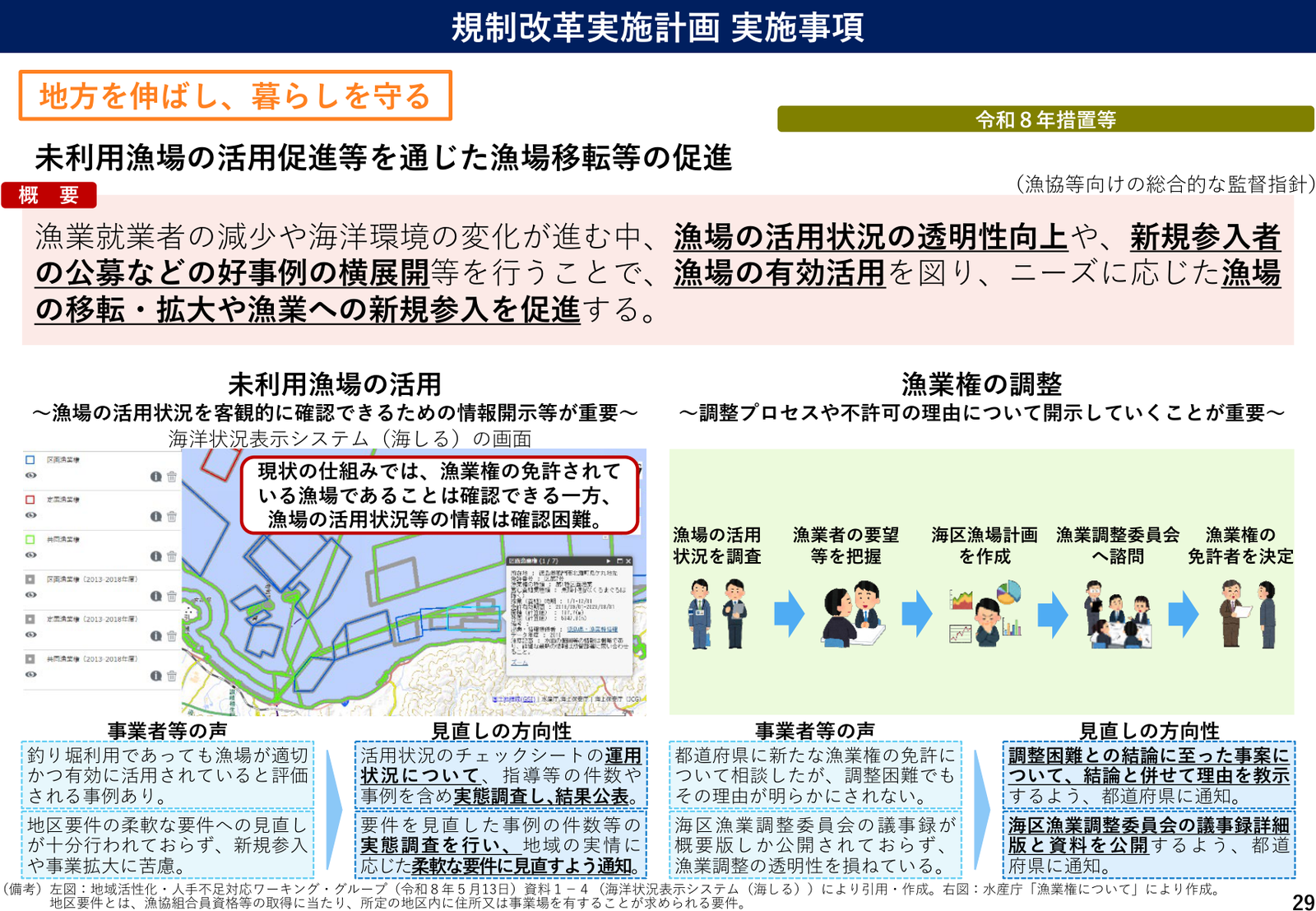
Source: Cabinet Office, "Regulatory Reform Implementation Plan" (Cabinet decision, July 21, 2026), Implementation Items briefing material
30. Resolving land with long-unregistered inheritance and the like
Third is the problem of land whose owner is unclear. This is a review that supports regional revitalisation from the land side.
To set the scene, land with unknown owners is increasing in Japan. There are two national projects to resolve it. One is the "project to resolve land with long-unregistered inheritance and the like," in which the Legal Affairs Bureau searches for the heirs of land that was inherited but left unregistered for a long time until the owner became unclear. The other is the "project to resolve land with unknown title-section owners," in which the Legal Affairs Bureau searches for the owners of land whose title section (the column carrying the land's basic information) does not correctly record the owner's name or address. The problem was that municipalities found it hard to tell which project to apply to, so cases that should go to the title-section project were sent to the inheritance project, and it was unclear what to do when a case fell outside the scope of the inheritance project.
This reform lets the Legal Affairs Bureau make a single combined inquiry to the two projects. After communicating that a request to the inheritance project which contains land with unknown title-section owners will be deemed a request to the title-section project, it unifies the inquiry for the two requests. On top of that, for land that falls outside the scope of the inheritance project, other resolution methods are to be signposted.
What it means for businesses is a tidier entrance when you want to use land in a region. Land with an unknown owner tends to become a wall when you try to advance a new business or facility locally. If municipalities can proceed at the counter without hesitation, the time it takes before land becomes usable further downstream is expected to shorten.
As for the outlook, the material lists measures in 2026. The relevant law is the Act on Special Measures concerning Facilitation of the Use of Land with Unknown Owners and the like. Note that on the consolidation and optimal use of farmland itself, the plan includes as a separate item the simplification of the renewal procedure for lease contracts at the farmland bank. If you are thinking about land use in a region, checking these neighbouring reviews in the main text of the plan too will give you the whole picture.
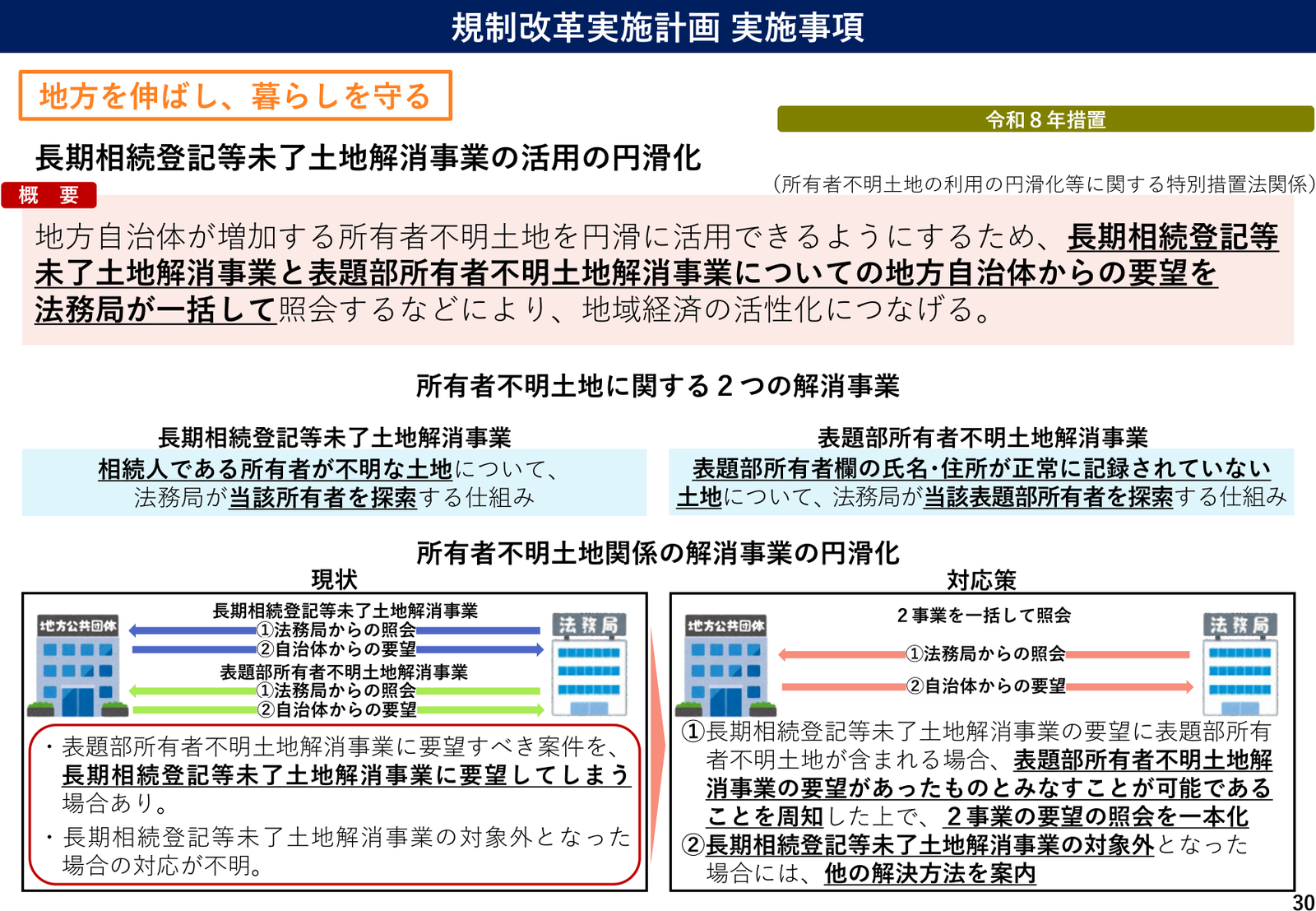
Source: Cabinet Office, "Regulatory Reform Implementation Plan" (Cabinet decision, July 21, 2026), Implementation Items briefing material
Corporate and Company Law reforms
From here, the reviews touch how companies are formed and run. Running through them is the aim of making investment and M&A easier and supporting the growth and international competitiveness of Japanese companies.
13. Reviewing the voting-rights holding limit under the Antimonopoly Act
First, a review to let banks and insurance companies put money into startups for the long term. It is a little technical, so let me explain it step by step.
The Antimonopoly Act limits how much of another company's voting rights (the right to decide a company's course at a general meeting of shareholders) a bank or insurance company may hold. Where they take part in a fund (an investment limited partnership) as a limited partner and hold another company's voting rights as the partnership's assets, they may hold more than the usual limit, without special procedures, for up to ten years: over 5% for a bank and over 10% for an insurance company. But to keep holding beyond ten years, approval from the Japan Fair Trade Commission is required. That is the problem: at the point of investing there is no assurance that approval will be granted. In fields such as biotech and drug discovery, where commercialisation takes longer than ten years, the plan explains that this sometimes causes investment in startups to be passed over. In fact, the material shows that for university-originated ventures, more than half of the time from founding to an initial public offering of shares took ten years or more.
This reform reviews this voting-rights holding limit to expand the supply of funds to startups and the like in fields that take a long time to commercialise, beginning with biotech and drug discovery. The direction is to let banks and insurance companies, moneyed backers with staying power, get involved in earnest with businesses that need long nurturing.
What it means for businesses is that the base of available funding may widen. Especially for research-and-development startups, more backers willing to provide long-term funds is a big tailwind. Companies taking on time-consuming technology, such as regional university-originated ventures, are the ones most likely to benefit from this theme.
As for the outlook, the material lists reaching a conclusion in FY2026 and taking measures and the like promptly once a conclusion is reached. The relevant laws are the Antimonopoly Act and its enforcement order and the like. Check the main text of the plan and the coming design of the system for the concrete picture of how far and in what way the limit is eased.
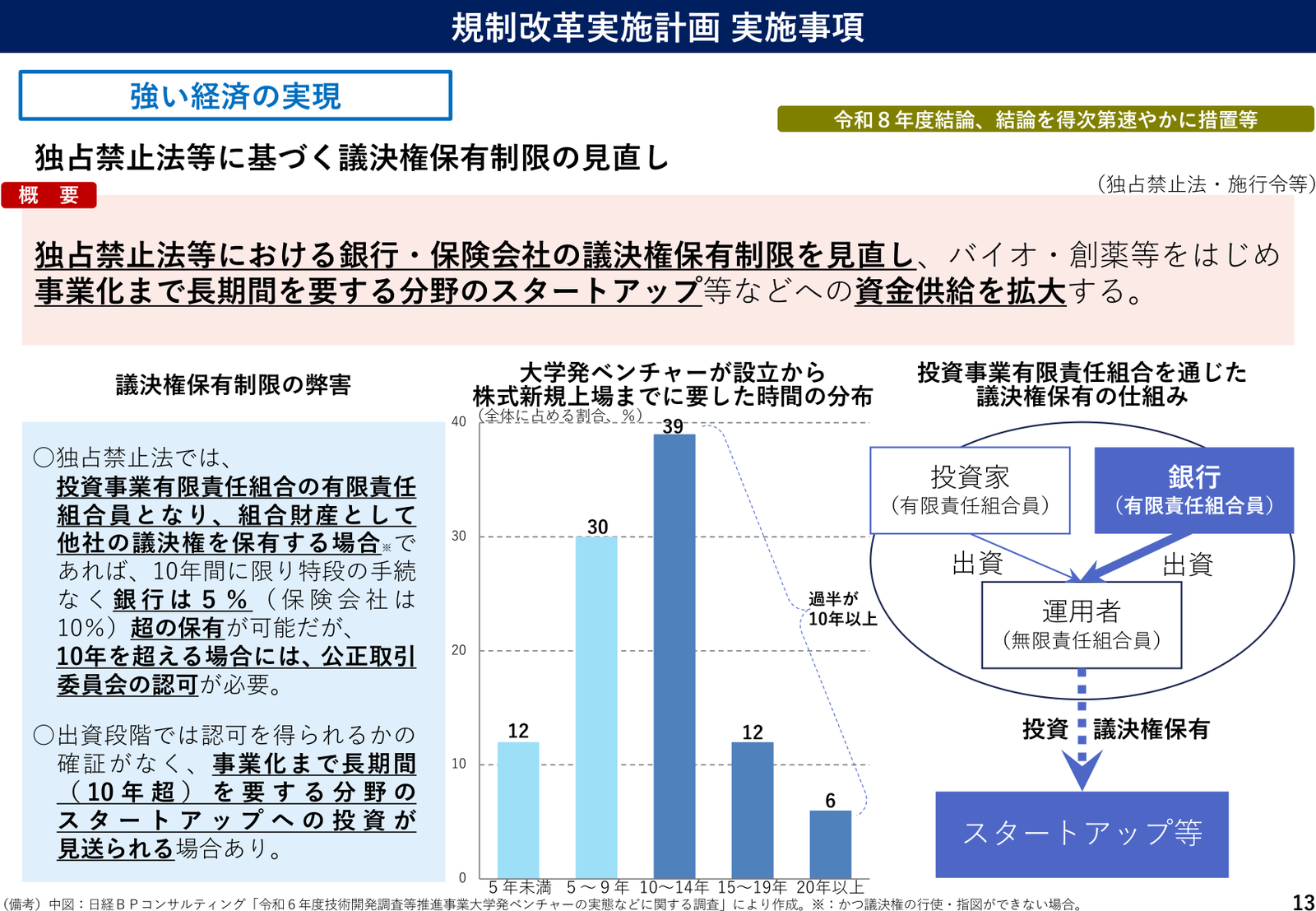
Source: Cabinet Office, "Regulatory Reform Implementation Plan" (Cabinet decision, July 21, 2026), Implementation Items briefing material
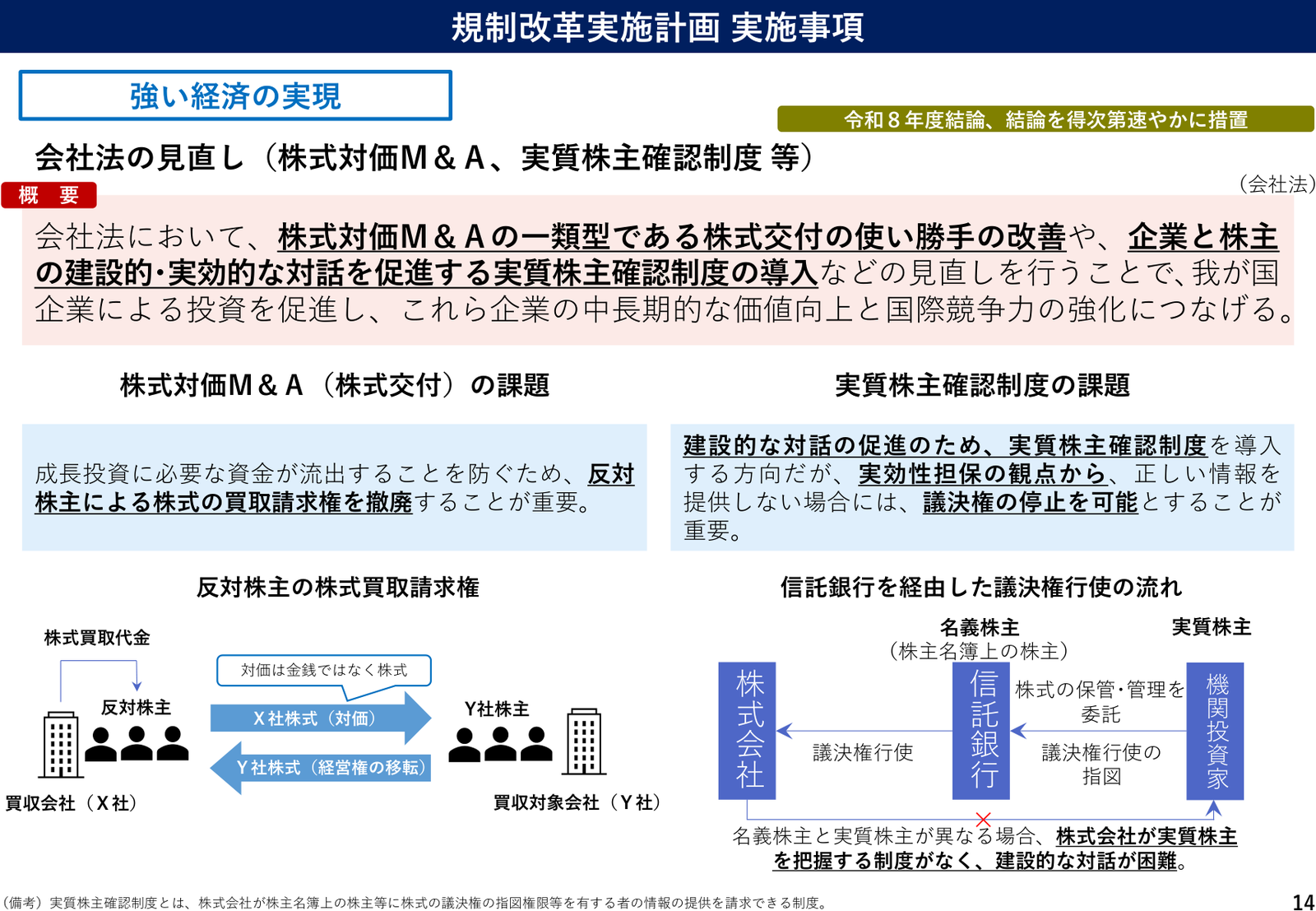
14. Company Law reform (share-for-share M&A and beneficial-shareholder confirmation)
Next is Company Law reform, which contains two themes. Both aim to make it easier for a company to use its money for growth and to deepen dialogue with shareholders.
The first is improving the usability of share-for-share M&A. Many people picture M&A as buying a company with cash, but there is a way to pay not in cash but in the acquirer's own shares. One type of it is "share delivery," a mechanism in which the acquiring company (Company X) hands its own shares to the shareholders of the company being acquired (Company Y) and gains control of Company Y. The problem is the appraisal right, by which a shareholder who opposes this procedure can demand "please buy my shares back." When cash flows out to meet the buyback, money that was meant for growth investment leaks away. So the material treats as important, in order to prevent the outflow of funds needed for growth investment, the abolition of the appraisal right of dissenting shareholders.
The second is introducing the beneficial-shareholder confirmation system. For the shares of a listed company, it is common for the register of shareholders to show the name of a trust bank or similar, while a separate institutional investor is the one actually directing how the voting rights are used. In this case the company cannot grasp who the "real shareholder" is, which makes constructive dialogue difficult. So the plan points toward introducing a system by which a company can request from the registered shareholder and the like information about the real shareholder (the beneficial shareholder) who directs the voting rights. From the standpoint of ensuring effectiveness, the material treats as important the ability to suspend voting rights where correct information is not provided.
There are two things this means for businesses. If share-for-share M&A becomes easier to use, a company can buy another without reducing its cash on hand, making it easier to step into restructuring for growth. If the beneficial-shareholder confirmation system takes shape, a company can advance dialogue and disclosure while correctly knowing who its shareholders are. Connecting this to raising corporate value over the medium and long term and strengthening international competitiveness is the plan's aim.
As for the outlook, the material lists reaching a conclusion in FY2026 and taking measures promptly once a conclusion is reached. The target is Company Law. Details such as how the appraisal right is handled and how far beneficial-shareholder information is required await the debate on the legal amendment, so check the main text of the plan and the coming movement on Company Law for the concrete picture.
Source: Cabinet Office, "Regulatory Reform Implementation Plan" (Cabinet decision, July 21, 2026), Implementation Items briefing material
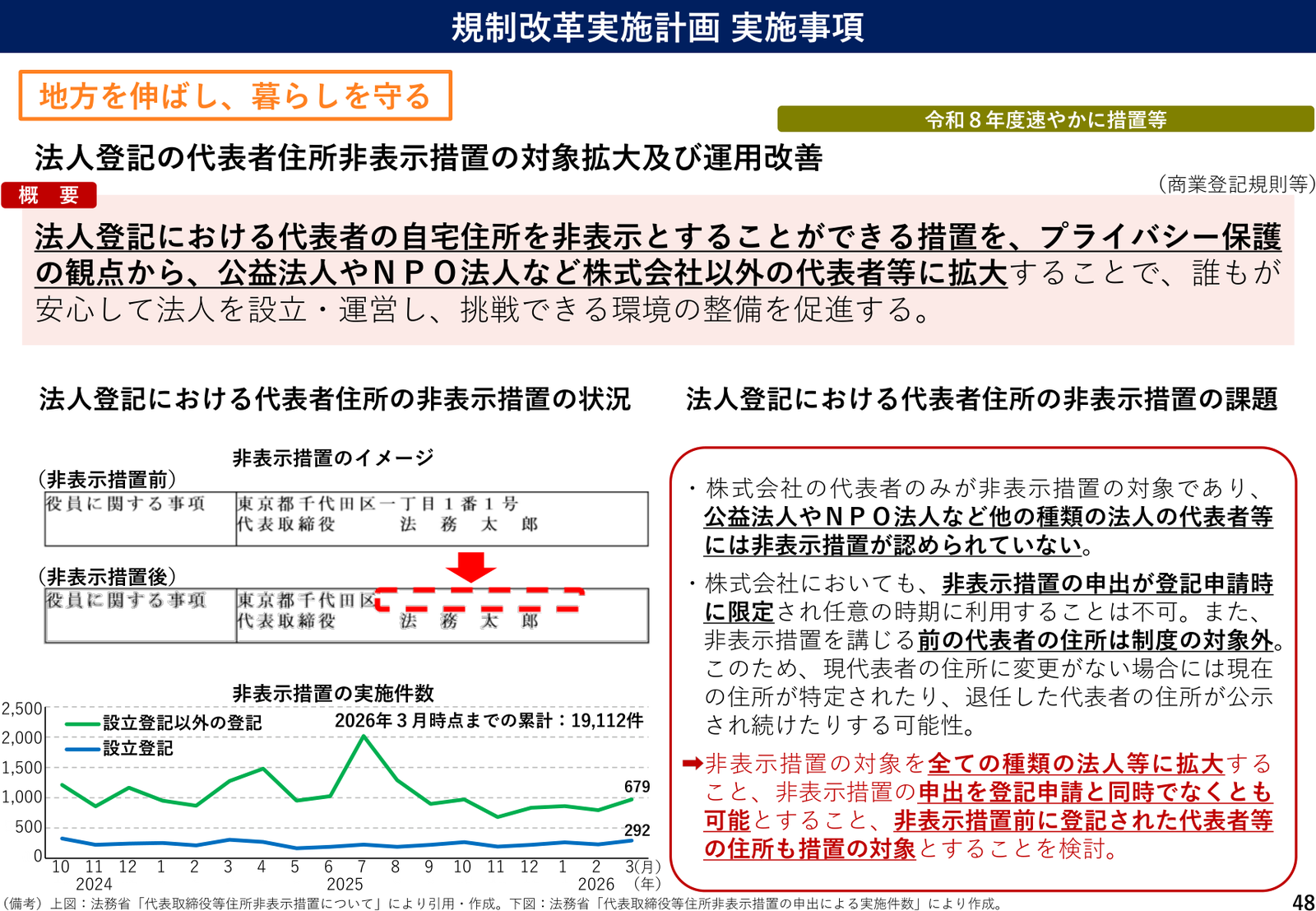
48. Expanding the hiding of a representative's address in corporate registration
Third is a review to protect the home address of a company's representative and the like. It supports people who hesitate over starting or running a corporation because of privacy.
To set the scene, corporate registration information can be viewed by anyone, and it carries the representative's address. The measure to hide this address had so far applied only to the representatives of stock companies. According to the material, the cumulative number of cases in which this hiding measure was applied reached 19,112 up to March 2026. But problems remained: the representatives and the like of other kinds of corporation, such as public-interest corporations and NPOs, were outside its scope. Even for a stock company, an application to hide could be made only at the time of a registration application, not later at a time of one's choosing. On top of that, an address registered before the measure was taken was outside the scope, so unless the address had been changed, the current address could be identified, or the address of a representative who had already left could keep being made public.
This reform considers expanding the scope of the hiding measure to all kinds of corporation and the like, allowing the application to be made even when it is not simultaneous with a registration application, and bringing addresses of representatives and the like registered before the hiding measure into scope.
What it means for businesses is a wider environment for launching and running a corporation with peace of mind. For people active in NPOs and public-interest corporations, or individuals starting a business from home, anxiety over having their address widely published was a real wall. Lowering that wall makes it easier to step into a new venture.
As for the outlook, the material lists taking measures promptly in FY2026 and the like. The target is the Commercial Registration Regulations and the like. Check the main text of the plan and the coming amendment of the regulations for operational details such as which corporations can use it from when, and how already-registered addresses are handled.
Source: Cabinet Office, "Regulatory Reform Implementation Plan" (Cabinet decision, July 21, 2026), Implementation Items briefing material
So far the reviews have touched a company's funds and governance, and the environment around its representative. Whether you can actually put such policy tailwinds to work comes down to how well you have organised your own information and operations. The reason we keep walking alongside managers through an AI consulting service called WARP is that we feel we are getting somewhere in translating changes in the system into the one move in front of you. Next, let me move to the labour field, which is closer to daily practice.
Looking for AI training and consulting?
Learn about WARP training programs and consulting services in our materials.
Labour and ways of working reforms
Reviews touching ways of working concern every company. You can read in them the intent to prepare, amid the labour shortage, both a mechanism for flexible working and a mechanism to protect workers.
9. Working-hours law (variable and discretionary working)
This item consists of two themes. Both review how working time is set to fit today's realities.
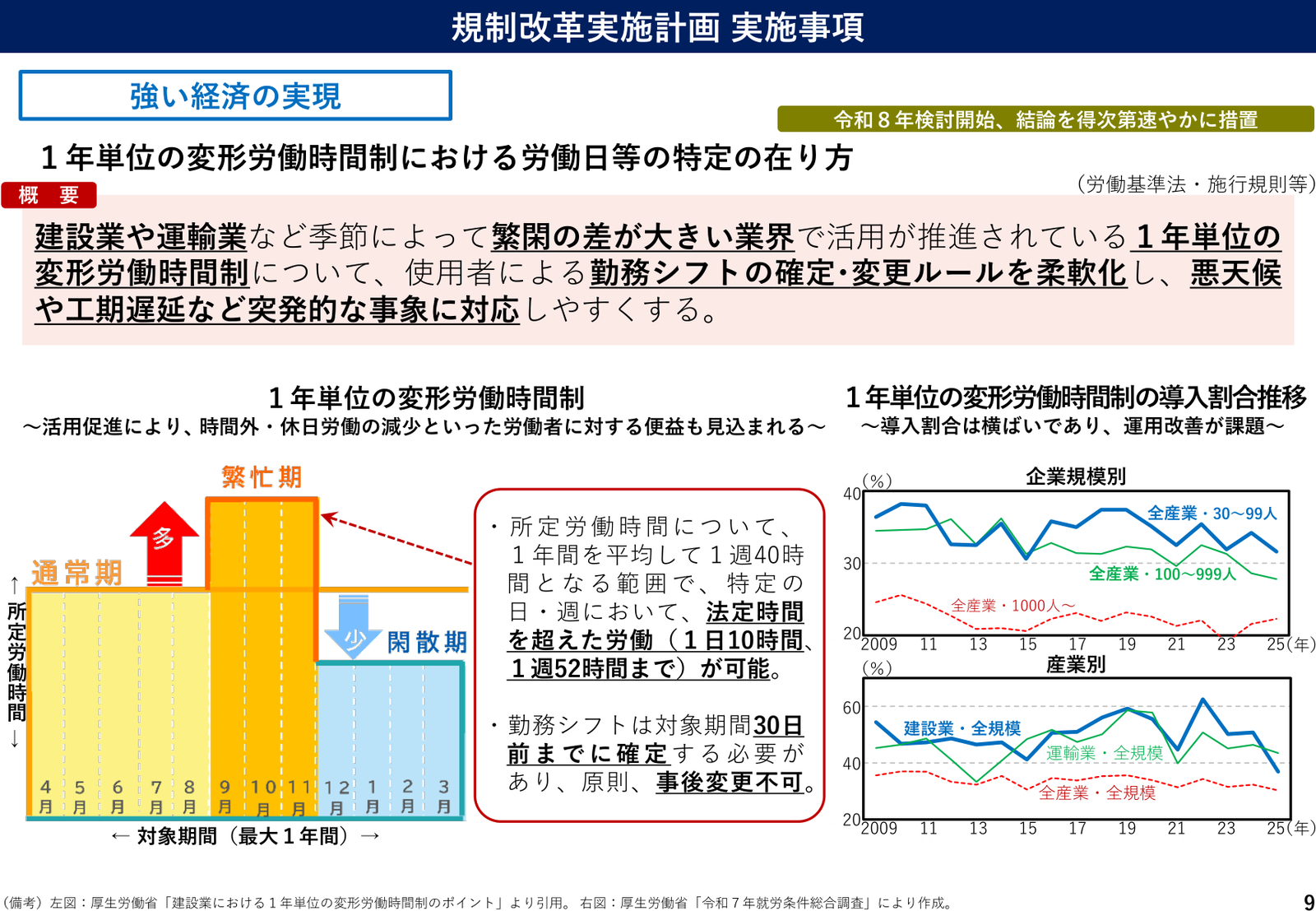
The first is a review of the one-year variable working-hours system. This system is used in industries whose busyness rises and falls with the seasons, and it has spread in construction and transport. If, averaged over a year, hours stay within 40 per week, you can work beyond statutory hours (up to 10 per day and 52 per week) on particularly busy days or weeks. But the shift roster must be fixed by 30 days before the target period, and as a rule cannot be changed afterward. That is where it failed to match practice. In construction and transport, sudden circumstances arise, such as bad weather or delays in the work schedule. Fixing the shift completely in advance makes it hard to respond to such situations. The material also notes that the adoption rate is flat and that improving the operation is the challenge. So this time, the rules by which the employer fixes and changes the shift roster are made more flexible, in a direction that makes it easier to respond to sudden events.
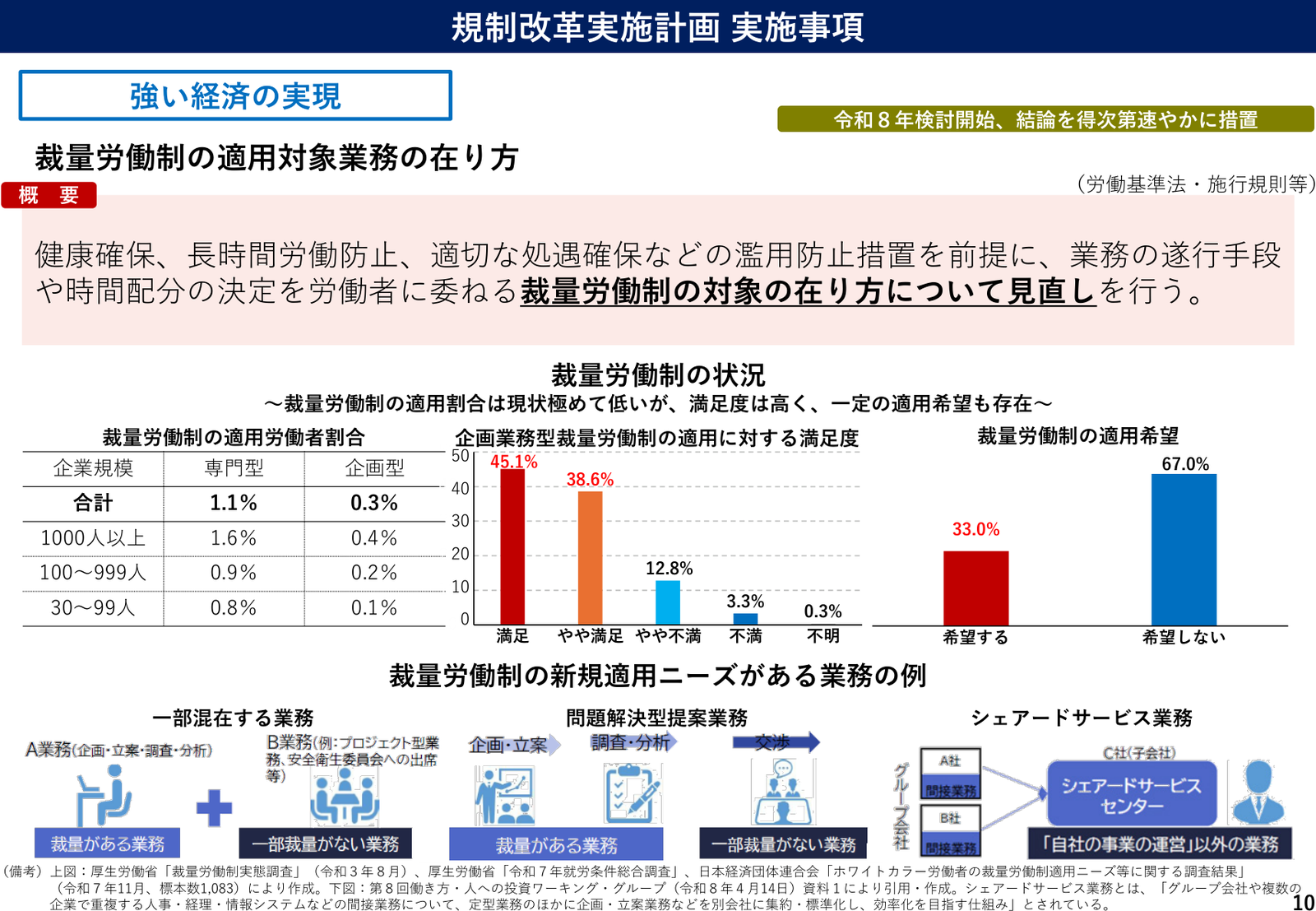
The second is a review of the work covered by the discretionary working-hours system. The discretionary system leaves how to carry out the work and how to allocate time to the worker. According to the material, the application rate of this system is currently very low, around 1%, but satisfaction among those to whom it applies is high (satisfied and somewhat satisfied together exceed roughly 80%), and a certain demand to apply it exists. Examples of work with demand for new application include problem-solving proposal work and shared-service work (work that consolidates and standardises back-office functions within a group). This time, on the premise of measures to prevent abuse, such as securing health, preventing long working hours, and ensuring appropriate treatment, the plan reviews how the covered work should be defined.
What it means for businesses is that it becomes easier to design working time to fit reality. Companies with sites at the mercy of weather and schedules can move closer to a workable operation if they can re-arrange shifts more flexibly. Companies whose work centres on planning and proposals can more easily choose a way of working evaluated on results if the scope of the discretionary system widens. It is worth keeping in mind that both come as a set with mechanisms to prevent abuse.
As for the outlook, for both the material lists starting consideration in 2026 and taking measures promptly once a conclusion is reached. The target is the Labour Standards Act and its enforcement regulations and the like. How flexible shifts can become, and how far the discretionary system's scope widens, depend on the debate to come. Check the main text of the plan and the coming consideration for the specific requirements.
Source: Cabinet Office, "Regulatory Reform Implementation Plan" (Cabinet decision, July 21, 2026), Implementation Items briefing material
42. Annual paid leave under shift work
Next, paid leave for people who work shifts. For companies with many part-timers and casual workers, this is a familiar labour-management theme.
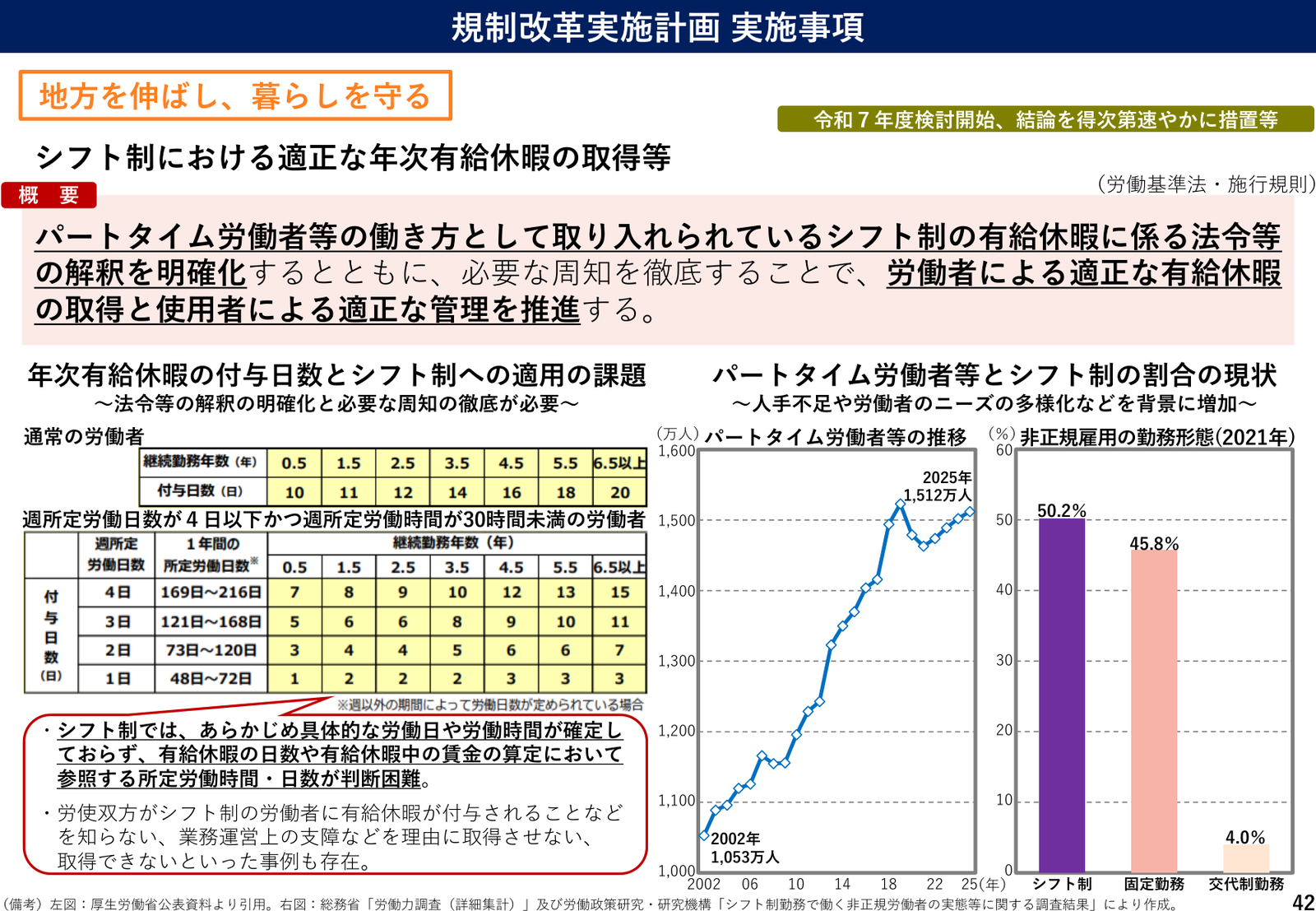
The problem is that calculating paid leave is hard. Under shift work, the specific working days and hours are not fixed in advance. So when deciding how many days of paid leave to grant, and how much to pay for a day taken off, the prescribed working hours and days you should refer to are hard to identify. On top of that, the material notes cases where neither side, employer or worker, even knew that shift workers are granted paid leave, and cases where leave was not given or could not be taken on the grounds that it would disrupt operations. The number of part-time workers and the like grew from 10.53 million in 2002 to 15.12 million in 2025, and shift work accounts for roughly half of non-regular employment. Judging by the number of people involved alone, this is a theme you cannot leave alone.
This reform clarifies the interpretation of the laws and the like on paid leave under shift work, and thoroughly carries out the necessary communication. Rather than creating a new system, the direction is to make clear how the current rules apply to shift work so that they are operated correctly.
What it means for businesses is that labour trouble becomes easier to avoid. If how to grant paid leave and how to calculate wages become clear, a company can respond without hesitation, and workers can take leave with peace of mind. Amid a labour shortage, this kind of workability also helps retain people.
As for the outlook, the material lists starting consideration in FY2025 and taking measures promptly once a conclusion is reached, and the like. The target is the Labour Standards Act and its enforcement regulations. The substance of the specific interpretation will become clear in notices and the like to be issued, so check it together with the main text of the plan.
Source: Cabinet Office, "Regulatory Reform Implementation Plan" (Cabinet decision, July 21, 2026), Implementation Items briefing material
43. Making notice of working conditions available online
Third is a review to fit the method of conveying working conditions to a digital age. For companies that prepare documents at each hire, it lightens practice.
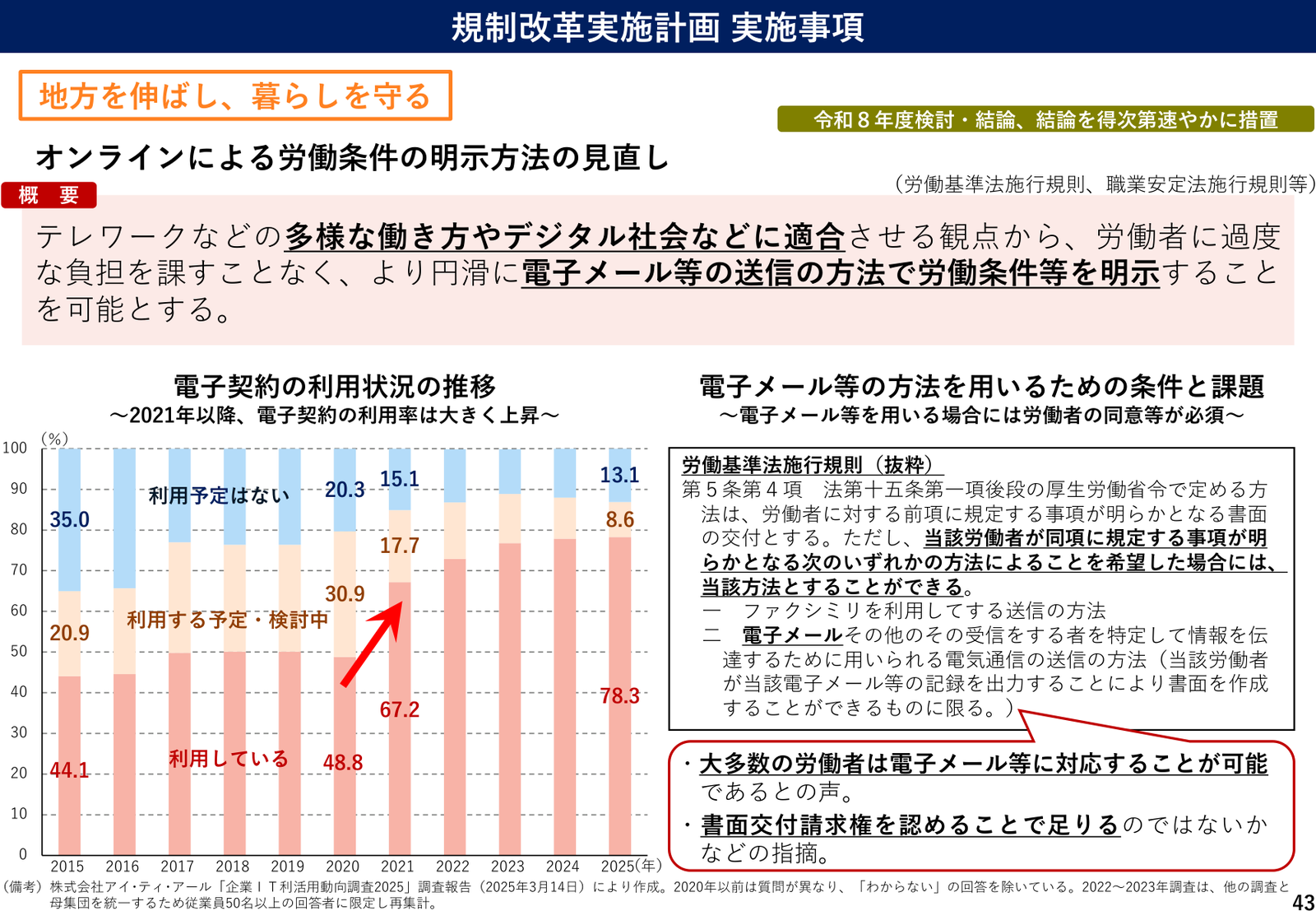
Under the current rules, notice of working conditions is by delivery of a document as a rule. Only where the worker so wishes can it be sent by facsimile, email and the like, and even this is limited to means from which the email record can be printed to create a document, and the worker's consent and the like are essential. Meanwhile, according to the material, the use rate of electronic contracts has risen sharply since 2021, reaching nearly 80% answering that they use it by 2025. The material also introduces voices saying that the great majority of workers can handle email and the like, and the suggestion that recognising a right to request delivery of a document might be enough.
This reform, to fit diverse ways of working such as telework and a digital society, makes it possible to give notice of working conditions more smoothly by sending it via email and the like, in a form that does not impose an excessive burden on workers.
What it means for businesses is more efficient hiring practice. Preparing a paper document and handing it over at each new hire becomes more of a chore as the number rises. Being able to give notice easily by email and the like also fits remote hiring and telework-based ways of working. It can also reduce the burden of managing and storing documents.
As for the outlook, the material lists consideration and a conclusion in FY2026 and taking measures promptly once a conclusion is reached. The target is the enforcement regulations of the Labour Standards Act, the enforcement regulations of the Employment Security Act, and the like. The specific conditions for smoother operation, such as how the worker's consent is handled, will be settled in the coming consideration, so check the main text of the plan.
Source: Cabinet Office, "Regulatory Reform Implementation Plan" (Cabinet decision, July 21, 2026), Implementation Items briefing material
Reforms concerning the acceptance of foreign workers
Last is the field of foreign workers. Amid an acceptance that is widening against a backdrop of labour shortage, the reviews here aim to fit the system to reality and build an orderly society of coexistence.
44. Reviewing the technical intern (employment-for-skill-development) exams
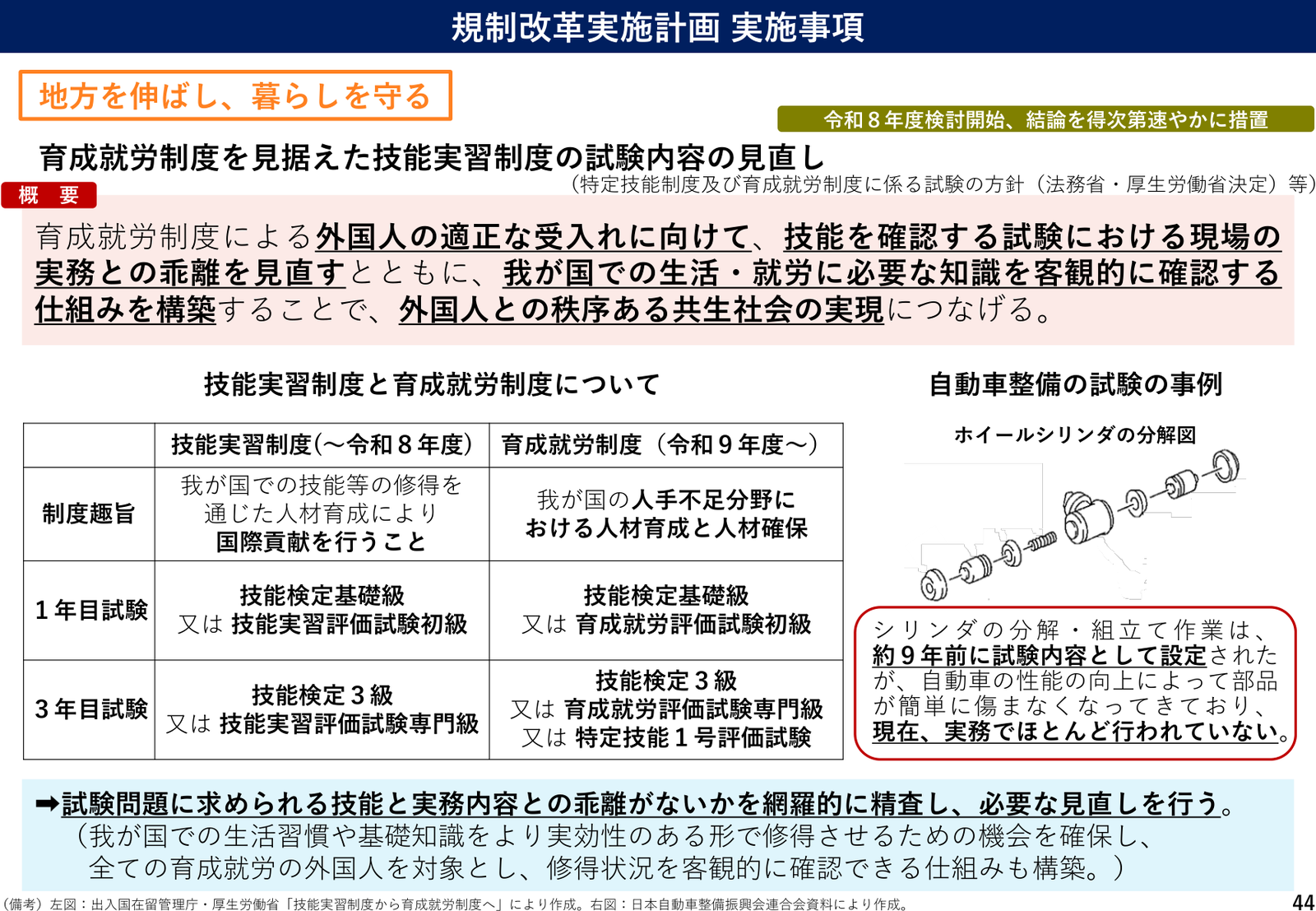
First, keep in mind that the very system for accepting foreign workers is changing significantly. The Technical Intern Training scheme runs through FY2026, and from FY2027 it shifts to the employment-for-skill-development scheme. The purpose of the system also changes, from international contribution through acquiring skills to developing and securing human resources in fields facing labour shortages. This item is the review of exam content ahead of that shift.
The problem is that the skills asked about in the exams diverge from actual on-site work. The material gives the example of automobile maintenance: the task of dismantling and assembling a cylinder was set as exam content about nine years ago, but as vehicle performance improved, parts stopped wearing easily, and today that task is rarely carried out in practice. Keeping asking about a task not done in practice cannot measure true skill.
This reform comprehensively examines whether there is a divergence between the skills required in the exam questions and the content of actual work, and makes the necessary revisions. In addition, it secures more effective opportunities to acquire everyday habits and basic knowledge for life in Japan, and it builds a mechanism to objectively check the acquisition status of all foreign workers under the employment-for-skill-development scheme.
What it means for businesses is that the skills of the people you take in and the exams align. If the exam follows actual work, it can measure the ability that is genuinely useful on the ground. If a mechanism to check knowledge of daily life is in place, the people who come to Japan fit into their communities more easily, which also helps retention for the accepting company. Companies that employ foreign workers, or plan to, would do well to prepare with the very shift to the employment-for-skill-development scheme in FY2027 in view.
As for the outlook, the material lists starting consideration in FY2026 and taking measures promptly once a conclusion is reached. The target is the policy on exams for the Specified Skilled Worker system and the employment-for-skill-development scheme (a decision of the Ministry of Justice and the Ministry of Health, Labour and Welfare) and the like. How the exam for each occupation changes depends on the examination to come, so check the main text of the plan and the movement of each system.
Source: Cabinet Office, "Regulatory Reform Implementation Plan" (Cabinet decision, July 21, 2026), Implementation Items briefing material
45. Japanese-language ability tests for foreigners
Next is a review of the tests that check the Japanese-language ability of foreign workers. The wider the acceptance, the more securing opportunities to measure Japanese becomes a practical challenge.
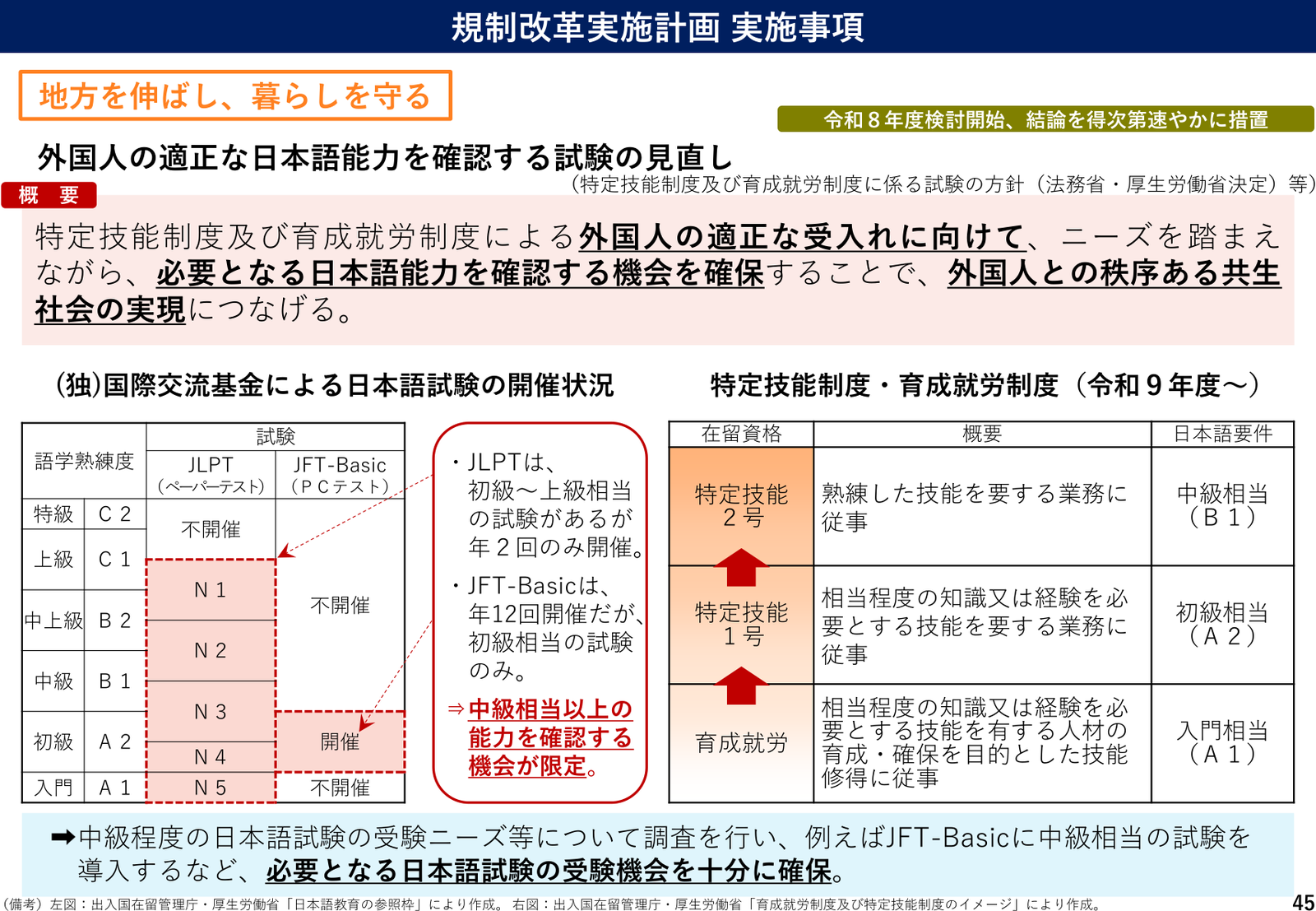
To set the scene, the level of Japanese required is fixed for each residency status. According to the material, Specified Skilled Worker (ii) is set at intermediate-equivalent, Specified Skilled Worker (i) at beginner-equivalent, and employment-for-skill-development at introductory-equivalent. The tests that confirm these include the JLPT (Japanese-Language Proficiency Test), held twice a year, and the JFT-Basic, held twelve times a year. But the JLPT has a wide range of tests from beginner to advanced yet is held only twice a year, while the JFT-Basic is held more often but only offers a beginner-equivalent test. As a result, opportunities to confirm ability at intermediate-equivalent or above are limited.
This reform, after surveying the demand to sit an intermediate-level Japanese test and the like, secures sufficient test opportunities as needed, for example by introducing an intermediate-equivalent test into the JFT-Basic.
What it means for businesses is that it becomes easier to identify people at the level you need. If opportunities to measure intermediate-equivalent ability increase, you can more easily confirm and secure people who need high Japanese ability, such as Specified Skilled Worker (ii), without waiting for a particular time. Being less bound by the timing of the tests when drawing up an acceptance plan is a practical advantage.
As for the outlook, the material lists starting consideration in FY2026 and taking measures promptly once a conclusion is reached. The target is the policy on exams for the Specified Skilled Worker system and the employment-for-skill-development scheme and the like. Which test gains an intermediate-equivalent level and when will be decided after survey and consideration, so check the main text of the plan.
Source: Cabinet Office, "Regulatory Reform Implementation Plan" (Cabinet decision, July 21, 2026), Implementation Items briefing material
46. Making residency management appropriate
Last is a review of residency management concerning the residency status of "Engineer, Specialist in Humanities, International Services." This concerns companies that take in foreign workers for specialist work.
This residency status is for people engaged in work requiring knowledge of the natural sciences or humanities, or work requiring ideas grounded in a foreign culture. According to the material, the number and share of resident foreigners under this status have grown year by year, exceeding roughly 10% of all resident foreigners as of the end of 2025. There are two problems. One is that the guideline setting out the scope of work you can engage in lists limited industries and offers explanations that are not practical, so there is a risk of unintentionally assigning work that does not fit the status, and some hesitate to hire out of fear of that. The other is that even when an illegal broker is involved in the residency application, it is currently hard to exclude them; the material points to the problem of brokers creating false documents and using them to obtain residency status.
This reform, by revising the guideline, clarifies the scope of work you can engage in under this residency status. Alongside this, it ensures the appropriateness of brokerage in residency applications.
What it means for businesses is an environment where you can accept people with peace of mind. If it is clear which work can be done under this status, a company can hire people without anxiety and assign them to appropriate work. If illegal brokerage is excluded, companies that accept people through legitimate routes are not put at a disadvantage, and sound hiring is protected.
As for the outlook, the material lists starting consideration in FY2026 and taking measures promptly once a conclusion is reached. The target concerns clarifying the residency status of "Engineer, Specialist in Humanities, International Services" and the like. How far the scope of work is clarified and how the appropriateness of brokerage is ensured will take shape in the coming consideration, so check the main text of the plan.
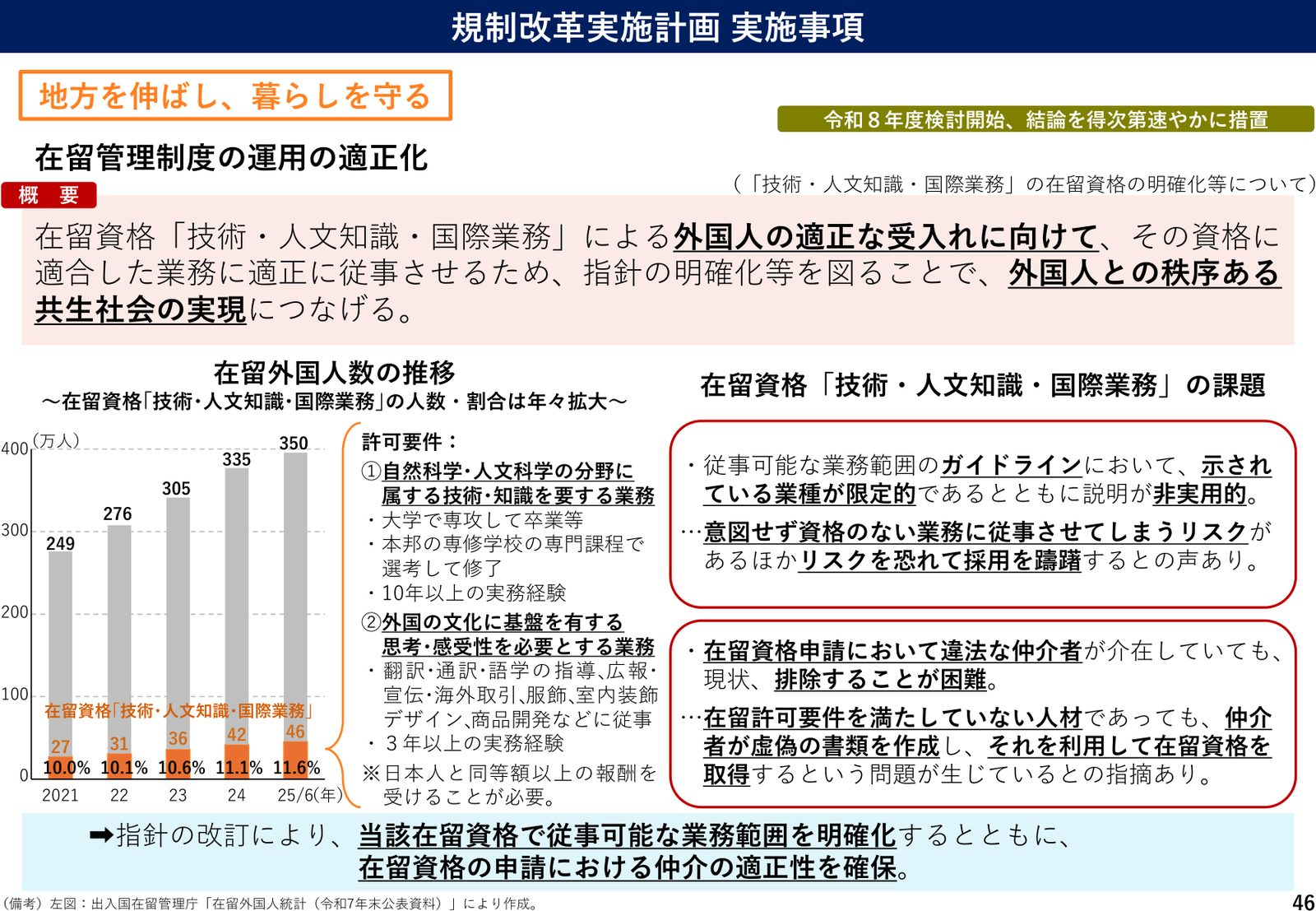
Source: Cabinet Office, "Regulatory Reform Implementation Plan" (Cabinet decision, July 21, 2026), Implementation Items briefing material
Reading this plan as a story about your own company
I have looked at twelve reviews across agriculture, forestry and fisheries and the regions, corporate matters, labour, and foreign workers. The fields look scattered, but at the root there is a shared aim. Amid a severe labour shortage, reduce the burden on the ground, put dormant resources to work (fishing grounds, land, and people), and make it easier for companies to step out toward growth. These three run through it like a bass line.
And what can be said in common across every review is this: even when a system changes, whether you can make use of it depends on the company's own preparation. Hiding a representative's address, making the variable working-hours system flexible, giving notice of working conditions online: none of these produces its effect automatically just because the system is in place. There is always the work of identifying where in your own company the change bites, and bringing it down into your operations.
Here is how I see it. The difference between the company that actually catches such a policy tailwind and the one that lets it pass by lies in how well it has organised its own information and operations. Labour rules, and the acceptance of foreign workers alike, can be matched to change quickly if the groundwork is laid with AI and digital. Conversely, if you wait without knowing where to start, you cannot make the most of a review even when it comes.
If you are unsure where to begin bringing digital or AI into your company, or where the bottleneck in your labour and hiring actually sits, please talk to the WARP team. Specialists who led DX and data strategy at major companies walk alongside you month by month, helping to translate the large flow of the system into the one step in front of you.
To sum up
It ran long, so let me organise the key points.
- The Regulatory Reform Implementation Plan is an action plan of 57 items in total, decided by the Cabinet on 21 July 2026. This article took up twelve items across agriculture, forestry and fisheries and the regions, corporate matters, labour, and foreign workers
- In agriculture, forestry and fisheries and the regions, the plan sets out reviewing patrol rules through remote monitoring of traps, using unused fishing grounds and improving transparency, and combined inquiry for the projects to resolve land with unknown owners
- In corporate matters, it lines up reviewing the voting-rights holding limit for banks and insurers, Company Law reform for share-for-share M&A (share delivery) and the beneficial-shareholder confirmation system, and expanding the scope of the measure to hide a representative's address
- In labour, it includes reviewing the variable and discretionary working-hours systems, clarifying the interpretation of paid leave under shift work, and online notice of working conditions
- In foreign workers, it sets out reviewing exam content ahead of the shift to the employment-for-skill-development scheme, securing opportunities for an intermediate-equivalent Japanese test, and making residency management appropriate
- Many items are set for consideration, a conclusion or measures in FY2026, but the specific requirements depend on the debate to come. Check the main text of the plan for details
Within the same plan, the fields touching energy and manufacturing are covered in a guide to the energy and manufacturing fields of Regulatory Reform 2026. For the whole picture, start with a guide to the overall shape of Regulatory Reform 2026.
A policy document, read only as a document, looks like someone else's business. But the "greater flexibility in ways of working" and the "acceptance of foreign workers" written into it are exactly the themes each company can start thinking about from tomorrow. Pick one field that concerns your own company first, and begin from reviewing how you operate today.
References and primary sources
Footnotes
-
"Regulatory Reform Implementation Plan," Cabinet decision of 21 July 2026 (令和8年7月21日) (Council for the Promotion of Regulatory Reform, Cabinet Office). The facts in this article are based on the government's briefing material on the items of the plan. For the details and citations of each item, refer to the main text of the Regulatory Reform Implementation Plan. https://www8.cao.go.jp/kisei-kaikaku/kisei/ ↩