Hello, this is Ryuta Hamamoto from TIMEWELL.
On 21 July 2026, the Japanese government made a Cabinet decision on the "Regulatory Reform Implementation Plan." It is a plan of 57 items that reviews the rules of daily life and the economy all at once. Agriculture, transport, healthcare, labour and many other fields are covered, but in this article I want to take up the 10 items that touch on AI and frontier technology, the area that overlaps with our own work.
For where the plan sits overall and how to read it, I have put together a plain-language guide to the whole of the Regulatory Reform Implementation Plan 2026, so if this is your first encounter, reading that first will keep you from getting lost. If you want the transport and mobility field in depth, there is also a piece on autonomous driving and ride-share.
In a single line, today's theme is this: the state is trying, one item at a time, to resolve the practical question of "we want to use AI, but we do not know how far the current rules allow it." From medicine to law, recruiting, government systems, robots and data centres, wherever AI enters real work there are snags, and the plan removes them through clarification or new rules. Those are the items lined up here. If you are curious about where AI works in your own company, checking your starting point first with our free AI literacy self-check will make the rest of this concrete.
Note that the timelines and the finer details of each item below are the directions set out in the plan's briefing material. Where something cannot be stated definitively, I say so in the text. For the exact content, please refer to the plan itself.
7. Promoting AI use in physician image reading
This item is about letting cancer-screening image reading be handled by a single physician with the help of AI.
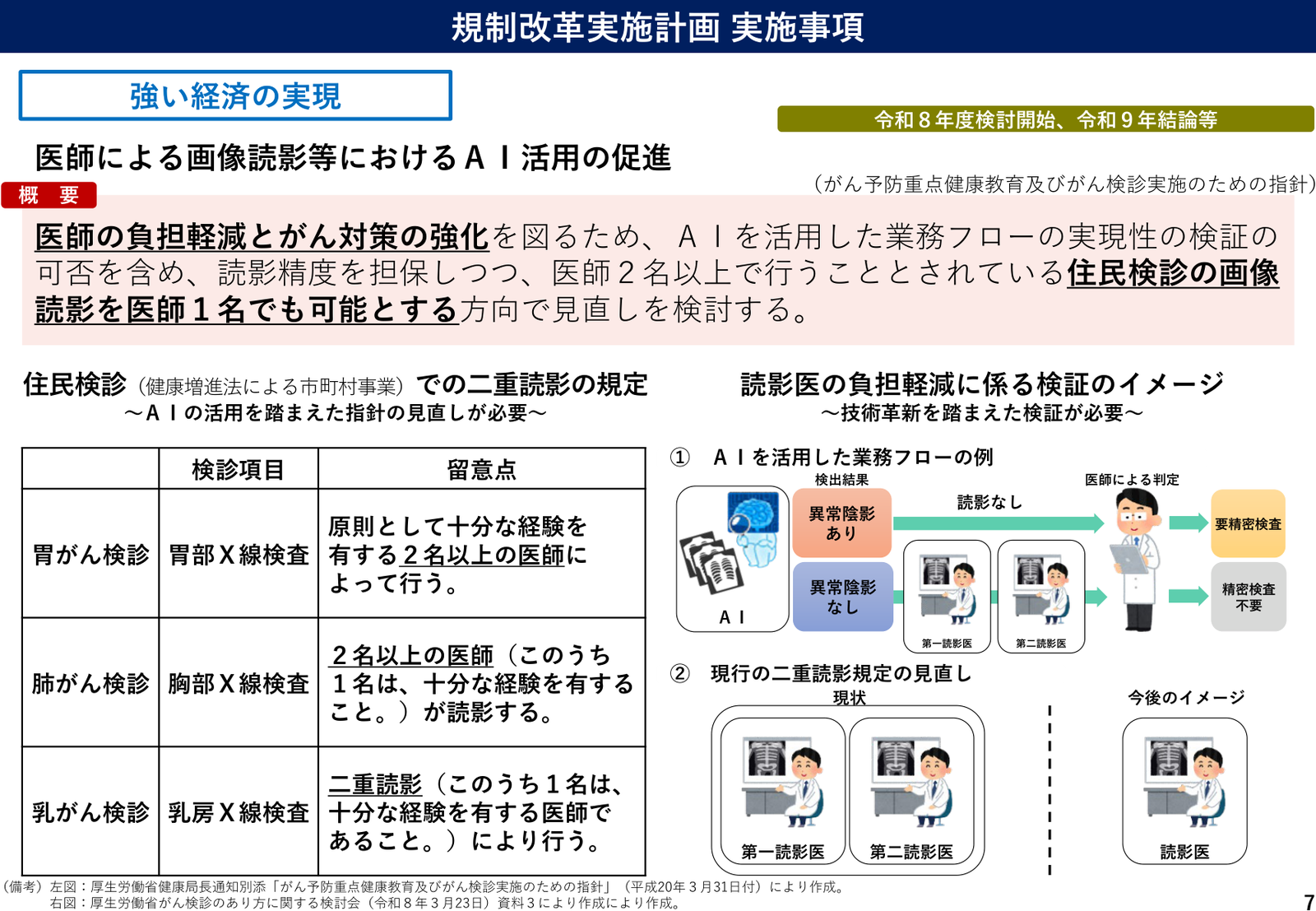
Background and the current issue. In resident screenings run by municipalities (municipal work under the Health Promotion Act), double reading, in which several physicians check the screening images, is prescribed. Under the guidelines for cancer-prevention health education and cancer screening, stomach X-rays in gastric cancer screening are, in principle, to be read by two or more sufficiently experienced physicians; chest X-rays in lung cancer screening by two or more physicians (one of them experienced); and mammography in breast cancer screening by double reading. It is a mechanism for preventing oversights, but the burden on the physicians who do the reading is heavy, and securing enough of them grows harder year by year.
What changes. Including whether the feasibility of an AI-assisted workflow can be verified, the plan will consider a review toward allowing a single physician to perform the image reading in resident screenings that has until now required two or more, while keeping reading accuracy assured. The picture is a flow in which AI first detects whether abnormal shadows are present and a physician makes the final judgment.
What it means for businesses and medical settings. Lightening the reading physicians' load lets limited physician capacity go to where human judgment is genuinely needed, such as detailed examinations. For companies developing medical AI, it is a move toward AI being formally positioned within the concrete work of screening, which makes the path to implementation easier to see.
Outlook. This item is set to begin study in FY2026 and reach a conclusion in 2027. Because how to keep reading accuracy assured is the core of the study, it is designed not to be rushed. For the concrete verification method, please refer to the plan itself.
Source: Cabinet Office, "Regulatory Reform Implementation Plan" (Cabinet decision, July 21, 2026), Implementation Items briefing material
12. The shape of regulatory and institutional reform for the AI era
Rather than fixing individual rules, this item aims to raise the very speed at which rules are fixed. This is the foundation of the AI and digital field.
Background and the current issue. New technology, AI above all, advances at a startling pace. Yet reviewing rules and institutions tends to take time, and when institutions cannot keep up with technology, they become a brake on social implementation. The situation of "the technology has changed, but there is no rule built on it" is happening in many places.
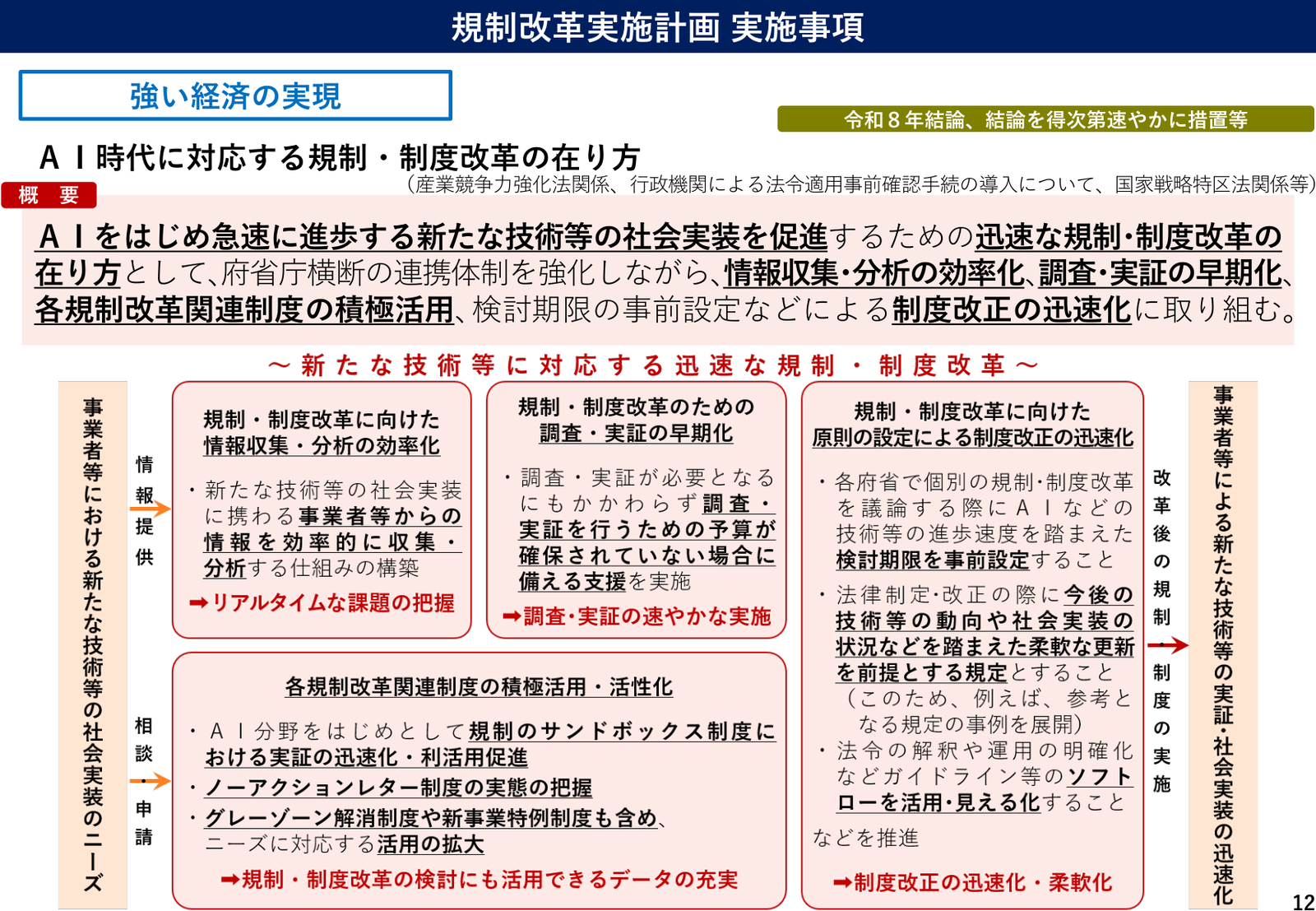
What changes. To encourage the social implementation of fast-moving new technology, the plan will put in place a faster way of carrying out regulatory and institutional reform. Concretely, while strengthening cross-ministry coordination, it will work on making information gathering and analysis more efficient, bringing surveys and trials forward, actively using existing schemes such as the prior-confirmation procedure for how laws apply (the mechanism for clearing grey zones) and the National Strategic Special Zones, and speeding up institutional change by setting study deadlines in advance. The Act on Strengthening Industrial Competitiveness is among the cited grounds.
What it means for businesses. This is less a deregulation of any one field than an upgrade of the engine that reviews rules. If a business that wants to try new technology can quickly confirm "is this use lawful," and the institutional changes it needs move faster, the outlook for turning AI into a business in Japan becomes easier to see. Reading the later items on top of this foundation is what brings the whole picture together.
Outlook. A conclusion is set for 2026, with measures taken promptly once reached. Because it is an upgrade of the mechanism itself, the results are likely to show up gradually, as the speed of individual items. For details, please refer to the plan itself.
Source: Cabinet Office, "Regulatory Reform Implementation Plan" (Cabinet decision, July 21, 2026), Implementation Items briefing material
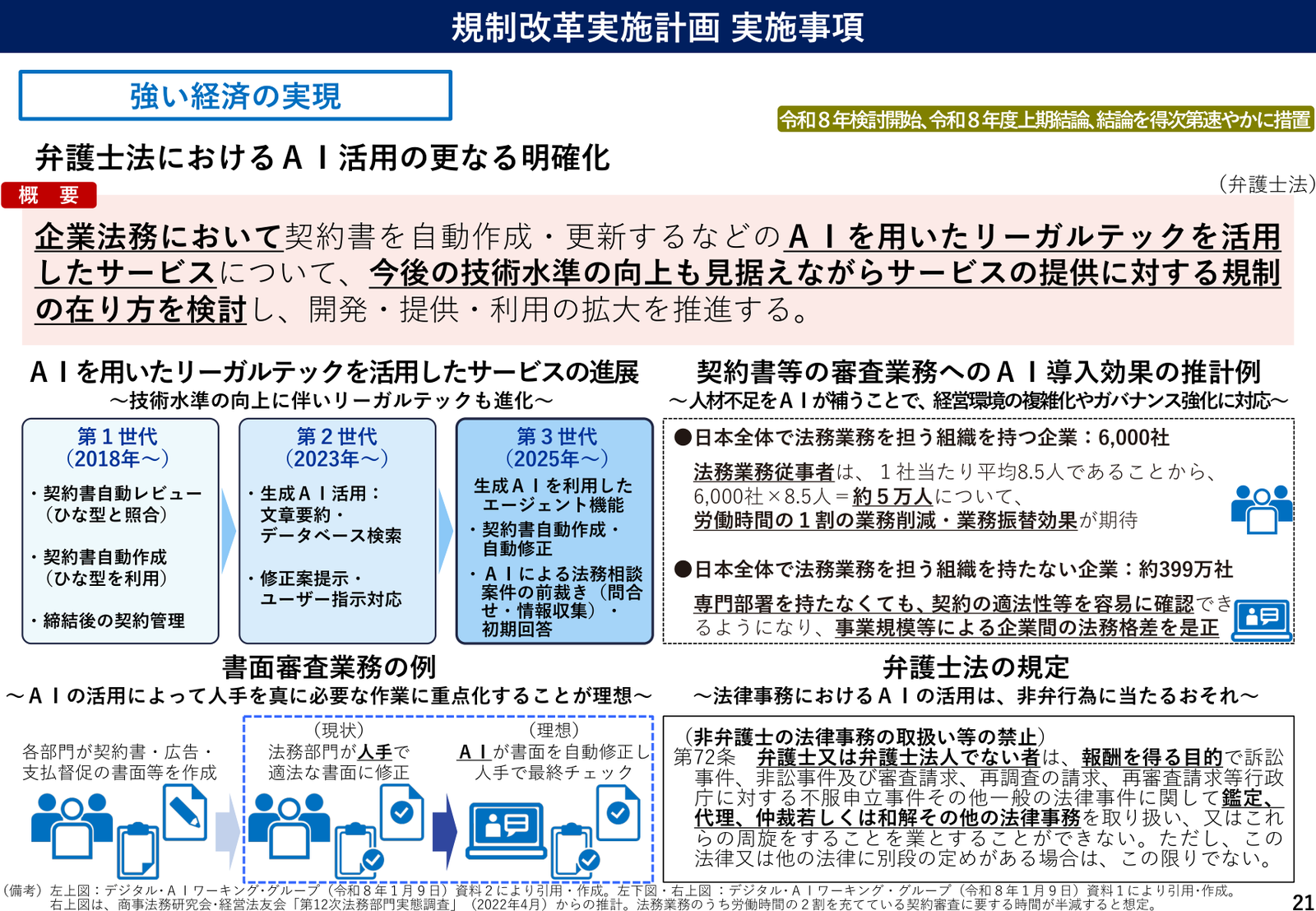
21. Further clarifying AI use under the Attorney Act
This item sorts out whether legal tech, in which AI drafts or revises contracts, runs into the Attorney Act.
Background and the current issue. Article 72 of the Attorney Act prohibits anyone who is not an attorney or a legal professional corporation from handling, as a business, legal appraisal, representation or other legal matters concerning legal cases for the purpose of obtaining compensation. This is the so-called non-attorney prohibition. The problem is AI-based legal tech. Legal tech has evolved across generations. The first generation (from around 2018) centred on automatic review and drafting of contracts by matching against templates; the second (from around 2023) added generative AI for text summarisation and suggested revisions; and the third (from around 2025) has widened to generative-AI agents that handle automatic drafting and revision of contracts and even the first triage of legal consultation. Yet because AI performing processing that includes legal judgment was said to risk counting as a non-attorney act, some providers held back from deciding how far they could take a service.
What changes. For AI legal tech that automatically drafts and updates contracts in corporate legal work, the plan says it will, with an eye on the rising technical standard ahead, examine the shape of regulation on service provision and promote wider development, provision and use. The direction is to organise the line between what is permitted and what is not to fit the reality of the technology.
What it means for businesses. The plan's briefing material shows an example estimate of the effect. Companies with an organisation handling legal work number 6,000 nationwide, with an average of 8.5 legal staff per company, which multiplies out to about 50,000 people. To this, an effect equivalent to trimming or reallocating one tenth of working hours is expected. On top of that, companies without a dedicated legal department reach about 3.99 million, and if such companies too could easily confirm the lawfulness of a contract, it would help correct the legal gap by company size. There is a two-sided meaning: for providers of legal tech the business outlook becomes clearer, and for the smaller companies that use it, it raises the floor of their legal capacity.
Outlook. This item is set to begin study in 2026, reach a conclusion in the first half of FY2026, and be acted on promptly once reached. Within the AI and digital field, the line is likely to be shown on a comparatively early timeline. For the concrete content, please refer to the plan itself.
Source: Cabinet Office, "Regulatory Reform Implementation Plan" (Cabinet decision, July 21, 2026), Implementation Items briefing material
By this point you can see that where AI enters specialist fields such as medicine and law, the rules are moving toward being sorted out. To turn such institutional changes into a tailwind for your own company, the starting point is grasping "which of my tasks does AI actually help." The service we provide, WARP, is an AI consulting service that designs exactly that judgment together with management, from the ground up. Rather than only waiting for the rules to fall into place, the idea of preparing to move the moment they do is what pays off.
Looking for AI training and consulting?
Learn about WARP training programs and consulting services in our materials.
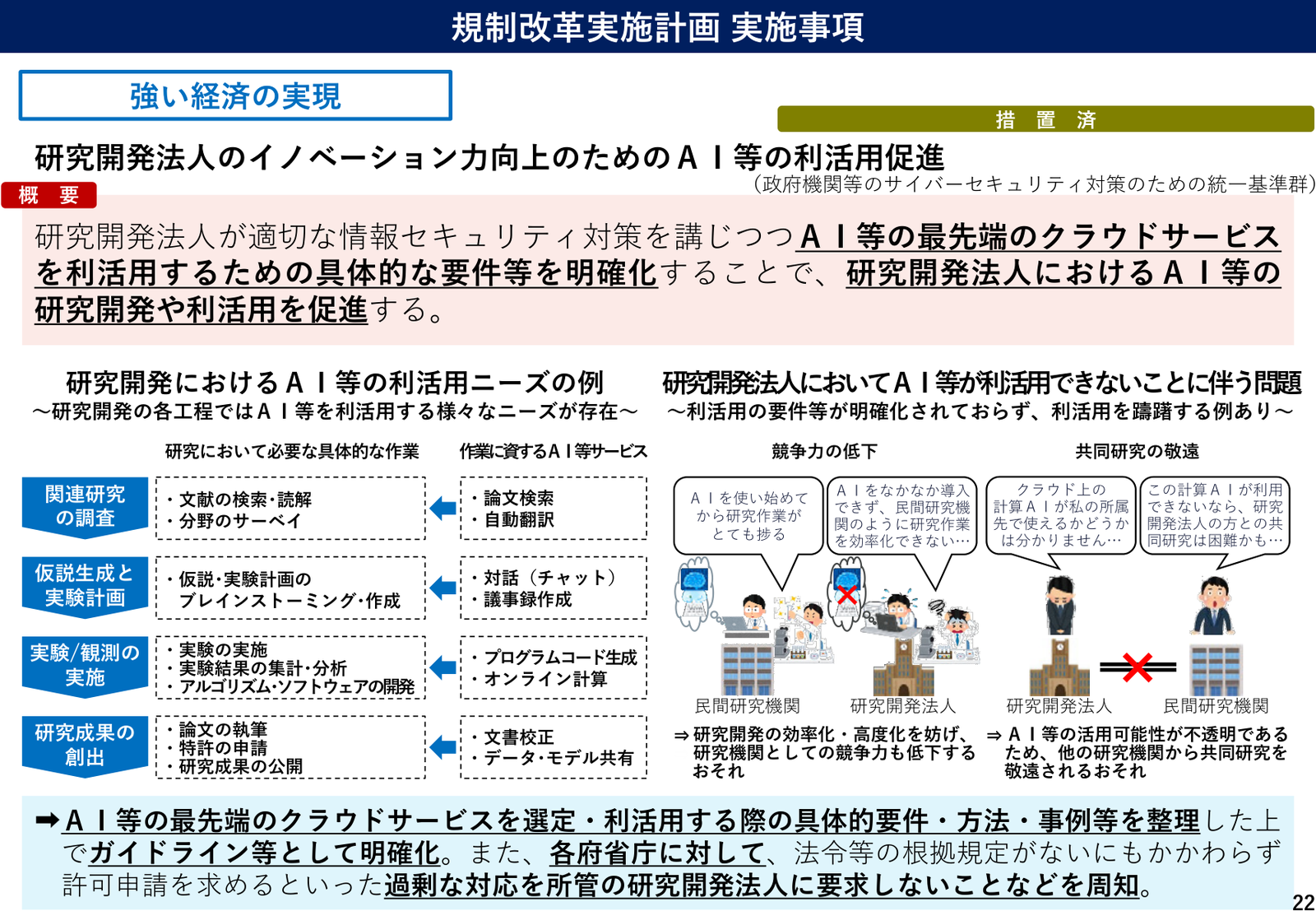
22. Promoting AI use to raise the innovation capacity of research institutions
This item lets national research and development agencies and the like use the latest cloud AI with confidence. It is said to be already implemented.
Background and the current issue. Research and development agencies must protect information in line with the common standards for the cybersecurity of government bodies. Yet because the requirements for whether they may use frontier cloud services such as AI were unclear, some hesitated to make use of them. Across the stages of research there are many places one wants to use AI: searching papers, automatic translation, brainstorming hypotheses, generating program code, and tabulating and analysing experimental results. Being unable to bring AI in, unlike private research institutions, meant research work could not be made as efficient, and there were concerns about falling competitiveness and about other bodies shying away from joint research.
What changes. The plan organised and clarified, as guidelines and the like, the concrete requirements, methods and cases for research institutions to select and use frontier cloud AI while taking appropriate information-security measures. Alongside this, it says it will make ministries aware not to demand excessive responses, such as requiring a permit application where there is no legal basis, from the research agencies under their jurisdiction.
What it means for research institutions and related businesses. Once the uncertainty over whether AI may be used is resolved, research can become more efficient and advanced, and joint research easier to arrange. For businesses that provide cloud AI to research institutions, it is a change toward lower barriers to adoption.
Outlook. This item is said to be already implemented. From here, the focus is on how the requirements and guidelines are applied in the field and whether the restraint on excessive responses actually takes hold. For details, please refer to the plan itself.
Source: Cabinet Office, "Regulatory Reform Implementation Plan" (Cabinet decision, July 21, 2026), Implementation Items briefing material
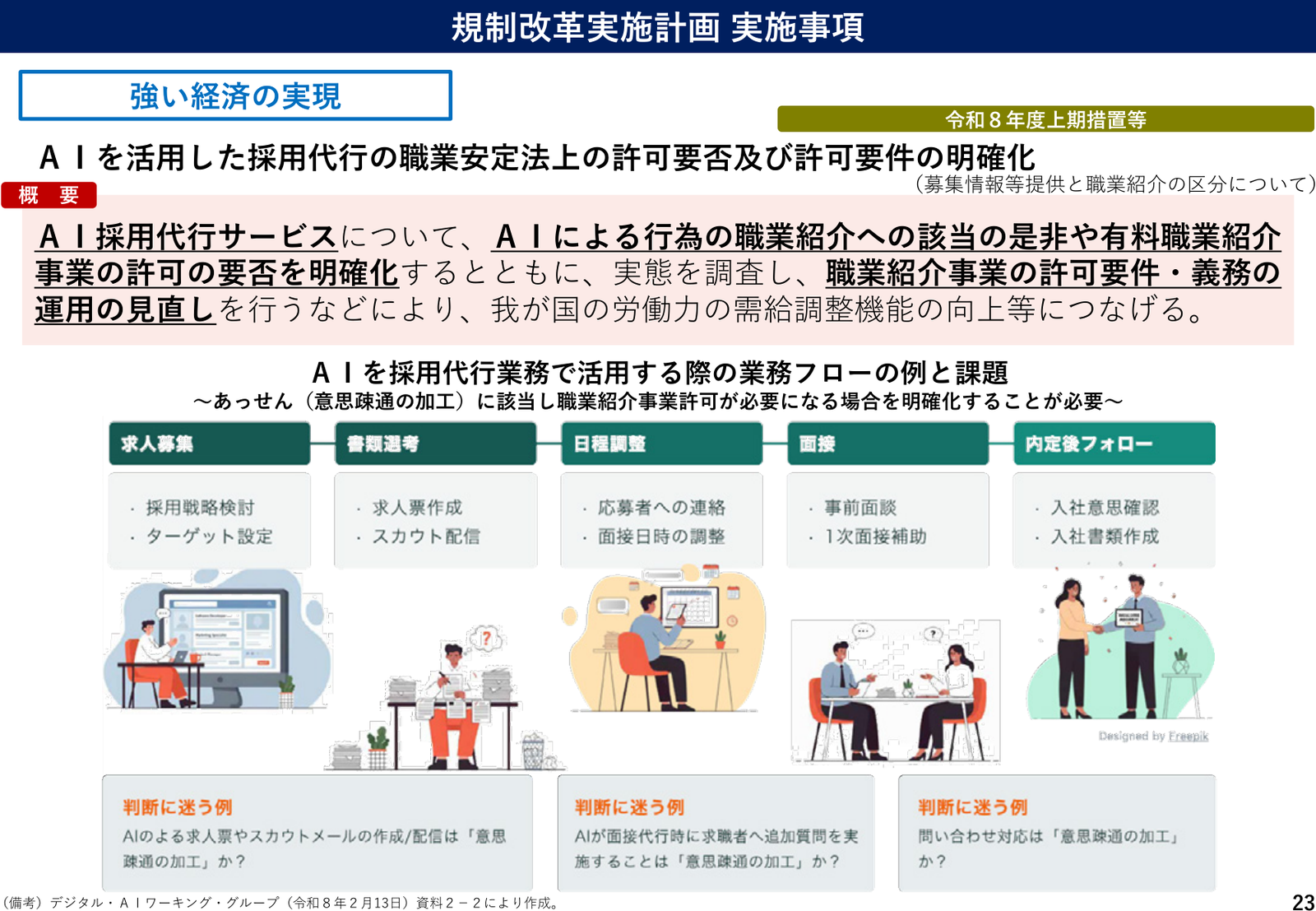
23. Clarifying whether AI-driven recruiting needs a licence under the Employment Security Act
This item sorts out from what point an AI recruiting service becomes "employment placement."
Background and the current issue. Standing between an employer and a job seeker and mediating their match requires, under the Employment Security Act, a licence for fee-charging employment placement. By contrast, simply delivering job information (recruitment information provision) needs no licence. The key to this line is "mediation," that is, whether an act counts as intermediating or processing the communication between employer and job seeker. As recruiting that has AI handle applicant screening and outreach to candidates spreads, it was unclear how far AI processing has to go before it counts as "mediation" and needs a licence.
What changes. For AI recruiting services, the plan will clarify whether AI actions fall under employment placement and whether a fee-charging employment-placement licence is required. Alongside this, it will survey the reality and also review how licensing requirements and duties for employment-placement businesses are applied. The direction is to make clear whether using AI requires a licence and, if so, on what conditions.
What it means for businesses. For providers of HR tech and AI recruiting support, the line that underlies service design will be settled. Once the areas that need a licence and those that do not are visible, they can build services while avoiding the risk of operating without one. For companies that recruit, it is also expected to improve the matching of labour supply and demand.
Outlook. This item is set to be acted on in the first half of FY2026. A comparatively early response is planned, so those who provide or use AI recruiting services would do well to check the thinking as soon as it is shown. For the concrete way the categories are drawn, please refer to the plan itself.
Source: Cabinet Office, "Regulatory Reform Implementation Plan" (Cabinet decision, July 21, 2026), Implementation Items briefing material
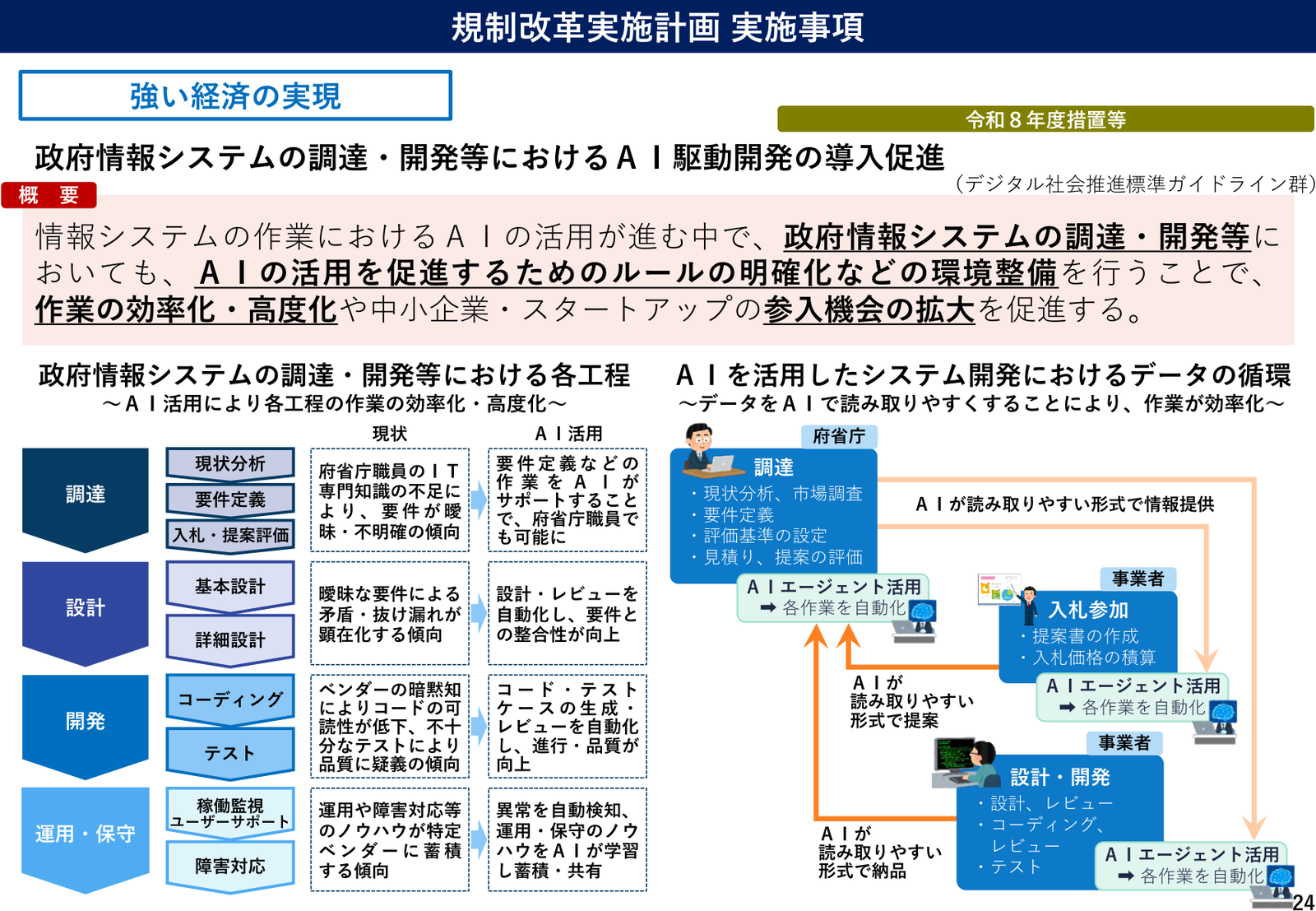
24. Promoting AI-driven development in the procurement and development of government information systems
This item brings AI in earnest into how the government itself develops systems.
Background and the current issue. On the ground, using AI in system development is advancing fast, but for the procurement and development of government information systems the rules that would encourage that use were not sufficiently in place. The plan's briefing material lists the issues at each stage. In procurement, a lack of IT expertise among ministry staff tends to leave requirements vague and unclear. In design, matters and gaps tend to surface out of those vague requirements. In development, vendors' tacit knowledge lowers code readability, testing is insufficient, and doubts about quality tend to arise. In operation and maintenance, know-how tends to accumulate with a particular vendor. It is a structure prone to what is called vendor lock-in.
What changes. In the procurement and development of government information systems, the plan will put in place an environment, such as clearer rules, to encourage AI use. The Standard Guidelines for Promoting a Digital Society are cited as grounds. It envisages AI agents at each stage: AI supporting requirement definition so that ministry staff can move it forward, automating design and review to raise consistency with requirements, and automating the generation and review of code and test cases to lift quality. It also sketches a flow in which information is exchanged in a form AI can read easily.
What it means for businesses. This is not only a matter for the government. Once AI-driven development becomes the premise, one stated aim is that SMEs and start-ups can more easily enter areas that had leaned on the tacit knowledge of large vendors. It is an item that aims at both more efficient, advanced work and wider entry. If the manners of government procurement change, it is expected to ripple out into private-sector system development too.
Outlook. This item is set to be acted on in FY2026. In the form of developing the Standard Guidelines, it is likely to move comparatively fast. For details, please refer to the plan itself.
Source: Cabinet Office, "Regulatory Reform Implementation Plan" (Cabinet decision, July 21, 2026), Implementation Items briefing material
25. Promoting public-road trials toward the social implementation of physical-AI walking robots
This item lets "physical AI," where AI has a body and moves in the real world, be tested on public roads.
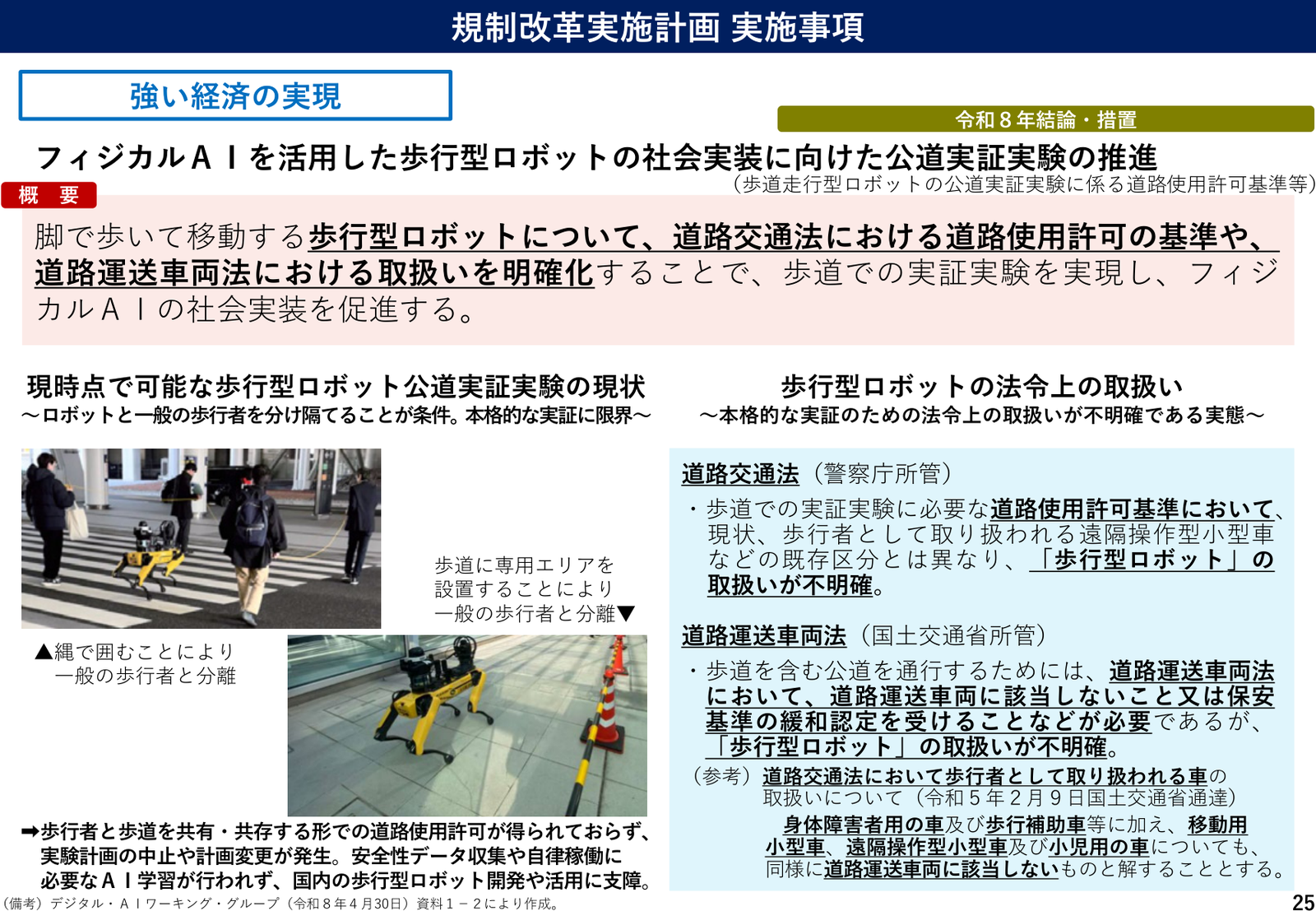
Background and the current issue. A walking robot that moves on legs is one representative example of physical AI. Yet when you try to run a trial on a public road, its position is unclear under two laws. One is the Road Traffic Act, under the National Police Agency: in the road-use permit criteria needed for a pavement trial, the treatment of "walking robots" is not clear, unlike existing categories such as remotely operated small vehicles that are treated as pedestrians. The other is the Road Transport Vehicle Act, under the Ministry of Land, Infrastructure, Transport and Tourism: to travel on public roads including pavements, a device must either not fall under road transport vehicles or receive a safety-standard relaxation, and here too the treatment of walking robots is unclear. Because of this, current trials have been conditioned on separating the robot from ordinary pedestrians by roping off an area or setting up a dedicated zone, which limited full-scale testing. Permits to share a pavement with pedestrians could not be obtained, trial plans were cancelled or changed, and the collection of safety data and the AI training needed for autonomous operation could not advance.
What changes. For walking robots, the plan will clarify the road-use permit criteria under the Road Traffic Act and the treatment under the Road Transport Vehicle Act, thereby making pavement trials possible and encouraging the social implementation of physical AI.
What it means for businesses. Once robots can walk on real pavements, the accumulation of real data for uses such as delivery and patrol advances. For physical AI, running the learning loop on collected travel data is the key to better performance, so being able to run public-road trials is itself the premise of development. For businesses developing and using robots in Japan, it is a change that opens a path.
Outlook. This item is set for a conclusion and measures in 2026. As the treatment under the two laws is sorted out, the barrier to trials is likely to come down. For the concrete criteria, please refer to the plan itself.
Source: Cabinet Office, "Regulatory Reform Implementation Plan" (Cabinet decision, July 21, 2026), Implementation Items briefing material
26. Accelerating the domestic siting of next-generation AI data centres
This item makes it easier to build the very computing base that runs AI within the country.
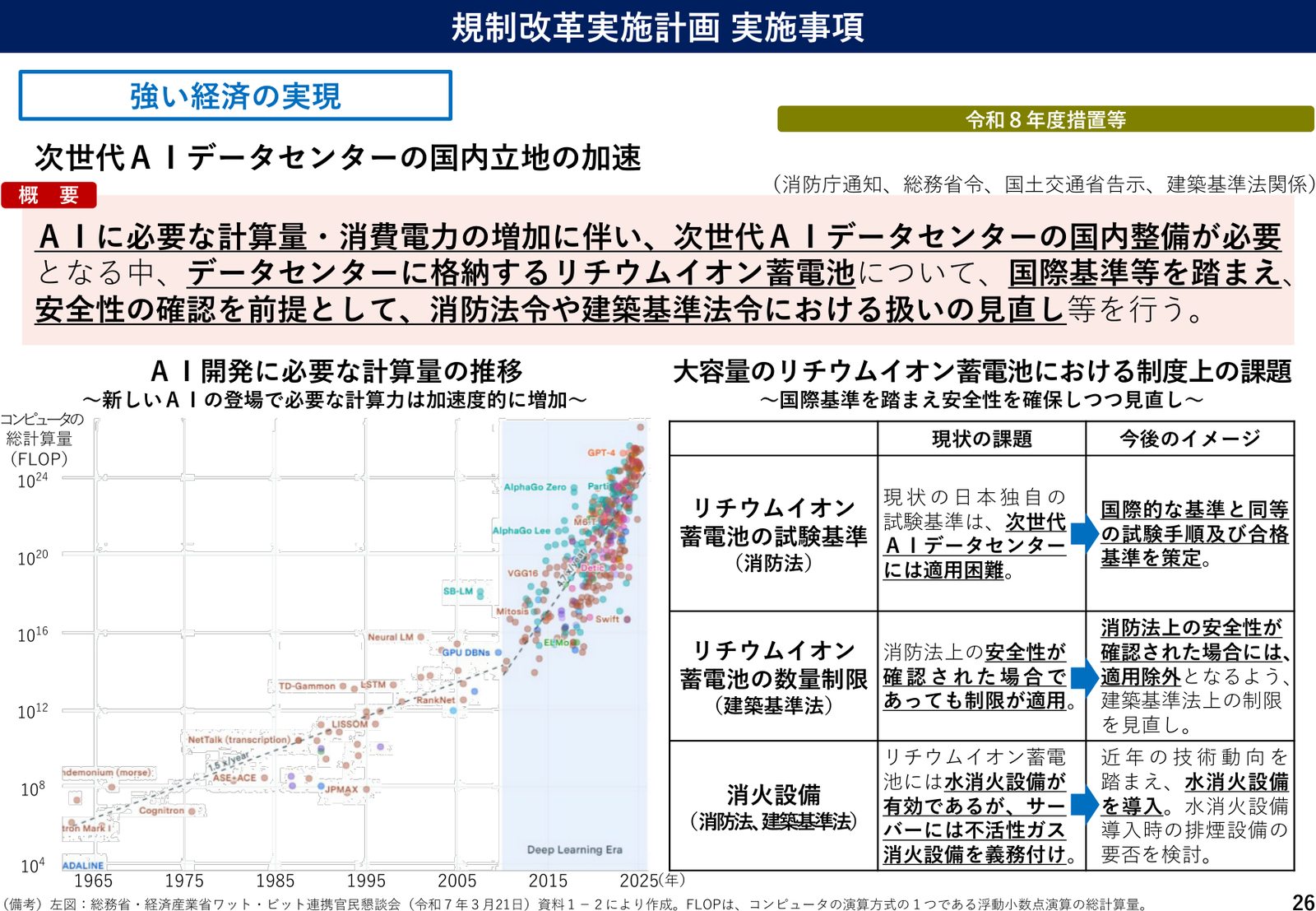
Background and the current issue. The computing needed to develop AI grows at an accelerating pace with each new model. Power consumption swells alongside it, raising the need to build next-generation AI data centres domestically. Yet three institutional snags are pointed out around the large-capacity lithium-ion storage batteries such centres hold. One is the test criteria under the Fire Service Act: Japan's own test criteria are hard to apply to next-generation AI data centres. One is the quantity limit under the Building Standards Act: a limit applies even where safety has been confirmed under the Fire Service Act. And one is fire-fighting equipment: water-based systems are effective for lithium-ion batteries, while inert-gas systems are mandated for servers. Safety is to be kept, but as things stood a large data centre equipped with high-capacity batteries was hard to build.
What changes. Taking international standards and the like into account, and on the premise of confirming safety, the plan will review the treatment under the Fire Service Act and the Building Standards Act. For the test criteria, the direction is to establish test procedures and pass criteria equivalent to international standards; for the quantity limit, to review the Building Standards Act limit so it does not apply where safety under the Fire Service Act is confirmed; and for fire-fighting equipment, to introduce water-based systems in light of recent technical trends and to examine whether smoke-exhaust equipment is then needed.
What it means for businesses. As the domestic siting of AI data centres advances, it becomes possible to hold the computing base for AI within the country, widening the options for companies that want to handle data domestically. For related industries such as construction, power supply, storage batteries and cooling, it is a change that makes investment easier to move. It bears on the foundation for all businesses developing and operating AI in Japan.
Outlook. This item is set to be acted on in FY2026. On the premise of confirming safety, a review aligned with international standards is likely to advance. For details, please refer to the plan itself.
Source: Cabinet Office, "Regulatory Reform Implementation Plan" (Cabinet decision, July 21, 2026), Implementation Items briefing material
27. Reviewing the attendance of licensed real-estate agents at important-matter disclosures, to make effective use of digital and AI
This item sorts out the cases in which a licensed real-estate agent need not attend in person at the important-matter disclosure in a property transaction.
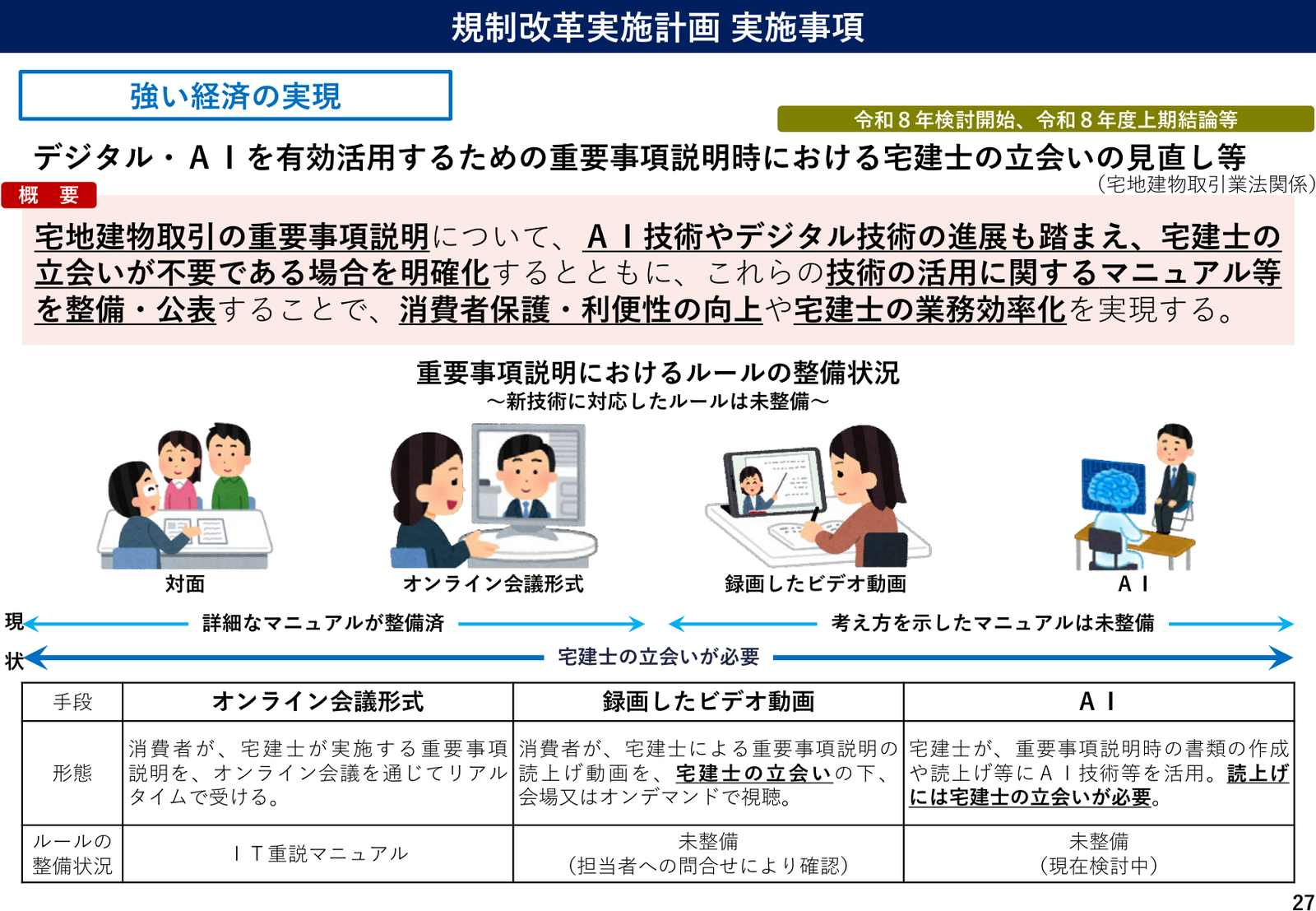
Background and the current issue. In the sale or lease of real estate, the Building Lots and Buildings Transaction Business Act requires a licensed real-estate agent (a takken-shi) to explain the important matters before the contract. The means of this explanation have widened: alongside in person, there is receiving it in real time by online meeting, and viewing a video of the agent reading it out under attendance. There are moves to use AI here too, but even when AI is used to prepare documents or read them out, an agent's attendance is required for the reading, and the rules were not in place. Manual provision varies for online-meeting and recorded-video formats, and for AI there is as yet no manual setting out the thinking.
What changes. For important-matter disclosures, taking the progress of AI and digital technology into account, the plan will clarify the cases in which an agent's attendance is unnecessary. Alongside this, it will develop and publish manuals and the like on the use of these technologies. The direction is to make clear in which cases attendance can be dispensed with and to show a guide to how the tools are used.
What it means for businesses. Once the cases needing no attendance are clear, it makes the disclosure more convenient for consumers, who can receive it at a time that suits them, and more efficient for agents. For real-estate businesses and companies working on digital services in this field, the premise of how far AI and digital tools may be used will be settled. Consumer protection is also stated as an aim.
Outlook. This item is set to begin study in 2026 and reach a conclusion in the first half of FY2026. Because manual development is involved, the steps toward actual operation are expected to be shown alongside. For details, please refer to the plan itself.
Source: Cabinet Office, "Regulatory Reform Implementation Plan" (Cabinet decision, July 21, 2026), Implementation Items briefing material
33. Using digital technology in instruction at designated driving schools
This item makes it easier to bring online and remote digital tools into driver's-licence instruction.
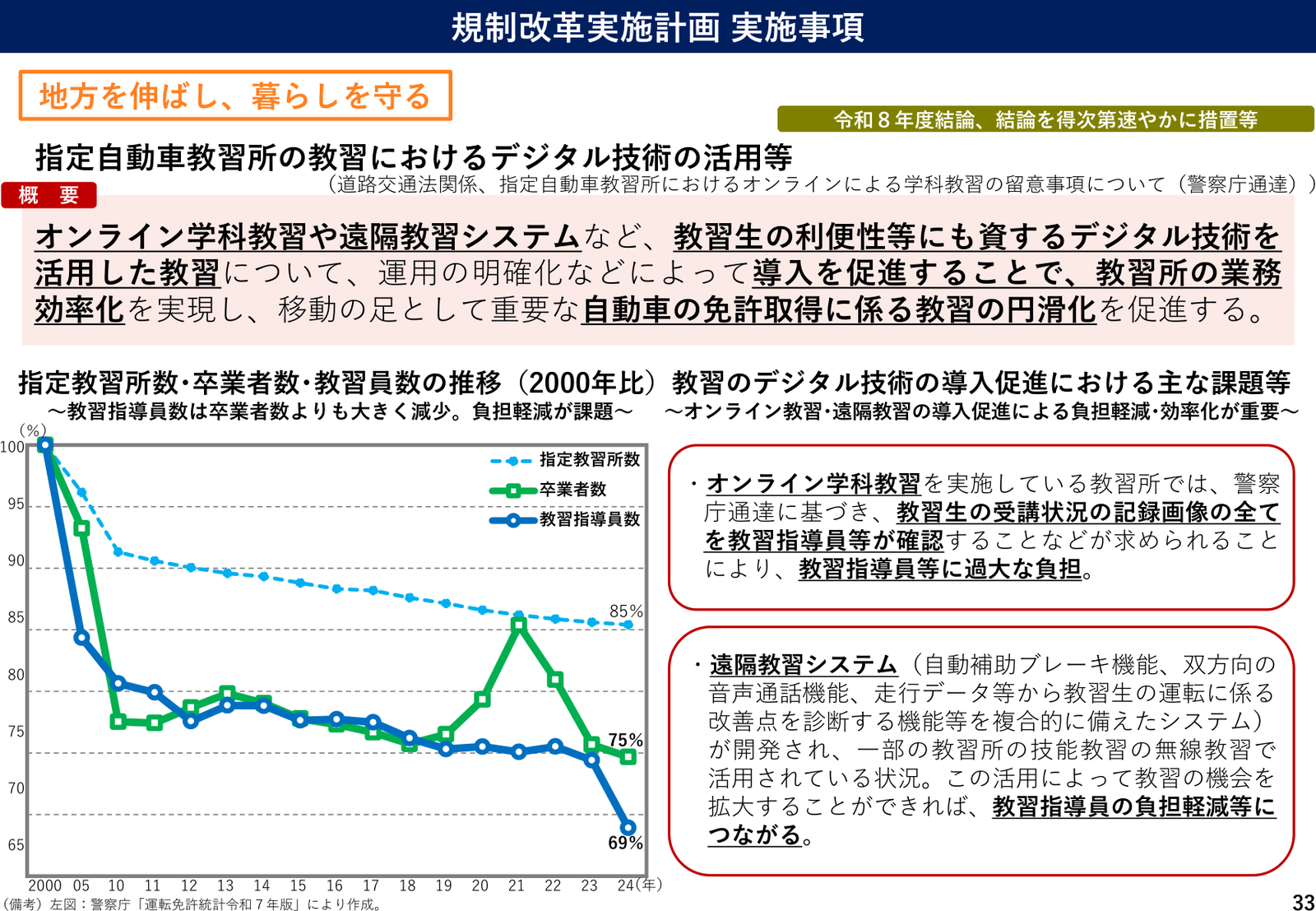
Background and the current issue. Designated driving schools are an important place supporting the licences that make a car the means of getting around in rural life, but their staff are dwindling. According to the plan's briefing material, compared with the year 2000, the fall in the number of instructors is larger than the fall in the number of designated schools or graduates, and easing the instructors' burden has become an issue. Digital use has begun, but two snags are raised. One is online classroom instruction: under a National Police Agency notice, instructors are required to check all of the recorded images of students' attendance, which places an excessive burden on them. The other is remote instruction systems: systems combining features such as automatic assist braking, two-way voice communication and diagnosis of points to improve from driving data have been developed and are used in some schools' radio-linked practical instruction, but room remains to widen their use.
What changes. For instruction that uses digital technology beneficial to student convenience, such as online classroom instruction and remote instruction systems, the plan will promote adoption by clarifying operation and the like. Provisions related to the Road Traffic Act and a National Police Agency notice on points to note for online classroom instruction at designated driving schools are cited as grounds. The direction is to sort out the operation of digital use, including how the excessive checking burden is handled.
What it means for businesses. For schools, making online and remote instruction easier to adopt leads to more efficient work and a lighter load on instructors. For students, it is expected to widen the chance to attend and make it easier to obtain a licence in rural areas. For businesses developing digital services for instruction, it is a change that supports adoption.
Outlook. This item is set to reach a conclusion in FY2026, with measures taken promptly once reached. It is likely to advance in the form of clarifying operation. For details, please refer to the plan itself.
Source: Cabinet Office, "Regulatory Reform Implementation Plan" (Cabinet decision, July 21, 2026), Implementation Items briefing material
Reading this plan as a story about your own company
Line up the 10 items and a common theme comes into view. Every one of them tries, through clarification or new rules, to reduce the uncertainty of "we want to use AI, but we do not know how far the current rules allow it." Medicine, law and recruiting, government systems, robots and data centres, they all point the same way: removing the snags that arise just before AI enters real work.
What matters here is that the rules falling into place does not, by itself, produce results. Even once regulation is clear, if you do not know which of your tasks AI would actually make easier, the tailwind passes you by. Between the order from above and the shop floor, translation is always needed. Waiting without knowing where to start means you cannot move even when the rules exist.
If you are unsure where and how to bring AI into your own company, or where the bottleneck in your productivity sits, please talk to the WARP team. Specialists who led DX and data strategy at major companies walk alongside you month by month, helping you bring AI down into your management. Let us start from translating the large flow of policy into the one step in front of you. That said, bringing in AI does not solve everything. The judgment about where it works and where it does not is itself the first fork in the road.
To sum up
It ran long, so let me organise the key points of the AI and digital field.
- The Regulatory Reform Implementation Plan is a plan of 57 items decided by the Cabinet on 21 July 2026, among which sit the items relating to AI and digital
- In medicine, study advances toward allowing a single physician to read cancer-screening images while keeping accuracy assured (item 7)
- The shape of AI-era regulatory reform, which raises the speed of institutional change, is the foundation of the whole (item 12)
- The lines for those who turn AI into a service are sorted out, such as clarifying AI use under the Attorney Act and whether AI recruiting needs a licence (items 21 and 23)
- The environment for organisations that use AI is prepared too, such as AI use at research institutions and AI-driven development for government systems (items 22 and 24)
- The foundations for AI acting in the real world are addressed, such as public-road trials for walking robots and accelerating the siting of next-generation AI data centres (items 25 and 26)
- Everyday settings are covered too, such as agent attendance in real estate and digital use at driving schools (items 27 and 33)
A policy document, read only as a document, looks like someone else's business. But the "use of AI" and "efficiency of work" written into it are exactly the themes each company can start thinking about tomorrow. With the government now pointing a direction, this is not a bad time to start moving. Begin from working out where AI actually helps in your own company.