Hello, this is Ryuta Hamamoto from TIMEWELL.
On 21 July 2026, the government made a Cabinet decision on the "Regulatory Reform Implementation Plan." It is a large plan spanning 57 items in all, gathering reviews of regulations across a wide range of fields from agriculture to healthcare, AI and labour. In this series I have been organising the contents field by field in plain language, and the field I take up this time is mobility, logistics and transport.
Autonomous driving, drones, ride-sharing, how roads are used, vehicle maintenance, and logistics in disasters. Every one of these touches our daily lives and our businesses directly, yet the original document is full of the phrasing peculiar to administrative writing and is a tough read for anyone coming to it for the first time. So in this article I take up the nine implementation items in this field one by one, and for each I break it down in the order of background, the substance of the change, what it means for businesses, and the outlook. It runs long, but by the time you finish I want you to be able to picture the whole of where the regulation of movement and logistics is heading.
If you first want to place where this plan sits overall, see our article explaining the whole picture of the Regulatory Reform Implementation Plan 2026, and if you are interested in the review of the AI and digital field, read it together with our article on Regulatory Reform 2026 x AI and digital. If you are thinking about how to bring AI into your own operations, checking where you stand first with our free AI literacy self-check will make the later discussion more concrete.
Note that the figures, system names and timing of enforcement I touch on below are all based on the government's briefing materials. For the detailed conditions and citations of each item, please refer to the text of the Regulatory Reform Implementation Plan.
Making autonomous driving easier to run in line with actual practice
Let me start with what could be called the lead role of this field, autonomous driving. This is item 3.
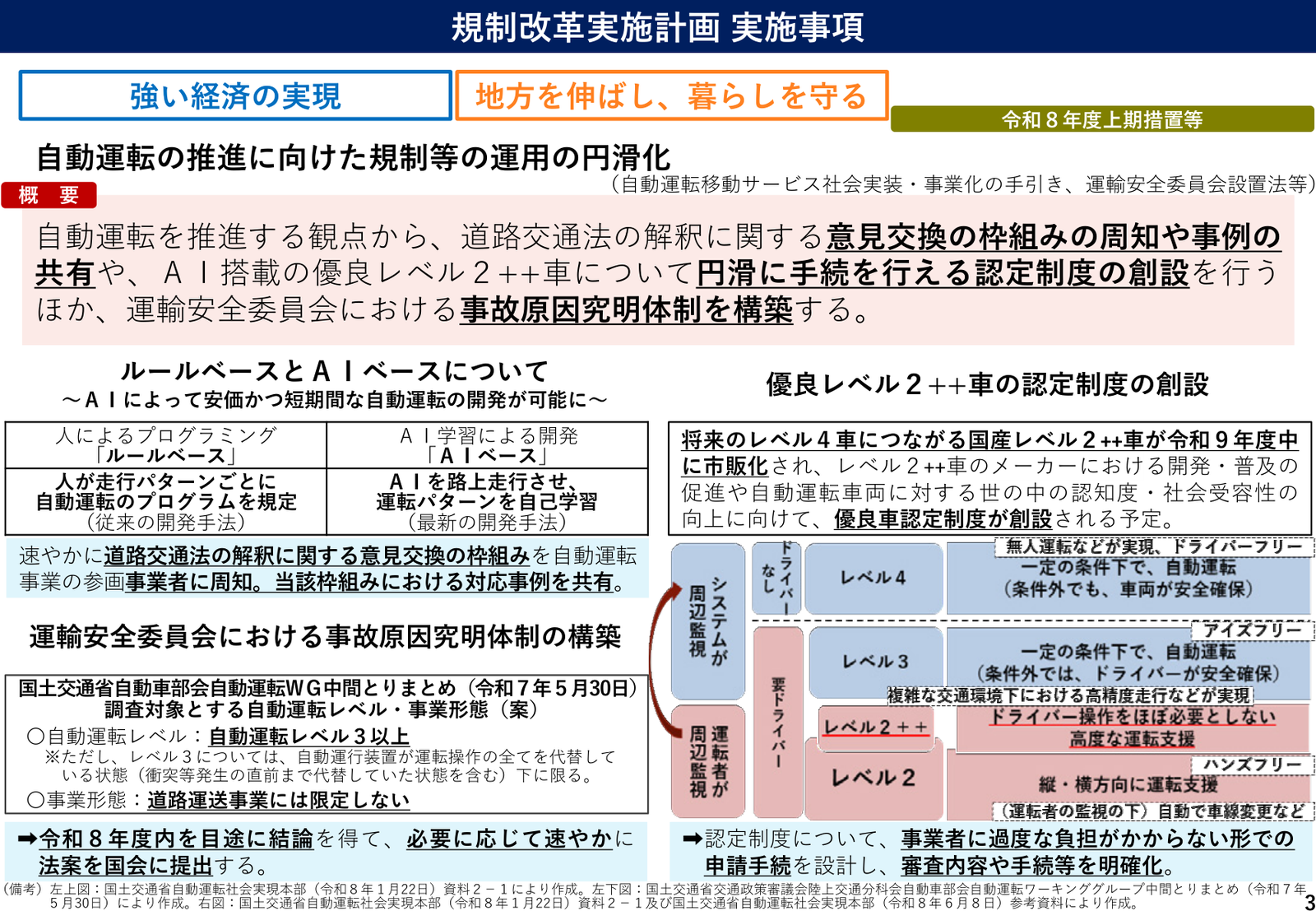
Let me organise the background first. The way autonomous driving is developed is changing greatly right now. The mainstream used to be the "rule-based" approach, in which people wrote driving programmes for each driving pattern. Recently, though, "AI-based" development, in which an AI is actually run on real roads and learns driving patterns for itself, has spread. Using AI, autonomous driving can now be developed more cheaply and in a shorter time. That is the starting point. The faster the technology advances, the more the operation of the systems supporting it has to keep pace.
The change this time has three parts. The first is to make the framework for exchanging views on how the Road Traffic Act is interpreted known promptly to businesses joining autonomous-driving ventures, and to share the worked examples produced within that framework. The aim is to reduce cases where a business stalls because it cannot tell how a rule should be read. The second is to create a new certification system that lets excellent AI-equipped Level 2++ vehicles clear procedures smoothly. Application procedures will be designed so as not to place an excessive burden on businesses, and what is examined and the procedure itself will be made clear. The third is to build a system at the Japan Transport Safety Board for investigating the causes of autonomous-driving accidents.
What this means for businesses is not small. A Level 2++ vehicle here is a bridging vehicle that leads toward future Level 4 (the stage where driving can be fully entrusted under specific conditions). In the government's materials, these domestic Level 2++ vehicles are expected to reach the market during FY2027. A certification system for excellent vehicles would give a boost to makers' development and to wider adoption, and would also raise public awareness of and comfort with autonomous vehicles. That is the reasoning. For a business considering a service that uses autonomous driving, simply having a place to consult when unsure how to read a rule is a source of practical reassurance.
Now the outlook. Making the framework for exchanging views known and creating the certification system are targeted for measures in the first half of FY2026. For the accident-cause investigation system at the Japan Transport Safety Board, the aim is to reach a conclusion by around the end of FY2026 and then, as needed, submit a bill to the Diet promptly. The reviews here are envisioned to cover autonomous driving of Level 3 and above, and the business form is not limited to road transport operations. The timing could shift forward or back depending on how the technology progresses, but it is clear that the system-building has entered a concrete stage.
Source: Cabinet Office, "Regulatory Reform Implementation Plan" (Cabinet decision, July 21, 2026), Implementation Items briefing material
Widening drones from both the places they can fly and the spectrum they can use
Next is drones, item 11. Formally it is the item on promoting the social implementation of unmanned aircraft, and here the lead role goes to VTOL drones, which can fly high, fast and over long distances.
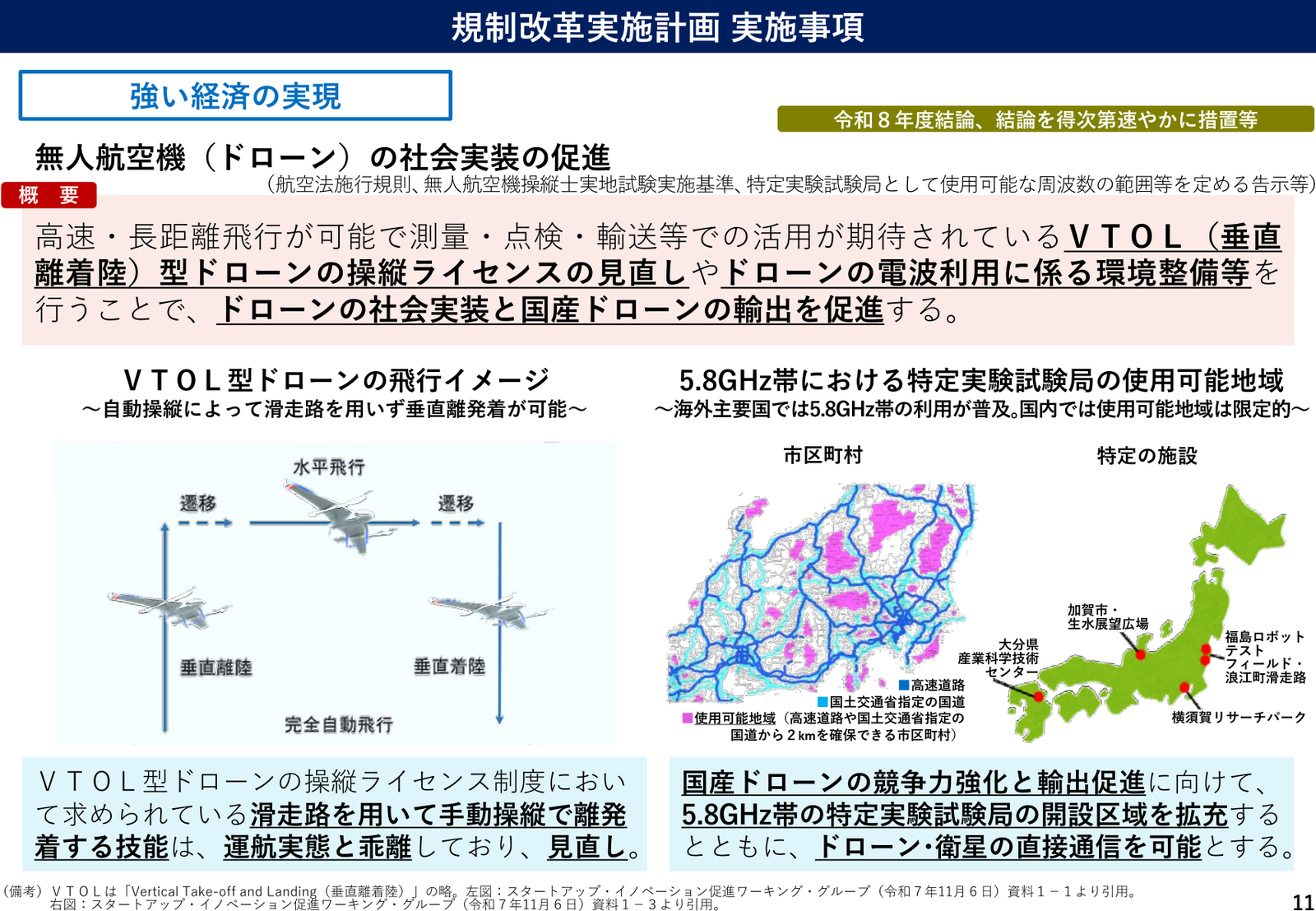
The background. VTOL stands for vertical take-off and landing, and its feature is that it can take off and land vertically under automatic control without using a runway. Uses in surveying, facility inspection and transport are expected. Yet the current pilot licence system requires the skill of taking off and landing manually using a runway. Requiring runway-based manual piloting skills for an aircraft that can take off and land vertically does not match how it is actually operated. Another wall is the radio spectrum. The 5.8 GHz band, which suits drone use, is widely used in major countries abroad, but at home the areas where it can be used were limited to places that could keep a certain distance from expressways or designated national roads, which was restrictive.
The change has two parts. One is to review, in line with actual operation, the runway take-off and landing skills required in the pilot licence system for VTOL drones. The other is to prepare the radio-spectrum conditions by expanding the areas where experimental stations in the 5.8 GHz band can be set up, and, together with that, to allow direct communication between drones and satellites. It works on both the qualification for flying and the spectrum for flying.
What this means for businesses comes down to a wider range of uses. The government positions this review as leading, together with the social implementation of drones, to strengthening the competitiveness of domestic drones and to promoting exports. For a business that wants to use drones in earnest for inspection or transport, having both the qualification requirements and the usable places move closer to reality is a tailwind for stepping from demonstration to actual operation.
Now the outlook. This item is to reach a conclusion in FY2026, with measures taken promptly once the conclusion is in. If the review of the pilot licence and the expansion of spectrum use advance on the same timeline, the hurdles to use will come down together.
Source: Cabinet Office, "Regulatory Reform Implementation Plan" (Cabinet decision, July 21, 2026), Implementation Items briefing material
Looking for AI training and consulting?
Learn about WARP training programs and consulting services in our materials.
Arranging ride-sharing along three directions: promotion, checks and local rules
As a response to the shortage of transport options, the ride-sharing-related items move as a set of three. Promotion itself (item 34), the interim check of vehicles (item 35), and the local rules for community-based private paid passenger transport (item 36). I take them in turn below.
34 Promoting ride-sharing to resolve the nationwide shortage of transport options
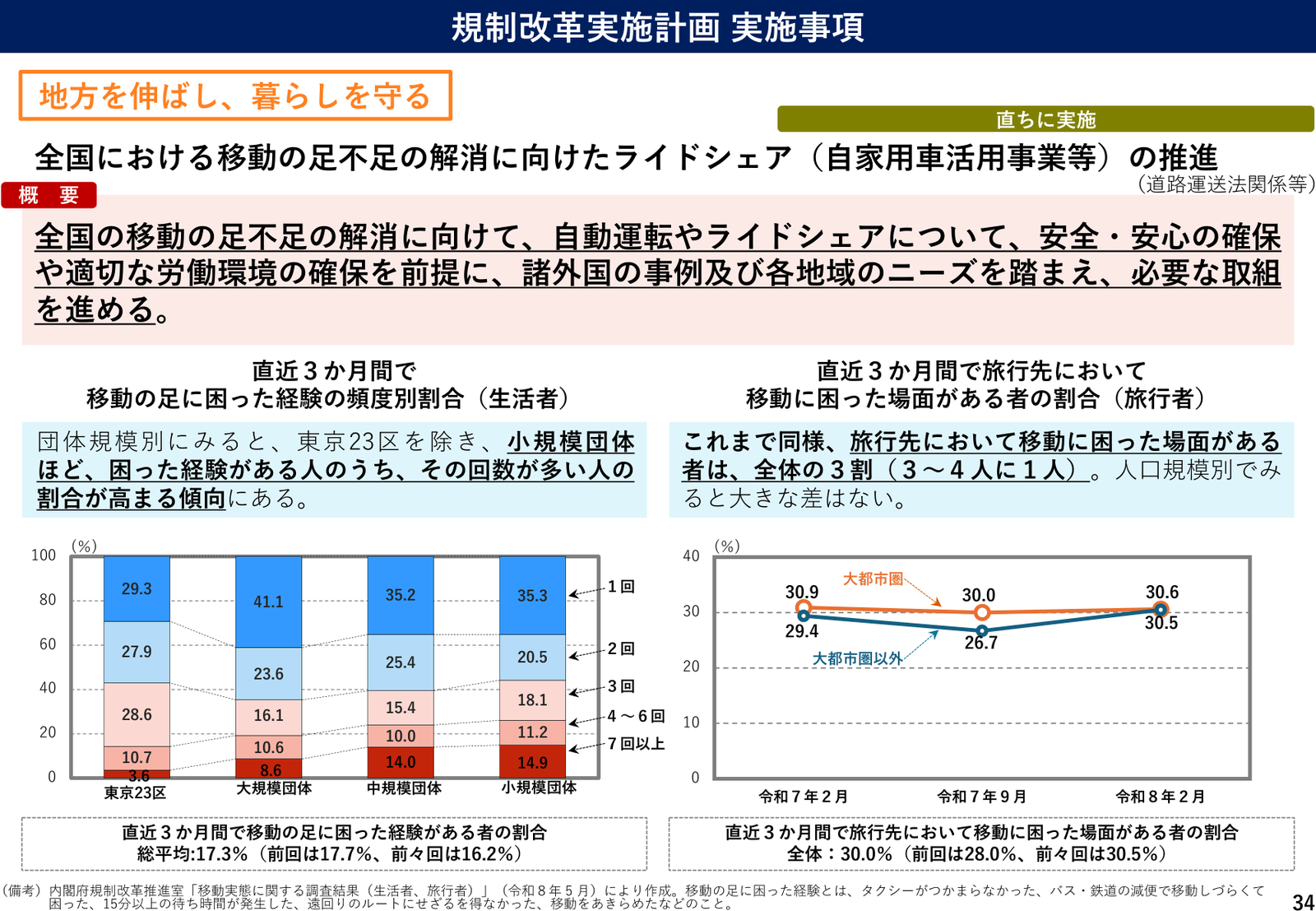
The background. In a government survey, the share of people who had trouble finding a way to get around in the most recent three months was 17.3%, and those who had a moment of difficulty getting around at a travel destination came to 30.0%. In particular, once the 23 wards of Tokyo are excluded, the smaller the municipality, the higher the share of people who, among those who had trouble, had trouble many times. Problems such as reduced bus and rail services and being unable to catch a taxi show up more severely in the regions.
The direction of the change is to advance necessary measures on autonomous driving and ride-sharing, on the premise of securing safety, peace of mind and an appropriate working environment, and reflecting examples from other countries and the needs of each region. Rather than rolling out one particular method all at once, it is written as increasing the options that can be used according to the real conditions of each area.
What this means for businesses and regions is that the path to becoming a provider of transport widens. For taxi operators of course, and for any body that wants to support local transport, having ride-sharing backed as an option within the system bears on how they build their operations.
Now the outlook. This item is set as "immediate implementation." Rather than being examined over time, it is placed at the stage of already being put into motion.
Source: Cabinet Office, "Regulatory Reform Implementation Plan" (Cabinet decision, July 21, 2026), Implementation Items briefing material
35 Clarifying who carries out the interim check and how, in the private-vehicle utilisation business
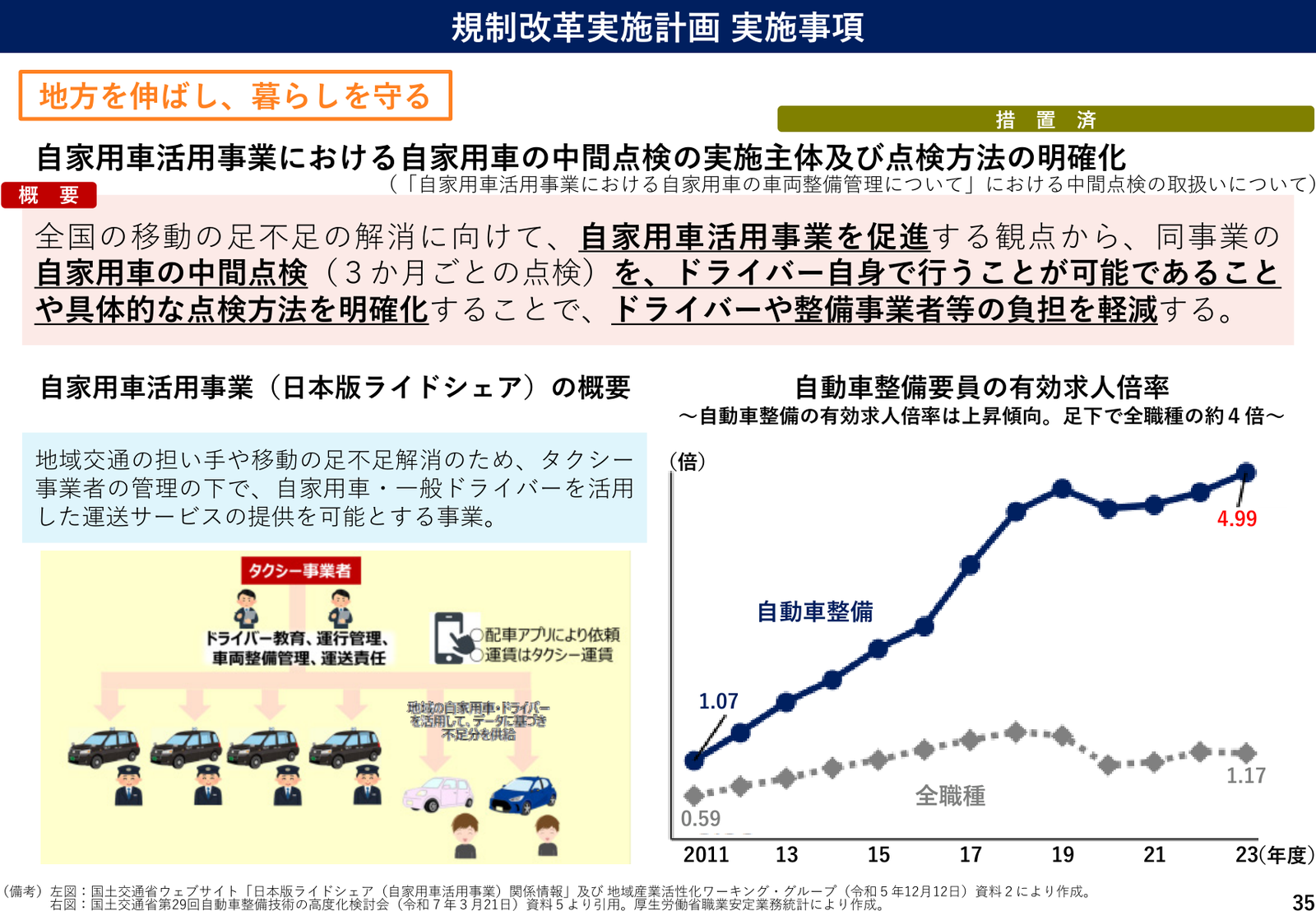
The background. The private-vehicle utilisation business, also called Japan's version of ride-sharing, is a scheme in which, under the management of a taxi operator, private vehicles and general drivers are used to provide transport services. The issue here was the interim check of vehicles, that is, who carries out the three-monthly check and how. As it happens, there is a shortage of people to do vehicle maintenance: the effective ratio of job openings to applicants for vehicle maintenance has reached about four times the figure for all occupations (4.99 times) recently. Asking maintenance businesses to do all of the checks is not always realistic in terms of the burden.
The change is to clarify that this three-monthly interim check can be carried out by drivers themselves, and to make clear how it is to be done. This item has already been implemented.
The meaning is plain: it eases the burden on both drivers and maintenance businesses. Once it is clear who may carry out the check, it becomes easier to keep the checks running without halting operations. It is one step toward an environment in which the business can continue even amid a shortage of mechanics.
As for the outlook, since it has already been implemented, what remains is for the practice to settle in on the ground.
Source: Cabinet Office, "Regulatory Reform Implementation Plan" (Cabinet decision, July 21, 2026), Implementation Items briefing material
36 Reviewing the local rules of the community-based private paid passenger transport system
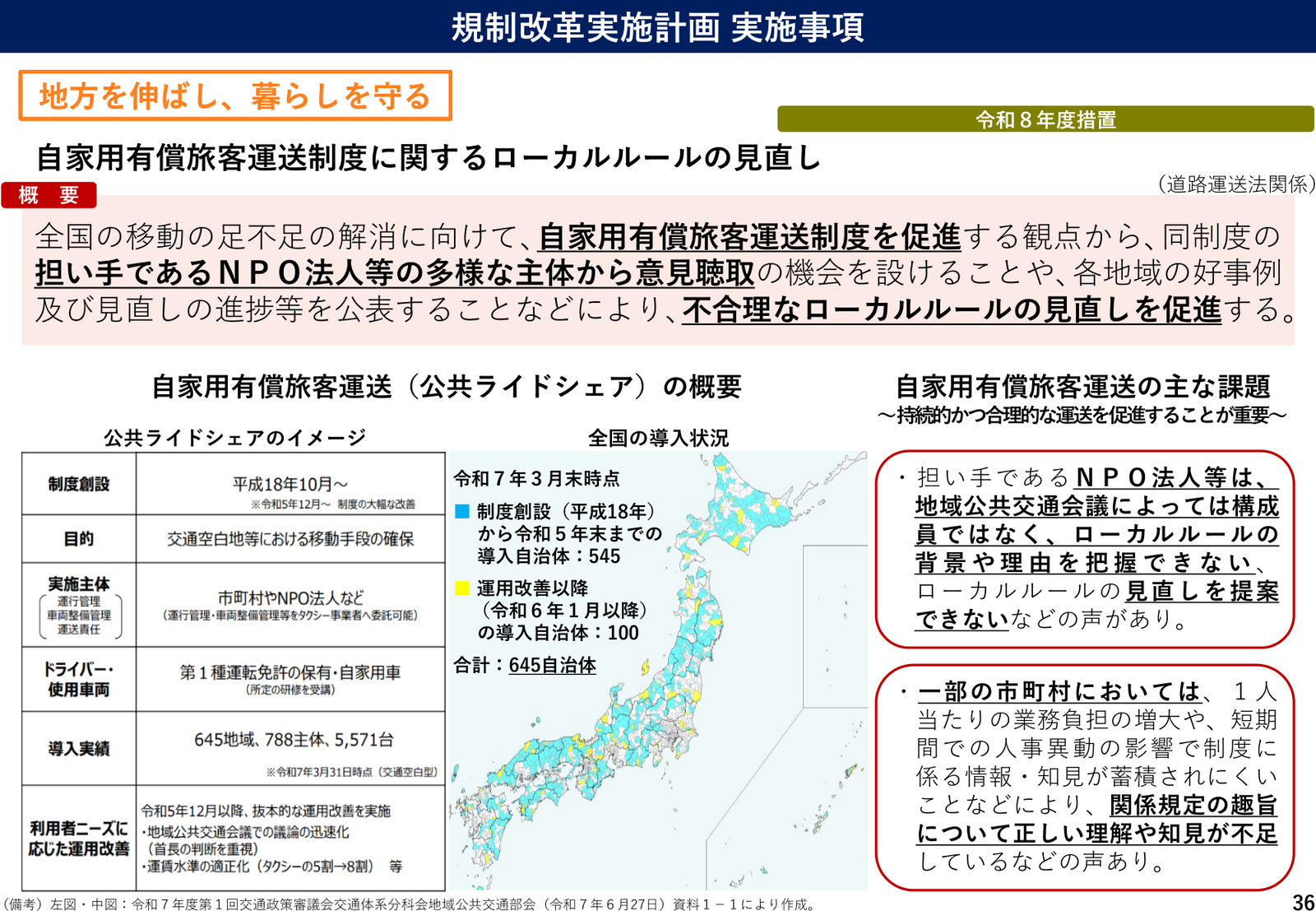
The background. Community-based private paid passenger transport, also called public ride-sharing, is a system in which bodies such as NPOs are often the providers. From the system's creation in 2006 to the end of FY2023, 545 municipalities had introduced it, and 100 municipalities introduced it after the operational improvement of January 2024, for a total of 645 municipalities as of the end of March 2025. There were issues, though. In some municipalities the per-person workload is heavy, or the knowledge of the system does not accumulate well because of short-cycle personnel transfers, so there are voices saying the intent of the rules is hard to understand correctly. There was also the point that the NPOs and other providers are not members of the regional public transport councils, so they cannot grasp the background of local rules or propose reviews.
The direction of the change is to encourage the review of unreasonable local rules through such means as setting up opportunities to hear the views of the diverse providers such as NPOs, and publishing good examples from each region and the progress of reviews.
What this means for businesses and regions is that the voice of the front line reaches the operation of the system more easily. If area-specific rules remain in place while out of step with reality, a system that should be useful becomes hard to use. Once there is a circuit through which providers can propose reviews, transport moves closer to being sustainable and reasonable.
Now the outlook. This item is scheduled for measures in FY2026. If the publication of good examples spreads sideways, the later a municipality starts, the easier it will be to draw on them.
Source: Cabinet Office, "Regulatory Reform Implementation Plan" (Cabinet decision, July 21, 2026), Implementation Items briefing material
Reviews of this kind around transport options are also deeply connected to laying the foundation of regional economies. The policy flow from the angle of regional industrial development is also covered in our beginner's guide to the Regional Future Strategy, and reading them together brings the picture into three dimensions. And the phrase "labour shortage" that keeps coming up here is the recurring undertone of this whole field. As the number of providers falls, how do you keep things running with a limited number of people? One answer is the use of AI and digital, which is the very theme we face day in and day out through WARP, our AI consulting service.
Widening vehicle maintenance to a range that can be done on site
This is item 37, allowing limited on-site specified maintenance for statutory inspections. It is a slightly unfamiliar phrase, but it is an important change that bears directly on the labour shortage in the maintenance industry.
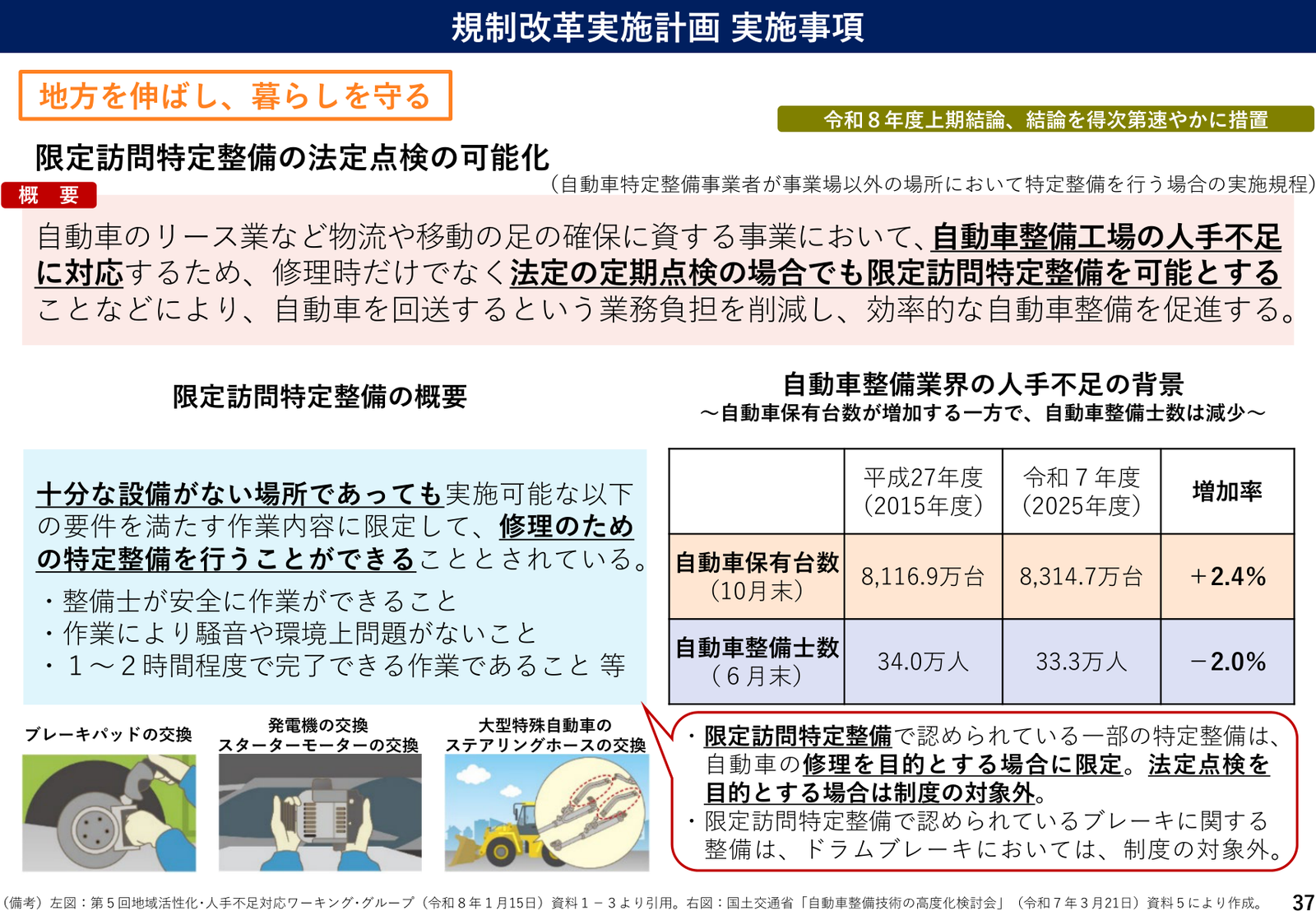
The background. The number of vehicles owned rose 2.4%, from 81.169 million in FY2015 to 83.147 million in FY2025, while the number of vehicle mechanics fell 2.0%, from 340,000 to 333,000. Vehicles are increasing, but the people who maintain them are decreasing. This structure lies behind the industry's labour shortage. This is where the scheme called limited on-site specified maintenance comes in. It is a system that lets specified maintenance be carried out on site, even in a place without sufficient equipment, limited to work that meets requirements such as being work a mechanic can do safely, having no problem of noise or the environment, and being completable in about one to two hours. Examples given include replacing a generator, a starter motor or brake pads. However, under the current situation, some of the work allowed under this limited on-site specified maintenance was limited to cases aimed at repairing the vehicle, and cases aimed at the statutory periodic inspection were outside the scheme.
The change is to widen this scope so that limited on-site specified maintenance is possible not only for repairs but also for the statutory periodic inspection. Businesses such as vehicle leasing, which contribute to securing logistics and transport options, are kept in mind.
What this means for businesses is that the burden of ferrying vehicles to the maintenance workshop is reduced. Bringing a vehicle to the workshop every time there is an inspection, and then taking it back. If the statutory inspection can also be handled on site, this round-trip effort and time can be spared. The effect of being able to run inspections efficiently even amid a shortage of mechanics should be large.
Now the outlook. This item is to reach a conclusion in the first half of FY2026, with measures taken promptly once the conclusion is in. Some parts are marked as a draft in the government's briefing material, and the specific requirements will be worked out from here, so for the latest content please check the text of the Regulatory Reform Implementation Plan and follow-up reports.
Source: Cabinet Office, "Regulatory Reform Implementation Plan" (Cabinet decision, July 21, 2026), Implementation Items briefing material
Matching logistics and road use to the real conditions of each area
Next are two items relating to logistics and road space. The treatment of farm-machinery transport (item 31) and the walkable-street system, commonly called hokomichi (item 32).
31 Clarifying the treatment of farm-machinery transport under the Motor Truck Transportation Business Act
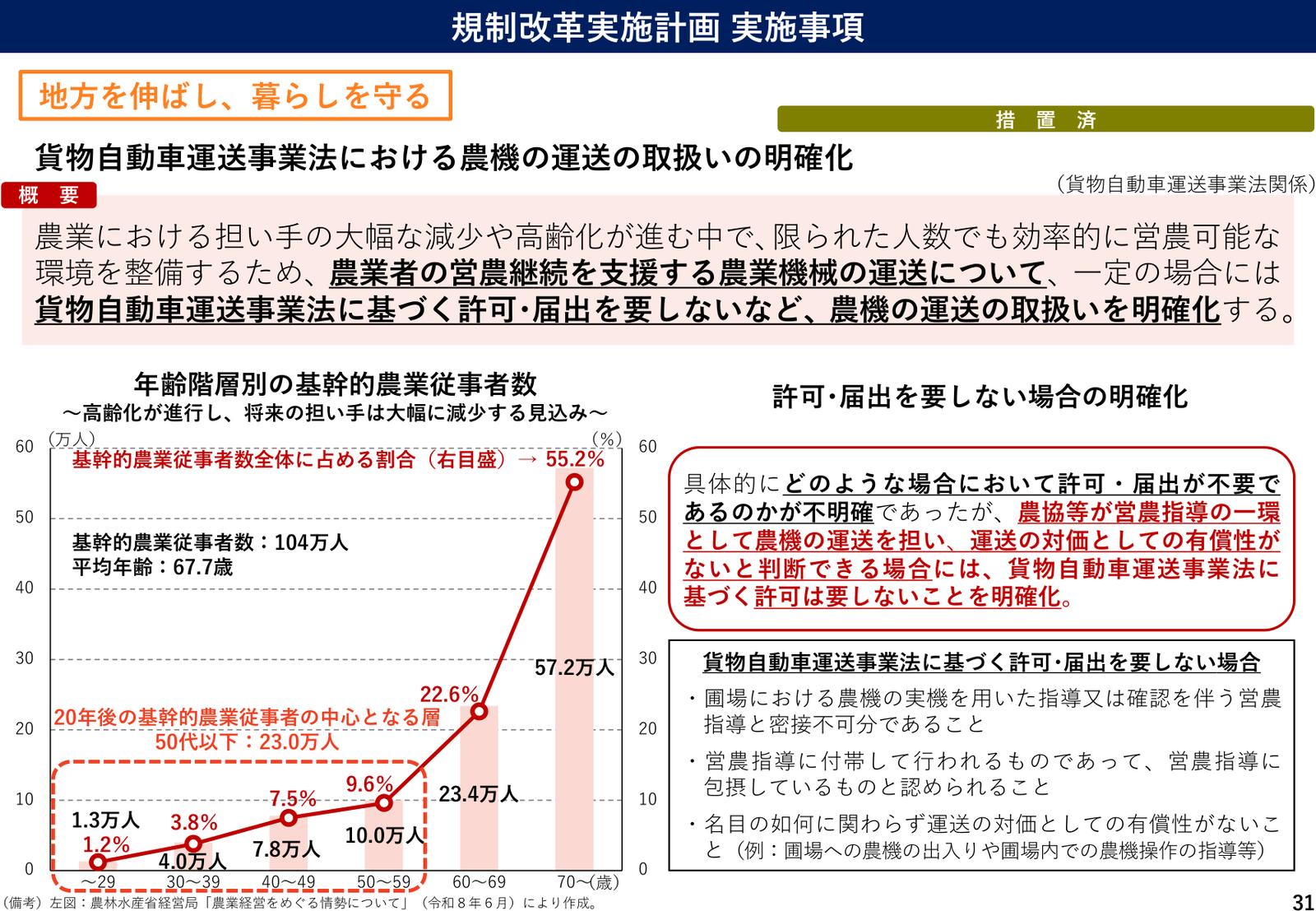
The background. The number of people carrying agriculture has fallen greatly, and ageing is advancing. Core agricultural workers number 1.04 million with an average age of 67.7, and those in their fifties and below who will be central 20 years from now are projected to be only 230,000. Preparing an environment in which farming can be run efficiently with a limited number of people has become urgent. The problem here was that it was not clear whether transporting farm machinery required a permit or notification under the Motor Truck Transportation Business Act.
The change is that this treatment has been clarified. It has already been implemented, and it has been made clear that where an agricultural cooperative or similar body carries farm machinery as part of its farming guidance, and it can be judged that there is no consideration in the sense of payment for transport, no permit under the Motor Truck Transportation Business Act is required. Concretely, conditions are set out such as being inseparably linked to farming guidance that involves instruction or checking using actual farm machinery in the field, being carried out incidental to and included within farming guidance, and, regardless of what it is nominally called, having no consideration in the sense of payment for transport.
What this means for businesses is that agricultural cooperatives and the like can carry farm machinery together with farming guidance with peace of mind. Once it is clear in which cases no permit is required, they need not agonise over unnecessary procedures. It is a plain but practically effective change that backs farmers in continuing to farm.
As for the outlook, since it has already been implemented, it has moved to practice on the ground.
Source: Cabinet Office, "Regulatory Reform Implementation Plan" (Cabinet decision, July 21, 2026), Implementation Items briefing material
32 Promoting use of the walkable-street system (hokomichi)
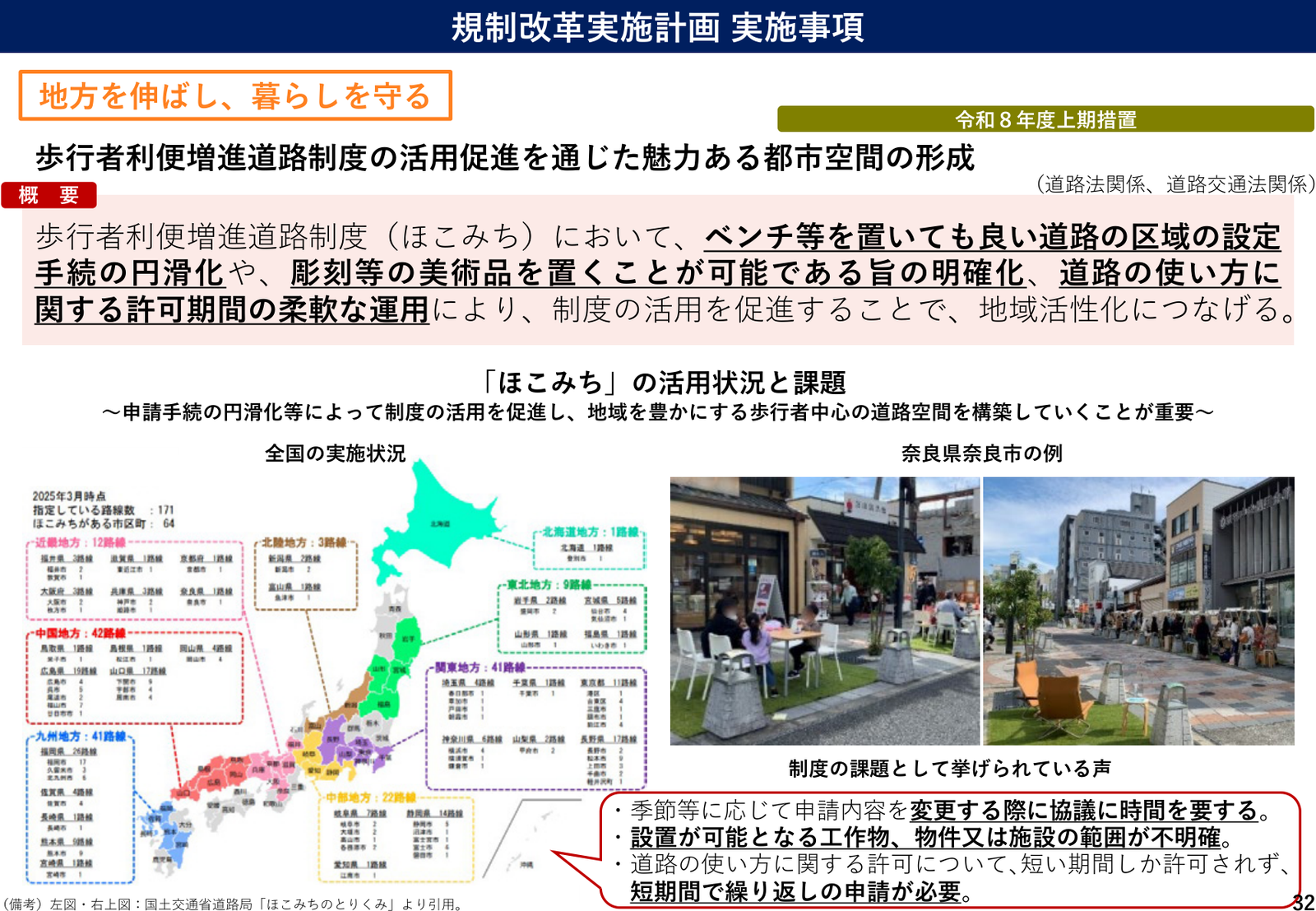
The background. Hokomichi is a system for creating spaces where pedestrians can stay comfortably, by placing benches and the like on roads. There are examples of its use in places such as Nara City, Nara Prefecture. But users had raised several issues. Trying to change the content of an application in line with the season takes time in consultations; the range of structures and objects that may be placed is unclear; and permits for how a road is used are issued only for short periods, so one has to reapply many times over a short span.
The change has three parts. To make the procedure for setting the road zone where benches and the like may be placed smoother; to make clear that art such as sculptures may be placed; and to operate the permit period for road use flexibly.
What this means for businesses and regions is that road space becomes easier to use for town-building. For a shopping street or municipality that wants to use a road as a cafe terrace or event space, easing the burden of losing time on each application is a practically welcome change. Through building attractive, pedestrian-centred spaces, it leads to creating local bustle.
Now the outlook. This item is scheduled for measures in the first half of FY2026.
Source: Cabinet Office, "Regulatory Reform Implementation Plan" (Cabinet decision, July 21, 2026), Implementation Items briefing material
Strengthening disaster-time logistics from the procedural side
Last is item 47, moving the application for confirmation of emergency vehicles online. It is a change that bears on the preparation for a critical moment, supporting logistics in disasters.
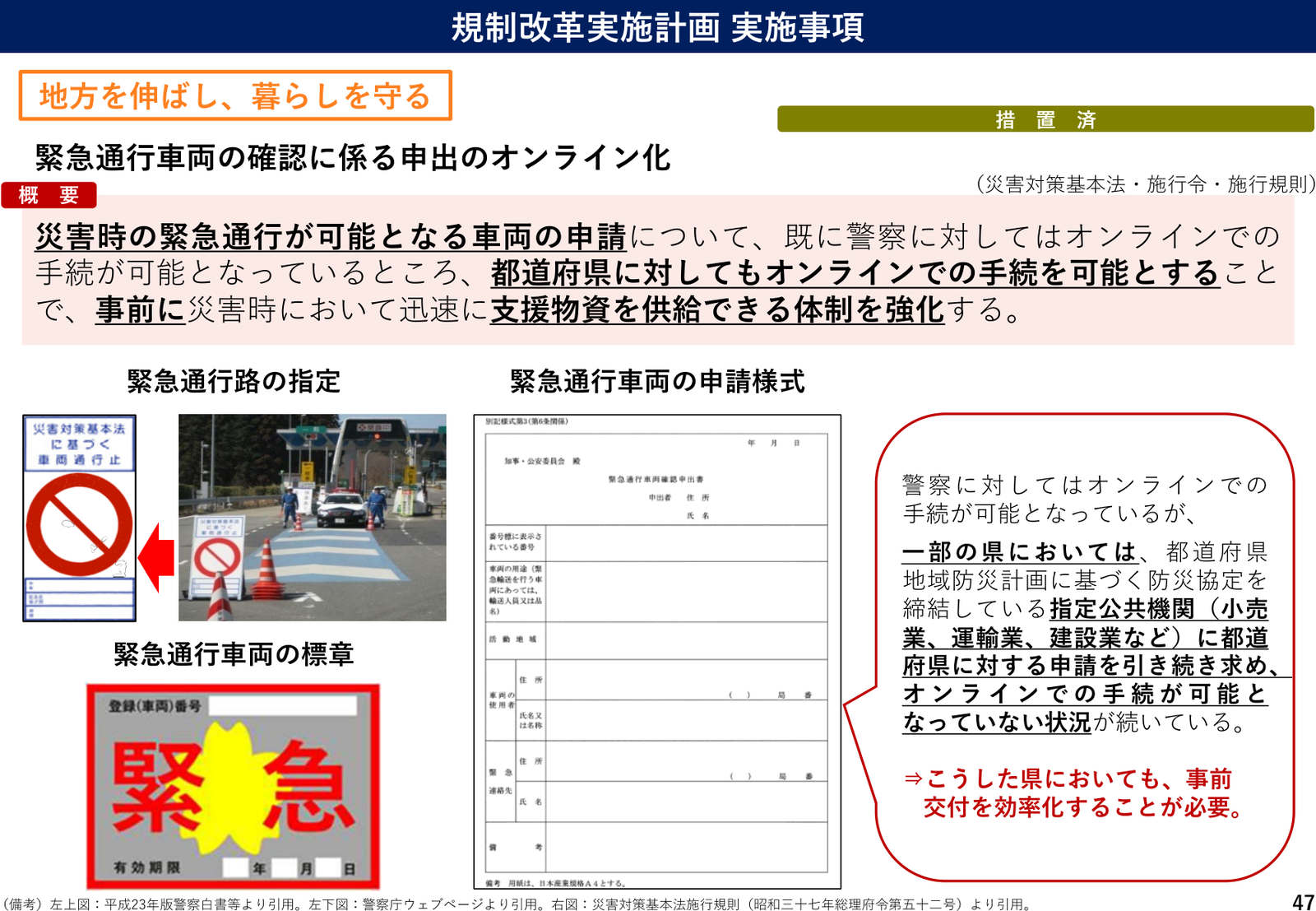
The background. When a disaster strikes, vehicles carrying relief supplies and the like need to receive confirmation in advance so that they can travel as emergency vehicles. For this application, online procedures are already possible with the police. In some prefectures, however, designated public institutions that have concluded disaster-prevention agreements based on the prefectural regional disaster-prevention plan, such as those in retail, transport or construction, were still required to apply to the prefecture on paper, and online procedures remained impossible.
The change is to make the procedure with the prefecture available online as well. This item has already been implemented.
What this means for businesses is that preparation for disasters becomes more efficient. If a business that supplies goods can receive confirmation online in normal times, it leads to a structure that can move swiftly at a critical moment. Making the advance issuance efficient is a preparation that raises the resilience, the ability to recover, of the logistics front line, at a time when the intensification of disasters is being pointed out.
As for the outlook, since it has already been implemented, what remains is for the practice to spread across each prefecture.
Source: Cabinet Office, "Regulatory Reform Implementation Plan" (Cabinet decision, July 21, 2026), Implementation Items briefing material
Reading this review as a story about your own business
I have followed nine items this far. Let me close by writing about how to take them.
Lay them side by side and what runs through this field is the reality of the labour shortage. Mechanics are decreasing, drivers are short, and the people carrying agriculture and regional transport are ageing. Within that, this plan feels like an attempt to prepare an answer, from the side of the system, to the question of how to keep things running with a limited number of people. Clarifying procedures, certification systems and widening the scope of coverage are none of them flashy, but they are steady reviews that take the burden off the front line one piece at a time.
And what lies beyond them is the use of AI and digital. For both autonomous driving and drones, the progress of AI was the starting point that moved the system. Issuing an order alone does not change the front line, but where and how you bring AI in so that this company's, this task actually gets easier is the question. It is the organisations that can answer it that will receive the tailwind of the system.
If you are unsure where to start in organising where AI works in your own operations and what to tackle first, please talk to the WARP team. Specialists who led DX and data strategy at major companies walk alongside you month by month, helping you bring AI down into your business. Let us start from translating the large flow of policy into the one step in front of you.
To sum up
It ran long, so let me organise the key points.
- In the mobility, logistics and transport field of the Regulatory Reform Implementation Plan 2026, nine implementation items move, centred on autonomous driving, drones and ride-sharing
- Autonomous driving advances through making the framework for interpreting the Road Traffic Act known, creating a certification system for excellent Level 2++ vehicles, and building an accident-cause investigation system (measures in the first half of FY2026 and the like)
- Drones get their environment prepared from both the places they can fly and the spectrum they can use, through the review of the VTOL pilot licence and the expansion of 5.8 GHz band use (conclusion in FY2026)
- Ride-sharing is arranged along three directions: promotion (immediate implementation), clarifying the interim check (already implemented), and reviewing local rules (measures in FY2026)
- Vehicle maintenance widens limited on-site specified maintenance to statutory inspections too, cutting the burden of ferrying vehicles (conclusion in the first half of FY2026)
- In logistics and roads, the treatment of farm-machinery transport is clarified (already implemented) and use of the hokomichi system is promoted (measures in the first half of FY2026); in disaster response, the confirmation of emergency vehicles moves online (already implemented)
Every one of them is a review aimed at running a business with a limited number of people, on the premise of a labour shortage. Now that the system is pointing a direction, I think it is a good moment to work out where AI and digital help in your own operations. Please start from there.

![The Battleground for Autonomous Driving Has Moved to Software | How In-Vehicle OS, SDV, and AI Agents Are Reshaping Mobility in 2026 [SusHi Tech Tokyo 2026]](/images/columns/autonomous-driving-software-battleground-2026/cover.en.png?dpl=dpl_GTagW71VKjD4VDo3w4ymrXrCfn1y)