Hello, this is Ryuta Hamamoto from TIMEWELL.
On 21 July 2026, the Japanese government made a Cabinet decision on the "Regulatory Reform Implementation Plan." Think of it as the country's to-do list for reviewing old rules that hold back daily life and the economy, so that new attempts become easier to make. It lists 57 implementation items in all, and the range it covers is very wide, from agriculture to healthcare, labour and transport.
In this article I take up the items that touch energy, the environment, manufacturing and daily life. Concretely, that means the rules for equipment that uses radio waves, storage batteries, next-generation solar cells, inspection of solar power facilities, home-appliance recycling, premiums at the storefront, advertising regulation, and bicycle anti-theft registration. These are themes people tend to assume have nothing to do with them, but for any company that runs a factory, a warehouse, a store or a manufacturing site, there is a surprising amount here that hits close to home.
Policy documents are written in stiff phrasing and are quite tough for a first-time reader. So for each item I break it down gently from four angles: first, what the problem has been up to now; second, what changes or is under consideration this time; third, what it means and what opportunities it holds for businesses; and fourth, the outlook ahead. It runs long, but I have structured it so you can safely skim just the items that interest you.
If you would first like the overall placement of the plan, or the items on agriculture and corporate law, please also see the article summarising the big picture of the Regulatory Reform Implementation Plan 2026 and the article explaining the agriculture and corporate-law implementation items. If you are interested in how to bring AI and digital tools into your own company, checking where you stand first with the free AI literacy self-check will make the later parts of this piece feel more concrete.
For the record, the facts in this article are based on the government's briefing material published together with the Cabinet decision (the Regulatory Reform Implementation Plan, briefing material on the implementation items). For the detailed conditions and scope of individual items, checking the text of the Regulatory Reform Implementation Plan directly is the surest approach1.
Item 15: Reviewing radio-wave regulation (type approval and wireless power transfer)
We start with the rules for equipment that uses radio waves. This item is made up of two parts: one is a review of type approval (technical-standards conformity certification), and the other is a review of wireless power transfer systems. Let me take them in turn.
Reviewing type approval (technical-standards conformity certification)
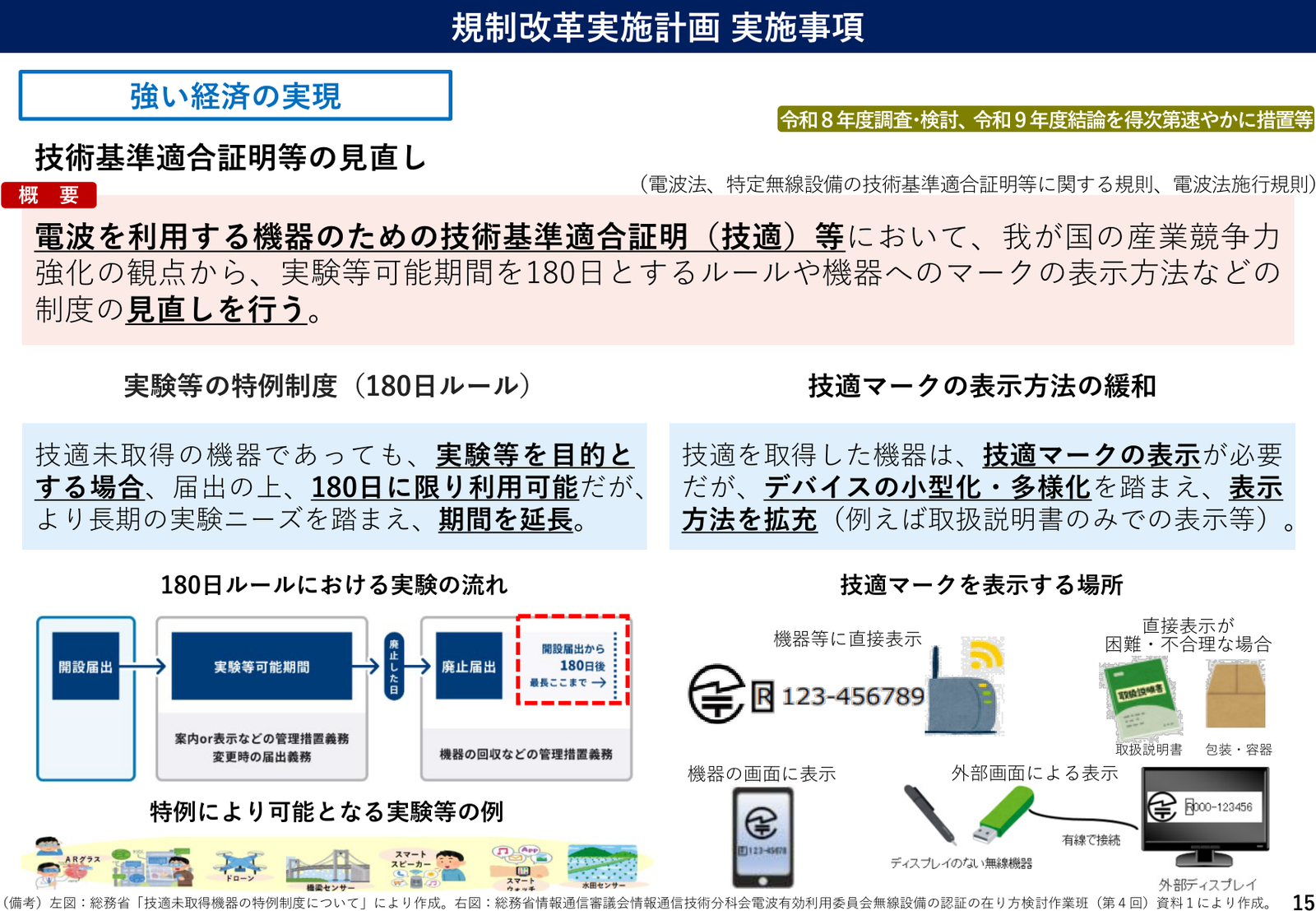
Background and the current problem. Equipment that emits radio waves, such as smartphones and Wi-Fi devices, must be certified as conforming to technical standards under the Radio Act, and this is what type approval refers to. As a rule, equipment used within Japan must carry a "type approval mark." There is a special exception for experimental use: even equipment without type approval can be used for up to 180 days for purposes such as experiments, provided a notification is filed. But from research and development sites there were voices saying "180 days is not enough" and "we want to test for longer." Also, as equipment grew ever smaller and more varied, there were more cases where displaying the type approval mark directly on the body of the device was difficult.
The review this time. The government material says that, from the standpoint of strengthening Japan's industrial competitiveness, it will review this experimental-use exception, including its duration and the way the mark is displayed on equipment. Concretely, the direction is to extend the 180-day period in light of longer-term experimental needs, and to expand the ways the type approval mark can be displayed. On display, one example given is allowing the mark to appear only in the instruction manual rather than on the device body, widening the options when direct display is difficult. The underlying rules are the Radio Act and related regulations, and the direction is to study the matter in FY2026 (Reiwa 8) and, once a conclusion is reached in FY2027 (Reiwa 9), to act on it promptly.
What it means for businesses. For a company developing new radio-wave equipment, or testing the latest overseas devices within Japan, a longer experimental period is a real practical help. It lets you run prototyping and verification at home without rushing. Making mark display more flexible also raises design freedom for makers of ultra-compact IoT devices and wearables.
The outlook ahead. The schedule for study and conclusion is shown, but the specific number of days after extension, and the detailed requirements for display methods, are still to be settled in the study ahead. If you are involved in a development plan, I would follow the text of the Regulatory Reform Implementation Plan and further updates from the Ministry of Internal Affairs and Communications, and confirm the finalised conditions as they come.
Source: Cabinet Office, "Regulatory Reform Implementation Plan" (Cabinet decision, July 21, 2026), Implementation Items briefing material
Reviewing wireless power transfer systems
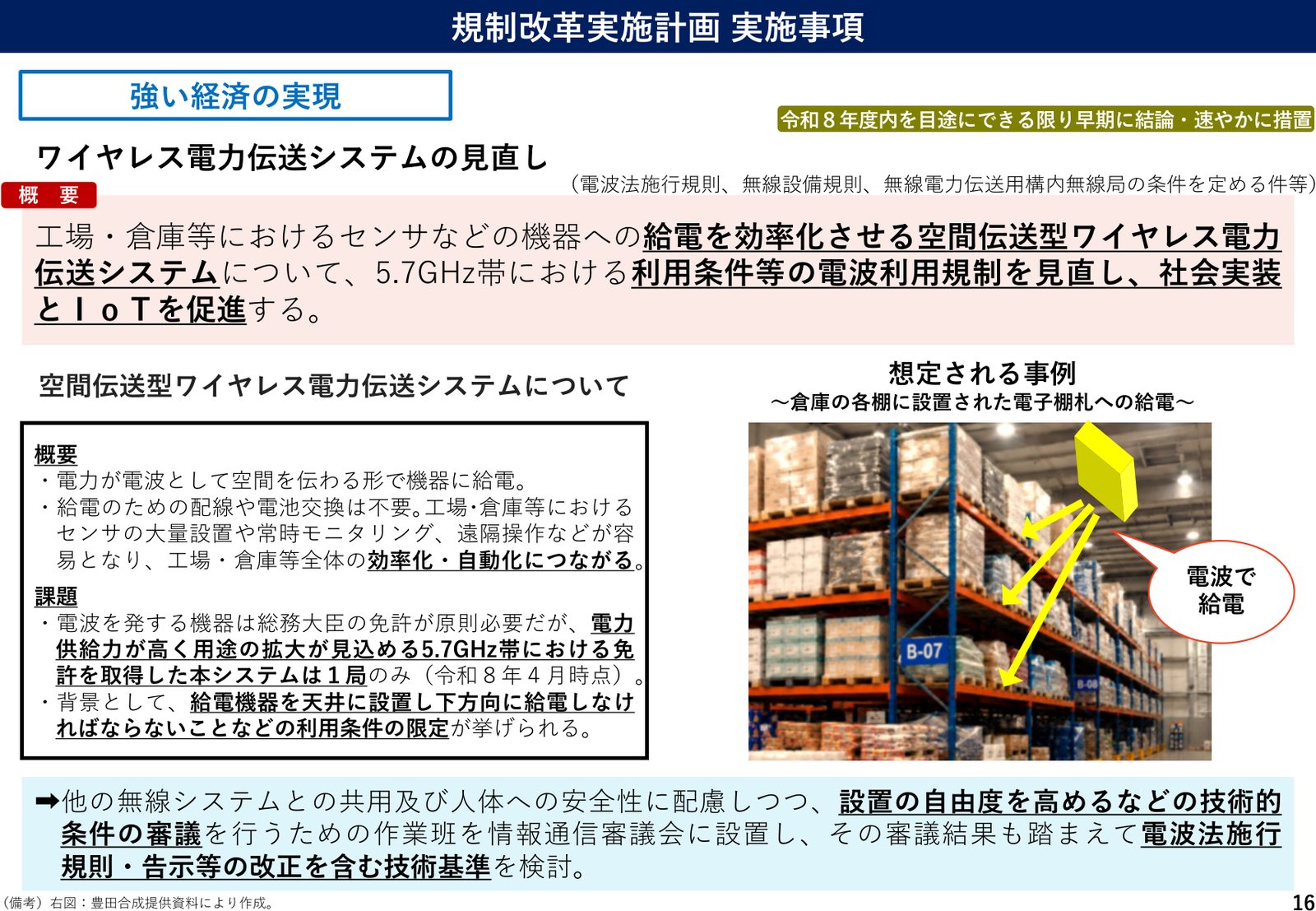
Background and the current problem. Wireless power transfer (WPT) is a mechanism that delivers electricity to a device through space in the form of radio waves, without plugging into an outlet. What is treated here is the type called "space-transmission," which sends power by radio waves to a distant location. When you want to place many sensors around a factory or warehouse and monitor them constantly, it removes the need for wiring and battery changes, which is expected to help make sites more efficient and automated. However, equipment that emits radio waves generally requires a licence from the Minister for Internal Affairs and Communications, and in the 5.7 GHz band, where wider uses are expected, only one station had obtained this licence as of April 2026 (Reiwa 8). Behind this were limited usage conditions, such as being able to install the power-supplying equipment on the ceiling and supply power only downward.
The review this time. The government material says that for this space-transmission wireless power transfer system it will review radio-wave regulation, including usage conditions in the 5.7 GHz band, and promote its social implementation and IoT. The flow is to set up a working group under the Information and Communications Council to deliberate on technical conditions that raise installation freedom while giving due regard to radio-wave sharing with other wireless systems and to safety for the human body, and, based on the results, to consider technical standards such as the Radio Act enforcement regulations and public notices. On timing, the plan is to reach a conclusion as early as possible, with FY2026 (Reiwa 8) as the target, and to act promptly.
What it means for businesses. For logistics warehouses handling large numbers of sensors and electronic shelf labels, and for factories running many devices continuously, a path opens up to be freed from the work of battery changes and wiring. If installation freedom rises, uses that fit the layout of the site, such as supplying power from places other than the ceiling, may also broaden. The more seriously a site wants to bring in IoT, the larger the benefit of this theme.
The outlook ahead. Since the council's study of technical conditions is only about to get under way in earnest, how far the usage conditions will actually be eased will depend on the conclusion of the deliberations. Companies considering adoption would do well to keep track of the information, bearing in mind that the timing of the conclusion, "targeted within FY2026," is relatively near.
Item 17: Clarifying the fire-service treatment of storage batteries to promote their adoption
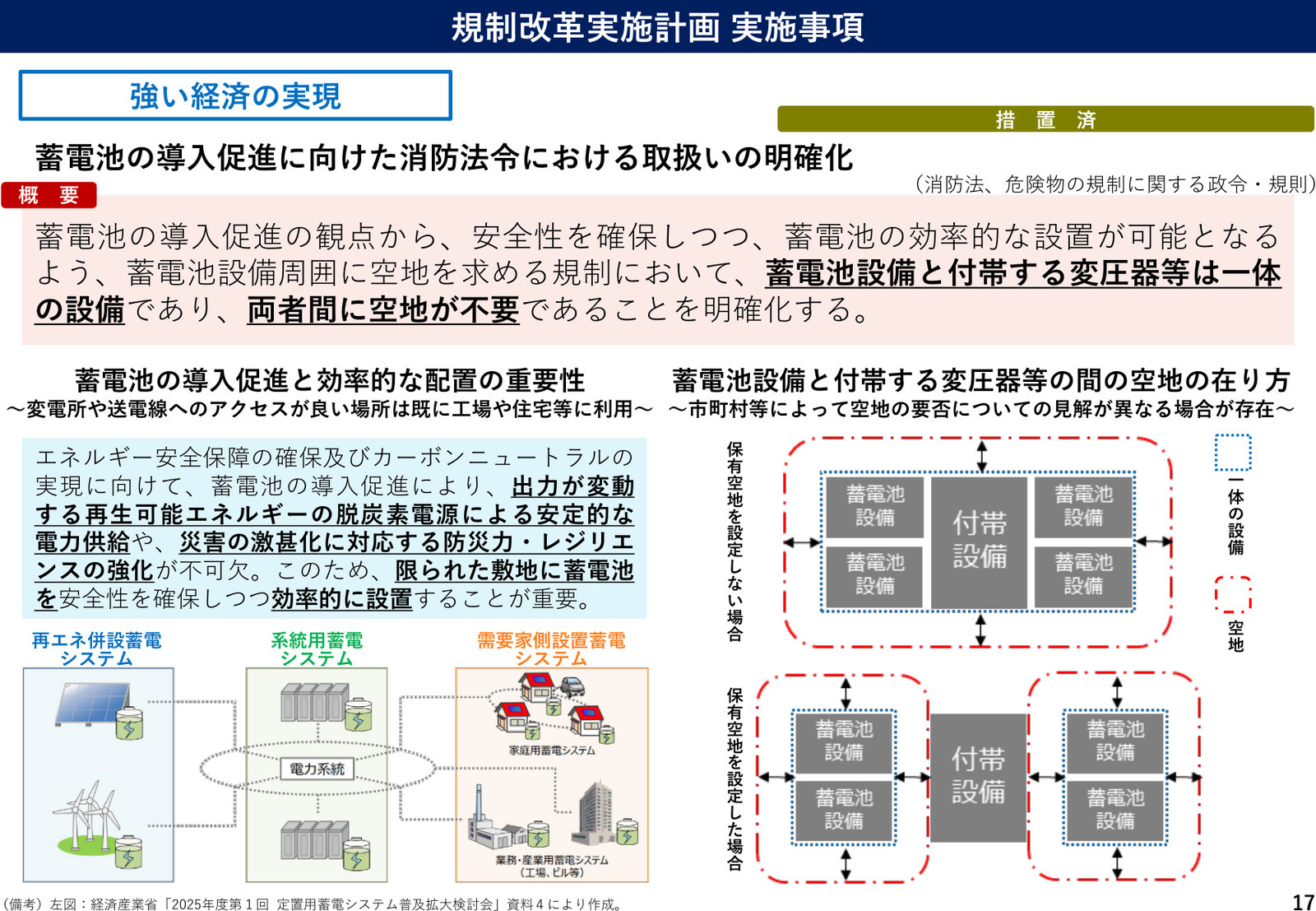
Background and the current problem. Storage batteries are equipment that stores electricity from renewable energy such as solar and wind, whose output tends to fluctuate, so that it can be used stably. Their importance is rising in terms of energy security, achieving carbon neutrality, and resilience (the underlying strength to keep power on) in a disaster. However, storage batteries are subject to regulation under the Fire Service Act and the like, and open space (land kept clear for safety) must be secured around the equipment. Here there was a practical headache. Storage-battery equipment comes with associated transformers and the like, and municipalities had at times differed on whether open space was also required between the battery and the transformer. When the judgment varies by region, it becomes hard to install efficiently on a limited site.
The review this time. The government material says that, so that storage batteries can be installed efficiently while keeping safety, it will clarify, within the rule requiring open space around the equipment, that the storage-battery equipment and the associated transformers and the like form a single integrated facility and that no open space is required between them. The basis lies in the Fire Service Act and the Cabinet Order and regulations on the control of hazardous materials. This item is positioned in the government material as already implemented.
What it means for businesses. Land in good condition, close to substations and transmission lines, is often already used for factories and housing, so the sites where storage batteries can be placed tend to be limited. Once it is clear that no open space is needed between the battery and the transformer, you can lay out the same site more efficiently. This lowers the installation hurdle for storage co-located with renewables, storage connected to the grid, and storage that consumers (the users of electricity) hold themselves alike.
The outlook ahead. Since it is recorded as already implemented, the focus from here is whether local practice around the country aligns with this arrangement. Companies considering installation can set their minds at ease by confirming the latest treatment reflecting this clarification with the fire department for their location. There is also, as a separate item, a move to review the testing standards reflecting international standards and the treatment under the Building Standards Act for the large-capacity lithium-ion storage batteries used for AI data centres, so the rules around storage batteries are, on the whole, being organised in a direction that makes them easier to adopt.
Source: Cabinet Office, "Regulatory Reform Implementation Plan" (Cabinet decision, July 21, 2026), Implementation Items briefing material
Item 18: Promoting the spread of next-generation solar cells
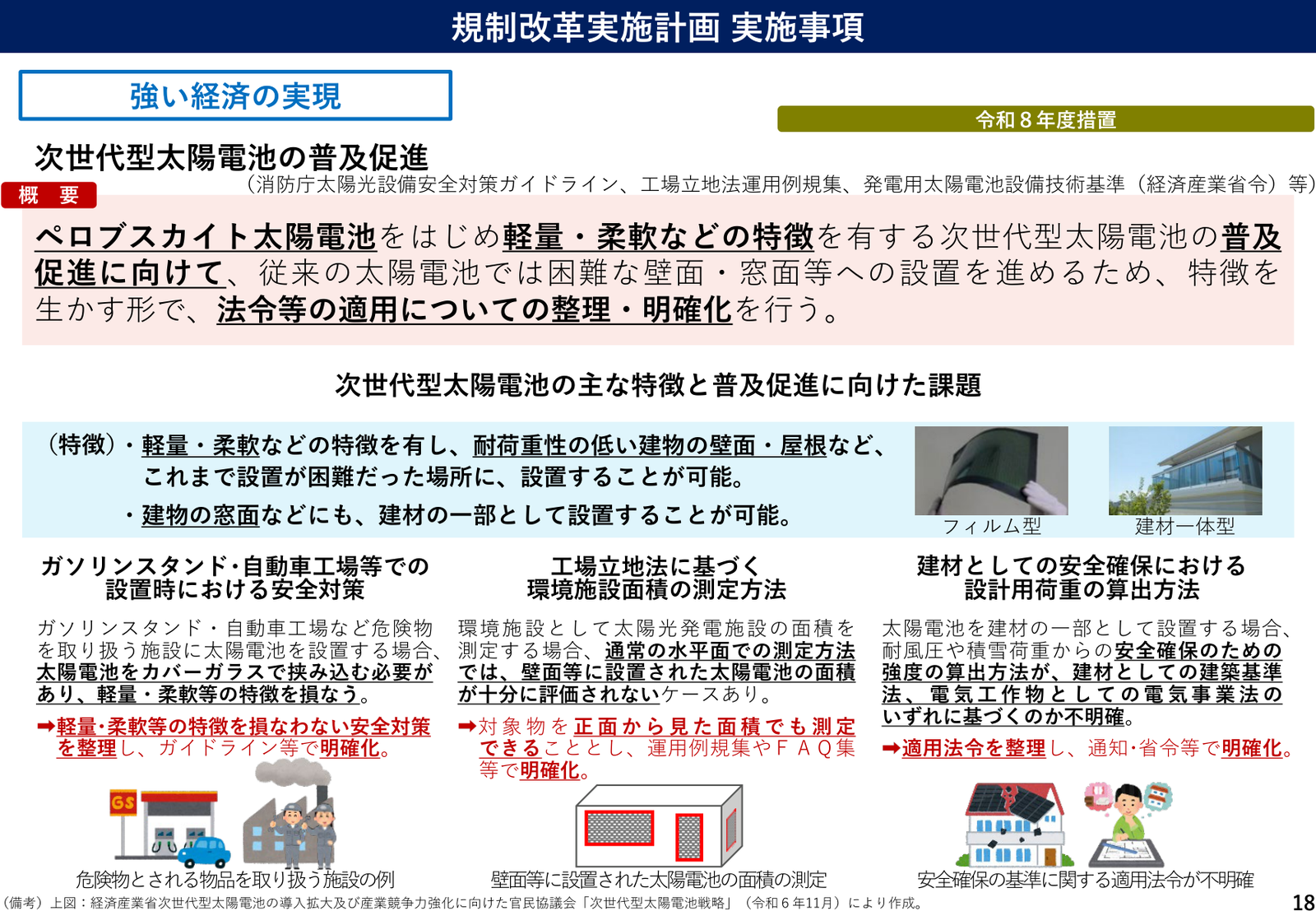
Background and the current problem. Next-generation solar cells are a new type, represented by perovskite solar cells, that are light and can be bent. They may be installable on the roofs of buildings with low load capacity, and on the walls and windows of buildings, where the conventional heavy, rigid panels could not go, and they are also anticipated as a domestic technology. Yet trying to make use of these features brings up situations that existing laws did not anticipate. The government material raises three problems. First, when a solar cell is installed as part of a building material, it is unclear how to calculate its strength against wind pressure and snow load, and whether this rests on the Building Standards Act as a building material or on the Electricity Business Act as an electrical facility. Second, when installed at a facility handling hazardous materials, such as a petrol station or an automobile factory, the solar cell has to be sandwiched between cover glass, which undermines its lightweight, flexible features. Third, when measuring the area of a solar power facility as an environmental facility under the Factory Location Act, the usual horizontal-plane way of measuring can fail to fully credit the area installed on walls and the like.
The review this time. The government material says it will organise and clarify how the laws apply in a way that makes use of the features of next-generation solar cells. On the first point, the strength calculation, it will organise which law applies and clarify it through notices and ministerial ordinances. On the second, installation at hazardous-materials facilities, it will organise safety measures that do not undermine the lightweight, flexible features and clarify them through guidelines and the like. On the third, area measurement, it will allow measurement by the area of the object viewed from the front, and clarify this through operational precedent collections and FAQ collections. The basis lies in the Fire and Disaster Management Agency's guidelines on safety measures for solar facilities, the Factory Location Act operational precedent collection, and the technical standards for solar power generation facilities (a Ministry of Economy, Trade and Industry ordinance), and it is shown as a measure for FY2026 (Reiwa 8).
What it means for businesses. For companies with factories, warehouses and stores whose roofs could not take heavy panels, walls and windows become a realistic new place to install. For manufacturers wanting to increase self-consumption generation, and for businesses with hazardous-materials facilities, a clear approach to safety measures makes the adoption decision easier. Clarifying area measurement under the Factory Location Act also makes wall installation an easier option to add for factories that have long struggled to secure green space and environmental facilities.
The outlook ahead. A relatively near timing, a measure for FY2026, is shown. That said, for actual installation, the substance of the concrete standards set out in notices, guidelines and FAQs will be the key. Perovskite solar cells are a technology at the entrance to wider adoption, so I think this is a stage for confirming the finalised standards while working out where, and how, they can go on your own buildings.
Source: Cabinet Office, "Regulatory Reform Implementation Plan" (Cabinet decision, July 21, 2026), Implementation Items briefing material
Looking for AI training and consulting?
Learn about WARP training programs and consulting services in our materials.
Item 19: Reviewing pre-use self-confirmation for solar power facilities
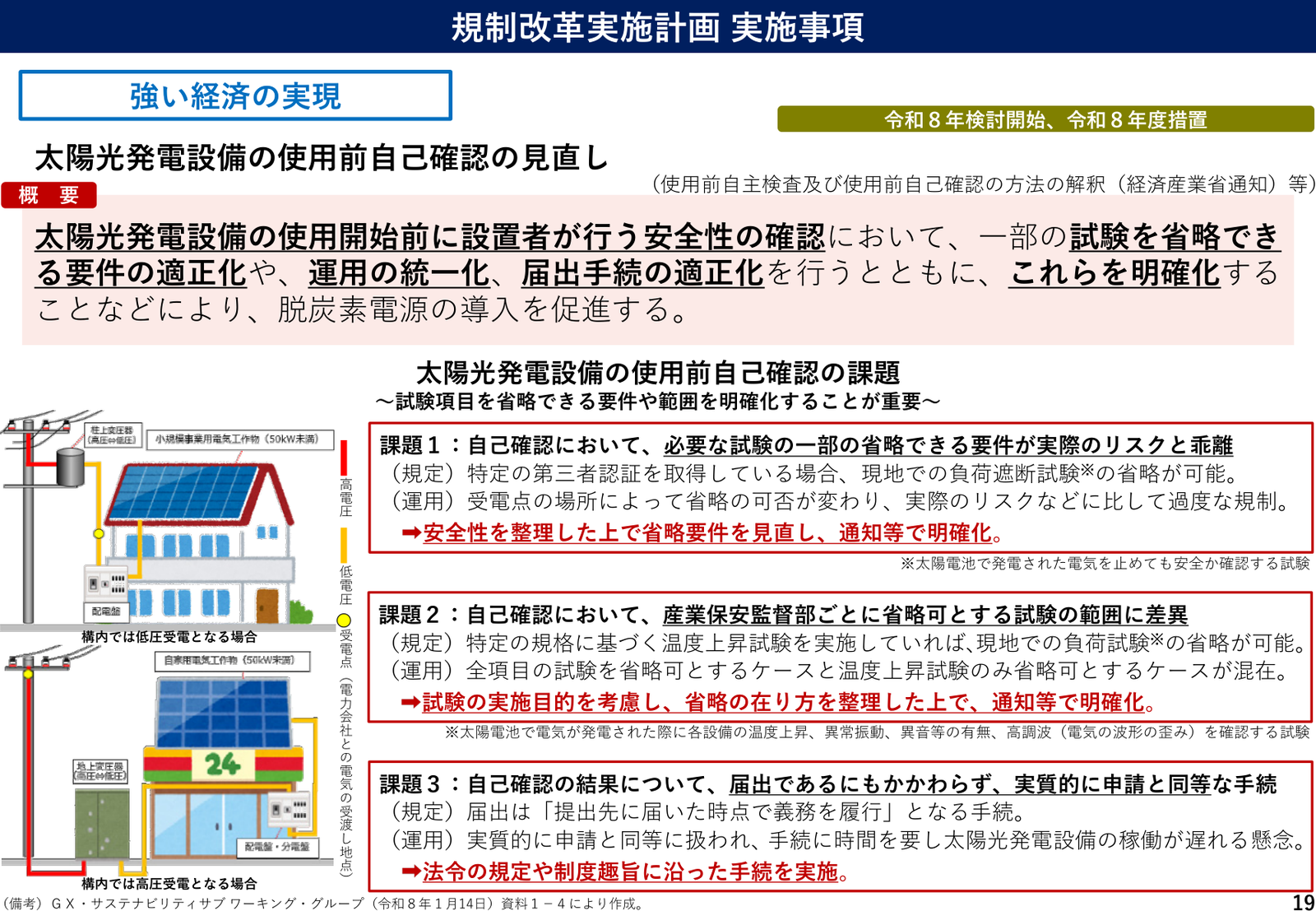
Background and the current problem. Solar power facilities above a certain scale require a procedure called "pre-use self-confirmation," in which the installer checks the safety themselves before starting to use them. There were three practical headaches here. First, the requirements for omitting some tests did not match the actual risk. For example, there is a provision that lets you skip the on-site load-rejection test (a test confirming safety even if the generated electricity is cut) if you hold third-party certification, yet whether omission is allowed changed depending on whether the receiving point where electricity is handed over is low-voltage or high-voltage within the premises, which was excessive regulation relative to the actual risk. Second, the scope of tests that could be omitted differed by Industrial Safety and Inspection Department (the regional office in charge of safety). A treatment allowing all items to be omitted and one allowing only the temperature-rise test to be omitted existed side by side. Third, although this confirmation is a "notification," it was in practice handled like an "application," raising concern that the procedure would take time and delay the start-up of the generating facility. A notification is, by nature, a procedure where the obligation is fulfilled the moment it reaches the recipient.
The review this time. The government material says it will make the requirements for omitting some tests appropriate, unify the operation, make the notification procedure appropriate, and clarify these. On the first, it will review the omission requirements after organising the safety aspects and clarify them through notices and the like. On the second, it will organise the way omission works considering the purpose of each test and clarify it through notices and the like. On the third, it will carry out the procedure in line with the provisions of the law and the purpose of the system. The basis lies in the Ministry of Economy, Trade and Industry's notice on the interpretation of the methods of pre-use self-inspection and pre-use self-confirmation and the like, and the direction is to begin study in 2026 (Reiwa 8) and act during FY2026.
What it means for businesses. For businesses about to adopt solar power, the uncertainty of being asked for unnecessary tests, or of procedures varying by region, is reduced. Once notification is handled in its proper sense, the wait between completing the facility and starting generation shortens, and the outlook for recouping the investment becomes easier to draw. For companies wanting to increase decarbonised power sources, it is a plain but effective improvement.
The outlook ahead. A near timing, a measure for FY2026, is shown. How the requirements and scope for omission are organised, and the concrete substance of the notices, will be the practical point. Companies planning adoption would do well to build their test plans and start-up schedules on the finalised requirements.
Source: Cabinet Office, "Regulatory Reform Implementation Plan" (Cabinet decision, July 21, 2026), Implementation Items briefing material
Item 20: Promoting recycled-material use and recycling in home appliances
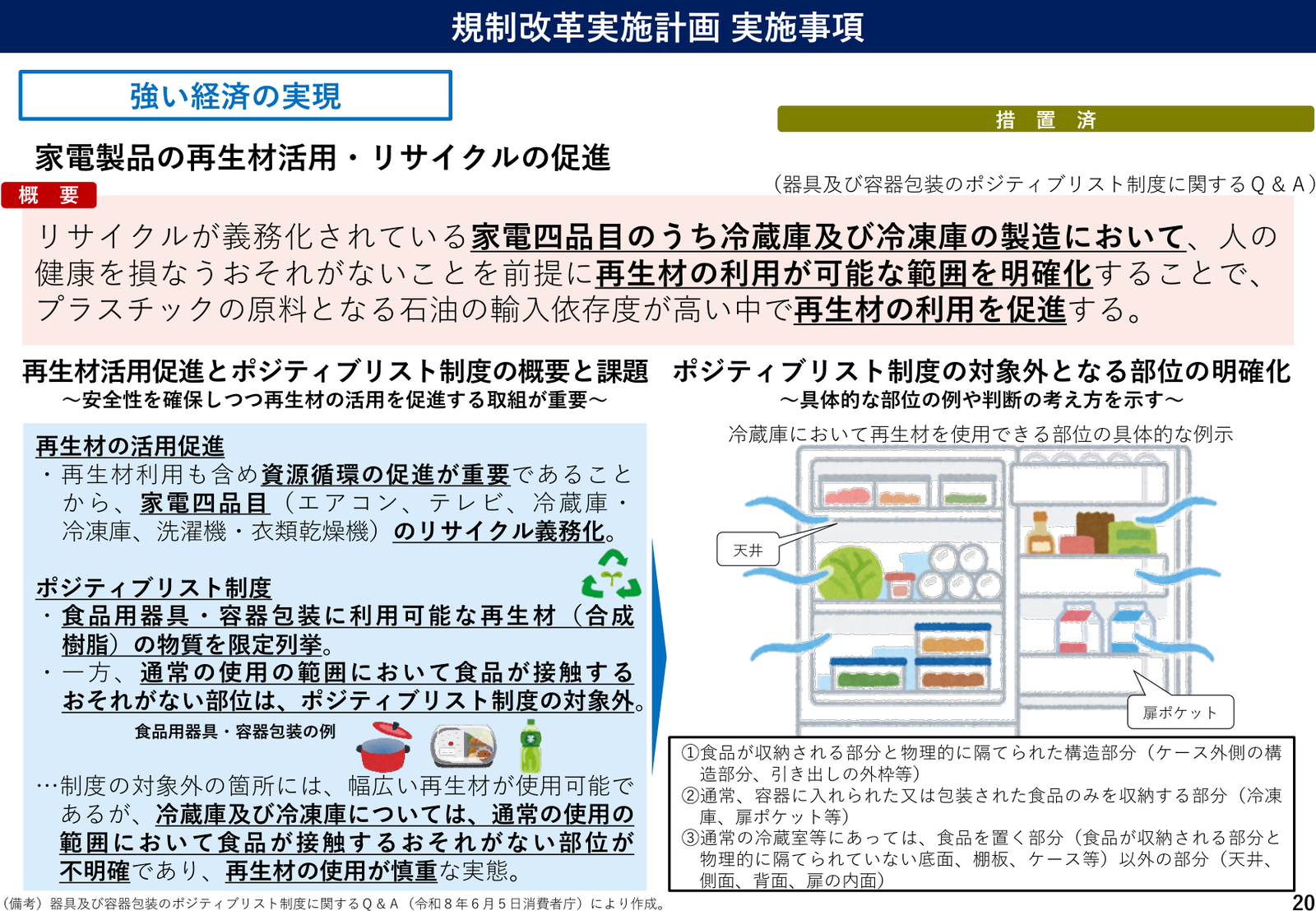
Background and the current problem. The so-called four home-appliance categories, air conditioners, televisions, refrigerators and freezers, and washing machines and clothes dryers, are subject to a recycling obligation. Using "recycled material," where plastic and the like recovered from collected appliances is used again as raw material, is an important theme both for resource circulation and for Japan, which is highly dependent on imported oil as the feedstock for plastic. Refrigerators and freezers, however, had circumstances that made recycled material hard to use. For utensils, containers and packaging that touch food, there is a "positive list system" that permits only listed safe substances to be used. Conversely, parts that food is unlikely to touch in ordinary use fall outside this system, and a wide range of recycled materials can be used there. But in refrigerators and freezers it was unclear which parts were the "parts food is unlikely to touch," and makers were cautious about using recycled material.
The review this time. The government material says it will clarify the range in which recycled material can be used, on the premise that there is no risk of harming human health. Concretely, it gives examples of the parts of a refrigerator that fall outside the positive list system. Those cited are structural parts physically separated from the part where food is stored (the outer side of the case, the outer frame of drawers, and so on), parts that ordinarily store only food already in containers or packaging (the freezer, door pockets, and so on), and parts other than where food is placed (the ceiling, sides, back, the inner face of the door, and so on). The basis lies in the Q&A on the positive list system for utensils and containers and packaging (Consumer Affairs Agency, 5 June 2026), and this item is recorded in the government material as already implemented.
What it means for businesses. For home-appliance makers and the companies that make their parts, it becomes clear which parts recycled material may be used on, so the time spent hesitating over the judgment falls and recycled material becomes easier to adopt. Being able to lower dependence on virgin, oil-derived plastic also connects to resilience against raw-material price swings and to the ability to respond to trading partners who want environmental consideration. A stance of working on resource circulation is also a factor that will be easier to have valued in future procurement and business dealings.
The outlook ahead. Since it is recorded as already implemented, the stage from here is for each maker to actually move ahead with adopting recycled material based on the illustrated parts. How horizontal expansion proceeds to home appliances other than refrigerators and freezers, and to other products, is also, I think, a point to watch going forward.
Source: Cabinet Office, "Regulatory Reform Implementation Plan" (Cabinet decision, July 21, 2026), Implementation Items briefing material
Item 50: Raising the cap on giveaway premiums to invigorate consumption
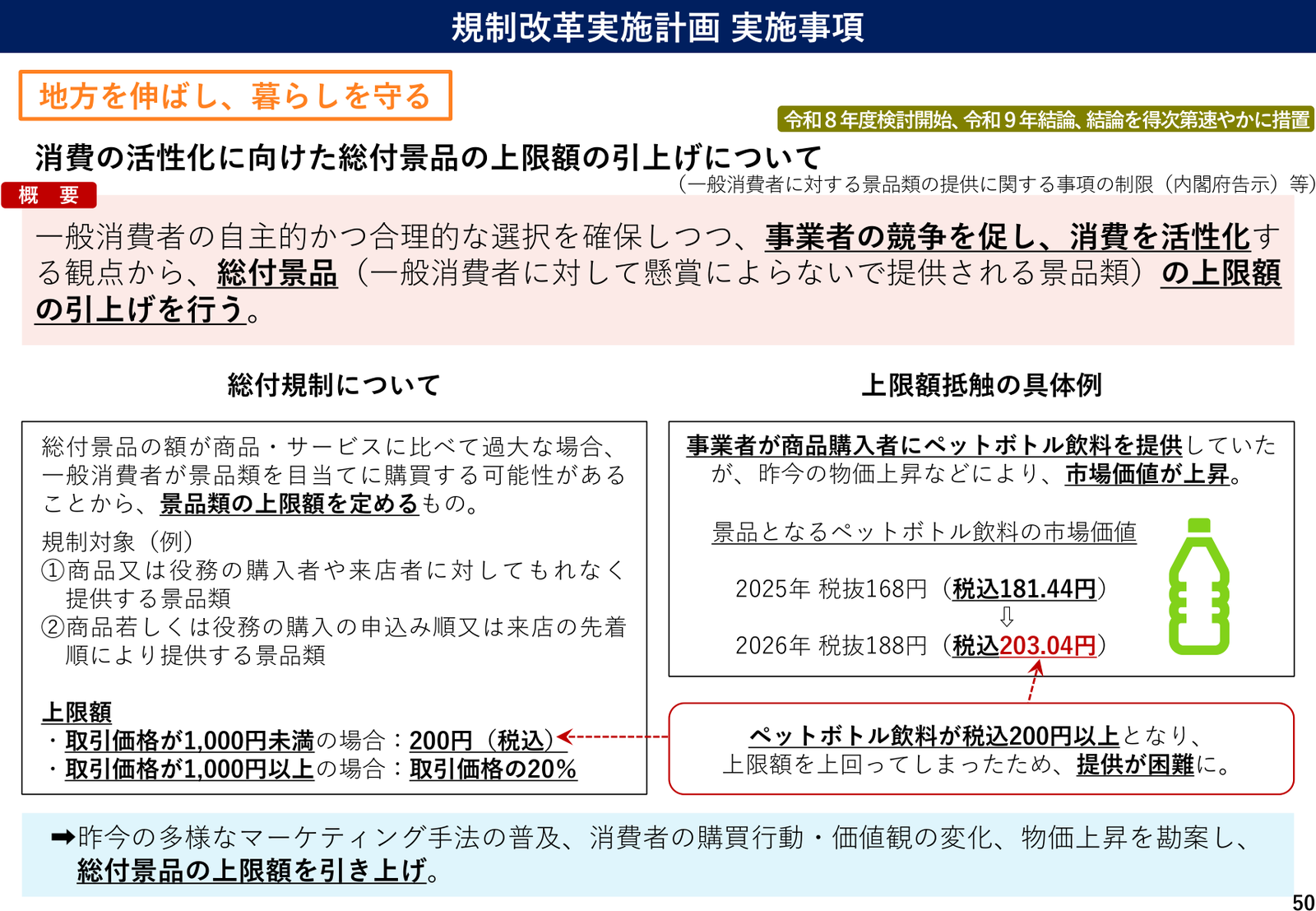
Background and the current problem. From here the themes come closer to daily life and consumption. First is the rule on premiums. A premium handed to everyone who buys a product or visits a store, not by lottery, is called a "giveaway premium." It helps to picture a free extra or a novelty item. If the premium is too large relative to the price of the product or service, consumers may buy for the sake of the premium and lose the ability to choose on the product itself. So under the Act against Unjustifiable Premiums and Misleading Representations, a cap is set on premiums. The current cap is 200 yen (tax included) for a transaction under 1,000 yen, and 20 percent of the transaction price for 1,000 yen or more. As prices rose, however, an unexpected problem arose. Take a business that had been handing a bottled drink to purchasers of a product: the market value of that drink rose from 181.44 yen (tax included) in 2025 to 203.04 yen (tax included) in 2026, exceeding 200 yen (tax included). The same sales promotion then exceeded the cap and could no longer be continued.
The review this time. The government material says it will raise the cap on giveaway premiums, from the standpoint of securing the voluntary and reasonable choice of general consumers while promoting competition among businesses and invigorating consumption. It is a review that takes into account the recent spread of diverse marketing methods, changes in consumers' purchasing behaviour and values, and rising prices. The basis lies in the restriction on matters concerning the offering of premiums to general consumers (a Cabinet Office public notice) and the like, and the direction is to begin study in FY2026 (Reiwa 8), reach a conclusion in 2027 (Reiwa 9), and act promptly once the conclusion is reached.
What it means for businesses. For retailers, food-service businesses and makers that use free extras and novelties for storefront promotion, sales promotions that "could no longer be run" because of rising prices may become easier to continue. If the cap rises, the range of plans such as seasonal campaigns and store-visit perks also widens. The more a business routinely uses premiums, the more directly this bears on its practice.
The outlook ahead. The specific amount or percentage after the raise will be decided in the study ahead. Since the conclusion is aimed at 2027, those involved in designing promotions would do well to confirm the finalised cap before reworking their plans. At this point it cannot be stated definitively "how far it will rise," so this is a stage for awaiting further updates.
Source: Cabinet Office, "Regulatory Reform Implementation Plan" (Cabinet decision, July 21, 2026), Implementation Items briefing material
Item 51: Reviewing the unsubstantiated-advertising rule for appropriate product choice by consumers
Background and the current problem. Next is the rule on advertising. The Act against Unjustifiable Premiums and Misleading Representations has a mechanism prohibiting "misleading representations of superiority" that make something look markedly better than it is, and within it sits the "unsubstantiated-advertising rule." Under this system, the Consumer Affairs Agency asks a business to "submit, by a deadline, material showing reasonable grounds that back the representation," about the effect of an advertisement and the like, and if the business cannot submit it within the deadline, or the submitted material is not recognised as showing reasonable grounds, the representation is deemed a misleading representation of superiority. It is an important mechanism for protecting consumers, but businesses and consumer groups had raised their voices. From the business side, the point was that excessive fear of this regulation was causing a chilling effect, making it harder to attempt new products and services. From the consumer side, the request was that, since the Consumer Affairs Agency's findings are useful, the content written in cease-and-desist orders and the like be made fuller.
The review this time. The government material says it will improve the exchange (communication) between the Consumer Affairs Agency and businesses over whether something amounts to a misleading representation of superiority, thereby advancing the appropriateness of representations and appropriate product choice by consumers. Concretely, when issuing a cease-and-desist order, it will explain and publish the reasons for judging that the material a business submitted "does not fall under material showing reasonable grounds that back the representation," while giving due regard to trade secrets. The basis lies in the operational guidelines for Article 7, paragraph 2 of the Act against Unjustifiable Premiums and Misleading Representations and the like, and the direction is to begin study in FY2026 (Reiwa 8), reach a conclusion in FY2027 (Reiwa 9), and act promptly once the conclusion is reached.
What it means for businesses. For companies that claim effects in advertising or product descriptions, it becomes easier to see what kind of material is enough as grounds, and why material was judged insufficient. Once the reasons for the judgment are visible, businesses can, without shrinking more than necessary, prepare proper grounds and attempt new expressions. For businesses that want to deliver correct information properly, it is a review that raises predictability (the ease of seeing ahead).
The outlook ahead. This centres on reviewing guidelines, with the conclusion aimed at FY2027. The concrete way of explaining and publishing, and where the line is drawn on regard for trade secrets, will be the practical point. Those involved in advertising representations would do well to follow further updates to the operational guidelines and review how they prepare their supporting material.
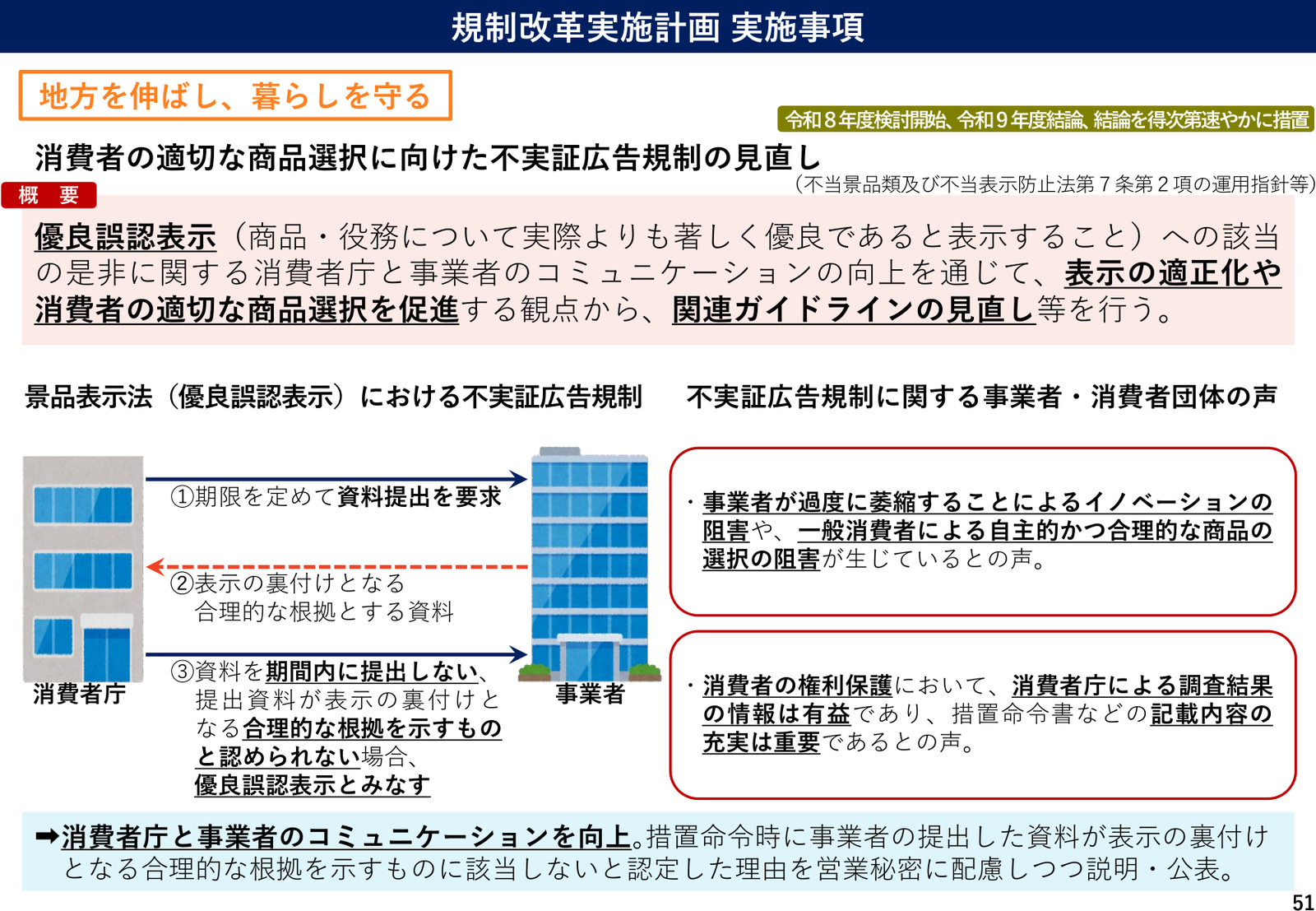
Source: Cabinet Office, "Regulatory Reform Implementation Plan" (Cabinet decision, July 21, 2026), Implementation Items briefing material
Item 53: Reviewing local rules for bicycle anti-theft registration and digitising it
Background and the current problem. Last is the anti-theft registration of bicycles, the closest of all to daily life. When you buy a bicycle, in most cases you register it against theft at the shop. But this system had operated differently from one prefecture (designated body) to another. According to the government material, many items differ by region, including the amount of the registration fee and its accounting treatment, the valid period of registration, how cancellation of registration is accepted, the format of the registration card and of the registration number and certificate (the sticker affixed to the frame), and how long the registration card is kept. The procedure was also mainly paper-based, and shops bore the burden of keeping paper application forms for long periods. And because paper changes hands, the time from application until the registration reaches the police shared-platform system took, according to a National Police Agency survey, a national average of 47.9 days at the shortest and 62.0 days at the longest. When registration takes many days, procedures for identifying the owner of an abandoned bicycle, or for buying and selling a bicycle between individuals, do not go smoothly.
The review this time. The government material says it will correct local rules that lack rationality and pursue the digitisation and standardisation of anti-theft registration. The aim is to make procedures such as registration possible immediately and efficiently, and to advance swift responses to identifying the users of abandoned bicycles and smoother registration procedures in transactions between individuals. The basis lies in the National Police Agency's directive on bicycle anti-theft registration and the like. For details such as the timing of enforcement, please refer to the text of the Regulatory Reform Implementation Plan.
What it means for businesses. For bicycle shops, the burden of keeping paper lightens and registration work becomes more efficient. As standardisation advances, businesses operating stores across regions are also less troubled by the differences from prefecture to prefecture. For businesses in individual-to-individual transactions that handle bicycles, such as flea-market apps, and for services that make use of bicycles, such as bike-sharing, smoother registration procedures are a tailwind too.
The outlook ahead. The government material aims to reach a conclusion in FY2026 (Reiwa 8). How far, and how fast, digitisation and standardisation advance will, however, depend on the concrete content of the directives ahead. If the immediacy of registration rises nationwide, it is expected to help with returning stolen bicycles and identifying owners as well. Those running a bicycle-related business would do well to confirm further updates from the National Police Agency and each prefectural police force.
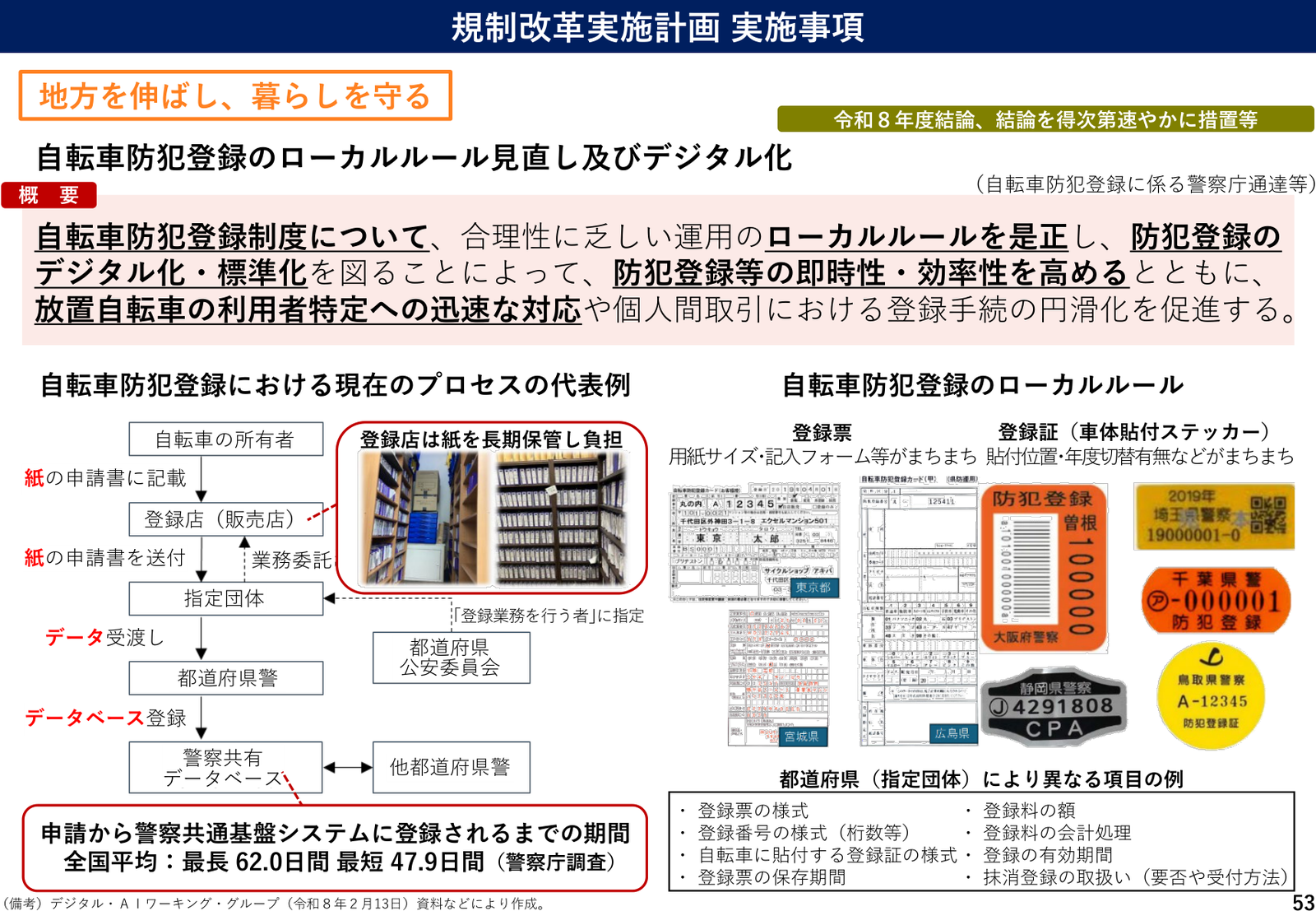
Source: Cabinet Office, "Regulatory Reform Implementation Plan" (Cabinet decision, July 21, 2026), Implementation Items briefing material
Related items not covered in this article
The field of energy, the environment, manufacturing and daily life has other related items too. For plant factories, for instance, the plan is to standardise the evaluation items and methods for artificial-light plant factory systems, and, for sunlight-type plant factories, to create a guidebook that resolves legal questions, in order to back the use of smart agriculture technology and food tech. Points raised also include whether a greenhouse with a compound environment-control system is regarded as a "building" under the Building Standards Act, upper limits on noise and vibration, and limits on boilers and heavy oil under the Fire Service Act, which differ from one local government to another.
There is also an item, for industrial complexes, that organises how the High Pressure Gas Safety Act applies when a company reorganises its business or organisation. In a petrochemical complex where plants operate as an integrated whole, the aim is to ensure the safety rules apply smoothly even when there is a corporate reorganisation. These sit outside the eight items covered here, but as themes bearing on the manufacturing site, I would invite anyone interested to read them alongside the text of the Regulatory Reform Implementation Plan.
How to turn these reviews into a step for your own company
We have now looked at eight items. Line them up and a common aim comes into view. Keep safety firmly secured, and then organise and clarify rules that had varied in judgment, or no longer fit reality, so that new equipment, materials and methods become easier to try. Let companies that want to move actually move, on the sites of energy, manufacturing and daily life. Everything points in that direction.
But a system changing and your company actually receiving the benefit are two different things. Whether it is putting next-generation solar cells on a wall, laying out storage batteries efficiently, or bringing in IoT sensor power supply, the work of judging "what, put where in our company and how, delivers how much" is required. This does not advance on an order alone. It needs a design fitted to the site, and people with the capability to run it.
The reason we keep running an AI consulting service called WARP is exactly that we feel we are getting somewhere on this "translating systems and technology into the one step in front of you." Decisions about new capital investment and digitisation grow harder the more the options increase. What to tackle first, and where to concentrate resources. It is work of organising that prioritisation together with the management. That said, you do not have to chase every new system and technology. The judgment that tells apart where it works for your company from where it is fine to wait and see is itself the first fork in the road.
To sum up
It ran long, so let me organise the key points.
- In the review of radio-wave regulation, the experimental-use exception period is extended, the way the type approval mark is displayed becomes more flexible, and 5.7 GHz-band wireless power transfer is deregulated, moving in a direction that makes equipment development and IoT adoption easier
- For storage batteries, it is clarified that no open space is required between the equipment and the associated transformer (already implemented), making efficient installation on limited sites easier
- For next-generation solar cells, the strength calculation as a building material, safety measures at hazardous-materials facilities, and how the area of an environmental facility is measured are organised, making installation on walls and windows easier to advance (a measure for FY2026)
- For pre-use self-confirmation of solar power, the omission requirements, the operational differences, and the notification procedure are made appropriate, promising a shorter time to start-up (a measure for FY2026)
- For recycled-material use in home appliances, the parts of a refrigerator where recycled material can be used are illustrated, making resource circulation easier to advance (already implemented)
- For giveaway premiums, raising the cap is under consideration in light of rising prices; the unsubstantiated-advertising rule raises predictability by explaining and publishing the reasons for judgments; and bicycle anti-theft registration advances toward digitisation and standardisation
Each is a review that looks plain but hits the site. Even when a system is in place, if the readiness to make use of it is not there, the benefit passes straight by. If you are unsure where to begin in organising the starting point of where new equipment and digital tools work for your company, please talk to the WARP team. Specialists who have led DX and data strategy at major companies walk alongside you month by month, helping to translate the large flow of policy into the one step in front of you.
References and primary sources
Footnotes
-
"Regulatory Reform Implementation Plan," Cabinet decision of 21 July 2026 (令和8年7月21日), Council for the Promotion of Regulatory Reform, Cabinet Office. The facts in this article are based on the government's briefing material published together with the Cabinet decision, "Regulatory Reform Implementation Plan (Cabinet decision, 21 July 2026), Implementation Items." For details and quotations of individual items, please refer directly to the text of the Regulatory Reform Implementation Plan. Council for the Promotion of Regulatory Reform, Cabinet Office https://www8.cao.go.jp/kisei-kaikaku/kisei/ ↩