Hello, this is Ryuta Hamamoto from TIMEWELL.
On 21 July 2026, the government made a Cabinet decision on the "Regulatory Reform Implementation Plan." It is a fairly large package of reviews covering 57 items in total. Of those, this article takes up the healthcare, nursing-care and medical field. Medical data touches on people's illnesses and bodies, so it is very sensitive information, and nursing care and online medical care connect directly to the security of daily life. That is exactly why it is worth understanding, accurately and calmly, how the system is about to change.
Regulatory reform in the medical field is an area full of technical terms, and it is easy to freeze up in front of it. In this article, so that even business people who are not close to policy can read it through, I unpack seven implementation items one at a time. For each item I organise the discussion in four parts: the background and current issues, how it is about to change, what it means for businesses, and the outlook. It runs long, but by the time you finish you should have a grasp of the whole picture of regulatory reform in the healthcare and nursing-care field.
For the overall picture of the Regulatory Reform Implementation Plan itself, and for the reviews in the AI and digital field, I have organised those in separate articles. Reading them together brings the picture into three dimensions.
- A plain-language guide to the overall picture of the Regulatory Reform Implementation Plan 2026
- An article organising Regulatory Reform 2026 and the reviews in the AI and digital field
If you are thinking about using AI or digital tools in medical or nursing-care settings, it helps to first check where you stand with our free AI literacy self-check. The discussion in the second half will read more concretely once you have.
4. Preparing for the use of national and hospital cancer registry information
Background and current issues
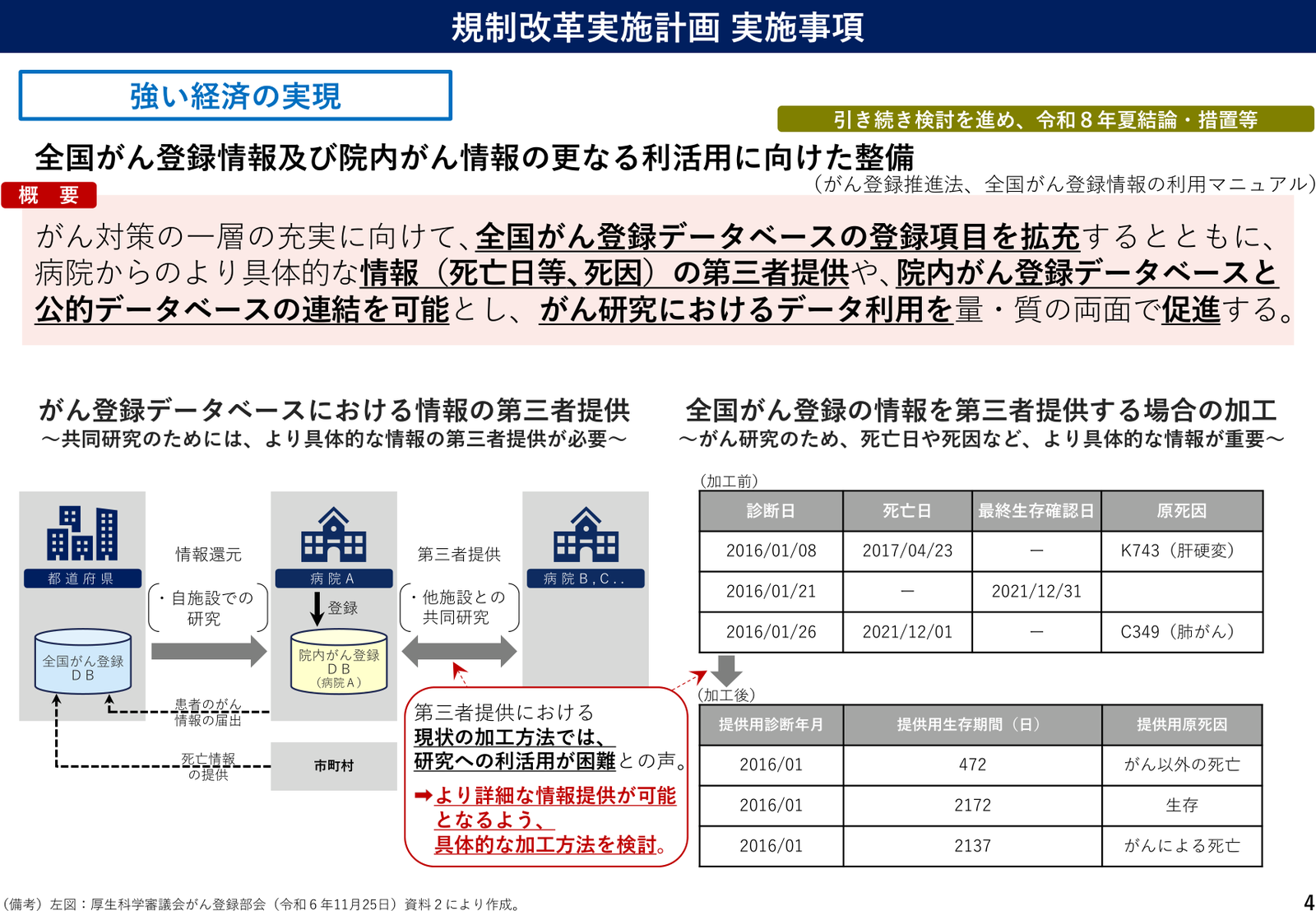
Let me start with the "national cancer registry" system. This is a mechanism in which the state gathers information on everyone diagnosed with cancer in Japan into a single database. It runs under a law called the Act on Promotion of Cancer Registries, and its purpose is to accurately grasp what kinds of cancer occur, in which regions, and in what numbers, and to put that to use in cancer control.
Providing this data to outside researchers for cancer research is called third-party provision. When data is provided, however, it is processed so that individuals cannot be identified, and this is where an issue arose. For example, concrete dates and causes such as the date of diagnosis, date of death, date of last confirmed survival and underlying cause of death were, at the provision stage, processed into rough forms such as "year and month of diagnosis for provision," "survival period for provision (in days)," and "underlying cause of death for provision" (a classification of death from cancer, death from a cause other than cancer, or survival). Researchers had voiced that this processing method made the data hard to use for research and that they wanted more concrete information.
How it is about to change
To further strengthen cancer control, the plan aims to advance three things. One is to expand the registration items in the national cancer registry database itself. Another is to make it possible to provide more concrete information from hospitals, such as the date of death and the cause of death, to third parties. And another is to make it possible to link the hospital cancer registry database with public databases. Hospital cancer registration is data in which individual hospitals record their own patients in detail, and linking it with public data would greatly widen the range of research. The aim is to promote the use of data in cancer research on both the quantity and the quality side.
What it means for businesses
For companies and research institutions involved in cancer research and development, this is a move toward having more usable data and being able to run more detailed analysis. In drug discovery, medical device development, epidemiological research and the like, there is a prospect of accessing information at a granularity that was out of reach before. At the same time, the more concrete the information handled, the more care its management and handling will require. That should not be forgotten.
Outlook
For this item, study is to continue, with a conclusion and measures in the summer of 2026. The related laws include the Act on Promotion of Cancer Registries and the manual on the use of national cancer registry information. The concrete processing methods and linkage schemes are still at a stage of being worked out. For details, see the full text of the Regulatory Reform Implementation Plan.
Source: Cabinet Office, "Regulatory Reform Implementation Plan" (Cabinet decision, July 21, 2026), Implementation Items briefing material
5. Promoting the use of electronic health record data
Background and current issues
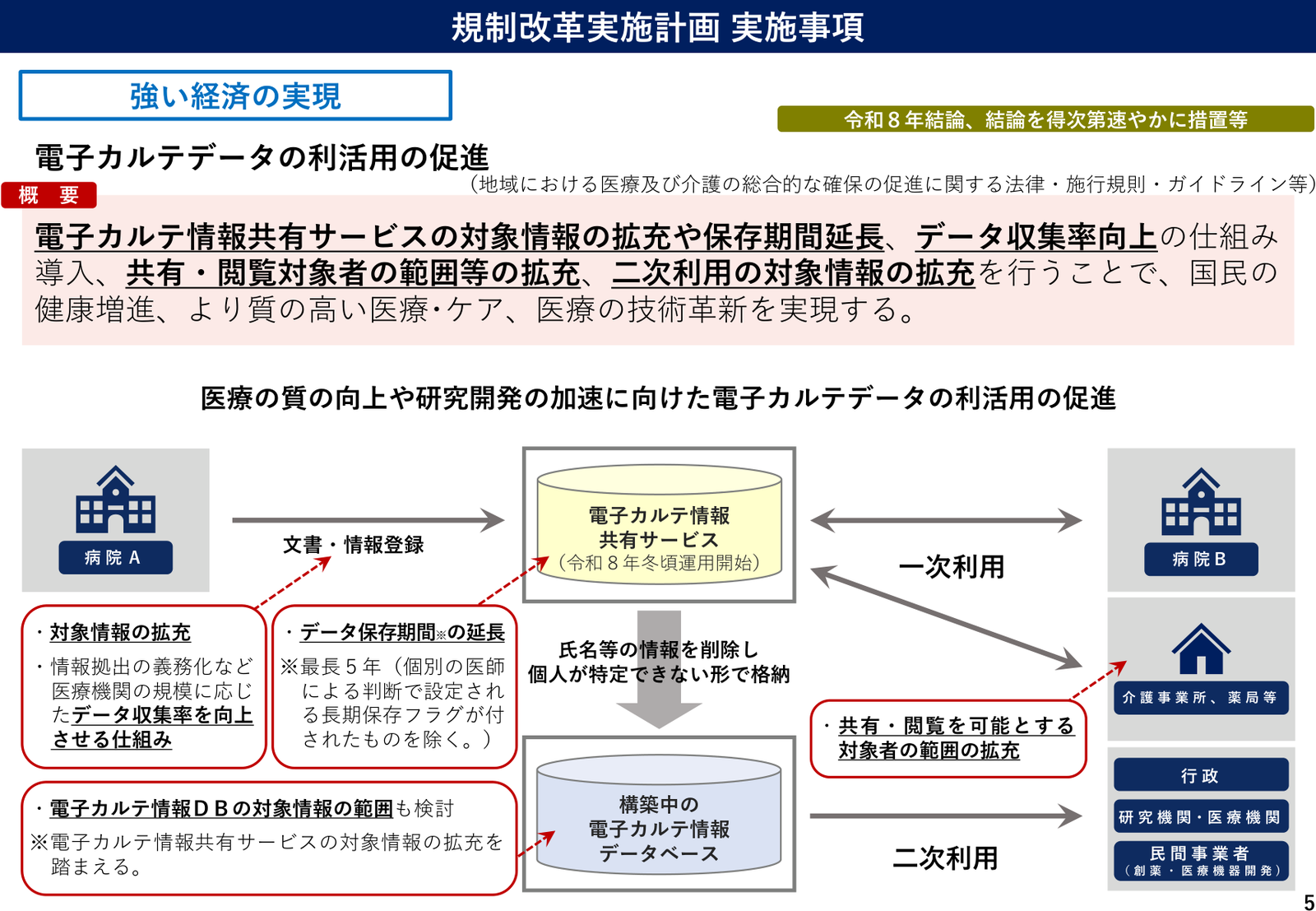
Next is electronic health records. Many medical institutions manage treatment records not on paper but in electronic health records. An "electronic health record information-sharing service" that lets institutions share this information is scheduled to start operating around the winter of 2026. When a patient goes to a different hospital, having their past treatment information carried over leads to safer, higher-quality medical care.
There are broadly two ways medical data is used. One is primary use, meaning using it directly in the treatment of the patient in front of you. The other is secondary use, meaning that once names and other identifiers are removed so individuals cannot be identified, research institutions and private companies developing drugs and medical devices use it for research and development. How to expand this secondary use holds the key to innovation.
How it is about to change
To promote the use of electronic health record data, the plan lists several reviews. Increasing the types of information covered by the sharing service. Extending how long data is retained (at present the maximum is five years, except for records flagged for long-term retention at an individual doctor's judgment). Introducing mechanisms that raise data-collection rates in line with the scale of the institution, such as making the provision of information mandatory so that the institutions supplying the data reliably provide it. Broadening the range of parties who can share and view information (not only hospitals but also nursing-care facilities and pharmacies are envisaged). And expanding the information subject to secondary use. Alongside this, for the electronic health record information database now being built, the plan will also consider the scope of the information it covers.
What it means for businesses
For businesses developing drugs and medical devices, this is a move toward a wider base of data usable for research and development. For nursing-care facilities and pharmacies too, if the scope of sharing and viewing widens, there is a prospect of grasping the condition of patients and users more easily. For the public, it is expected to lead to better health and higher-quality medical care and support. At the same time, the more information handled, the more important security and the protection of personal information become.
Outlook
For this item, a conclusion is to come in 2026, with measures to follow promptly once a conclusion is reached. The related laws include the Act on Securing Comprehensive Medical and Long-Term Care in the Community and its enforcement regulations and guidelines. The sharing service itself is scheduled to start operating around the winter of 2026, and this review is expected to move in step with it. For details, see the full text of the Regulatory Reform Implementation Plan.
Source: Cabinet Office, "Regulatory Reform Implementation Plan" (Cabinet decision, July 21, 2026), Implementation Items briefing material
Looking for AI training and consulting?
Learn about WARP training programs and consulting services in our materials.
6. The scope, users and purposes of medical data usable without individual consent
Background and current issues
When you think about the secondary use of medical data, the question of "individual consent" is unavoidable. As a rule, when personal data is used, the consent of the individual is required. But in situations like medicine, where you want to use a large amount of data for research, obtaining consent from each person case by case is not always realistic. So the point at issue becomes how far to draw the line for data that, once names and other identifiers are removed so individuals cannot be identified, can be used without obtaining case-by-case individual consent.
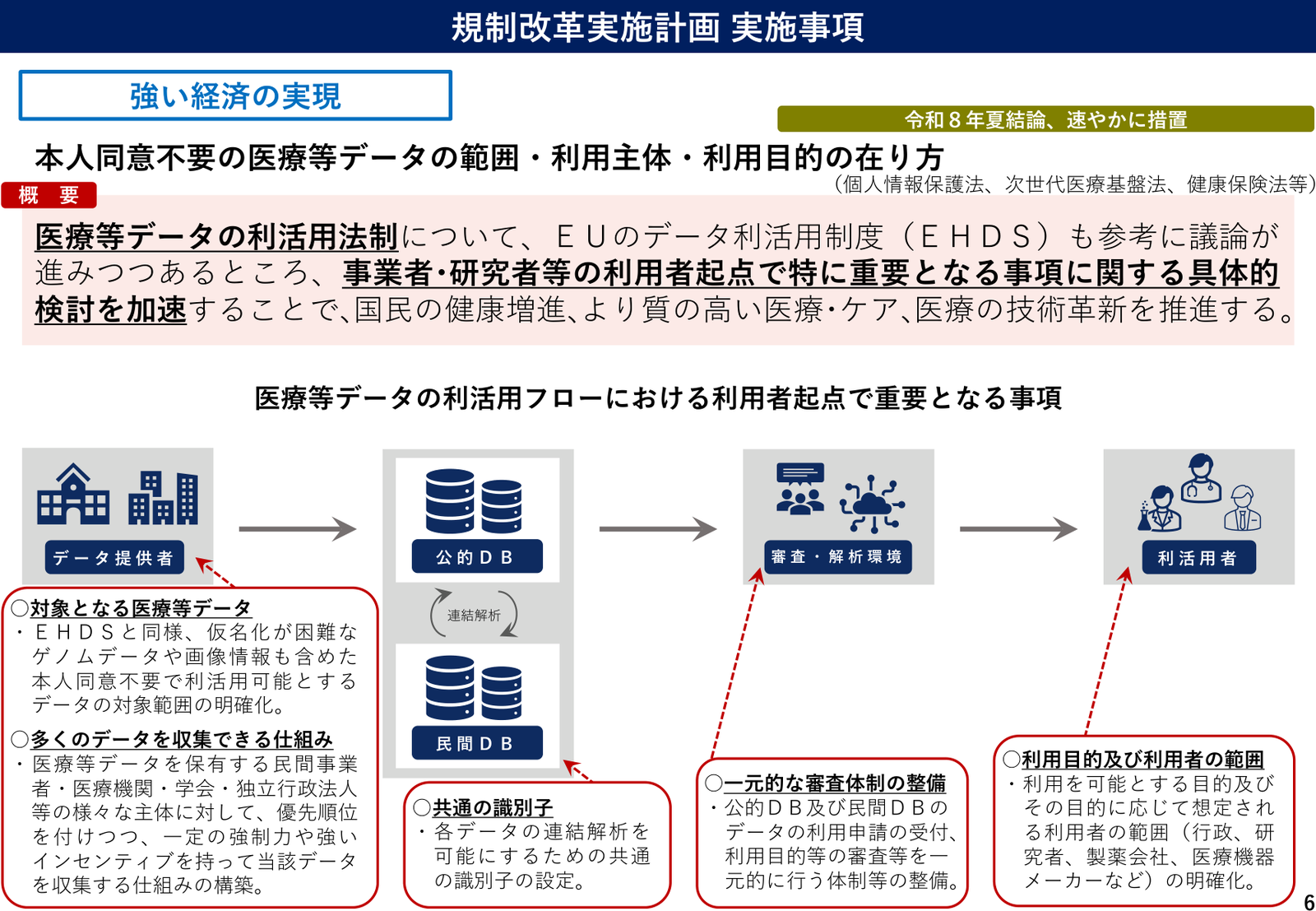
In this field, discussion is moving forward with reference to the EU's data-use system, the EHDS (European Health Data Space). The background is a wish to accelerate concrete study of the items that are especially important from the starting point of the user, meaning the business or researcher, within the flow of using medical data.
How it is about to change
The plan organises the points that are important from the user's starting point. The main ones are as follows.
- The scope of medical data covered. As with the EHDS, clarify the scope of data that can be used without individual consent, including genomic data and image information that are hard to pseudonymise (to process so that individuals cannot be directly identified)
- A mechanism to collect a large amount of data. Build a mechanism that collects data from the various parties holding medical data, such as private companies, medical institutions, academic societies and independent administrative agencies, with priorities set and with a degree of compulsion or strong incentives
- A common identifier. Set a common identifier so that the linked analysis of each dataset is possible
- A unified review structure. Set up a structure that handles the receipt of applications to use data from public and private databases, and the review of purposes of use, in a unified way
- Purposes of use and the range of users. Clarify the purposes for which use is permitted, and the range of users envisaged for each purpose (government, researchers, pharmaceutical companies, medical device makers, and so on)
What it means for businesses
For pharmaceutical companies, medical device makers and research institutions, this is a move toward clarity on the scope of data usable for research and development and on the path to using it. In particular, if genomic data and image information that were hard to handle before are included, there is a prospect that this matters for research in precision medicine and AI diagnosis. What is important here is that this is not a story of "data being used without limit and without the individual's consent." It is a careful review that, within frameworks such as the Act on the Protection of Personal Information and the Act on Anonymously Processed Medical Information (the Next-Generation Medical Infrastructure Act), and once data is put into a form in which individuals cannot be identified, sets up the scope of use and the review structure. Precisely because medical data is sensitive, this line will be drawn with care.
Outlook
For this item, a conclusion is to come in the summer of 2026, with measures to follow promptly. The related laws include the Act on the Protection of Personal Information, the Act on Anonymously Processed Medical Information (the Next-Generation Medical Infrastructure Act), and the Health Insurance Act. The concrete shape of the scope and the review structure is still at a stage of being fixed. For details, see the full text of the Regulatory Reform Implementation Plan.
Source: Cabinet Office, "Regulatory Reform Implementation Plan" (Cabinet decision, July 21, 2026), Implementation Items briefing material
The use of medical data is a large opportunity for businesses, and at the same time an area where one wrong step in how you handle it can cost you trust. When you want to organise how your company handles healthcare data and how far you can use AI, bringing in the perspective of an outside specialist is valuable. Through our AI consulting service WARP, we work with management to design this kind of data use and AI adoption together.
8. Making ethics review appropriate (single review of clinical trials)
Background and current issues
To bring a new drug into the world, clinical trials, meaning clinical studies conducted on people, are essential. When a trial is run, an independent body called an institutional review board reviews the plan to confirm that the safety and human rights of the participants are protected. In Japan, this has been a major bottleneck.
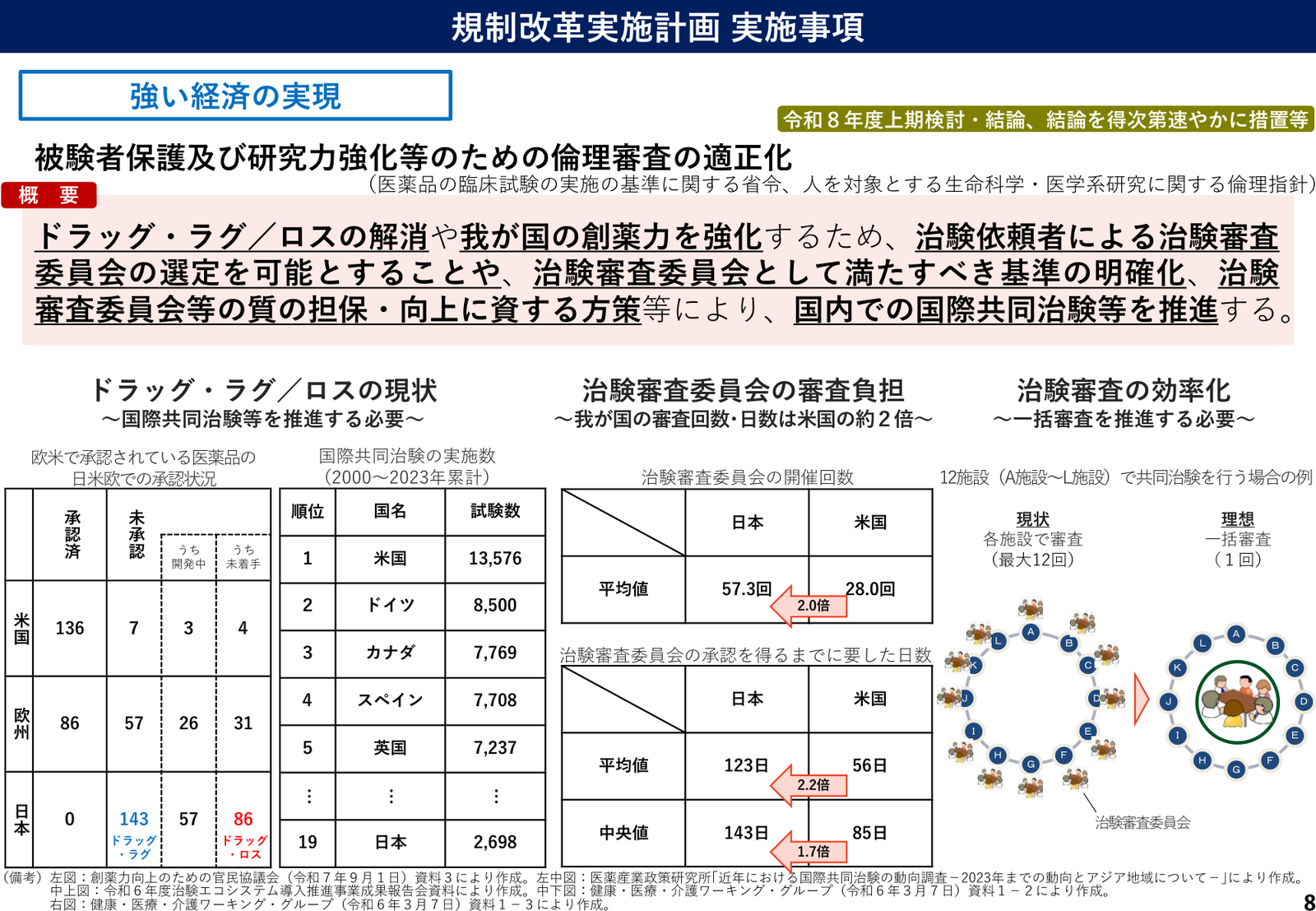
The figures shown in the plan make the gap clear. The number of times an institutional review board meets averages 57.3 in Japan against 28.0 in the United States, roughly double. The number of days needed to obtain approval averages 123 in Japan against 56 in the United States, again more than double. The case flagged as a particular issue is joint trials in which multiple sites participate. For example, when a joint trial is run across 12 sites, at present each site conducts its own review, so up to 12 reviews are needed. The ideal is to finish with a single review.
This inefficiency is one cause of what is called drug lag and drug loss. Drug lag is the delay before a drug available overseas becomes available in Japan. Drug loss is when a drug is not even developed in Japan in the first place. In the number of international joint trials conducted, Japan ranks 19th in the world for the cumulative total from 2000 to 2023, at only 2,698 trials.
How it is about to change
To resolve drug lag and loss and strengthen Japan's drug-discovery capacity, the plan aims to make clinical-trial review more efficient. Concretely, it lets the trial sponsor (the party leading the trial) select the institutional review board. It clarifies the standards an institutional review board must meet. And it takes measures that help secure and raise the quality of institutional review boards. The aim is to promote single review, rather than each site reviewing separately, so that international joint trials and the like can proceed more easily within Japan.
What it means for businesses
For pharmaceutical companies, the medical institutions that conduct trials, and trial-related businesses, cutting the number and time of reviews bears directly on the speed and cost of development. If it becomes easier for Japan to join international joint trials, the time before the newest overseas drugs reach patients in Japan may also shorten. You could call this a review that strengthens the base of drug discovery, a field in which Japan competes internationally.
Outlook
For this item, study and a conclusion are to come in the first half of FY2026, with measures to follow promptly once a conclusion is reached. The related laws include the Ministerial Ordinance on Good Clinical Practice (the GCP Ordinance) and the Ethical Guidelines for Medical and Biological Research Involving Human Subjects. A conclusion is expected on a comparatively early timeline. For details, see the full text of the Regulatory Reform Implementation Plan.
Source: Cabinet Office, "Regulatory Reform Implementation Plan" (Cabinet decision, July 21, 2026), Implementation Items briefing material
38. Reviewing nursing-care service provision and staffing standards to suit local conditions
From here the discussion moves to nursing care. This item is made up of two parts. Let me take them in order.
Background and current issues
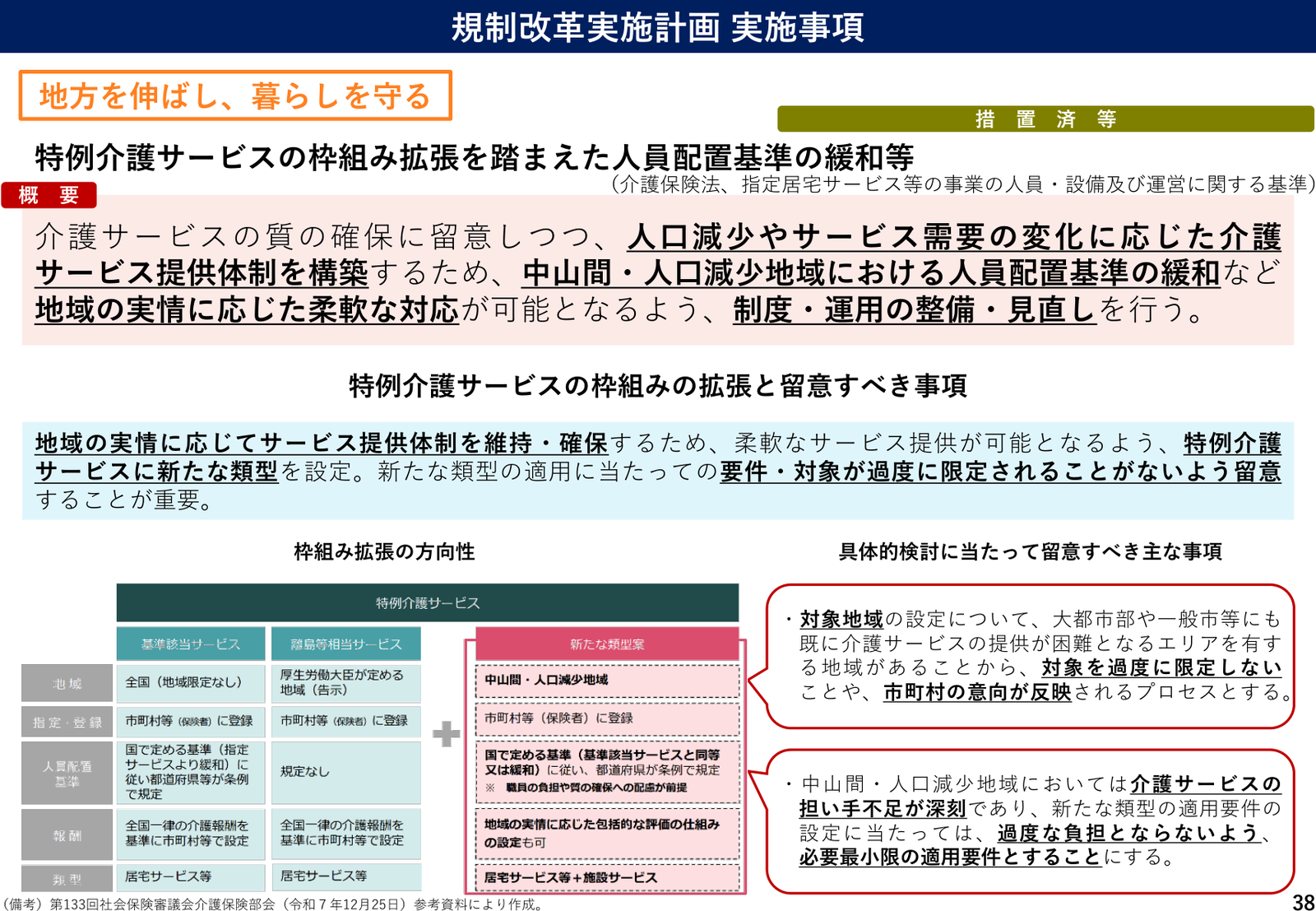
Nursing-care settings are caught between population decline and ageing. Especially in hilly and mountainous areas and areas with declining populations, securing the staff who support nursing-care services is getting harder and harder. Standards under laws such as the Long-Term Care Insurance Act set the number of staff each facility needs, but in some regions meeting that standard is itself becoming difficult. The question is how to build a flexible structure suited to local conditions while keeping the quality of care.
How it is about to change
The first part is expanding the framework of special nursing-care services. So that flexible responses suited to local conditions become possible, such as easing staffing standards in hilly, mountainous and population-declining areas, the plan sets a new category within special nursing-care services. What matters here is that it explicitly states care will be taken so that the conditions and scope for applying the new category are not excessively limited. Even large cities and ordinary municipalities have areas where providing nursing-care services is already difficult, so the process is required not to narrow the scope too much and to reflect the intentions of municipalities.
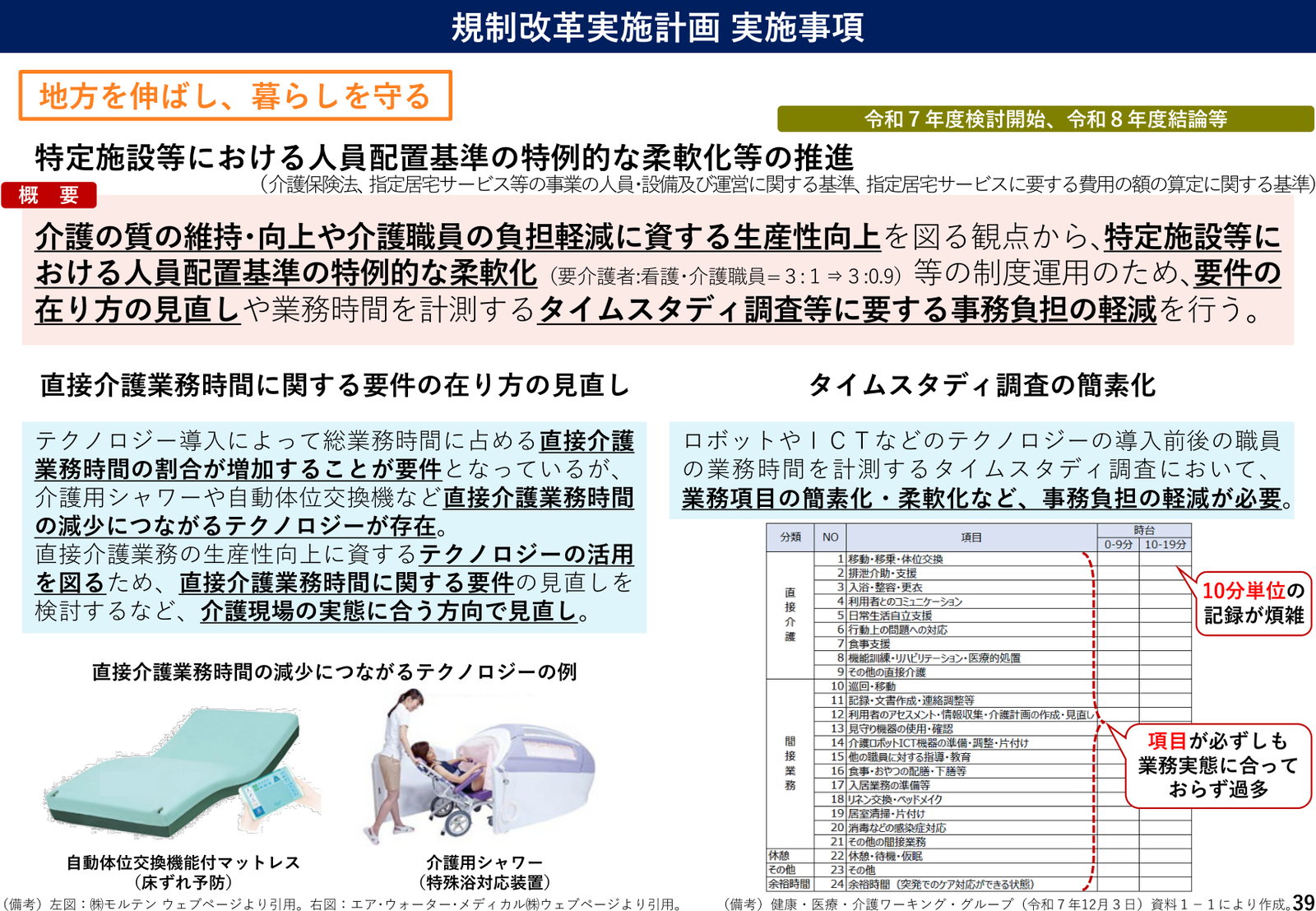
The second part is a special, more flexible treatment of staffing standards at specified facilities and the like. Concretely, it envisages the operation of a rule that makes the ratio of care recipients to nursing and care staff more flexible, from the current "3 to 1" to "3 to 0.9." This is premised on introducing technology such as robots and ICT to raise productivity. Alongside this, the plan includes lightening the administrative burden of the "time-study survey" that measures staff working time before and after introducing technology. This is because recording in ten-minute units is cumbersome, and survey items can be excessive and out of step with the reality of the work. Given, too, that there are technologies that reduce the working time spent on direct care, such as bathing showers for care and mattresses with an automatic repositioning function, a review of the conditions is also being considered.
What it means for businesses
For nursing-care providers, this is a review in the direction of making it easier to keep services running even in areas where staff are hard to secure. In particular, the more flexible staffing premised on introducing technology is a move that is closely relevant to businesses supplying nursing-care robots and ICT equipment. If the burden of the time-study survey lightens, the hurdle to introducing technology also comes down. That said, it is worth noting that the premise, repeated again and again, is that this proceeds while keeping care to the quality of nursing care.
Outlook
The expansion of the framework of special nursing-care services is noted as already implemented. The more flexible staffing standards at specified facilities and the like, and the simplification of the time-study survey, are noted as study beginning in FY2025 and a conclusion in FY2026. The related laws include the Long-Term Care Insurance Act and the standards on the staffing, facilities and operation of designated in-home service businesses and the like. For details, see the full text of the Regulatory Reform Implementation Plan.
Source: Cabinet Office, "Regulatory Reform Implementation Plan" (Cabinet decision, July 21, 2026), Implementation Items briefing material
40. Promoting task shifting and task sharing in the medical and nursing-care field
Background and current issues
The terms task shifting and task sharing come up often in the world of medicine and nursing care. They refer to efforts that, under certain conditions, let another occupation take on work an occupation used to handle, so that the load is shared and limited manpower is used well. With chronic shortages of doctors and nurses, they draw attention as a way to sustain medicine and nursing care.
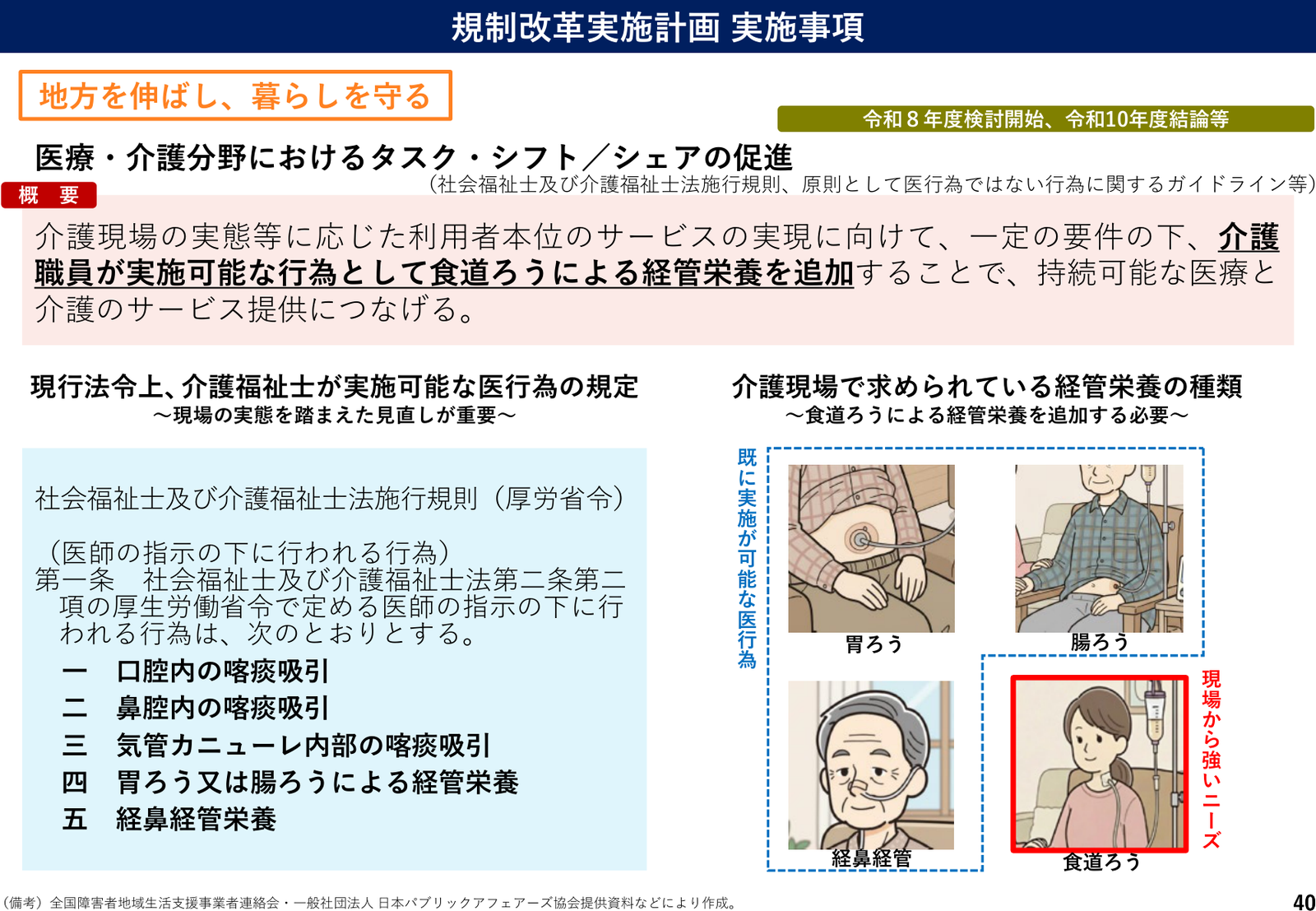
In nursing-care settings, the medical acts that certified care workers may perform under a doctor's instruction are set out in law. The Enforcement Regulations of the Act on Certified Social Workers and Certified Care Workers list five: suctioning sputum from the oral cavity, suctioning sputum from the nasal cavity, suctioning sputum from inside a tracheal cannula, tube feeding via gastrostomy or enterostomy, and nasogastric tube feeding. Tube feeding is a method of delivering nutrition through a tube or the like to people for whom eating by mouth is difficult. In the field, however, there is a need to respond to "tube feeding via esophagostomy," which is not among these, and a strong demand for it had been pointed out.
How it is about to change
To realise user-centred services suited to the reality of the nursing-care field, the plan aims, under certain conditions, to add tube feeding via esophagostomy to the acts that nursing-care staff may perform. It is a review that adds esophagostomy to the tube feeding via gastrostomy, enterostomy and the nasogastric route that are already permitted. The aim is to connect this to the sustainable provision of medical and nursing-care services.
What it means for businesses
For nursing-care facilities and in-home nursing-care providers, this is a review in the direction of widening the range of users they can respond to. If, under certain conditions, nursing-care staff can take on part of what previously required a medical professional, it becomes easier to provide services with limited personnel. Still, what is added is only under certain conditions, and securing safety and the necessary training are premises. The concrete content of the conditions is still to be fixed.
Outlook
For this item, study is to begin in FY2026, with a conclusion in FY2028. Compared with the other nursing-care items, the timeline to a conclusion is somewhat longer. The related laws include the Enforcement Regulations of the Act on Certified Social Workers and Certified Care Workers and the guidelines on acts that are, as a rule, not medical acts. For details, see the full text of the Regulatory Reform Implementation Plan.
Source: Cabinet Office, "Regulatory Reform Implementation Plan" (Cabinet decision, July 21, 2026), Implementation Items briefing material
41. Further spread and smoothing of online medical care in the regions
Background and current issues
The last item is online medical care. For people who live far from a medical institution, and for people for whom visiting is difficult, online medical care, in which a consultation can be received using information and communication devices, is a great help. Especially in areas with few medical institutions, its significance grows all the larger.
In this field, preparing the system has already taken a step forward. Through a revision of the Medical Care Act, a new system called an "online medical care facility" was established for the place where online medical care is received, covering dedicated online-care vehicles and the like. For example, a dedicated vehicle carrying medical equipment tours a region, and inside the vehicle a nurse is present while online medical care is provided. That is the kind of operation envisaged. Several issues remained, however. One is that it was not clear how far the nursing assistance can go when a patient is together with a nurse at such a facility. The other is the treatment under medical fee rules. In the FY2026 revision of medical fees, the calculation for examinations and procedures in online medical care when a patient is together with a nurse was clarified, but this calculation could not be made at an "online medical care facility."
How it is about to change
The plan aims to advance two things. One is to prepare guidelines and the like that clarify the possible nursing assistance, and the necessary equipment and structure, when a patient is together with a nurse at an online medical care facility. The other, premised on preparing those guidelines, is to clarify the treatment under medical fee rules. For reference, in the method of calculating medical fees, when a consultation using information and communication devices is provided to a patient who is together with a nurse and a certain procedure is performed, the "remote medical procedure fee with a nurse present" is shown in categories of 100 points for one type and 150 points for two or more types. The direction is to make it possible to handle such calculations appropriately at online medical care facilities too.
What it means for businesses
For businesses involved in online medical care services and in touring medical provision using dedicated vehicles, this is a review in the direction of clarifying the range of what can be done and the treatment of fees. Once the rules are clear, it becomes easier for those who carry regional medicine to step into new forms of care. In the medical device and information-communication fields too, related demand may widen. It is an area that also connects with efforts that underpin daily life, such as securing local mobility and maintaining medicine in remote areas.
Outlook
For this item, study is to begin in 2026, with a conclusion in 2027. The related laws and rules include the creation of new guidelines and the method of calculating medical fees (a notification). The part relating to medical fees will be prepared in step with the timing of the fee revision. For details, see the full text of the Regulatory Reform Implementation Plan.
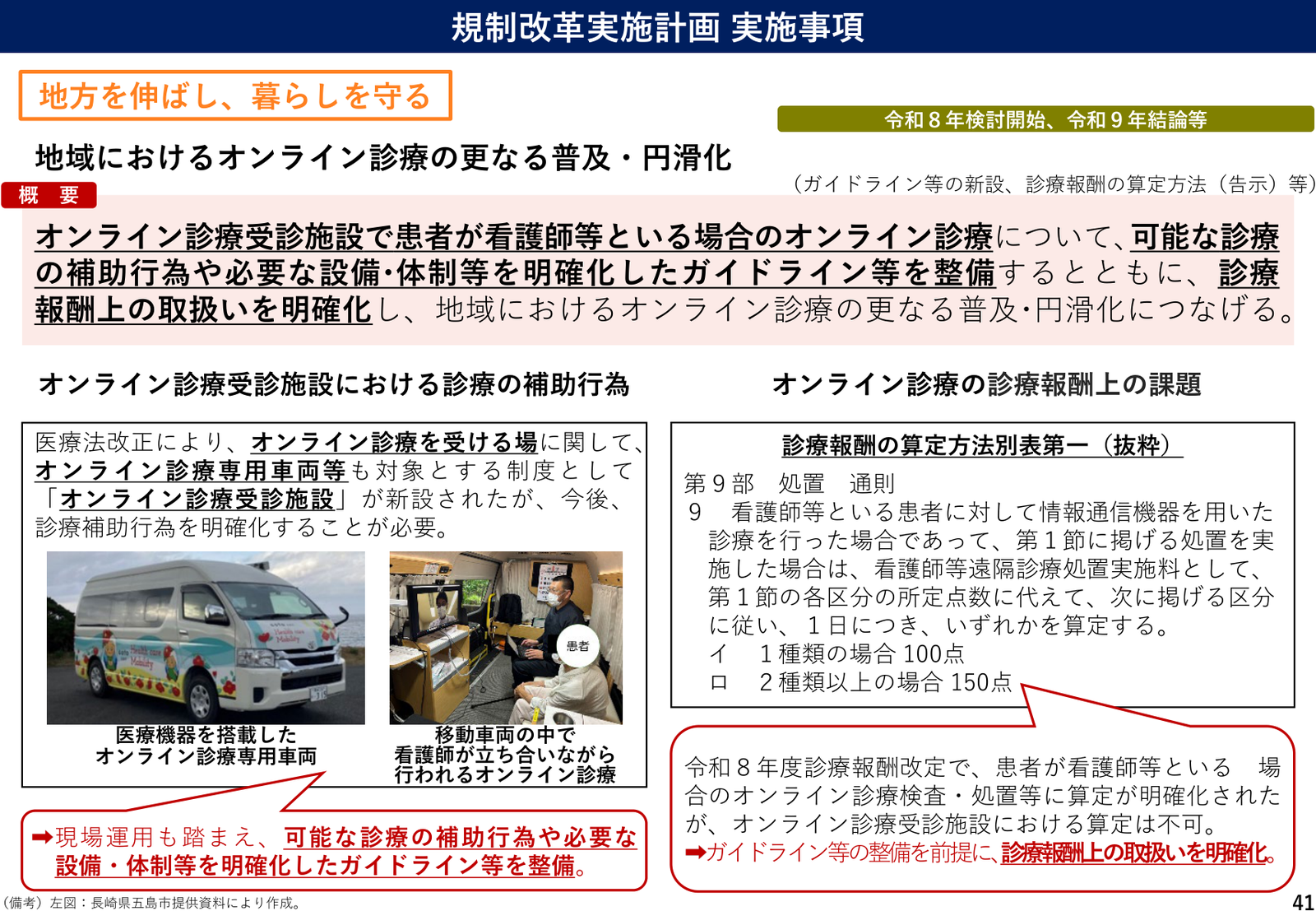
Source: Cabinet Office, "Regulatory Reform Implementation Plan" (Cabinet decision, July 21, 2026), Implementation Items briefing material
Reading this review as a story about your own business
I have looked at seven implementation items in the healthcare, nursing-care and medical field this far. Running through the whole, I think, are two currents.
One is the current of moving data and technology forward while taking care over safety. The use of cancer registries and electronic health records, clarifying the scope of data usable without individual consent, making clinical trials more efficient. Each of these tries to widen the path to data use in the sensitive area of medicine while keeping its caution. The other is the current of facing the reality of the labour shortage. More flexible nursing-care staffing, task shifting, online medical care. Under the harsh premise that there are not enough people, these try to maintain services through technology and careful design of the rules.
What these two currents share is that the use of AI and digital tools sways how effective they are. Turning data to research, and keeping services running with limited manpower, both come down in the end to how well you can fit technology into the work. Even if the system is prepared, if the field cannot use it, the opportunity slips right past.
Here is how I see it. For businesses involved in healthcare, nursing care and medicine, this review can be a tailwind. But whether you can receive that tailwind changes greatly depending on whether you can make AI and data your company's weapon. If you wait without knowing where to start, you will not fully use the system even though it exists. And bringing in AI will not make the labour shortage disappear on its own. The judgment about where it works and where it does not is the first fork in the road.
If you are unsure where and how to bring AI and data into your own company, and are struggling to organise that starting point, please talk to the WARP team. Specialists who led DX and data strategy at major companies walk alongside you month by month, helping you bring AI down into your business. Precisely because healthcare and nursing care demand particular caution, let us start together from the design of where it works and where it does not.
To sum up
It ran long, so let me organise the key points.
- National and hospital cancer registry information (item 4) advances expanding registration items, providing more concrete information to third parties, and linking hospital data with public data, promoting the use of data in cancer research on both quantity and quality. A conclusion and measures are set for the summer of 2026
- Electronic health record data (item 5) advances expanding the information covered, extending retention, mechanisms to raise collection rates, widening the parties who can share and view, and expanding secondary use. A conclusion is set for 2026
- Medical data usable without individual consent (item 6) is a review that clarifies the scope, the collection mechanism, a common identifier, a unified review structure, and the purposes and range of users. It is not a story of using data without limit; it is a careful line-drawing. A conclusion and measures are set for the summer of 2026
- Making ethics review appropriate (item 8) aims to resolve drug lag and loss and strengthen drug-discovery capacity through single review of clinical trials and the like. Study and a conclusion are set for the first half of FY2026
- Nursing-care provision and staffing standards (items 38 and 39) advance more flexibility suited to local conditions, a review of staffing standards premised on technology, and simplifying the survey
- Task shifting in medicine and nursing care (item 40) adds tube feeding via esophagostomy to the acts nursing-care staff may perform, under certain conditions. Study begins in FY2026, with a conclusion in FY2028
- Online medical care (item 41) clarifies, through guidelines, the assistance and the equipment and structure at online medical care facilities, and clarifies the treatment under medical fee rules. Study begins in 2026, with a conclusion in 2027
A policy document, read only as a document, looks like someone else's business. But each of the reviews written into it is a theme that companies in healthcare, nursing care and medicine can start thinking about tomorrow. With the direction of the system now pointed out, start from working out where AI and data actually help in your own company.



![AI x Healthcare Implementation Patterns: Diagnostic Support, Drug Discovery, and Medical Administration Automation [2026 Edition]](/images/columns/ai-healthcare-diagnosis-drug-discovery-administration-2026/cover.en.png?dpl=dpl_GTagW71VKjD4VDo3w4ymrXrCfn1y)