Hello, this is Ryuta Hamamoto from TIMEWELL.
You have a service you want to build in your head. You can see the market. And yet, the moment you try to give it shape, your feet stop. Hiring even one engineer runs to several hundred thousand yen a month, and if you ask an outside firm for a quote, the initial development alone comes back at several million. Fundraising is still a long way off, and the money on hand cannot even produce a prototype. In the end, only the proposal decks and slides pile up. Does any of this sound familiar?
Or perhaps you set off with a small team, but there is only one engineer, and if that person falls ill development halts entirely. Every time you want to add a feature, it gets pushed back with "let's do that next month or later." The freshness of the idea fades faster than the implementation can catch up.
I regard this wall of "I can't start because I can't build" as one of the biggest factors keeping the bar for entrepreneurship high in Japan. And right now, the height of that wall is dropping rapidly thanks to AI-driven development. In this article I lay out why founders should step into AI-driven development, tracing primary data from the government and research institutions, in a way that makes sense even to a beginner. If you are curious about where you or your company stand on using AI, it helps to first check your position with our free AI literacy self-check. The later part of this piece will feel more concrete once you have.
Why "not being able to build" became a wall for founders
Let me begin by digging into where this pain comes from. Once you understand the cause, you can see what AI actually changes.
Until now, putting something into the world with software usually required a large precondition. Someone to design, someone to write the code, someone to test, someone to set up the infrastructure. You gather specialists for each role and pay their salaries, for months or even years, up front. The product reaches the world and starts earning only much later, so someone has to prepare the money for the interval in between. In other words, the act of "building" was bound together with the heavy task of "gathering a lump of money first."
Yet in Japan, gathering that upfront money is itself quite difficult. According to the Cabinet Secretariat's Five-Year Plan for Startup Development, investment into startups by operating companies stood at 40.2 billion dollars in the United States as of 2020, against a mere 1.5 billion dollars in Japan. The number of startup M&A deals was 1,473 in the United States, but only 15 in Japan1. The exit through which someone buys the company you built, and the entrance through which the money to grow it flows in, are both far thinner than in the West. In this environment, the way of fighting that says "raise big, then build big" is hard to adopt in the first place.
The result shows up in the startup rate too. Within the same plan, Japan's startup rate is given as 5.1%, below the United States at 9.2% and the United Kingdom at 11.9%1. The share of newly founded companies is low, and the metabolism of the economy is poor. The double weight of high building costs and thin capital flow is, I think, what has turned so many people's "I want to start" into "I can't start." Note that these figures for the startup rate and so on are as of 2022, when the plan was drawn up, and the latest trends shift year by year. Please take them here as a rough guide to the structure of Japan's entrepreneurial environment.
What AI-driven development is, and what it changes
This is where AI-driven development comes in. It sounds difficult from the name alone, but the substance is quite simple.
AI-driven development refers to a way of building in which humans organise the specification and requirements of what they want to make in words, and hand much of the manual work of writing code over to AI. There are two representative approaches. One is spec-driven development, where you first pin down "what to build" firmly as text, and then have AI implement it based on that specification. It helps to picture building a house where you draw the blueprint carefully before you start construction. The other is AI coding, where AI suggests the next line inside your code editor, or generates a chunk of code in response to your instructions. I cover the thinking behind spec-driven development in detail in a beginner's guide to AI spec-driven development, so please read that alongside this.
What changes? Put plainly, walls that "could only be crossed by a team of specialists" are becoming crossable by a small team, and in some cases by a single person. Overseas, there is a growing movement to call the approach of handing much of the implementation to an AI agent while humans concentrate on designing what to build "vibe coding." Cursor, a development tool with AI built into the editor, is reported by published funding announcements and press coverage to have grown quickly in a short time, and Replit, which has AI build apps in the browser, is said, based on the company's announcements and press reports, to have greatly increased its users and revenue. The fine details of the numbers are not disclosed point by point by each company and rest on reporting, so they warrant some discount, but the underlying current itself, that examples keep appearing of small teams generating large value with AI as a tool, feels solid to me.
What matters is that AI does not take away the human role; the place the human occupies shifts. Because AI takes on the hands-on writing, humans can spend their time on the design and verification of "what to build" and "why it is needed." For a founder, the part with the most value has always been exactly this "working out what to build," so the fit should be good.
Looking for AI training and consulting?
Learn about WARP training programs and consulting services in our materials.
The change in development speed and capital efficiency, in numbers
Feelings alone are shaky ground, so from here let me look at the evidence in survey data.
On development speed, a frequently cited study is GitHub's experiment. The company ran a controlled experiment with 95 professional developers on the task of implementing an HTTP server in JavaScript. The result: the group using AI coding assistance completed the task roughly 55% faster than the group without it. In time, the group that used it finished in an average of one hour and 11 minutes, against two hours and 41 minutes for the group that did not, and the completion rate was also higher at 78% versus 70%2. That said, this is the result for one specific task, implementing an HTTP server. Generalising it to "every part of development gets 55% faster together" is going too far, and it is safer to take it as the effect varying by the type of task and how it is used. Even so, it serves as one rough guide showing that the speed of the hands-on part can change greatly.
Next, how does this speed feed into the capital efficiency of a startup? As I touched on earlier, in Japan both the money flowing to startups and the exit through which a company is sold are thin. Seeking to change this, the government has set out goals of expanding investment into startups to a scale of 10 trillion yen in FY2027, a more than tenfold increase, and creating 100 unicorns and 100,000 startups1. A tailwind has begun to blow. Even so, for a founder fighting the battle in front of them right now, the realistic order is not to wait for a lot of money but to build something that moves quickly with a small stake, prove the value, and only then gather funds and colleagues. AI-driven development, which changes the speed and cost of building, meshes with this way of fighting where you "show the value first."
And to the question of whether people who are not specialists can build, the government itself has provided an answer. In Digital Agency's technical verification, government staff were reported to have created a cumulative 85 business apps using generative AI. What was 13 in January grew to 33 in February, and of the 117 people surveyed, 12, or roughly one in ten, built apps themselves and used them in their work, of whom 8 shared them with their team3. Staff who are not specialist engineers turn their own troubles into apps themselves, with AI's help. The government's verification showed that this is not a feat only special people can pull off. Still, I should add that keeping the quality and security of a full-scale service requires a fair amount of expertise, so this is not a story where "anyone gets a finished product by handing everything over."
Precisely because Japan's startup environment is a blank space, it becomes a winning path
Having read this far, you may feel that "Japan is nothing but unfavourable conditions." But I see the opportunity on the very reverse side of that disadvantage.
According to IPA (the Information-technology Promotion Agency)'s DX Trends 2025, the share of companies positive about generative AI, meaning the total of those who have adopted it, are trialling it, or are considering it, reaches just under 80% in the United States and just under 70% in Germany, while in Japan it stays at just under 50%. On top of that, the smaller a company's workforce, the lower its rate of engaging with AI tends to be in Japan, and AI-related talent is pointed out to be in short supply regardless of category4. Read normally, this is pessimistic data showing Japan lagging.
But read it through a founder's eyes, and the scenery changes. That so many companies have not yet stepped into AI also means that, for someone who can create value with a small team on the assumption of AI, a blank market with few competitors is spreading out. Being able to move when those around you cannot is itself an advantage. The tailwind of the government trying to increase startup investment tenfold, and the blank space where AI use is still thin. Now, when these two overlap, is, I think, by no means a bad time for someone starting with a small stake.
The figure showing the gap in AI use between Japan and abroad helps you feel the size of this blank space.
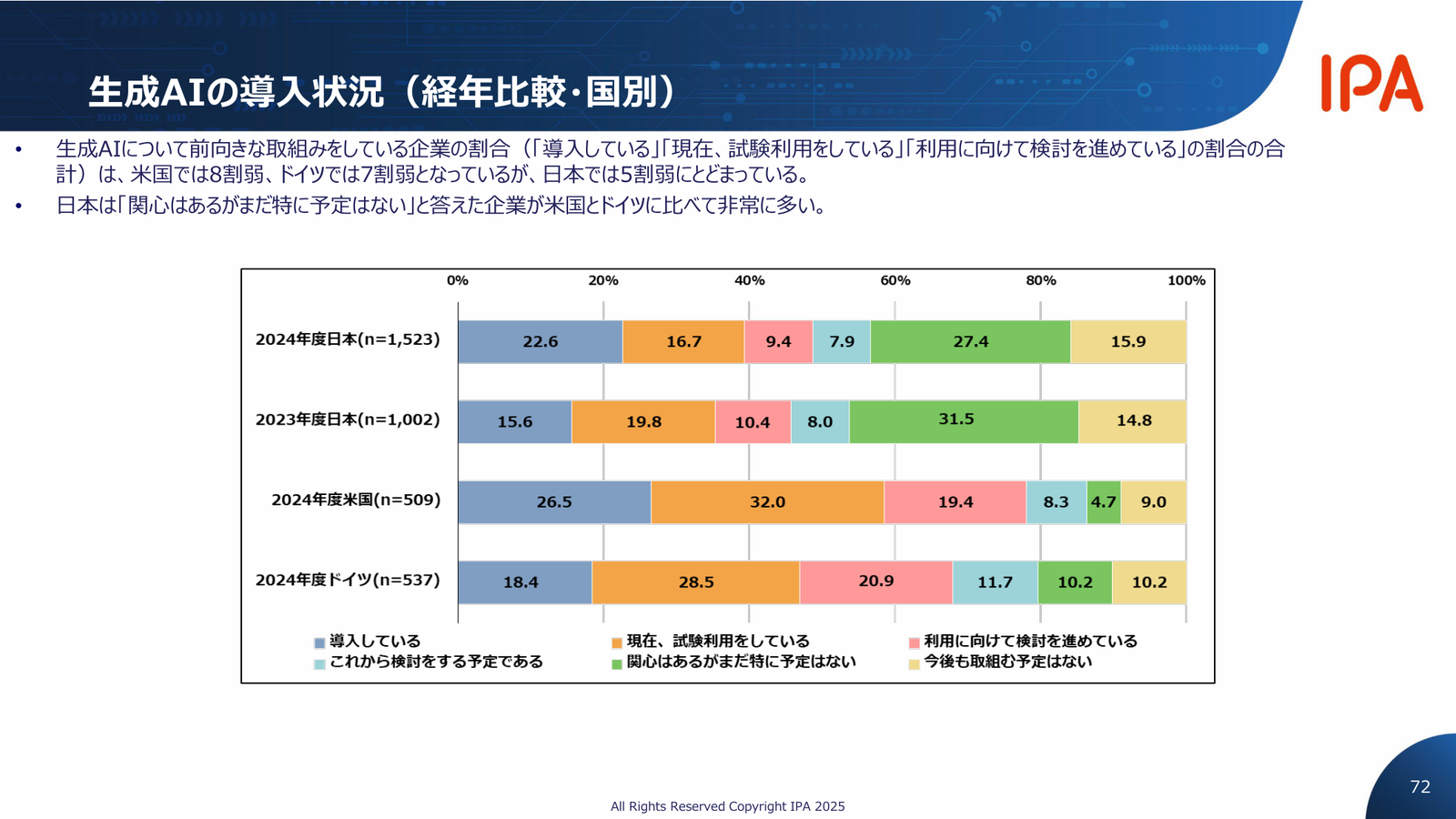
Source: IPA, "DX Trends 2025" data collection (June 2025) Of course, a blank space does not mean you win automatically. Only when you have the ability to use AI as a tool and to work out what to build does this blank space turn into a winning path. How AI-driven development is beginning to be learned in universities and research settings is something I touch on in a piece on university AI-driven development in the sciences, so if the angle of education and talent development interests you, please take a look.
Behind the convenience, the cautions you must keep in mind
I have written mainly about possibilities so far, but AI-driven development is no all-powerful magic. On the contrary, used wrongly, there are scenes where it can damage the credibility of your business. Before you step forward, let me share a few key points.
First, information leakage and security. When you hand implementation to AI, if you carelessly enter confidential material such as customer information, an undisclosed business plan, or an authentication key, there is a risk of it being passed to an outside service. It is essential to decide, at the very start, which AI tools you may put what into, as an internal rule. Second, the problem of AI presenting wrong content with confidence. It is not rare for generated code or an explanation to look plausible while being wrong. Even when something appears to be working, AI can write code that breaks on an unexpected input. Please do not break the stance of humans always reviewing what comes out.
Third, the problem of the trail. The wider the range you hand to AI, the more humans tend to lose the ability to explain "why this implementation was chosen." A state where you cannot trace the reasoning, when a defect later occurs or when you explain your technology to an investor or a business partner, becomes a risk to the business. Keeping a record of specifications and the reasons behind decisions, and staying able to explain them, becomes important precisely because you are small. Fourth, over-reliance itself. The faster AI builds for you, the more the temptation arises to neglect verification and design. But the one who decides what to build, and who bears responsibility for finally putting it into the world, is, in the end, the human. AI-driven development becomes a weapon only when you hold to the premise that humans keep the design and the final judgment. Please also keep an eye, from time to time, on whether bias has crept in or whether judgments skewed toward particular data are being produced.
These cautions are not there to make you stop in fear. Rather, if you use AI while being properly wary, you can draw on the speed of AI-driven development with peace of mind. Where it works and where it does not, what you may hand over and what humans should hold. That line-drawing is, I think, where a founder shows their skill.
How to take the first step, and to sum up
Finally, let me write about what to do from tomorrow. No large preparation is needed.
The first step is not to aim straight for a finished product. First, build with AI a minimal thing carrying only the one value you most want to test. Write out the requirements of what you want to make in words, hand them to AI, and assemble a small thing that moves. Just by running this back-and-forth a few times, a prototype that used to take months appears in your hands in a surprisingly short time. Once you have something that moves, you can show it to prospective customers and check their reaction. If the reaction is good, it becomes material for gathering funds and colleagues; if it is bad, you can change direction early. This speed is exactly what a low-capital founder should get their hands on above all. I also organise the concrete way to proceed with AI-driven development in a practical guide to AI-driven development, so reading it before you start moving your hands should reduce the hesitation.
Even so, I often hear that it is hard to see where to begin, or where AI works within your own company. In such times, bringing in one outside perspective changes the scenery. WARP, the service we offer, is one in which specialists who led DX and data strategy at major companies walk alongside you month by month, helping you bring AI down into your business. From the design of what you want to build to the line-drawing of where to hand to AI and where humans hold, they think it through together with the manager. When you want a sparring partner rather than carrying it all alone, please talk to the WARP team.
This ran long, so let me organise the key points.
- Until now, building something with software required a team of specialists and a lump of money, and that became the entrepreneurial wall of "I can't start because I can't build"
- Japan's startup rate is 5.1%, lower than the West, and startup investment and M&A are thin too, so the way of fighting where you raise big before building is hard to adopt
- AI-driven development lets humans handle the design of the specification and hand the manual work of implementation to AI, so that even a small team with little capital can give value a shape
- In GitHub's experiment, AI assistance made a specific task roughly 55% faster, and in Digital Agency's verification non-engineer staff built 85 business apps. You can use these as rough guides on the premise that the effect varies
- Japan, where AI use is still thin, has a blank space, and those who can move hold a first-mover advantage. But guarding against information leakage, error, the trail and over-reliance is essential
For those who had something they wanted to build but could not start, the current change is a tailwind. Rather than a perfect plan, one thing that moves, however small. Please start from there.
References and primary sources
Footnotes
-
Cabinet Secretariat, Council for the Realization of a New Form of Capitalism, "Five-Year Plan for Startup Development" (28 November 2022) https://www.cas.go.jp/jp/seisaku/atarashii_sihonsyugi/kaigi/dai13/shiryou1.pdf ― Japan-US-UK comparison of the startup rate (Japan 5.1%, United States 9.2%, United Kingdom 11.9%), startup investment by operating companies (Japan 1.5 billion dollars, United States 40.2 billion dollars) and number of M&A deals (Japan 15, United States 1,473), and the goals of a 10-trillion-yen-scale investment, 100 unicorns and 100,000 startups (p.1-3) ↩ ↩2 ↩3
-
GitHub, "Research: quantifying GitHub Copilot's impact on developer productivity and happiness" https://github.blog/news-insights/research/research-quantifying-github-copilots-impact-on-developer-productivity-and-happiness/ ― A controlled experiment with 95 developers found the AI-assisted group roughly 55% faster (one hour 11 minutes vs two hours 41 minutes), with a completion rate of 78% vs 70%. The subject was the specific task of implementing an HTTP server ↩
-
Digital Agency, "FY2024 Report on the Technical Verification and Environment Development for the Business Use of Generative AI" (published 2 June 2025) https://www.digital.go.jp/assets/contents/node/information/field_ref_resources/527968c1-5f55-42d4-868c-54112776c19f/9df94519/20250602_news_generative-ai_report_01.pdf ― Government staff created a cumulative 85 generative-AI apps; of 117 surveyed, 12 (roughly one in ten) used self-built apps in their work, of whom 8 shared them with their team (executive summary, p.9 and elsewhere) ↩
-
IPA (Information-technology Promotion Agency), "DX Trends 2025" data collection (26 June 2025) https://www.ipa.go.jp/digital/chousa/dx-trend/tbl5kb0000001mn2-att/dx-trend-data-collection-2025.pdf ― The share of companies positive about generative AI is just under 80% in the United States and just under 70% in Germany against just under 50% in Japan; the smaller the workforce, the lower Japan's engagement rate; AI-related talent is in short supply (data collection p.70-73) ↩