Hello, this is Ryuta Hamamoto from TIMEWELL.
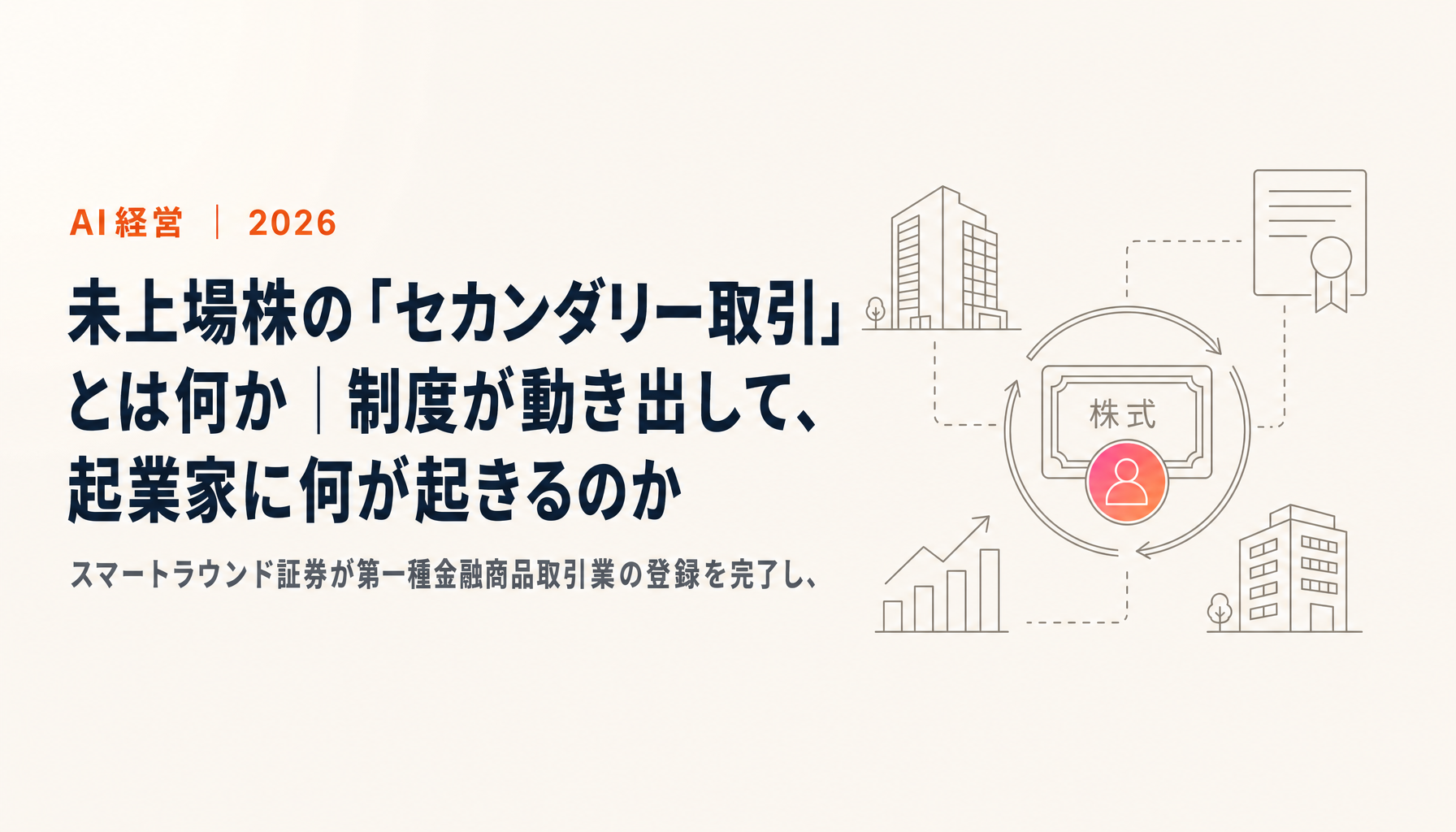
Japan's startup community has been talking about Smartround Securities completing its registration as a Type I financial instruments business.1 The registration category is special intermediary business for unlisted securities, and the company plans to offer services centred on secondary transactions in private company shares once it completes membership procedures with the Japan Securities Dealers Association.
"Secondary" is everyday vocabulary inside the industry, but opaque if you are early in your first company or newly a shareholder. There is also a regulatory story behind the timing that is not obvious from the announcement.
So: what a secondary transaction is, what the law changed, and then the part that matters — what founders actually gain, and what they should be careful about.
The short version
- A secondary transaction is an existing shareholder selling already-issued shares to another investor. No money reaches the company
- In Japan, finding buyers was hard enough that neither founders nor employees could convert shares to cash before an IPO
- The enabling statute is Act No. 32 of 2024. The related orders took effect May 1, 2025
- It created the special intermediary business for unlisted securities, disapplying capital adequacy ratio rules, business restriction rules, and reserve requirements
- It also made proprietary trading systems dealing only in illiquid unlisted securities exempt from authorization, runnable on registration alone
- The scope is specified investors and similar parties. Retail individuals cannot trade freely
- For founders the value shows up in hiring, exit diversity, and the option not to rush an IPO
- Set policy in advance on transfer approvals, how the price is treated, and changes to the register
What a secondary transaction is
Primary versus secondary
| What happens | Where the money goes | |
|---|---|---|
| Primary (issuance) | The company issues new shares to investors | To the company |
| Secondary (circulation) | An existing holder sells shares they already own | To the seller. Nothing to the company |
"We raised a 1 billion yen Series A" is primary. New shares are issued and the proceeds land in the company's account, funding hiring and development.
Secondary is different. A founder, an early investor, or a former employee who exercised options sells shares they hold. The money goes to that person. The company's balance is unchanged.
That is the first fork in the road. "We raised money through a secondary" is not an accurate sentence.
Routine in public markets
Almost all trading you see reported is secondary. Buying Toyota shares through a broker sends no money to Toyota; it goes to the previous holder.
So secondary transactions are not exotic — they are what public markets do every day. The problem is that they almost never happened in private shares.
Looking for AI training and consulting?
Learn about WARP training programs and consulting services in our materials.
Why the market never developed in Japan
Several things stacked up.
No buyers. Private shares have no market. A seller exists; finding the buyer means working personal networks.
No price. Listed shares have a quoted price. A private company's value has to be inferred from the last round. Buyer and seller see it differently.
Heavy process. Most startup shares carry transfer restrictions. Articles of incorporation typically require board approval, so even a willing buyer and seller need the company's consent.
And regulation. Intermediating private shares as a business requires registration as a financial instruments business, and Type I requirements are demanding. Capital adequacy ratios, business restrictions, and statutory reserves were designed for brokerages handling large volumes of listed securities. For a firm quietly matching private share trades, they were plainly excessive.
The result: with ten years to IPO not unusual, neither founders nor employees could realize anything for the whole stretch. That constraint was structural.
What the law changed
The 2024 amendment
The basis is the Act Partially Amending the Financial Instruments and Exchange Act and the Act on Investment Trusts and Investment Corporations (Act No. 32 of 2024). The related cabinet order was approved on March 25, 2025, promulgated March 28, and took effect together with the cabinet office ordinances on May 1, 2025.2
The amendment outline puts it this way:3
5. Provisions on the special intermediary business for unlisted securities For Type I financial instruments business operators conducting only intermediary and related business in unlisted securities for specified investors and similar parties, the rules on capital adequacy ratios, the business restriction rules, and the rules on accumulating financial instruments transaction liability reserves shall not apply.
In plain terms: strip the heavy requirements from firms that only intermediate private shares.
There is a second change that gets less attention and matters just as much.
6. Provisions on proprietary trading system operations (1) Where a proprietary trading system handles only illiquid unlisted securities and operates at limited scale, authorization shall not be required, and the business may be conducted under Type I financial instruments business registration.
A proprietary trading system (PTS) is a venue for trading shares outside an exchange. Operating one used to require authorization; for private shares, registration is now enough.
Lighter intermediation rules, and a lower bar to building the venue. Only with both does building an actual secondary market become feasible.
And now the registration
On August 21, 2026, Smartround Securities completed Type I registration under this special intermediary category (Kanto Local Finance Bureau (Kinsho) No. 3539).1 Services are to begin after completing Japan Securities Dealers Association procedures.
The framework opened in May 2025; an operator has now reached registration on top of it.
What founders gain
1. Hiring conversations change
This is the biggest one, in my view.
Startups competing for talent usually cannot win on salary, so they offer stock options. From the candidate's side, that is a piece of paper that may be worth something if the company lists — on a timeline nobody can state.
A secondary route changes the sentence. Being able to say "there is a path to liquidity under defined conditions, even without an IPO" carries entirely different weight.
It matters most for people in their thirties and forties on their second or third move. With school fees and a mortgage, "this might be worth something in ten years" is not a workable offer. A lot of startups have lost candidates precisely here.
2. Founders can afford to think long
Founders selling part of their holdings draws mixed views. "Doesn't that reduce commitment?" is a fair question.
In practice the opposite effect is often larger. When your household depends entirely on the company, the pull toward an early exit gets strong. Whether to accept an acquisition offer starts bending around personal finances.
With some liquidity already taken, saying "not now" becomes easier. Building over a long horizon turns into a real option.
That said, how much to sell is a cap table question, and it feeds directly into how the next round's investors read the situation. Discuss it with your investors beforehand.
3. Angel money starts circulating
An effect on the ecosystem that is easy to overlook.
Angels and small funds who invested early get nothing back until an IPO. Nothing back means nothing to invest in the next founder. That is one reason angel investing has been slow to spread in Japan.
An intermediate exit means recovered capital flows into the next startup. Money that turned over once a decade turns over in five years. As a matter of arithmetic on the number of shots taken, that compounds.
4. Less pressure to list early
Japanese startups are often said to list earlier than their peers elsewhere. One reason is simply that an IPO was the only way to convert shares into cash.
Listing while still small means quarterly disclosure obligations alongside harder-to-justify growth spending. There is a real population of companies that could have grown much larger.
With a secondary route, "keep growing without listing" becomes plausible. I think this could change the scale of Japanese startups over time.
What founders should decide first
All of the above is upside. But secondaries are a management issue, and left alone they generate friction.
Set a transfer approval policy
Most startup shares carry transfer restrictions requiring board approval, so the company does control who joins the register.
The failure mode is handling requests without a policy. Approve for A and decline for B, and the resentment stays. Decide in advance:
- Who may sell (tenure, seniority, treatment of leavers)
- When (after a round closes, an annual window)
- How much (what share of a holding)
- To whom (existing investors only, or new parties)
This is not something to work out once the framework matures. Without a policy when the first request arrives, whatever you decide that day becomes the precedent.
How the price gets used
A price set in a secondary echoes in several directions.
It may be referenced in the next round's negotiation, and it can bear on stock option design. Tax-qualified stock options in Japan carry requirements about the exercise price, and share valuation is a delicate tax question.
This is beyond what I can state definitively. When you start considering a secondary, confirm the position with your tax and legal advisers. Discovering a tax problem after the trade has settled is the worst version of this.
What a changing register costs
More shareholders means more shareholder administration — convening meetings, collecting consents, handling information requests. While private, the cost of additional shareholders is higher than people expect.
And who joins matters commercially. An investor with ties to a competitor on your register changes how you handle information. The approval process exists for this too.
The scope is "specified investors and similar parties"
One point that gets garbled.
The new special intermediary business is, in the words of the amendment outline, aimed at "specified investors and similar parties."3 This is not a market where retail individuals freely trade private shares.
That design makes sense. Private shares come with thin information and no reliable price check, so participation is limited to parties with the knowledge and resources to assess them.
It is also entirely separate from solicitations promising access to "pre-IPO shares." Those scams have circulated for years, and a genuine regulatory change creates an opening for the line "there's a new framework, so you can buy now." Registered firms can be checked on the Financial Services Agency's site.
Worth preparing now
The framework is live, but real volume will take time. Useful things to do meanwhile:
1. Get the shareholder register right. More companies than you would think have gaps. Who holds what, and how they acquired it. Reconstructing this after a secondary request arrives is painful.
2. Check your transfer restriction clause and approving body. Whether you have a board changes who approves. Read what your articles actually say.
3. Revisit the stock option rules. Treatment of leavers, exercise conditions, transferability. Most were not drafted with secondaries in mind.
4. Write the policy down. The who, when, how much, and to whom. On paper, you stop improvising.
5. Talk to your investors. How they view founder and employee secondaries, and whether your shareholders agreement says anything relevant.
Closing thought
As a regulatory change, the accurate reading is modest: rules that did not match reality were adjusted to match it. Not dramatic.
What it acts on, though, is time. The inability to realize value before an IPO shaped hiring decisions, founder psychology, and how often angels could recycle capital. Loosening that will show up gradually over several years.
If you are thinking about starting a company, it is worth internalizing that "an IPO is the only exit" is no longer the settled premise. The cap table has more options in it now.
I talk with founders often, and watching candidates fail to be convinced by a stock option explanation is something I have seen many times. If that alone changes, it is worth a lot.
Wrapping up
- A secondary transaction is an existing shareholder selling to another investor. No money reaches the company
- In Japan, buyer scarcity, price opacity, transfer approvals, and heavy regulation combined to prevent a market
- Act No. 32 of 2024 created the special intermediary business for unlisted securities; related orders took effect May 1, 2025
- Capital adequacy, business restriction, and reserve rules are disapplied, and PTSs dealing only in private shares no longer need authorization
- On August 21, 2026, Smartround Securities completed Type I registration under this category
- For founders: hiring credibility, founder time horizons, angel capital recycling, and the option not to rush an IPO
- As management matters, settle approval policy, price treatment, and register composition in advance
- Scope is specified investors and similar parties — not a retail market, and not the same thing as pre-IPO share scams
A framework existing does not mean trading starts tomorrow. But the premise that nothing can happen before an IPO is genuinely breaking down. That belongs in your thinking about the cap table.
Footnotes
-
Smartround Inc., "Smartround Securities completes registration as a Type I financial instruments business (special intermediary business for unlisted securities)" (August 21, 2026). https://prtimes.jp/main/html/rd/p/000000098.000042542.html ↩ ↩2
-
Financial Services Agency, "Results of the public comment procedure on cabinet orders and cabinet office ordinances relating to the 2024 amendments to the Financial Instruments and Exchange Act" (March 28, 2025). https://www.fsa.go.jp/news/r6/shouken/20250328/20250328.html ↩
-
Financial Services Agency, Outline of the Bill Partially Amending the Financial Instruments and Exchange Act and the Act on Investment Trusts and Investment Corporations. https://www.fsa.go.jp/common/diet/213/01/youkou.pdf ↩ ↩2
![[October Update] Upcoming Accelerator Program Schedule](/images/columns/ainews-accelerator/cover.en.png)