Hello, this is Ryuta Hamamoto from TIMEWELL.
At eight in the evening, in a government building, there is a section where the lights are still on. The staff member in charge is pulling out past answers in preparation for tomorrow's council session, writing up the anticipated questions one at a time. At the desk beside them, someone is revising the notice for a residents' briefing over and over, while also having to answer an inquiry that has come round from another department. The daytime fills up with the counter and the phone, so the document work that needs a settled mind is inevitably pushed into the night. I suspect this scene rings true for more than a few people.
"Doesn't a night like this ring a bell?" A story from the field
From the outside, the work of a public servant may look centred on serving people at the counter. But what actually eats up the time is the vast amount of document and coordination work behind it. Answering inquiries from the national or prefectural government within the deadline. Preparing decision documents while checking the wording of guidelines and notices. Producing minutes after every meeting and summarising the key points. As a council session approaches, working out the questions that might come up and refining draft answers while keeping them consistent with past ones. Answering residents' inquiries carefully, after verifying the grounds. Every one of these is work that cannot be skipped, work that upholds trust in the administration.
The problem is that each of these takes time. Thirty minutes to find the past materials, an hour to shape the draft, another thirty minutes to check and correct. Stack it up and a day is gone in no time. And because the content bears directly on residents' lives, mistakes are not allowed. The more care is required, the more the back-and-forth of checking piles up.
The reason I use the phrase "AI-driven public servant" in this article is that I want to lighten this weight on the field. This is not a call for you to become a special IT engineer. It is about slipping AI in as a partner for the document drafting, inquiry responses and background research you handle every day. You leave the first drafts and summaries to AI, and you spend your own time on judgement, on the final check, and on talking with residents. That is the shift in the way of working I mean. If you would like to start by gauging how close you already are to AI, try measuring where you stand with the free AI literacy self-check.
Why the busyness of public servants never goes away
Why is the field this busy in the first place? Let me think about it not as a matter of willpower but as a matter of structure.
At the very root is population decline and the labour shortage. The draft "Regional Future Strategy" compiled by the Cabinet Secretariat in 2026 sets out its aim: even as the population falls and uncertainty about the future rises, to build a society where, wherever you live across the 47 prefectures, you can live safely, receive the healthcare, welfare and quality education you need, and have somewhere to work1. Turn that around and it means the level of public service cannot be allowed to drop even as people decrease. Staff numbers do not rise easily. Yet the range of duties that must be protected does not shrink. If anything, the more complex the systems become, the more there is to check. This scissor-like force, where the people to do the work do not increase but the work to be done does not decrease, is the true nature of the busyness.
A second structural factor is that much of government work is made of "documents." Decisions, inquiries, answers, notices to residents, in the end they all take the form of writing. Document work can be done faster and more accurately by experienced staff, but that speed is tied to the person. How much time it takes changes greatly with whether you happen to know a similar past document, or whether you remember where the guideline that provides the grounds is kept. So every transfer takes time to get up to speed, and the work tends to concentrate on the veterans. This person-dependence lowers the efficiency of the organisation as a whole.
And third, there is the demand for accuracy peculiar to government. In the private sector some variation in expression may be tolerated, but for government documents, grounds and consistency are everything. One wrong figure, one wrong citation, can lead to a disadvantage for residents or a loss of trust. So everyone grows cautious and the back-and-forth of checking increases. This caution is itself correct, but it is also a factor that squeezes time. Labour shortage, person-dependence, the demand for accuracy. Where these three overlap is that government building at eight in the evening.
Looking for AI training and consulting?
Learn about WARP training programs and consulting services in our materials.
What actually changes when you become an AI-driven public servant
So what part of this structure changes when you make AI a partner?
What generative AI is good at is precisely the area that has troubled public servants. Picking out the key points from a long meeting recording to make a first draft of the minutes. Reading in past answers and materials to prepare a first cut of the anticipated questions and answers. Writing several versions of a notice or email for residents from nothing more than a statement of purpose. Shaping a draft answer to a national inquiry from the materials at hand. Each of these takes time if a person writes from scratch, but when you have AI make the first draft and a person corrects it, the centre of gravity of the time spent shifts from "making" to "confirming."
The important point here is that AI does not take the work away; it changes how the time is used. If the hour you spent writing a draft from scratch becomes twenty minutes of checking and correcting the AI's draft, you can use the remaining forty minutes on something else. The ministry survey, too, lists among the uses for the capacity generative AI frees up, after improving internal work, "improving resident services, such as securing time for dealing with residents," near the top2. Efficiency is leading to the recovery of time spent facing residents. It also works on the person-dependence problem. If AI can supplement, from past documents, the "which materials should I look at" that used to live in a veteran's head, even a less experienced member of staff can get started on the work at a certain level.
The government is backing this change in individual staff. The Digital Agency has built an integrated platform called "Government AI" so that government staff can use AI safely, and prepared an in-house generative AI named "Gennai." On top of general functions such as document creation, summarising and translation, it is said to include apps specialised for practical government work, such as an AI to help with research on the legal system and an AI to search Diet answers. According to the Digital Agency's explanation, provision to all Digital Agency staff began in May 2025, with a plan to extend it in turn to ministries and agencies that want it3. As one example of AI working on jobs that handle the large volume of documents and data in government, the Digital Agency describes a case at one ministry where analysis of about 8,000 survey responses, which used to take one staff member roughly two months, was shortened to a matter of days3. It is a flow in which the state itself is starting to build the platform on the premise that "staff use AI."
The field of local government is moving on the same idea. The reason we at TIMEWELL keep running an AI consulting service called WARP is that we feel we are getting somewhere on this part, designing together which task to bring AI into, and how, so that it actually becomes easier. The field does not move on an order alone. Only when you concretely separate out which part of the inquiry work or answer preparation in front of you can be handed to AI does the way of working called an AI-driven public servant take root.
The effect in numbers, and the government fields already moving
Because principle alone is hard to believe, let me line up figures that can be verified against the government's primary sources. Where something is an estimate or a projection, I say so each time.
First, the overall picture. In the survey the Ministry of Internal Affairs and Communications carried out in FY2025, of all 1,788 local governments nationwide, 1,322 had already adopted AI, RPA or generative AI, which is 74.0 percent of the total4. For generative AI alone, prefectures and designated cities are at 100 percent adoption, and other cities, towns and villages have spread to 45.6 percent2. The generative-AI adoption rate among prefectures climbed from 87.2 percent in FY2024 to 100 percent in FY202525. The figures show that over these one or two years, AI use in government has spread all at once.
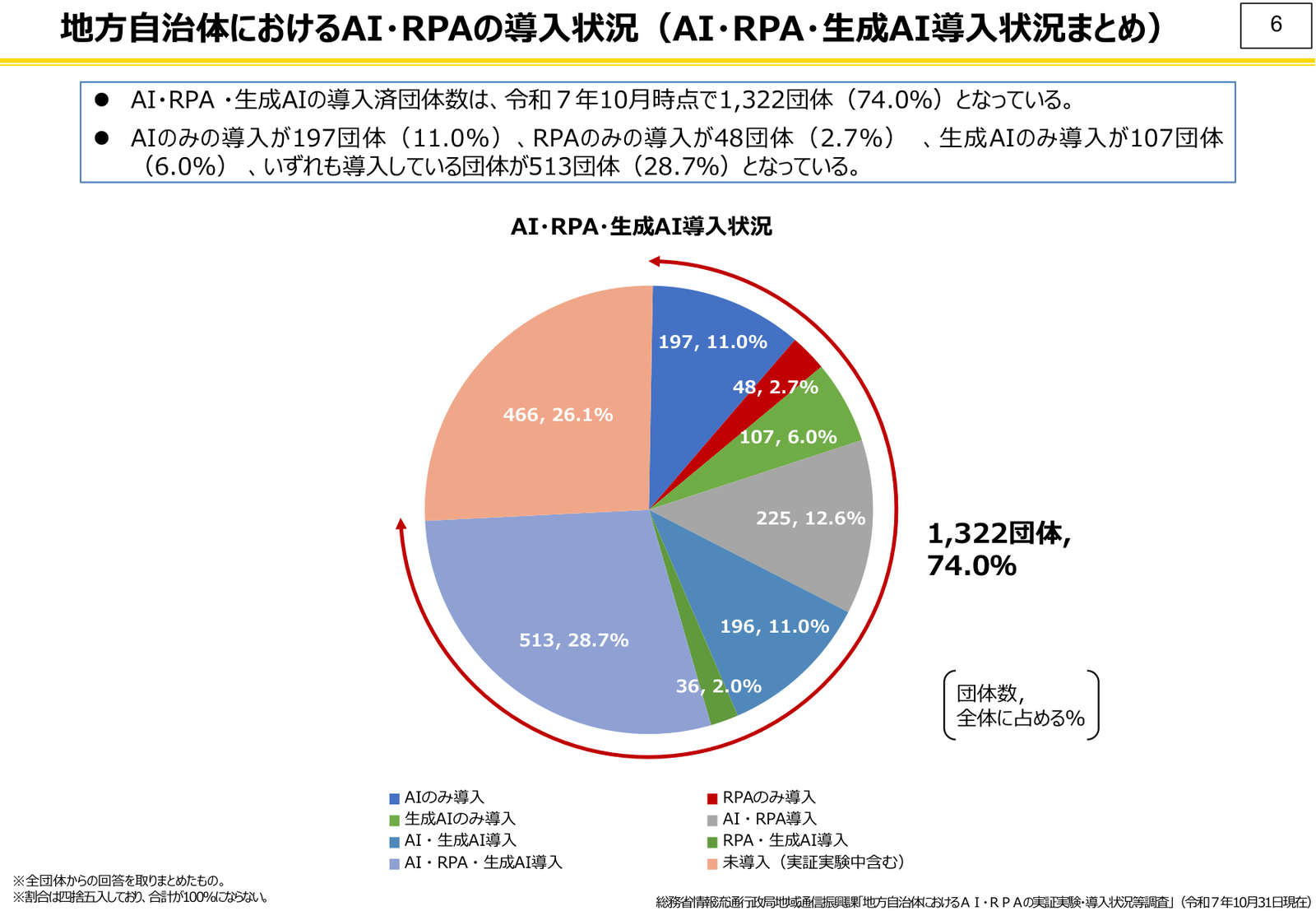
Source: Ministry of Internal Affairs and Communications, "Promoting AI and RPA Use in Local Governments (FY2025)" So what work is it actually used for? In the FY2025 survey, in order of how many cases were reported, the uses run: drafting greetings and notices, summarising minutes, preparing anticipated questions and answers for council sessions, drafting emails, making first drafts of proposals, and preparing draft answers to residents' questions2. You can see that the work I described at eight in the evening comes almost exactly at the top of the list of uses.
Effect figures are starting to appear too. Among the adoption effects the ministry reported in FY2025, what catches the eye is the reduction in document creation. At one local government of about 51,000 people, document work such as drafting greetings and emails is reported to have fallen from 190 hours a month to 51, a cut of 73 percent2. Results are showing in council-answer preparation as well. At a local government of about 58,000 people, using a mechanism to have AI search and reflect past answers, AI was used for drafting answers or preparing supplementary materials for as much as 96 percent of over 150 questions, and late-night overtime is said to have decreased2. On minutes, the FY2024 report shows that a local government of about 47,000 people expects to halve the time spent on audio transcription and summarising, from 2,800 hours a year to 1,4006.
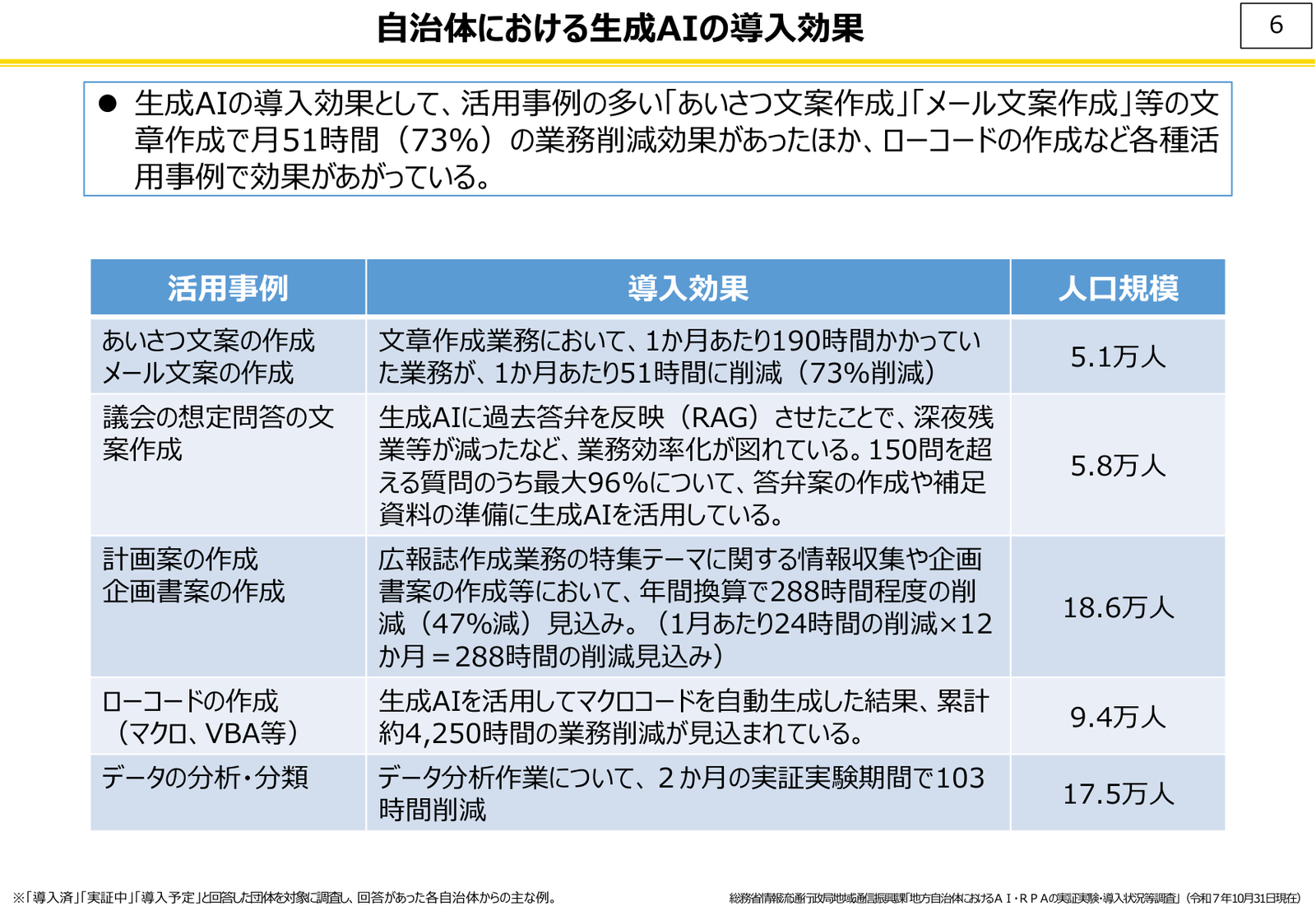
Source: Ministry of Internal Affairs and Communications, "Status of Generative AI Adoption in Local Governments (FY2025)" Let me add one note on how to read these figures. Each of them is a case or a projected value from a specific local government, and none of them guarantees the same reduction across every body. Even in the ministry's materials, much of the reduction effect is figures based on reports from each body, and evaluation of the effect as a whole is positioned as a task for the future. So rather than taking it as "put in AI and it will always cut things by 70 percent," it is more accurate to read it as a tendency: the heavier the document work, the greater the room for reduction.
These field movements do not stop at the ingenuity of individual local governments. In the outline of the Regional Future Strategy decided in 2026, the state, as a cross-cutting measure to face population decline and the labour shortage, raised "AI transformation (AX)" and, as its pillars, explicitly set out advancing municipal AX, firefighting AX and regional AX7. That means AI use in government has been positioned at the core of national policy. If you are interested in the whole shape of this strategy, please also see our plain-language guide to the Regional Future Strategy and our explainer on Basic Policies 2026, which covers the higher-level direction above it.
Cautions you must hold on to before you use it
I have written mainly about the effects so far, but AI is not an all-purpose tool. Used the wrong way, it can rather damage residents' trust. If you are considering adoption, you need to hold on to the following points first.
The most important thing is not to trust the AI's output as it stands. Generative AI can write, with an air of confidence, content that sounds plausible but differs from fact. In the ministry's FY2025 survey too, the top challenge with adopting generative AI was "worry about the accuracy of AI-generated content," raised by 608 bodies8. Because grounds and consistency are everything for government documents, an answer or reply drafted by AI must always be checked by a person against the original source. You must not break the principle that this final check and the responsibility belong to a person. AI is a partner that prepares first drafts quickly; it is not something that makes the judgement in your place. Being clear-eyed about that is the starting point.
Next is the handling of information. In the same survey, "worry about the leakage of confidential information" also ranked high, at 439 bodies8. You should avoid casually entering residents' personal information, or pre-release policy information, into a general external service. In fact, the generative AI used in local governments is mostly closed in-house environments, or dedicated services that meet security requirements built for local governments9. Which service, and how far can you put information into it. Drawing this line clearly as an organisation is indispensable.
The third is putting rules and people in place. In the ministry survey, "no personnel to take it on, or a shortage of them" stood at 558 bodies as a challenge with adoption, a large wall second only to the concern over accuracy8. In the previous year's survey, this personnel shortage was the number-one challenge5. In other words, how to develop staff who can use AI well has consistently been a bottleneck of the highest order. This is exactly why the shift to an "AI-driven public servant," where each staff member can get along with AI, is needed. Alongside this, you also need to advance the development of usage guidelines. In the FY2024 survey, over 80 percent of the bodies that had adopted generative AI had already drawn up guidelines6. The fact that the bodies using it more are also the ones with rules in place is suggestive. What may be entered, how outputs are checked, who holds responsibility. Building this foundation first is the condition for safe use.
In addition, you need to watch that AI can amplify the biases and slants in the work as they are. If you make a draft from past documents, you inherit the habits of past thinking too. That is precisely why a process where a person checks, rather than swallowing the output whole, always remains behind the efficiency. Bringing in AI does not mean doing away with checking; it means creating a state in which you can concentrate on the checking. Understand it that way and the gap between expectation and reality grows smaller.
The first step, and the way of working ahead
Lining up the cautions may make you brace yourself, but the way to start is utterly simple. Do not set up grandly; try it small. That is all there is to it.
If you try to roll out AI across the whole agency at once, you hit the walls of rule-making and budget and cannot move. Instead, first pick just one heavy routine task. It could be the notice you produce without fail every month, or the making of meeting minutes. Slip an AI draft into that, and check with your own hands how much the time changes and how much checking work remains. Once the effect is visible, share that success with colleagues and expand little by little to the neighbouring tasks. This way of building up is, in the end, the most reliable path to it settling in. The adoption-effect figures the ministry presents are mostly born, too, from this kind of accumulation, one task at a time.
On top of that, as an organisation you will be putting the foundation of people and rules in place in parallel. This is the part that is hard to do alone, and moments will always arise where you are unsure what to tackle first, which tasks AI works on and which it does not. If you work at a local government or an administrative body and are unsure how to organise the starting point for designing staff AI use, please talk to the WARP team. Specialists who led DX and data strategy at major companies walk alongside you month by month, designing together how to bring AI down into the work of the field. We start from translating the state's order into the one step in front of you.
To sum up
It ran long, so let me organise the key points.
- The true nature of a public servant's busyness is the result of three structural factors overlapping: the labour shortage, the person-dependence of the work, and the demand for accuracy peculiar to government
- An AI-driven public servant is a way of working in which you use AI drafts for document creation, inquiry responses and background research, and spend your own time on judgement, the final check, and talking with residents
- 74.0 percent of all 1,788 local governments have adopted AI, RPA or generative AI, and generative AI has reached 100 percent among prefectures and designated cities
- Effects are starting to show, such as a case where document work fell from 190 hours a month to 51, but each is an individual case, and evaluation as a whole is positioned as a task for the future
- The cautions: do not swallow outputs whole, do not casually enter confidential information, and put the foundation of rules and people in place. The final check and the responsibility always belong to a person
- The way to start is to pick one heavy routine task and try it small. Expand gradually from the tasks where the effect is visible and it settles in without strain
The labour shortage is not a problem that solves itself while you wait. But there is also a limit to piling ever more strain on the field. AI is a tool that eases that bind just a little. For the sake of the day when the light in that government building at eight in the evening goes out a little sooner. Start from working out where, in your own work, AI actually helps.
References and primary sources
Footnotes
-
Cabinet Secretariat, "Regional Future Strategy (draft)," Document 2 (2nd meeting of the conference of relevant deputy ministers on the Regional Future Strategy, 30 June 2026). https://www.cas.go.jp/jp/seisaku/chiikimirai/kaisai_jokyo/dai2/shiryo2.pdf ↩
-
Ministry of Internal Affairs and Communications, "Status of Generative AI Adoption in Local Governments (FY2025)" (as of 31 October 2025, published 24 April 2026). https://www.soumu.go.jp/main_content/001070295.pdf ↩ ↩2 ↩3 ↩4 ↩5 ↩6
-
Digital Agency News, "[Explainer] What is Government AI? The government's AI use strategy advanced by the Digital Agency [Gennai]," 11 December 2025. https://digital-agency-news.digital.go.jp/articles/2025-12-11 ↩ ↩2
-
Ministry of Internal Affairs and Communications, "Promoting AI and RPA Use in Local Governments (FY2025)" (as of 31 October 2025, published 24 April 2026). https://www.soumu.go.jp/main_content/001070291.pdf ↩
-
Ministry of Internal Affairs and Communications, "Status of Generative AI Adoption in Local Governments," 30 June 2025 edition (data as of 31 December 2024). https://www.soumu.go.jp/main_content/001018084.pdf ↩ ↩2
-
Ministry of Internal Affairs and Communications, "Status of Generative AI Adoption in Local Governments," 30 June 2025 edition (FY2024, guideline development status and adoption effect for minutes). https://www.soumu.go.jp/main_content/001018084.pdf ↩ ↩2
-
Cabinet Secretariat, "Regional Future Strategy (Outline)," decided by the conference of relevant deputy ministers on 24 June 2026. https://www.cas.go.jp/jp/seisaku/chiikimirai/pdf/20260624_gaiyo.pdf ↩
-
Ministry of Internal Affairs and Communications, "Status of Generative AI Adoption in Local Governments (FY2025)," challenges in adopting generative AI (p8). https://www.soumu.go.jp/main_content/001070295.pdf ↩ ↩2 ↩3
-
Ministry of Internal Affairs and Communications, "Status of Generative AI Adoption in Local Governments (FY2025)," generative AI services adopted (p9). https://www.soumu.go.jp/main_content/001070295.pdf ↩