Hello, this is Ryuta Hamamoto from TIMEWELL.
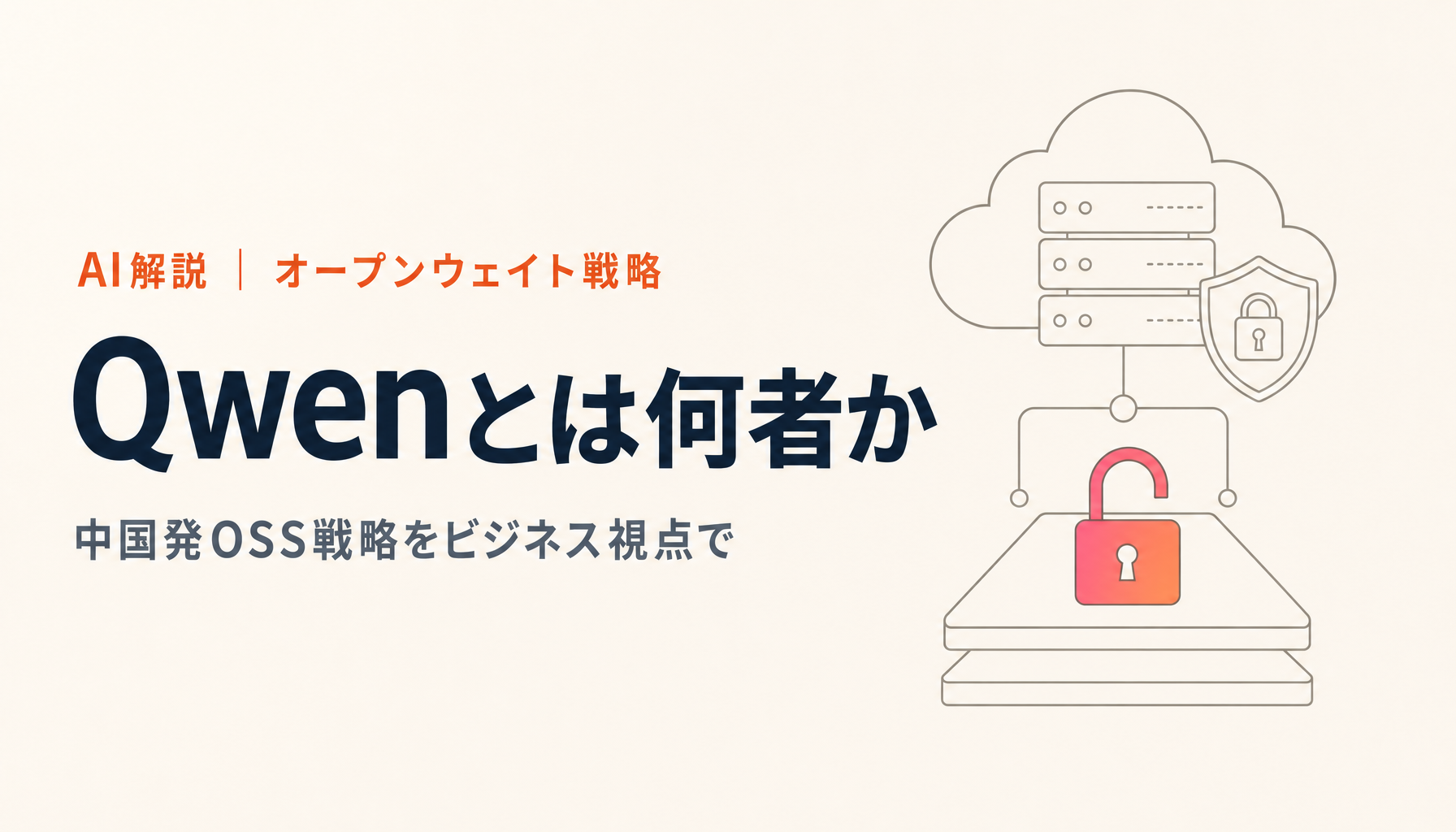
In the world of generative AI, names like America's OpenAI and Anthropic dominate the conversation. But quietly, and steadily, a family of models built by China's Alibaba, called Qwen, has been spreading to developers all over the world. In Chinese it is also known as Tongyi Qianwen. In July 2026, at WAIC (the World Artificial Intelligence Conference) held in Shanghai, Alibaba announced a preview of its latest top-tier model, Qwen3.8-Max, and drew fresh attention. In client conversations too, I increasingly hear "I gather Qwen3.8 is amazing."
This article reads Qwen not through the fine grain of its technology but as a business mechanism. Why does the top model stay closed while the tier just below it is released instantly, and for free? What is there to earn by giving something away? How does it differ from DeepSeek, another Chinese release? And how should a Japanese company make sense of all this? I will unpack the jargon as it comes up, so even a reader who is not especially familiar with AI should be able to read this through. If you are curious about where your own company stands on using AI, checking your footing first with our free AI literacy self-check will make the practical discussion in the second half feel more concrete.
Who, exactly, is Qwen?
Let me start with who Qwen is. Qwen is the umbrella name for the generative-AI models Alibaba builds. It is not the name of a single model but a "series" that bundles together many models of different purposes and sizes. There is the basic model for back-and-forth text, a model that is good at writing program code, and models that understand images and audio, among several kinds. The range of sizes is wide too, from small models that can even run on a smartphone in your hand to enormous models that only huge servers can run.
Let me sort out the naming here. Qwen's versions have run from the original Qwen, to Qwen1.5, Qwen2, Qwen2.5, and Qwen3. Then, in July 2026, Qwen3.8-Max was announced as a preview, as the latest top-tier model. Within a generation, the models branch out by a suffix that indicates purpose and by the model's size. For instance, the openly released flagship is Qwen3-235B-A22B, and the one specialised in code is Qwen3-Coder, so the symbols and numbers at the end signal the role and the scale. The naming takes a little getting used to, but you will not get lost once you grasp the structure: "Qwen" and a generation number in front, with purpose and size on the back.
Let me pause to define a term. It is "open weight," which will come up repeatedly from here. A generative-AI model is made of countless numerical values tuned through an enormous amount of computation, and these numbers are called the "weights." Releasing these weights to the public is what open weight means. Once you have the weights, you can run that model on your own PC or your company's servers. Note, however, that the data used for training and the fine detail of the training procedure are not necessarily released in full. That is why it is often carefully distinguished from "open source," and this article, too, uses "open weight" to match what is actually the case.
July 2026: Qwen3.8-Max announced as a preview
Let me begin with the newest development. On 19 July 2026, at WAIC (the World Artificial Intelligence Conference) in Shanghai, Alibaba announced a preview of Qwen3.8-Max as its latest top-tier model1. A preview is the stage where, ahead of a full public release, something is made available to try in a limited set of environments first. According to the company, this model takes a huge-scale sparse MoE configuration of 2.4 trillion parameters and is a multimodal model that can handle not just text but images and more.
Let me fill in the terms. Parameters are the number of weights I touched on earlier, and, broadly speaking, more of them tends to mean a model with greater expressive power. MoE (Mixture-of-Experts) is a design that keeps many small specialists with different roles inside one giant model and puts only the necessary specialists to work in response to the input. Because it does not have to run all of them at once, it can hold down the computational load relative to its scale. Sparse MoE refers to a design that selects and activates only a small fraction of those specialists.
That said, this is a place to keep a level head. The figure of 2.4 trillion parameters, the multimodal support, and the high performance are, at this point, basically Alibaba's own announcements and claims. Backing such as independent third-party benchmark results, a detailed model card, and the actual active parameter count is not yet fully in place. The company explains that it stands at a high level on performance, and reporting has introduced comparisons that put it close to other companies' top models, but this too rests on the company's internal evaluation. Because this is a field where numbers easily take on a life of their own, this article handles them with a clear reservation attached: "according to Alibaba's announcement." An official open-weight release is also said to be planned, but the release date and the licence details are at a stage that awaits future announcements. Until real-world verification advances, I think it is safest to hold both expectations and assessments back a little.
Looking for AI training and consulting?
Learn about WARP training programs and consulting services in our materials.
The top tier stays closed, the tier below opens instantly: the meaning of a two-layer structure
This is the single most important point for understanding Qwen's strategy. Alibaba is by no means "releasing everything for free." In reality it has a two-layer structure: keep the top-earning, top-tier model closed, and open up the tier just below it without holding back.
The upper layer is the closed top-tier model. In the previous generation, this was Qwen3-Max, announced at Alibaba's conference held in September 2025; according to reporting, its parameter count exceeds one trillion and it was trained on a vast 36 trillion tokens of data2. This Qwen3-Max does not have its weights published; it can be used only through Alibaba Cloud, the Qwen Chat chat app, and the API. Qwen3.8-Max, announced in July 2026, likewise starts by being offered first on the company's own services in preview form, and its role as the axis for securing revenue at the top has not changed. In other words, the model said to have the highest performance starts out as something you pay to use, through Alibaba's own services first.
The lower layer is the Qwen3 series released as open weight. The flagship is Qwen3-235B-A22B, released in April 2025 under a licence called Apache 2.03. Its design has 235B total parameters with 22B actually active at any moment, an arrangement that carries a large brain while holding down the computational load. On top of that, a wide range of sizes was released at the same time, from lighter models down to small ones that run even on a smartphone. Qwen3-Coder, specialised in code, was also released openly in July 20254. The point to hold on to here is the fact that a high-performance model just one step behind the cutting edge is being put out into the world without stinting, and under a licence that even permits commercial use. As for Qwen3.8-Max, an official open-weight release is said to be planned, and this "close the top, open the tier below" pattern looks set to continue.
Why split it into these two layers? In a phrase, to secure revenue at the top while drawing in developers around the world at the tier below. Keep the top closed, and the customers who genuinely need very high performance will pay to use the API and the cloud. Meanwhile, give away the tier just below for free, and developers, researchers and startups who want to hold down costs adopt it one after another. By separating the layer you close from the layer you open, Alibaba goes after revenue and expanding market share at the same time. That, as I read it, is the core of Qwen's design philosophy.
The aim is wider cloud usage, not model sales
So, by giving models away for free, how does Alibaba make money? This is where it gets most interesting as a business. The answer is that it earns not by selling the model but by getting people to use Alibaba Cloud, the place where the model runs.
A generative-AI model does not run just because you have downloaded it. To actually make it generate text or answer questions, you need a fair amount of powerful compute. Large models in particular will not run well without servers packed with high-performance GPUs. So rather than buying expensive hardware themselves, many companies and developers run models on the cloud. Through mechanisms like Model Studio and DashScope, Alibaba offers a service where models including Qwen can be called as an API. An API is the window through which an external program calls a model's functions. Spread open-weight models far and wide for free, and the use of the cloud compute and the API needed to run them grows. It clicks into place once you understand free distribution as an investment to widen the entrance to the cloud business.
This structure also has the effect of drawing developers into Alibaba's own environment. The more a company builds out its internal systems on Qwen, the more the surrounding tools and data flows get optimised around Alibaba's cloud. Once you have built things out there, switching to another model or another cloud becomes a chore. Giving things away looks generous at first glance, but behind it is a calculation: get wide adoption, take the position of a de facto standard, and keep developers inside the ecosystem. In the context of China's AI strategy, you can frame it as a move to enclose developers with open models and reach for the world standard, set against the American players who build around closed models. If you are interested in this US-China picture, reading it alongside our article that reads the US-China AI race through investment and patents will make the background come out in three dimensions.
Let me pull this back to your own situation for a moment. Just because we have entered an era where a powerful model can be had for free, whether you can actually put it to work in your business is a separate question. Which model, run where, applied to which task. That design is what divides the results. What we work on with executives in WARP, our AI consulting service, is exactly this part, the design of "where to put it in." The more models become free, the more the era rewards skill in how you use them.
The results, and how it differs from DeepSeek
This open-weight strategy is delivering results in the numbers as well. According to a report from China's state-run Xinhua on 13 January 2026, Qwen models surpassed 700 million cumulative downloads on the model-sharing site Hugging Face and, in October 2025, overtook Meta's Llama to become the world's largest open-source model ecosystem5. The same report says that around 400 models in the Qwen family have been released openly, and that derivative models built from them exceed 180,000. Download counts and derivative-model counts vary a great deal by source and by point in time, so this article uses only the figures from this report, which carries a clear date and source. In any case, it is worth noting that the strategy of free release is indeed working in terms of the sheer volume of adoption.
Now let me compare it with DeepSeek, another Chinese release that flies the open-weight banner. DeepSeek drew attention by releasing models such as R1, which is strong at reasoning, under an even looser condition, the MIT licence. What the two share is the direction of publishing weights, spreading them worldwide, and raising their presence through open models. Where they differ is where they put their effort. DeepSeek takes a lineup that concentrates on a small number of sharp models, and the impression is of competing on edge, whereas Qwen widens the base with a full-stack lineup: a chat app, an API, open weights, and a size range that runs from tiny to enormous. It is not a matter of which is better, but rather that the thinking behind their approaches differs, which is the accurate way to put it. As for DeepSeek itself, we cover it in detail in our article that explains DeepSeek from its technology and background, so do have a look if you are interested.
Let me add one thing calmly. What both companies release is basically the weights, and neither discloses the training data or the full training procedure. In terms of transparency, open weight is not the same as full open source. When you are weighing a deployment, it matters to keep this difference in mind and to sort out what you can and cannot confirm for your own company.
How should Japanese companies make sense of this?
Finally, let me write about what this means from the vantage point of a Japanese company. To put the conclusion first, I believe the situation, in which high-performance open-weight models can be had for free, can be a tailwind for Japan's mid-sized and small companies. There was a time when cutting-edge AI was something only a limited number of large enterprises used under expensive licences. Now, with the rise of models you can download for free and run in your own environment, the range of options has widened considerably. Open weight becomes a realistic choice in particular for companies that want to run a model on their own servers or in an on-premises environment without sending confidential information to an outside service.
That said, free does not mean you can drop it straight into your work. In practice there are several things to check. First, the licence. Many of Qwen's open-weight versions are released under Apache 2.0, which also permits commercial use, but the licence and terms differ from model to model. A model at the stage of a planned official open-weight release, like Qwen3.8-Max, calls for the attitude of confirming the terms before you jump in, because it is not yet clear what the licence will be at release. If you are going to use one for work, be sure to confirm under what conditions the specific model is distributed. Next, where you run it and how the data flows. Whether you run it in your own environment or use it via a cloud API changes where confidential information ends up. When you are handling personal data or a business partner's information in particular, you need to verify the path the data takes before you deploy. There is nothing wrong with using a foreign-made model in itself, but where you run it and what you hand over are things to judge under your own responsibility. If you are interested in domestic moves to build up foundation models, our article that lays out Japan's home-grown AI foundations and NEDO's efforts should also be useful as a reference.
On top of that, what I want to stress is that the design of how you use a model matters far more than the choice of model itself. That a powerful model is now free for anyone to get means, turned around, that model performance alone no longer sets companies apart. What sets you apart is the design: which of your tasks you point AI at, by what steps you use it, and which parts people handle. This judgement is hard to make from knowing the model technology alone; it is the work of holding your company's actual operations up against your management priorities. If you are unsure where to start, talk to the WARP team. Specialists who led DX and data strategy at major companies work alongside you month by month to embed AI into management. Even so, dropping in AI does not solve everything. Let us start from working out where it works and where people should stay in the loop, and go from there.
Summary
This ran long, so let me pull the key points together.
- Qwen is the umbrella name for Alibaba's family of generative-AI models, a series bundling many models of different purposes and sizes. In July 2026, the latest top-tier model, Qwen3.8-Max, was announced as a preview
- Qwen3.8-Max is said to be a 2.4-trillion-parameter sparse MoE model with multimodal support, but this is Alibaba's own announcement, and independent verification is still to come. An official open-weight release is also at the stage of being planned
- The heart of the strategy is a two-layer structure. The top-tier Max model stays closed and is monetised through the API and the cloud, while the tier just below it, such as Qwen3-235B-A22B, is released for free under a licence that even permits commercial use
- The aim of free distribution is not model-sales profit but increasing the use of Alibaba Cloud, the place where the model runs. There is a calculation to win wide adoption, take the position of a standard, and keep developers inside Alibaba's own environment
- On 13 January 2026, China's state-run Xinhua reported that Qwen's cumulative downloads had passed 700 million and that it had overtaken Llama to become the world's largest open-source ecosystem. Derivative models are said to exceed 180,000
- DeepSeek, another Chinese release, takes a lineup that concentrates on a small number of models, while Qwen widens the base with a full-stack lineup. The difference matters, though both release basically the weights, which is a different scope from full open source
- For Japanese companies it is a tailwind that widens the options, but before using it for work, always check the licence and the data path. What sets you apart is the design of how you use it, not the model's performance
The era in which a powerful AI can be had for free is also an era in which the more prepared a company is, the more of the benefit it can take. Start by working out which of your tasks AI works on, and move from there.
References and primary sources
Footnotes
-
Qwen (Alibaba Cloud) official site (https://qwen.ai/ ). Coverage by various outlets of the Qwen3.8-Max (preview) announcement at WAIC (the World Artificial Intelligence Conference) held in Shanghai on 19 July 2026. The figures on parameter count, multimodal support and performance are the company's own announcements and claims, and independent verification is not yet fully in place as of this writing. ↩
-
eWeek, "Alibaba Unveils Qwen3-Max, Its Trillion-Parameter AI Model" (September 2025) https://www.eweek.com/news/alibaba-qwen3-max-trillion-parameter-ai/ ↩
-
Qwen Team, "Qwen3: Think Deeper, Act Faster" (Qwen official blog, 29 April 2025) https://qwenlm.github.io/blog/qwen3/ ↩
-
Qwen Team, "Qwen3-Coder: Agentic Coding in the World" (Qwen official blog, 22 July 2025) https://qwenlm.github.io/blog/qwen3-coder/ ↩
-
Xinhua, "Alibaba's Qwen tops 700 mln downloads to become world's largest open-source AI ecosystem" (Xinhua, 13 January 2026) https://english.news.cn/20260113/004b0522f987475cbf83ffc3a8d009aa/c.html ↩