Hello, this is Ryuta Hamamoto from TIMEWELL.
Picture a day in the life of an executive. In the morning, documents waiting for your sign-off are stacked on the desk. From the shop floor comes a steady stream of "we are short of people, we have no bandwidth for anything new." Even when a meeting asks you to decide, the numbers that should be the basis are held in different shapes by sales, by manufacturing and by accounting, and just getting them into a single view takes days. Meanwhile there are signs the competition is moving. And at night, the heavy question remains: what to do about investing in AI. Everyone around you seems to be doing it. But you cannot bring yourself to sign off on a large sum while you still cannot see what in your own company it works on, or for how much.
If any of that rings even slightly true, I wrote this article for you. Labour shortages, slow decisions, information walled off by department, and the anxiety of an investment call. These four look like separate worries, but they are in fact strung along a single line. And the key to untangling that line lies not in handing AI tools to your staff, but in you, the executive, reworking how the company is run on the assumption of AI. That is what I want to convey today. It runs a little long, but by the time you finish reading I want you to be able to see, concretely, "what I myself need to change first." If you would like to know your own current position first, checking where you stand with the free AI literacy self-check makes the second half of this piece land as your own concern.
AI has barely entered the executive's day
In many companies, AI is treated as "something the shop floor uses." Younger staff use it to summarise minutes; the planning team uses it to build first drafts. That is a good thing in itself. But the layer that makes the judgments, meaning executives and managers, is almost untouched by AI in daily life. That is the reality in Japan right now.
There is a solid basis for saying so. Between May and July 2025, the Digital Agency prepared a generative AI environment for all its staff and recorded how it was used1. Of roughly 1,200 employees, about 950, or some 80 percent, used generative AI over three months, and the count of uses topped 65,000. Get an organisation to use it across the board and this much moves. Up to here, it looks like a familiar success story.
The problem is what lies inside. Break the usage down by rank and a clear skew appears. The Digital Agency's own materials state that "half of division-director-level staff recorded zero use of generative AI." Among office-head-level staff too, non-use ran to about 58 percent, again above half. Meanwhile, junior staff and private-sector specialists brought in from outside sat at around 30 percent non-use, and used it well. In other words, the people who give the orders and hold the budget are the ones not touching AI, while the people who actually do the work are the ones using it. A reversal has taken hold.
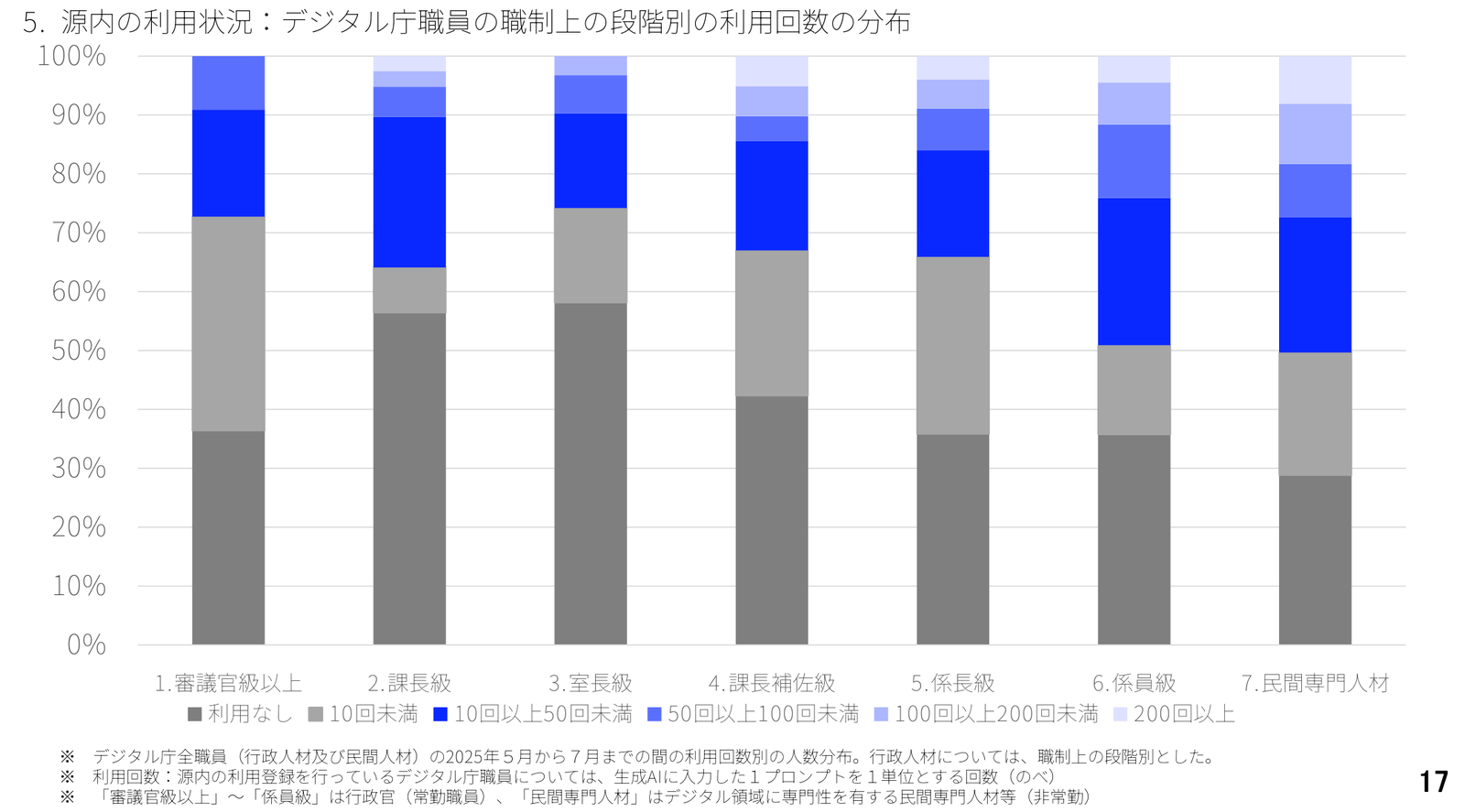
Source: Digital Agency, "Generative AI Usage Results by Digital Agency Staff," August 2025 This is a story about a government body, but I feel the shape is the same in private-sector management. The Ministry of Internal Affairs and Communications white paper also finds that personal experience of using generative AI is highest among people in their twenties at 44.7 percent, then falls with each older bracket, down to 19.9 percent for people in their fifties and 15.5 percent for those in their sixties, the ages that hold most manager and executive roles2. The closer a person sits to the deciding seat, the less they know the feel of AI. The first stumble is hidden right here.
Why the pain arises, and how it is built
Why do the four pains I opened with press on an executive all at once? Let me untangle them in turn.
First, the labour shortage is a problem of population, not of the business cycle. According to the Ministry of Internal Affairs and Communications white paper, the working-age population aged 15 to 64 is projected to fall from about 75.09 million in 2020 to about 55.40 million by 2050, a drop of 26.2 percent2. One in four of the people who work will be gone. Try to solve it through hiring and the pool itself keeps shrinking. On top of that, Japan's labour productivity, measured per hour, sits 26th among the 38 OECD member countries, low among developed nations. You must create more value than before with fewer people. There is no escaping this structure.
Next, slow decisions and fragmented information in fact grow from the same root. Decisions are slow not, first of all, because the executive lacks resolve, but because the information needed to decide is not gathered in one place. Sales sit in the sales system, costs in an accounting spreadsheet, and the state of the shop floor in the heads of each site manager. Someone gathers these by hand, tidies the format, and only then is there material to judge from. This "time spent gathering" is what kills the speed of a decision. The shorter you are on people, the less you can spare anyone for that consolidation, and the more the decision slips. Labour shortage, slow decisions and fragmented information make one another worse in exactly this way.
Then there is the anxiety of an investment call. This, if anything, is the flip side of an executive being conscientious. Not pouring large money into something whose contents you do not understand is a sound instinct. Yet press to the bottom of that anxiety and it usually arrives at a single point: "because I have never touched AI myself, I have no feel for whether it works." You cannot digest the return on investment of something you have never used, however long you stare at someone else's slides. The reality noted earlier, that the deciding layer is the layer not touching AI, comes back here as the weight on the investment call.
Looking for AI training and consulting?
Learn about WARP training programs and consulting services in our materials.
Handing out AI tools and an executive becoming AI-driven are different things
This is the part of the article I most want to convey. Many companies stop at the order to "get all staff using AI." That is not a bad starting point, but if you rest there, no effect appears. Why can I say so? This too has backing in a public analysis.
An analysis the Bank of Japan issued in September 2025 places AI as a "general purpose technology" alongside the steam engine, electricity and the internet3. Look back through history and such large technologies go through a period, right after they are adopted, when productivity stubbornly refuses to rise. This is called the "productivity paradox." Renew only the tools, and if the way work is done stays as it was, you cannot draw out the performance. The Bank of Japan's analysis puts it this way. Firms reorganise their work processes and the content of the work on the assumption of AI use; workers acquire the skills to collaborate with AI; and new businesses are born. Only when the whole social system transforms like this does the real effect that lifts productivity appear.
That single passage is decisive for an executive, I think. It is saying that what produces the effect is not the AI tool itself, but the act of redesigning the shape of work on the assumption of AI. And who can decide how to reorganise work processes, how to change the organisation and which businesses to bet on? Not the person on the shop floor. Only the executive. That is exactly why adopting AI is a management matter, and it will not move forward unless the executive personally becomes the designer. When I ask "should you become an AI-driven executive," this is what I mean.
Concretely, what does it mean for an executive to become AI-driven? I see it as three redesigns. The first is redesigning the decision. Stop gathering the information you need to judge by hand, and build a state in which AI always presents it in an ordered form. The second is redesigning the organisation. Recompose the division of roles you built on the premise that "people do all of it" into one where AI does the prep and people make the judgment. The third is redesigning the business. Build into your business plan the products and services that only stand up because AI is there, and the challenges in areas you had given up on for lack of people. Handing out tools is none of these three. Designing is the executive's job.
For the record, what I am handling here is the first-person angle of the executive personally becoming the designer. There is more than one road to bringing AI into management: besides the executive acting as the command tower, there is the road of growing internal talent and the road of bringing it in from outside. I have laid those three options side by side and compared them in three strategic options for AI-agent-driven management. This article narrows in, within all that, on the single step of the executive changing first.
What government pilots show about how a redesign pays off
I can almost hear the voice saying "you tell me to change the design, but does it really work?" Here I will avoid overstatement and honestly convey the range that public data lets us confirm.
The Digital Agency pilot noted earlier also surveyed the staff who used the tool1. About 79 percent said generative AI contributed to greater efficiency. Satisfaction after use averaged 3.7 out of 5, and the necessity for future work averaged 4.2, rated higher still. What you can read from this is an order: not an abstract hope, but a sense that the more people used it, the more they felt "I need this."
Beyond the numbers, concrete examples of time saved were reported too. Turning memos into written minutes became about 10 minutes shorter each time. Asking AI instead of checking a manual yourself cut roughly 30 minutes to an hour off a task each time. Time spent hunting for an illustration for a document freed up about an hour a week. Each one looks small, but stacked across the daily work of all staff, a considerable amount of time is created across the organisation. What matters here is that these are effects that came out of the ordinary work of ordinary staff, not of special AI experts.
Let me also look through a slightly wider lens. The Bank of Japan's analysis lines up estimates by researchers in Japan and abroad of how far AI lifts labour productivity3. But let me say up front that these are not confirmed results; they are predictions, and the range across studies is wide. Some estimates put the lift to US labour productivity at around 1.5 to 2.5 percent a year, while a more modest estimate for the whole world sits at around 1 percent. For Japan, an estimate of about a 0.5 percent lift in labour productivity from adopting generative AI is shown. The width of the numbers itself tells you that the result changes greatly with how you use it and how far you redesign.
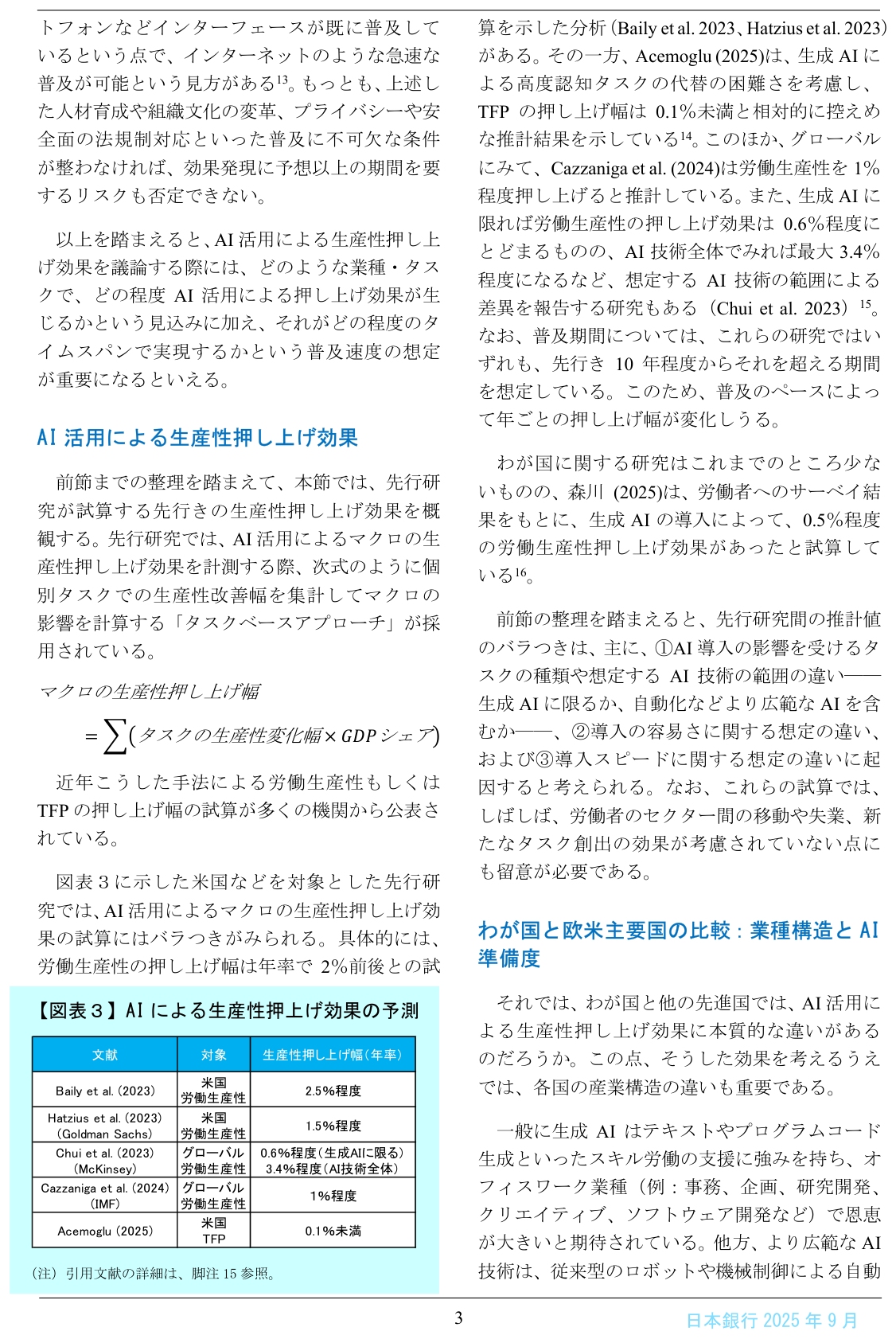
Source: Bank of Japan, "The Impact of AI Adoption on Productivity," Bank of Japan Review 2025-J-10 It is not that the foundation is missing. In the IMF index that scored each country's readiness for AI as of 2023, Japan ranks third within the G7 after the United States and Germany, and 12th in the world3. The preparation is done to a degree. The problem lies on the side of the "use and design" that turns it into actual productivity. That is the implication of the whole. What I want to stress again at the midpoint is that what this data shows is not "bring in AI and it works automatically" but "it works in an organisation redesigned from its premises." Walking alongside that design is also the work of our AI consulting service, WARP.
Why the whole company moves when the executive moves
Let me talk about scale here. AI-driven management tends to be thought of as something for large firms, but the data suggests, if anything, the opposite.
According to the Ministry of Internal Affairs and Communications white paper, the share of companies with a policy for using generative AI was about 50 percent in Japan2. That is up from about 43 percent the year before, but there is a gap against about 85 percent in the United States and about 76 percent in Germany. This figure itself shows that Japanese executives' judgment is still wavering. Split the domestic figure further by scale, and while about 56 percent of large firms have set a policy, only about 34 percent of SMEs have. That gap is less a gap in financial muscle than a gap in whether the executive has decided a policy. In other words, the executive's decision maps straight onto the adoption rate of AI.
I take this as an opening for smaller companies. The smaller the company, the faster one person's judgment reaches every corner of the organisation. Without needing to pass through the many layers of approval a large firm has, if the president decides "we reorganise our work on the assumption of AI" and shows the way themselves, the shop floor can start moving the following week. As we saw at the start, Japan's weak point was that the deciding layer was the layer not touching AI. Turn that over, and the moment the executive personally clears that hurdle, the company can leap over the wall that most companies have not cleared. Under a president who shows themselves using it, not one who issues orders, an organisation's use of AI becomes real for the first time.
This ordering, where "the executive first changes themselves," ripples out to the design of hiring and talent too. How to compose a business on the assumption of AI, and which talent to deepen, is a subject in its own right, but its starting point too rests, in the end, on whether the executive personally holds a feel for AI. It is hard to size up correctly what talent you need for something you cannot use yourself.
A few lines to draw so you do not overtrust it
I have kept up a forward-looking tone this far, but precisely because I recommend AI-driven management, I want to convey the sober lines with equal weight. Rush the adoption and get tripped up at your feet, and it all comes to nothing.
First, AI is not all-powerful. The data from the Digital Agency, the Bank of Japan and the Ministry of Internal Affairs and Communications introduced here are all either public-sector pilots or macroeconomic estimates and international comparisons; none of them promise the return on investment for your single company. There will always be tasks AI helps with and tasks it does not. Routine prep and summarising information work well, but the final management judgment, negotiations where the other side's feelings are involved, and decisions that carry responsibility remain as work for people to do. Deciding at the outset where the line runs between what you leave to AI and what people keep holding is the surest way to prevent overtrust.
Next, the handling of information. Once you pass internal information to AI, letting people use it without grasping where customer data and confidential information are sent and how they are handled is dangerous. Especially if the executive uses it out front, you need to decide, before you start, how to prepare an environment that is safe for your company. Rather than leaving unattended a state where each person uses free tools as they please, arranging the scope and rules the company permits becomes part of the executive's design.
And do not swallow what is generated whole. AI can present plausible errors with a straight face. For things that cause real harm if wrong, such as numbers, proper nouns and the content of laws, a person must always confirm against a primary source. Unless you make this habit ordinary across the organisation, you may lose trust in exchange for speed. AI-driven management does not mean handing judgment over to AI. Do not forget the principle that it means building a state where AI does the prep so that people can judge faster and more deeply.
The first step, and a summary
It has run long, so let me organise the key points.
- The executives and managers who decide judgments and investment are the very ones not yet touching AI. That is the reality in Japan. In the Digital Agency pilot, about half of division-director-level staff recorded zero use
- Labour shortages, slow decisions, fragmented information and the anxiety of an investment call look like separate worries but are strung along a single line
- What produces the effect is not the tool itself but the act of redesigning the shape of work on the assumption of AI. So adopting AI is a management matter, and the executive personally needs to become the designer
- For an executive to become AI-driven means redesigning three things: the decision, the organisation and the business
- The smaller the company, the faster one person's judgment reaches. The smaller the firm, the greater the upside the moment the executive changes
- AI is not all-powerful. Decide at the outset the line between what you leave to it and what people hold, the safe handling of information, and the checking of generated output against sources
The first step is neither a large investment nor a company-wide reform. It is you, the executive, collaborating with AI on one single task. Within your own judgment, where does it get faster, and where should a person do it? Only once you hold that felt sense does it become visible how to redesign the whole organisation. As that starting point, first check your current position with the free AI literacy self-check.
If you would like to think together, from the sizing-up stage, about which of your tasks AI helps with and where the bottleneck in your decisions sits, please talk to the WARP team. Specialists who led DX and data strategy at major companies walk alongside you month by month, helping you bring AI down into your management. From management that issues orders, to management that designs for itself. I would be glad to take that first step together.
References and primary sources
Footnotes
-
Digital Agency, "Generative AI Usage Results by Digital Agency Staff" (Strategy and Organisation Group, AI Implementation Strategy Office, 29 August 2025). https://www.digital.go.jp/assets/contents/node/information/field_ref_resources/08ded405-ca03-48c7-9b92-6b8878854a74/5147384f/20250829_news_ai_usage_report_01.pdf ↩ ↩2
-
Ministry of Internal Affairs and Communications, "2025 White Paper on Information and Communications in Japan" (summary, July 2025). https://www.soumu.go.jp/main_content/001019264.pdf ↩ ↩2 ↩3
-
Bank of Japan, "The Impact of AI Adoption on Productivity: A Conceptual Overview and International Comparison," Bank of Japan Review 2025-J-10 (Research and Statistics Department, September 2025). https://www.boj.or.jp/research/wps_rev/rev_2025/data/rev25j10.pdf ↩ ↩2 ↩3
![Three Strategic Options for AI-Agent-First Management: CEO, Talent Development, or M&A — Which Path to Choose [2026 Edition]](/images/columns/ai-agent-driven-management-3-strategic-options/cover.en.png?dpl=dpl_GTagW71VKjD4VDo3w4ymrXrCfn1y)
![AI Agent Operations KPI Monitoring | 7 Metrics Executives Should Track Weekly and How to Build the Dashboard [June 2026]](/images/columns/ai-agent-operation-kpi-monitoring/cover.en.png?dpl=dpl_GTagW71VKjD4VDo3w4ymrXrCfn1y)