Hello, this is Ryuta Hamamoto from TIMEWELL.
When I talk with people working in research and the topic turns to AI, I hear as much hesitation as expectation. They can see it looks useful. But how it connects to their own work, and whether they should step into it at all, is hard to judge. I think a good many people feel exactly this way.
This article is not a technical explainer on AI-driven research. Its subject sits one step earlier. Why is it worth it for you, the researcher, to move into this style of research now? I want to think that through carefully, starting from the dead ends everyone feels on the ground. I will build on a primary source, the "Basic Strategy for Promoting AI for Science" that Japan's Ministry of Education, Culture, Sports, Science and Technology (MEXT) formulated on 31 March 20261, and I will include the cautions as well. If you want to know where you stand before bringing AI into your own research, checking your footing first with a free AI literacy self-check will make the second half of this piece more concrete.
Do any of these dead ends sound familiar?
First, think back over the places where your daily research gets stuck. Some of them, I suspect, you will recognise.
You set out on a new theme and start gathering papers, but the related literature is vast, and no matter how much you read the end never comes into view. Just when you think you have covered the major papers, a new report appears. Honestly, have you ever once held the conviction that you had read everything through? I doubt it.
Or take the experimental bench. As you work by hand and vary the conditions, the results scatter even though the procedure is supposed to be identical. The state of the equipment, the reagent lot, some small difference on the day all make themselves felt. One condition can take days to test, and the combinations you can try are inevitably limited. Even when a voice in your head says "I really want to explore a wider range," time and hands run short, and in practice you have to proceed within reach.
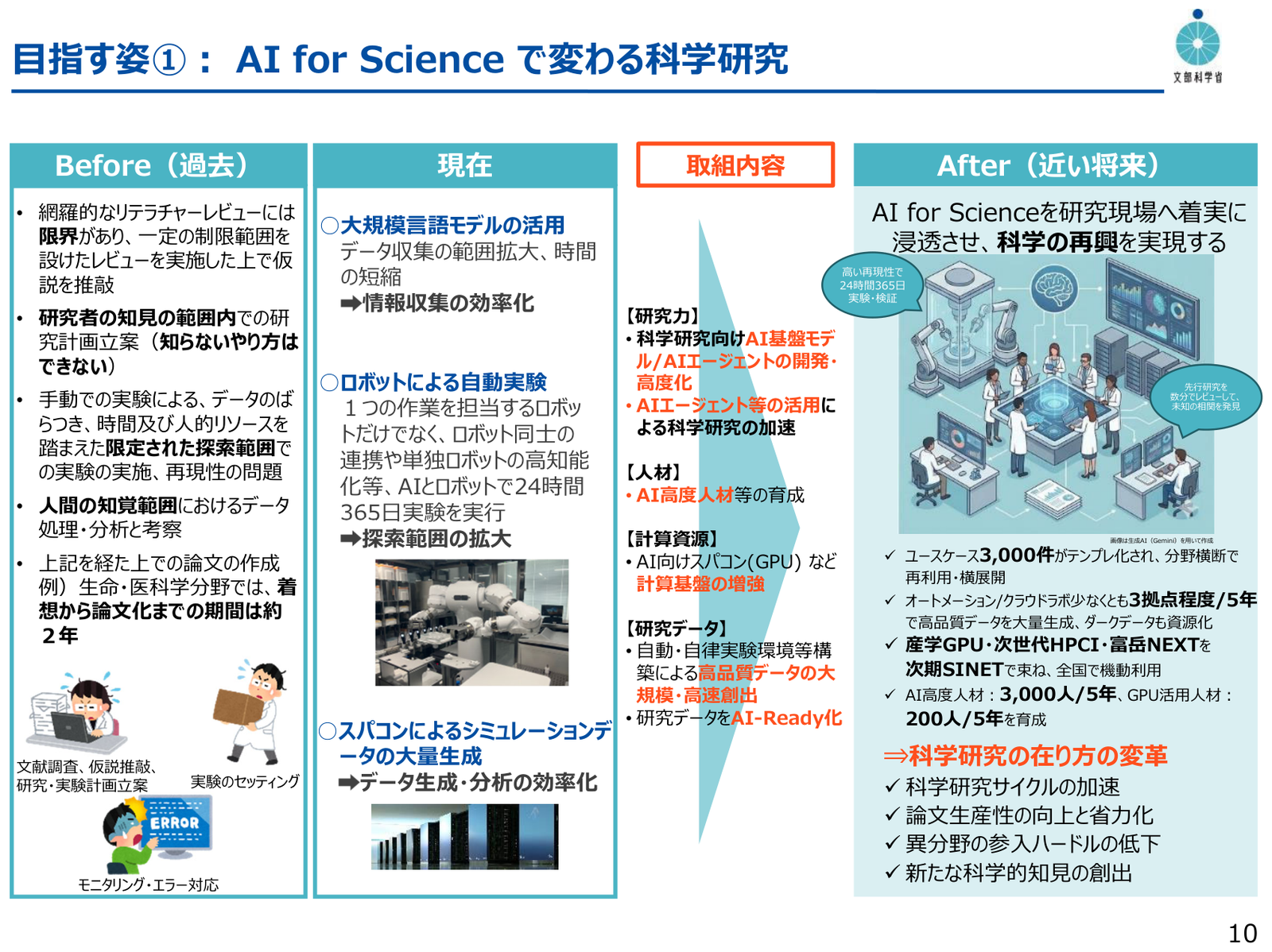
And then, drawing up a research plan. In the end, the approach you choose is decided within what you have learned so far and the methods you already know. Methods you do not know never even come up as options. The reference material accompanying the MEXT strategy raises exactly these points as the constraints on conventional research: that an exhaustive literature review has limits, that researchers find it hard to plan beyond their own knowledge, that manual experiments limit the scope of exploration through variance in data and constraints of time and human resources, and that data can only be processed and analysed within the range humans can perceive2. This is not any one person's weakness. It is a wall that the practice of research has carried structurally.
That wall piles up as time. The same reference states a figure: in the life and medical sciences, the period from idea to publication is about two years2. From posing a single question to arriving at an answer takes that many years. For a researcher, the weight of that time hardly needs explaining.
Source: MEXT
Why research stops at "the range of your own knowledge"
These dead ends do not happen for lack of effort. Several structural reasons are built into the way research itself is done. Putting them into words once makes it easier to see what AI can change.
The first is the explosion of information. In every field the number of papers keeps growing, long past what one person can read. There is a limit to reading speed, so you are forced to narrow your view to "the range you can keep up with." As a result, an effective method in use in the neighbouring field, or a finding reported a little earlier in another context, slips past you unknown.
The second is the physical cost of exploration. Experiments and observations take time, money and hands. There is a ceiling on the number of conditions you can try, and within that ceiling you pick "the promising spots" by intuition and experience. This way of choosing is a skilled craft, but what lay in the vast territory you did not choose stays unknown. In materials development, the weight of this trial and error has meant that reaching social implementation has been said to take roughly twenty years2.
The third, and perhaps the most fundamental, is that the plan itself is bound by your own experience. People can only choose from what they know. So a research plan drifts, without your noticing, toward "the way you are good at" and "the frameworks you are used to." This is not a bad thing; it is the flip side of expertise. Yet that same expertise can put an unknown path out of view from the start.
Volume of information, cost of exploration, the frame of experience. These three intertwine, and research settles naturally into "the range you can reach." For a long time there was no way to greatly exceed it. That is exactly why the arrival of a tool that can work on this point is no small matter.
Looking for AI training and consulting?
Learn about WARP training programs and consulting services in our materials.
AI enters every stage of the research process
So what does AI change? What matters here is that if you take AI as merely "a handy tool that speeds up literature search," you miss its essence.
The MEXT strategy uses committed language at the outset. AI, it says, not only raises the productivity and efficiency of research dramatically but takes deep part in every stage of the research process, including hypothesis generation, experimental design, analysis and knowledge integration, and is transforming the very nature of scientific research, a game changer that could change research activity across all fields at its root1. In other words, this is not about speeding up one step. It is a view in which AI works its way into the entire flow of research.
As for which stages specifically, the action items in the strategy say it will use AI across the whole research process, from setting the research question, hypothesis generation, planning, experiment and observation, analysis and knowledge integration through to report writing, and will develop research systems where people and AI co-create to raise research capability2. You will notice this maps directly onto the three walls above. Knowledge integration of vast literature: AI sweeps across a volume no person can read through. The wall of exploration cost: AI narrows down promising candidates and, combined with autonomous experiments, changes the number and speed of trials. The frame of experience: AI proposes hypotheses that were not in your own imagination, casting light outside your field of view.
In fact, this direction is already in motion. Sakana AI, for example, announced in August 2024 an attempt to automate the whole research lifecycle, from idea generation through code writing, experiments, visualising results, paper writing and peer review, showing an estimate of about 15 US dollars per paper3. Google, in February 2025, announced a hypothesis-generation system combining multiple specialist agents, and in the verification cases it presented, it reported work on candidate new uses for existing drugs and the identification of targets involved in a certain disease4. Both are content the companies officially announced; the final confirmation status of the results differs case by case, but they clearly show the trend that AI can be involved from the upstream to the downstream of research. If you want a bit more detail on the practical side of how to build AI into the research process, please also see our piece organising what AI-driven research is.
How much faster is the world trying to go?
That was a stretch of structural talk, so let me touch on the numbers here. Numbers need a little care, though, so I will proceed while making their source clear.
The reference material to the strategy gives, as a future picture brought by autonomous experiment systems using robots and AI, figures of experiment speed rising more than a hundredfold, productivity of results seven times higher and annual paper output doubling2. These are very large numbers, but take them precisely. The same document notes in a footnote that these values are "estimates from leading overseas cases." They are neither the Japanese government's actual results nor a promise that using AI will surely produce them. The effect changes greatly by field and by research setup, and there are areas where it will not turn out this way. The correct reading is to take them strictly as "estimates from leading cases" that indicate a sense of direction.
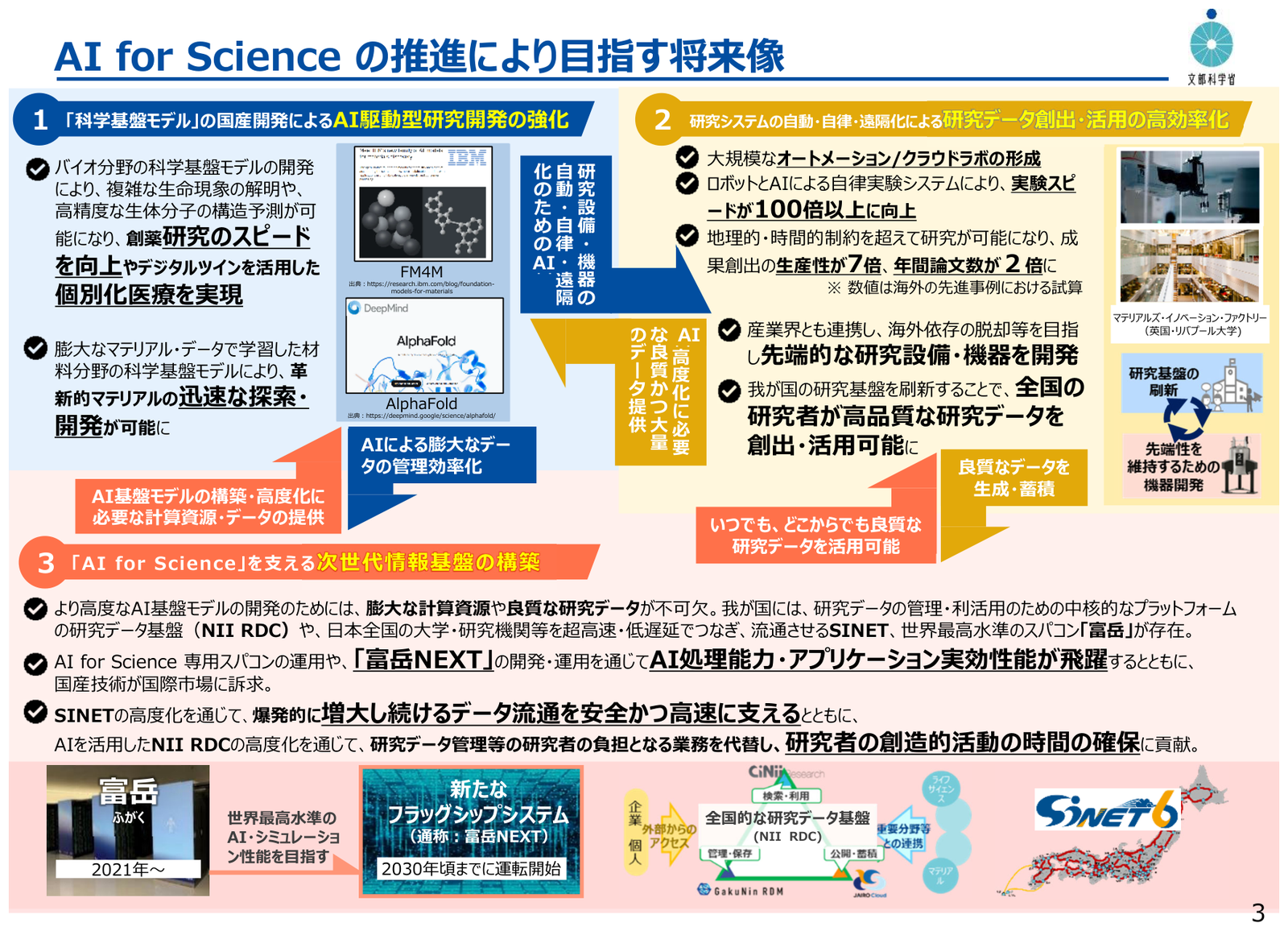
Source: MEXT With that reservation in place, let me also look at actual results. The reference material carries concrete cases in materials. For lithium-ion batteries, there is a report of finding a new additive through automated experiments and roughly doubling battery life25. For neodymium magnets, an example is shown of raising magnetic strength by about 1.5 times with roughly 40 experiments out of some 66 million combinations26. There is also a note that materials development, once said to take roughly twenty years, is being reported one after another as shortened to a few years or a few months through AI-based exploration2. Less flashy than the estimated figures, but these are changes that actually happened.
The state has set serious goals too. The strategy shows, as targets, raising Japan's rank in AI-related papers among the top 10% of papers to third in the world by FY2035, and reducing the time for research and development in key technology fields to one-tenth12. On the budget side, 32 billion yen was allocated in the FY2025 supplementary budget to a project-type programme promoting AI for Science (ARiSE), and 5 billion yen to a programme supporting nascent, ambitious challenges (SPReAD 1000)7. Such backing can be a tailwind for researchers.
Even so, you must not leave everything to AI
I have kept the tone forward-looking up to here, but I do not want to recommend AI as an all-purpose tool. If anything, precisely because you are stepping in, there are several points I want you to watch. For a researcher, this may be the most important part of all.
First, the handling of information. Unpublished ideas, data not yet written into papers, the confidences of a collaboration. Feed these carelessly into an external AI service and information can leak. You need to decide in advance which service you may put what into, and whether what you input is used for training. The more competitive the field, the more this single point can prove fatal.
Next, do not swallow the output whole. AI can generate content that differs from fact in a plausible way. It is not rare for it to cite a paper that does not exist or to mix up numbers. Bias contained in the training data can be reflected straight into a proposal. A hypothesis or an analysis result the AI produces is a starting point, and confirming its validity is the researcher's own job. Skip this, and you trade speed for a loss of reliability.
And then, reproducibility and the trail. Unless you record at which stage and how you used AI, and what output came back for what input, you will later be unable to verify the results. The trust of research rests on being reproducible, so a process that used AI, more than usual, calls for the stance of leaving footprints carefully.
Put differently, AI is not something that substitutes for judgment; it is a tool that widens exploration. What to ask, which hypothesis to choose, how to take responsibility for the conclusion. At the centre of that, the researcher remains, and will continue to. The more that can be left to AI, the clearer the outline of what must not be left to it becomes. Holding that in mind is, I think, the healthy way.
The first step as a researcher
So what should you actually start with? What matters here is not to try to automate the whole research process at once. That is not realistic, and it only creates confusion.
The realistic move is to pick one step where you now lose the most time, and let AI help you from there. If you are buried in literature review, start there. If organising data eats your whole day, start there. Entering from a single point where the effect is easy to feel gives you a sense of the distance to keep from AI. From there, spread what worked, little by little, to the neighbouring steps. Rather than changing the whole research process at once, this stacking is far steadier.
One more thing I would recommend before you begin: knowing objectively how well you and your team can currently handle AI. Take on advanced uses without a foundation, and your preparation for the cautions will not keep up. Measuring where you stand with a free AI literacy self-check brings into view where you should start. If you want to grasp it again from the national-strategy picture, see our AI for Science explainer; if you are interested in efforts across a university or research institution, our piece on university AI-driven development and science will widen the view.
That said, AI moves fast and carries many cautions, and it is a hard area to advance on self-study alone. The reason we keep running an AI consulting service called WARP is that we want to walk alongside you in exactly this design of "from where, and how, do you bring it in." Specialists who led DX and data strategy at major companies work with you month by month, discerning together where AI works in your research or operations. Bringing in AI does not solve everything. Telling apart the places it works from the places it does not, that judgment is the first fork in the road.
To sum up
It ran long, so let me organise the key points.
- Research carries structural walls: the limits of a literature review, the physical cost of exploration, and plans bound by your own experience. The MEXT strategy raises the same points as constraints of conventional research
- In the life and medical sciences, the idea-to-publication period is said to be about two years, and the weight of that time overlaps with what researchers feel
- AI does not merely speed up one step; the strategy positions it as able to take part in every stage of the research process, from hypothesis generation through experimental design, analysis, knowledge integration and report writing
- The figures of more than 100 times experiment speed, seven times productivity and doubled annual paper output are "estimates from leading overseas cases," not actual results or a promise. Meanwhile, the shortening of materials development and the like is reported as change that actually happened
- Be sure to hold the cautions of information leaks, output errors, and reproducibility and the trail. AI is a tool for exploration, not a substitute for judgment, and the researcher remains at the centre of responsibility
- If you are starting, begin from one time-consuming step. Grasp where you stand, combine hands-on support where needed, and take the first step without strain
The speed of research comes back, as it is, to how a researcher uses their time. The more you have spent long stretches facing a single question, the more you will find yourself facing again the question of what you want to turn that time toward. AI is a tool that makes that allocation a little freer. If you are unsure how to organise the starting point of where AI works in your own or your organisation's research, please talk to the WARP team. Let us start from translating the large flow of policy into the one step of research in front of you.
References and primary sources
Footnotes
-
"Basic Strategy for Promoting AI for Science," 31 March 2026 (令和8年3月31日), MEXT (main text PDF). https://www.mext.go.jp/content/20260403-mxt_jyohoka01-000048752_1.pdf ↩ ↩2 ↩3
-
"Basic Strategy for Promoting AI for Science," reference material collection, 31 March 2026 (令和8年3月31日), MEXT. https://www.mext.go.jp/content/20260403-mxt_jyohoka01-000048752_2.pdf ↩ ↩2 ↩3 ↩4 ↩5 ↩6 ↩7 ↩8 ↩9
-
Sakana AI, "The AI Scientist: Towards Fully Automated Open-Ended Scientific Discovery," 13 August 2024 (official blog). https://sakana.ai/ai-scientist/ ↩
-
Google Research, "Accelerating scientific breakthroughs with an AI co-scientist," 19 February 2025 (official blog). https://research.google/blog/accelerating-scientific-breakthroughs-with-an-ai-co-scientist/ ↩
-
Matsuda et al., Cell Reports Physical Science, 2022 (case listed in the reference material collection). ↩
-
G. Lambard et al., Scripta Materialia 209 (2022) 114341 (case listed in the reference material collection). ↩
-
MEXT, "On the Progress of the Basic Strategy for Promoting AI for Science," 21 May 2026. https://www8.cao.go.jp/cstp/gaiyo/yusikisha/20260521/siryo1.pdf ↩