This is Hamamoto from TIMEWELL.
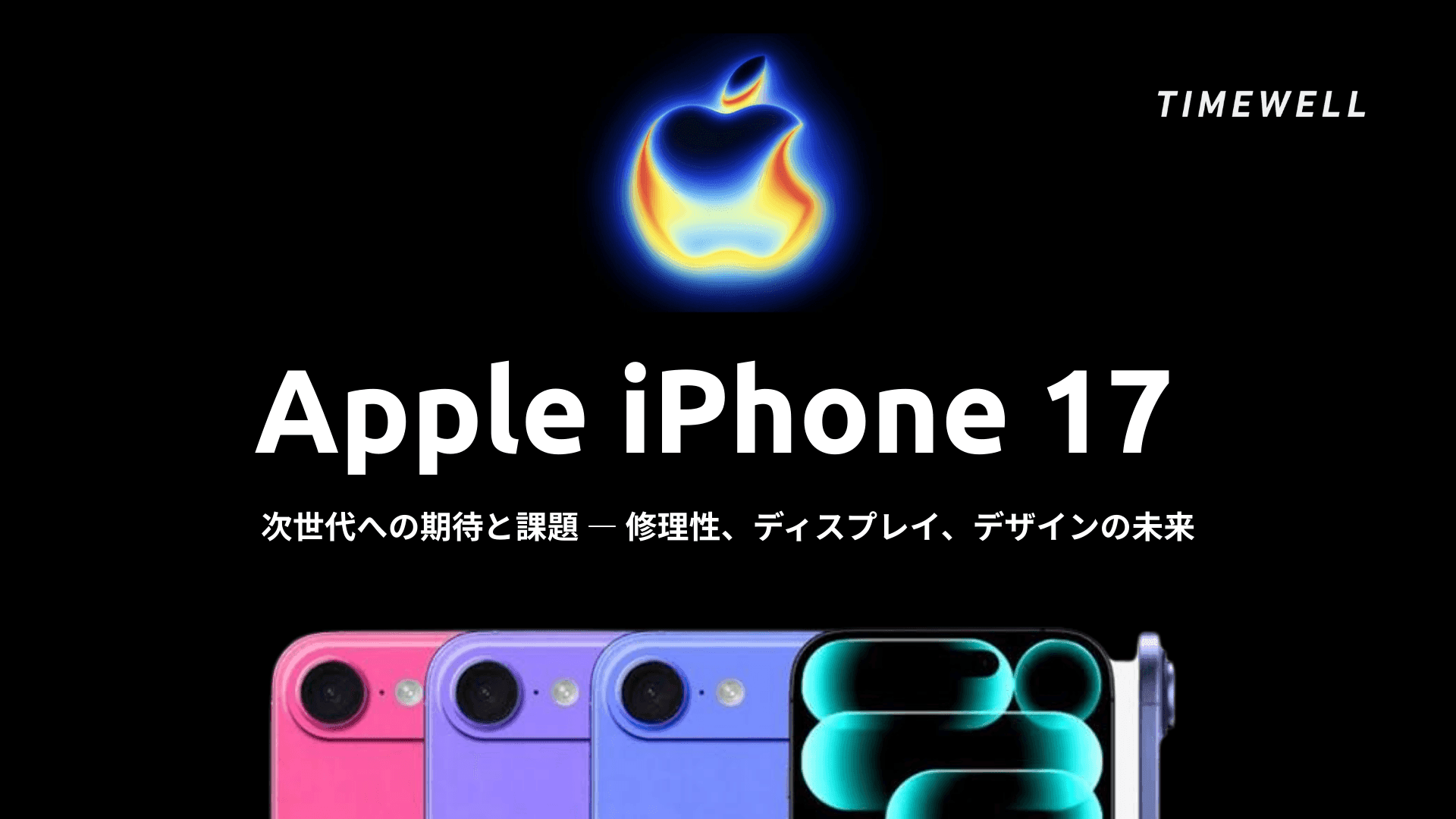
As the season turns and Apple prepares to announce the next iPhone series, anticipation for the iPhone 17 is running high — especially around the standard model, the iPhone 17 Pro, and the ultra-thin device widely referred to as the iPhone 17 Air. The rumors carry both good news and genuine concerns: improvements to battery life, camera performance, and beautiful design are expected, but so are price increases and reduced repairability, generating a mix of excitement and skepticism among fans.
This article examines the iPhone 17 series based on leaks and rumors, focusing on advances in repairability, display technology innovation, and color and design evolution. As Apple continues its long history of iterative improvement, how will the new lineup balance familiar usability with cutting-edge technology — and what trade-offs will users face?
Repairability and the Practical Case for the Slim Model
- Repairability improvements and practical usability in the slim model
- Display performance and usability — higher refresh rates and smarter screens
- Color options and design evolution — personal expression in iPhone 17
- Summary
Apple has long been celebrated for its refined design and high-performance hardware, but the company has faced criticism over the years for devices that are difficult to repair. The iPhone 15 series in particular received low repairability scores from iFixit, representing a notable step backward from earlier models.
By contrast, the iPhone 16 series showed meaningful improvement. Apple expanded its Self Repair and genuine parts programs, and iFixit awarded both the iPhone 16 and 16 Pro a score of 7 — a significant increase that left many consumers wondering whether Apple was finally taking repairability seriously.
The question becomes more complex with the introduction of the ultra-thin iPhone 17 Air. Reducing a device's thickness is a design achievement, but it comes at a cost: components are packed more tightly, and that density can make repairs far more complicated. How Apple balances these competing priorities will be one of the defining challenges of this lineup.
For users, the top concern is simple: ease of repair. Battery replacement and screen repair should require minimal tools and be accessible to users themselves. In response to growing demand, Apple may look at redesigning internal structures, revisiting adhesive usage, and further expanding its Self Repair program.
The Importance of Ease of Repair
Users care about more than just performance improvements — they also look at a product's long-term usability and environmental footprint. Even if a slimmer profile involves trade-offs in some functional areas, a design that is also sustainable and repairable would make future iPhones genuinely more trustworthy as long-term devices.
Improved repairability can also go hand in hand with greater durability through new materials and structural redesigns — for example, changing how adhesive is applied to metal frames and glass panels to minimize damage during disassembly. These improvements would represent a genuine step forward for users who see their iPhone as a reliable everyday tool, not just a beautiful object.
iPhone 17 repairability improvements represent a natural extension of Apple's track record of responding to user feedback. The ultra-thin form factor is a significant new challenge, but if Apple pulls it off, it will earn even greater trust in the market.
Display Performance and Usability — Higher Refresh Rates and Smarter Screens
Looking for AI training and consulting?
Learn about WARP training programs and consulting services in our materials.
Display Technology Is Central to the User Experience
Display technology has become one of the most influential factors in smartphone user experience. When the iPhone 16 launched with a 60Hz display on the standard model, some users found the experience lacking compared to competitors offering 90Hz or 120Hz. As a result, the iPhone 17 is widely expected to introduce higher refresh rates. With Pro models already featuring 120Hz ProMotion, the standard model is expected to receive at least 90Hz — delivering a noticeably smoother experience.
Screen size is another focal point. The 6.9-inch iPhone 16 Pro Max and the 8.3-inch iPad mini are separated by just 1.4 inches — a small gap that makes a meaningful difference in use. For the Pro Max in particular, users want iPad-like multitasking, home screen rotation, and split-screen functionality to make the most of that larger display.
Display Improvements Go Beyond Numbers
Display improvements are never just about raw specs. Advances in brightness, color accuracy, and power efficiency translate into real-world usability improvements. Achieving higher refresh rates while maintaining battery life will require meaningful engineering work, and that balance will be central to how users perceive the upgrade.
Rumors have also circulated about Apple Pencil support on larger iPhone models, along with handwriting input and drawing capabilities. If something like an Apple Pencil Mini were introduced alongside the iPhone 17, users would be able to jot down notes or sketch ideas on the go — pushing the device beyond traditional smartphone boundaries.
In short, display and usability improvements are not merely technical advances — they are central to Apple's ability to deliver a meaningfully better lived experience. A smarter display combined with richer multitasking could set the iPhone 17 apart from the competition.
■ Color Options and Design Evolution — Personal Expression in iPhone 17
One of the reasons Apple has remained beloved over the years is its ability to offer elegant designs while adapting to the trends of each era. The iPhone 17 series is expected to introduce more expressive and distinctive color options — a possible revival of Midnight Green, a new orange-toned color, and a liquid-glass-style finish have all been rumored. These additions would give users more ways to express their personality through their device choice.
Design Reflects More Than Aesthetics
Also, design innovation reflects Apple's rigorous internal user research and market analysis. Reviews of past models often highlighted not just visual appeal, but feel-in-hand, comfort during prolonged use, and durability. The iPhone 17 is expected to address all of these areas simultaneously. The result would be a product that is not just beautiful to look at, but genuinely satisfying to use day after day.
Sustainability also factors in. Apple has increasingly committed to environmentally responsible materials and carbon reduction in manufacturing. These efforts go beyond aesthetics to support lifecycle improvements.
Wider color variety and premium finishes may also have pricing implications. Leaks suggest that non-standard models could see price increases of around $50 (approximately ¥7,400). Apple's ability to communicate the tangible value of its design and technological improvements will be key to maintaining purchase intent.
Summary
This article has explored expectations and areas for improvement across the iPhone 17 series — repairability, display innovation, and design. Apple is pursuing both technical innovation and design refinement in parallel, aiming to bring greater convenience and satisfaction to users' lives.
As the official announcement approaches, comparisons with existing models and fact-checking of leaks will paint a clearer picture of what iPhone 17 will deliver. We remain eager to see how Apple's next chapter unfolds.
Reference: https://www.youtube.com/watch?v=Zu2zIct801U