Hello, this is Ryuta Hamamoto from TIMEWELL.
On 9 October 2026, a Japanese community-platform SaaS announced that member data of about 307,000 people (an estimate) had leaked through unauthorized access. Companies and local governments that used the platform have been announcing, one after another, how their own members were affected. For companies that run member communities or fan sites on an outside SaaS, this was not someone else's problem.
This article separates what has been disclosed from what is still unknown. It then sets out what both SaaS operators and the companies that use them should review, based on OWASP and RFC 8725. It is not a search for anyone's fault. There was a lot to learn from the companies that put out the facts, and from the customers that notified their own members quickly.
What has been disclosed, and what is still unknown
This is what can be confirmed from the announcements and press reports.12
| When | What happened |
|---|---|
| 5 October, around 18:00 | Unauthorized access began |
| 6 October | The operator detected it and blocked traffic and put defenses in place. Around 21:00 it switched all communities to maintenance mode |
| 7 October, 13:17 to 14:36 | Second leak: unauthorized registrations and viewing through a communication path left open during maintenance |
| 7 October, 14:58 | That path was blocked |
| 8 October | Communities reopened in stages after defenses against outside access were in place |
| 9 October | Public announcement. About 307,000 members (estimate) affected |
Two methods were disclosed. The attacker improperly obtained invite links to private communities and registered as an ordinary member. Then it impersonated an administrator, viewed and obtained member data, and overwrote data. The operator describes the cause as an attack that exploited a flaw in its system.1
Of the affected members, about 126,000 had information that included email addresses (including about 42,000 employee and test accounts), and about 181,000 had information without email addresses. The fields include display name, self-introduction and private-group membership, and vary by community and member. The passwords of 144 people were changed to temporary passwords without their action, but leakage of the passwords themselves has not been confirmed.12
The operator's measures include fixing the flaw that was used, renewing the signing key used for logins, blocking the unauthorized communication path and refusing access from unauthorized IP addresses, and closing accounts the attacker created. According to press reports, data was rolled back to its state at 18:00 on 6 October. As a result of the rollback, direct messages and new registrations are expected not to be restored.2
Customers have disclosed their own responses too. One customer said that the operator explained that an administrator account on a vendor site was used improperly, and wrote that the operator stopped the service on 6 October, reported to the customer on 7 October, and that the customer reported to the Personal Information Protection Commission on 8 October.3
Some things have not been disclosed.
- Which flaw the first intrusion went through. The announcements and press reports I could confirm do not give details of the initial entry path.1
- How the invite links were obtained.
- By what mechanism the administrator impersonation worked. Renewing a signing key is listed among the measures, but how a key was involved cannot be read from the official statements.
- How the figures each organization published relate to the total of about 307,000. The press also warns that the organizations' numbers cannot simply be added up.2
What I find most notable is the second leak. After all communities were switched to maintenance mode as the first response, a communication path left over from maintenance was misused. An entrance that was thought to be closed was in fact open. I come back to that lesson below.
AI Security training, taken seriously
A 2-day intensive course fully aligned with OWASP, NIST, ISO/IEC 42001, and METI. Take it as executives, practitioners, or both.
Five items for the operator to review
Here are five items that a SaaS operator, someone who holds other companies' member data, can review. What follows is general background, not a guess at the cause of this incident.
1. Do not let an invite link stand in for identity verification.
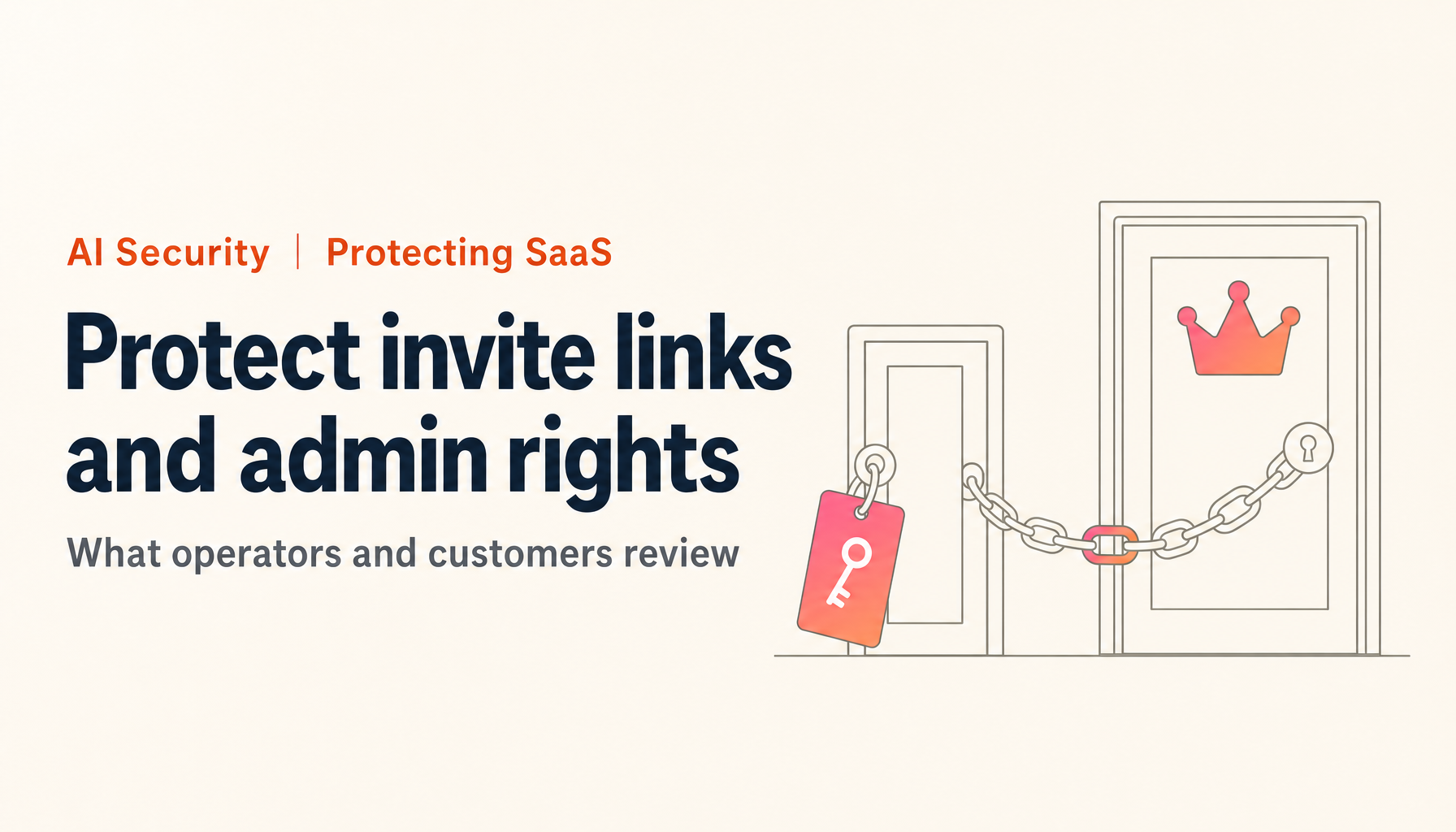
An invite link is a "secret URL" that anyone who knows it can use. It gets forwarded in email, appears in screen sharing, gets pasted into chat, and ends up with people nobody intended. To limit the damage when a link leaks, you need design such as an expiry date, a limit on the number of uses or people, an administrator-approval step for joining, and the ability to revoke the link at any time. For private communities in particular, it is worth reviewing whether merely knowing the link is enough to become a member.
2. Separate administrator privileges from ordinary functions.
The OWASP API Security Top 10 lists "Broken Function Level Authorization" as API5: the line between administrative and ordinary functions is blurry, and functions that should be out of reach can be reached.4 If an attacker can impersonate an administrator, viewing and extracting member data and overwriting data all become possible at once. You need safeguards: require extra authentication (multi-factor or re-authentication) for administrator actions, limit the routes by which administrator privileges can be granted, and always leave administrator actions in an audit log.
3. Separate signing keys by purpose and by tenant.
Many services use digital signatures on the tokens that represent a logged-in state. The JWT best practices (RFC 8725) say to validate the issuer (iss) and subject (sub), to include and validate the audience (aud), and that different kinds of tokens can use different keys.5 Where the same issuer issues tokens for multiple parties, it requires that aud be validated.
If several communities (tenants) in a SaaS share one signing key, a key that is broken affects everyone. It is not known how a key was involved in this incident. Still, separating signing keys by tenant and by purpose is a general way to localize damage. Decide the procedure for renewing keys ahead of time, in normal operations.
4. Enforce the tenant boundary on the server side.
What OWASP lists as API1, "Broken Object Level Authorization," is a handler that takes an ID the user specified and does not check enough, so another person's data can be reached.4 In a multi-tenant SaaS, the most important boundary is that the administrator of one community cannot reach another community's data. Check not just the title "administrator" but "administrator of which community."
5. Define "stopped" in your runbook.
In this case the operator switched all communities to maintenance mode on 6 October. On the 7th, a communication path left open during maintenance was still misused.1 During an incident, "stopping" does not mean stopping what appears on screen. It means closing every entrance: APIs, admin consoles, batch jobs, external integrations, and endpoints of old versions. Make a list of entrances in normal operations and add to the containment runbook an item to confirm that everything on the list is closed. The lack of API inventory that OWASP lists as API9 matters here too.4
Four things for the companies that use a SaaS
A company that runs a member community on a SaaS can prepare four things.
Limit what you hand over to the fields you need. Nicknames, self-introductions, group membership. Are all the fields you have put in the community really needed for its purpose? The fewer fields you hand over, the smaller the effect if the vendor has an incident. Separate the fields needed for contact, such as email address, from the rest.
Agree in the contract on how you will be notified. How long after the vendor learns of an incident it must tell you, what the notice must contain, how investigation results are shared, who decides to suspend the service. Deciding these in the contract or in an operating agreement makes you faster. One customer's announcement lays out, with dates, the path from the vendor's suspension to the report received to the report to the Personal Information Protection Commission.3 With agreements in place, that flow can be shortened further.
Prepare the suspension procedure and the wording of the notice to members. When an incident happens, you have to decide quickly whether to stop the community. Who can press the stop button, where will you post the notice while it is stopped, and what are the conditions for reopening? Decide these in advance. A notice to members should cover four things: what happened, which information is affected, what members should do, and where to ask questions. One customer, Unirita, warned that fraudulent emails exploiting the incident might arrive, and asked members not to open suspicious links or attachments.3
Decide who reports to the Personal Information Protection Commission, and by when. The four types of incident that must be reported are those that involve sensitive personal information, a risk of financial harm, a risk of malicious intent, or more than 1,000 people. When one applies, you file a preliminary report promptly, generally within about three to five days as a guide, and a final report within 30 days (60 days where malicious intent is suspected).6 Agree with the vendor in advance who will file.
What to tell members and staff
After an incident, members may need to log in to the community again or reset their passwords. In this case too, all members were logged out and needed to log in again after reopening, and members whose passwords had been changed to temporary ones needed to reset them.2 Say clearly that the steps should be followed through the official site.
Tell staff the same things. Turn on multi-factor authentication for the administrator accounts of staff who run the community, and do not reuse passwords from other services. Letting the people who operate the community know that, if an administrator account is taken over, member data can be viewed all at once, is the best preparation.
Summary
What was disclosed is improper acquisition of invite links to private communities, impersonation of administrators, and a second leak through a communication path left open during maintenance. The entrance of the first intrusion and the mechanism of the impersonation have not yet been disclosed.
What an operator can review is the design of invite links, separation of administrator privileges, how signing keys are divided, the tenant boundary, and the definition of "stopped." What a company that uses the SaaS can prepare is narrowing the fields it hands over, agreeing how it will be notified, preparing for suspension and notices, and deciding who reports and by when.
I think the biggest difference comes from the check before adoption. When choosing a vendor, confirm before signing how you will be notified in an incident and how data is held. I will update this article when more is reported. If you would like to talk about an internal review or managing vendors, please reach out through the consultation form for WARP SECURITY. For checking APIs that return member data, our piece on the Sourcenext breach is also a useful companion.
References
Footnotes
-
Unauthorized access to a Japanese community platform leaks an estimated 300,000 people's personal data (press report; Japanese) — INTERNET Watch (Impress) — October 2026 ↩ ↩2 ↩3 ↩4 ↩5
-
Summary of the unauthorized access to a Japanese community platform, and the affected organizations (press report; Japanese) — Security Measures Lab — October 2026 ↩ ↩2 ↩3 ↩4 ↩5
-
Important notice: leak of community member information through unauthorized access to an outside vendor (Japanese) — Unirita — 13 October 2026 ↩ ↩2 ↩3
-
RFC 8725 JSON Web Token Best Current Practices — IETF — 2020 ↩
-
Responding to leaks and useful materials (Japanese) — Personal Information Protection Commission ↩