Hello, this is Ryuta Hamamoto from TIMEWELL.
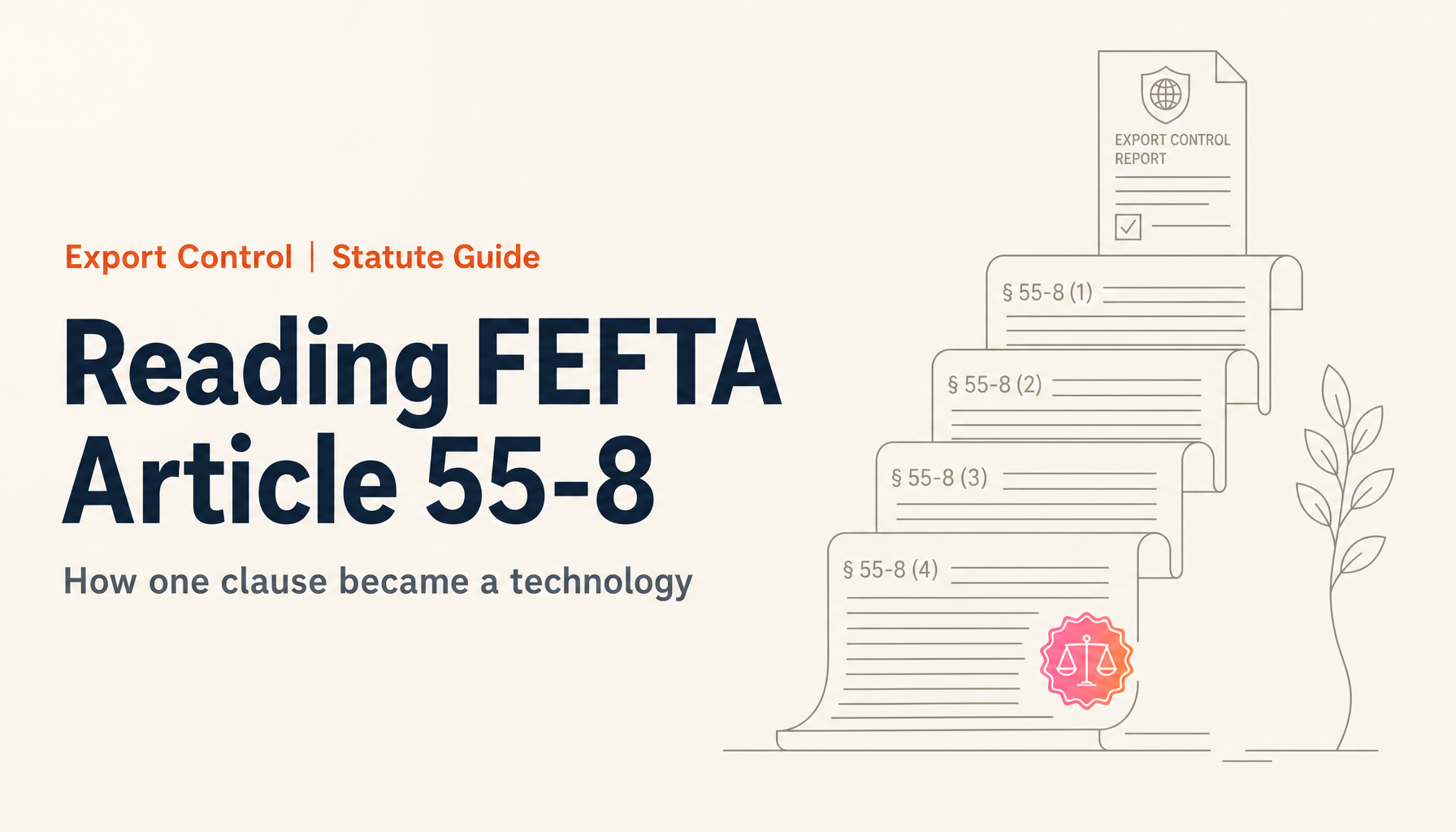
"The technology management scheme is based on Article 55-8 of the FEFTA." When I first heard that, I opened the article and was a little surprised. The word "technology" does not appear anywhere in it. What it contains is a general power for the government to ask people who have carried out transactions to report on them.
Here is the conclusion up front. Article 55-8 is a catch-all, titled "Other Reports." The concrete duty to report a technology transfer before the contract is signed was built on top of it, layer by layer, through a cabinet order, a ministerial ordinance and a METI notice. So reading Article 55-8 alone does not explain the scheme, and reading the notice alone does not explain its legal basis. You need both, and the link between them.
You will come away with four things: what Article 55-8 says, where it sits among its neighboring articles, how one clause turns into a working scheme in four steps, and what happens when someone breaks the rules and who does what inside a company. The list of technologies subject to the report, and the eight items added on August 16, 2026, are covered in detail in another article, so I point you there. This one concentrates on how to read the text.
Terms to Get Straight First
Statute explainers fall apart when the vocabulary is shaky. Here is a table to start.
| Term | Meaning | Think of it as |
|---|---|---|
| FEFTA | The Foreign Exchange and Foreign Trade Act (Act No. 228 of 1949), the main law for cross-border dealings | The school rulebook itself |
| Cabinet order | An order issued by the Cabinet that fills in details of a statute | The detailed rules in a student handbook |
| Ministerial ordinance | An order issued by a minister, usually about procedures and forms | The submission guide |
| Notice (kokuji) | A rule a minister publishes for general information; targets and dates change here most easily | This month's bulletin board |
| Competent minister | The minister in charge of the matter, such as the Minister of Finance or the Minister of Economy, Trade and Industry (METI) | The teacher in charge |
| Service transaction | A transaction that provides services or technology rather than goods | Exchanging know-how instead of products |
| Critical managed technology | A technology listed in the notice as subject to the advance report | A technology whose name is on the bulletin board |
| Inform notice | An individual notice from the METI Minister asking a company to apply for a license | A personal summons |
The "think of it as" column is an analogy to help you picture the structure, not a legal definition. I will use the school analogy again. The rulebook says "the school may ask students to report where necessary." The handbook decides who receives the report. The bulletin board says "this month, please submit X." The reporting system under the FEFTA is built much the same way.
One more anchor. Article 1 of the Act says that cross-border transactions are free in principle and that control is limited to the minimum necessary.1 That "free in principle, minimal control" stance is the background to the phrase "to the extent necessary" in Article 55-8.
Taking Article 55-8 Apart, Phrase by Phrase
Now the text itself. Here is the e-Gov wording, in my plain translation.1
In addition to what is separately provided in this Act, the competent minister may, to the extent necessary to achieve the purpose of this Act and as provided by cabinet order, request a report on the content of the transaction, act or payment, and on related matters, from a person who conducts or has conducted a transaction, act or payment subject to this Act, or from a related party.
It is one long sentence, but it breaks into simple parts.
| Part of the text | How to read it |
|---|---|
| In addition to what is separately provided in this Act | A gap-filler for cases with no specific reporting rule elsewhere. The word "other" in the title comes from here |
| The competent minister | The requesting party is the government. Which minister is decided elsewhere |
| To the extent necessary to achieve the purpose of this Act | A guardrail. The minister cannot ask for anything at all |
| As provided by cabinet order | The details are delegated to a cabinet order, not written in the Act |
| A person who conducts or has conducted a transaction, act or payment subject to this Act, or a related party | The addressees. The wording covers people doing it now and people who did it, not people who are merely planning it |
| May request a report on content and related matters | The power itself. The text says "may request"; it does not by itself impose an immediate duty on private parties |
Three things stand out. First, the opening phrase. The Act has many specific reporting rules: payments, capital transactions, inward direct investment and more. Article 55-8 is the fallback door for reports that fit none of them.
Second, the clause mentions neither "technology" nor "export." The reports it covers are described as relating to "transactions, acts or payments subject to this Act," which is the whole field the Act governs. It is not a technology-only provision.
Third, "as provided by cabinet order." This is the crucial part. The clause hands the details to a cabinet order, so you cannot tell who reports what, and how, until you read that order. I could not tell from this clause alone who exactly a "related party" is. I leave that as unconfirmed.
Replace siloed classification work with AI.
METI's FY2024 data shows 52% of foreign exchange law violations stem from classification errors. Download the TRAFEED product catalog covering features and rollout.
What the Neighboring Articles Show
Article 55-8 does not stand alone. It belongs to Chapter 6-2, "Reports, etc." Here are its articles.1
| Article | Title | What is reported (summary) |
|---|---|---|
| 55 | Reports on payments | Cross-border payments and similar |
| 55-2 | (Deleted) | Empty today |
| 55-3 | Reports on capital transactions | Content and timing of capital transactions, to the Minister of Finance |
| 55-4 | (No title) | Specified capital transactions, to the METI Minister |
| 55-5 | Reports on inward direct investment and specified acquisitions | Investments made by foreign investors |
| 55-6 | Reports on technology import contracts | Contracts that bring technology in from abroad |
| 55-7 | Reports on foreign exchange business | Requests to larger foreign exchange business operators |
| 55-8 | Other reports | Anything else needed for the Act's purpose |
| 55-9 | Statistics on external credit and the balance of payments | Compiling statistics |
Set side by side, you see where 55-8 fits. The other articles name what is to be reported. Article 55-8 alone does not; what to report is decided later, below the Act.
The closest neighbor on the subject of technology is Article 55-6, and it is easy to confuse with the scheme because the topics sound alike. Its direction is the opposite. It requires a Japanese resident to report a technology import contract concluded with a non-resident. Under Article 30, a technology import contract means a contract for assigning industrial property rights or other technology rights from a non-resident, granting rights to use them, or receiving guidance on business management technology.1 That is technology coming into Japan. The public-private dialogue scheme is about Japanese technology going out, so its basis is Article 55-8, not 55-6.
I also want you to read Articles 55-10 to 55-12 alongside. These form Chapter 6-3, "Exporter Compliance Standards." The METI Minister sets, by ordinance, standards that apply to anyone who exports or provides technology as a business, and those exporters must follow them. If a business falls short, the minister may give guidance and advice, then a recommendation, and then an order if the recommendation is ignored.1 The content of the standards is explained in our guide to the exporter compliance standards. They are a different duty from the Article 55-8 report, but for a company that handles technology they sit on the same desk, so I compare them in a table later.
How One Clause Becomes a Technology Scheme
This is where the school analogy earns its keep. Let me trace, in four steps, how a general clause turns into a duty to report a technology transfer before signing.
Step one is the Act. Article 55-8 gave the competent minister the power to ask for reports.
Step two is the cabinet order. Article 18-8 of the Foreign Exchange Order says that when the Minister of Finance or the METI Minister requests a report under Article 55-8, they designate the matters to be reported by notice or other means set in an ordinance. Anyone asked must report by the procedure the ordinance sets.2 One detail deserves attention. The order limits itself to certain chapters of the Act: Chapters 1, 3 and 4, Chapter 6-2-2 and Chapter 6-3. Article 25, on service transactions including technology provision, sits in Chapter 4, so it falls within that range. Chapter 6, which covers exports of goods, is not on the list. As I read it, then, a report under this order is not a report about exports of goods. METI's Q&A for the scheme agrees that exports of goods are not subject to the report.3
Step three is the ministerial ordinance. Article 10, paragraph 3 of the ordinance on trade-related invisible transactions says that, when the METI Minister requests a report under the cabinet order, the Minister "orders the submission of a necessary report, specifying the matters to be reported by notice." Paragraph 4 adds that a person so ordered must submit the report without delay.4 This is where an obligation first takes shape: an order to submit a report.
Step four is the notice. METI Notice No. 178 (October 30, 2024) sets out the matters to be reported, and it has applied since December 30, 2024.5 Item 1 says that a person who plans a transaction to provide critical managed technology outside the countries listed in Appended Table 3 of the Export Trade Control Order, for example in connection with investing in a foreign company or commissioning manufacturing abroad, must submit a report to the METI Minister, on the prescribed form, before signing the contract. Item 2 defines critical managed technology and lists it.5
Here is the whole chain in one table.
| Level | Basis | What it settles |
|---|---|---|
| Act | FEFTA Article 55-8 | The government may ask for reports |
| Cabinet order | Foreign Exchange Order Article 18-8 | Designating the matters by notice or other means; which chapters it covers |
| Ministerial ordinance | Invisible Trade Ordinance Article 10(3) and (4) | Ordering submission of a report, with matters specified by notice; submit without delay |
| Notice | METI Notice No. 178 | Who reports, when, what and on which form; the list of technologies |
The bottom layer, the notice, is lighter to amend than a statute, so targets can be added quickly. The technologies subject to the report started as items numbered 1 to 10, and additions followed on June 9, 2025, January 14, 2026 and August 16, 2026. METI's August 2026 overview now organizes them under numbers 1 to 24.6 If nobody at your company watches for new notices, you have little chance of noticing the changes. For each round of additions, the list and the procedures are set out in our article on the dialogue scheme's target technologies.
One more observation from reading closely. Article 55-8 speaks of people who "conduct or have conducted" a transaction. The notice speaks of a person who "plans" a transaction and must report before signing. The statute's wording points to present and past; the notice's wording points to the future. I did not find, in the materials I checked, how METI reconciles the two. I am not raising a legal objection. I am showing the kind of small gap you notice when you read the text, and I leave it as unconfirmed.
Three Duties for Technology, Side by Side
A company that provides technology faces more than one duty. To avoid mixing them up, here are three in a row.
| Aspect | Permission (Art. 25) | Advance report (Art. 55-8) | Compliance standards (Art. 55-10) |
|---|---|---|---|
| What you do | Obtain a license from the METI Minister | File a report before signing the contract | Maintain a compliant internal setup |
| Scope | Provision of list-controlled technology and similar | Technologies listed in the notice (design or manufacturing technology) | Everyone who exports or provides technology as a business |
| Outcome | You cannot provide the technology until permitted | A dialogue follows; if needed, an Inform notice asks for a license application | Guidance, advice, recommendation, then an order |
| Penalty for breach | Article 69-7 (up to 7 years or a fine up to 20 million yen, among others) | Article 71, item 9 (up to 6 months or a fine up to 500,000 yen) | Violating an order: Article 71, item 11 |
The relationship between license and report trips people up. METI's Q&A 1-1 states that provision of list-controlled technology is subject to a separate license application and is outside the scope of the scheme's report.3 The notice itself defines critical managed technology as technology in the middle column of item 16 of the Appended Table of the Foreign Exchange Order that the notice lists.5 Item 16 is the technology side of the catch-all (supplementary) control. If you want to start from how catch-all control works, our catch-all control explainer is the entry point, and permission for technology transfer in general is covered in our guide to service transactions and technology provision.
Compliance standards are a different layer again. Licenses and reports concern individual transactions; the standards concern the company's setup. The standards common to all exporters include appointing a person responsible for classification checks. So a company that sends technology abroad lives in two layers: the standards as its everyday system, and a license or a report for each transaction.
What Happens If You Break the Rules
Penalties are worth reading in the text, because the numbers are easy to mix up.
For the advance report, the relevant provision is Article 71, item 9 of the Act. A person who fails to report, or reports falsely, in violation of an order under Article 55-8 is punished by imprisonment of up to six months or a fine of up to 500,000 yen. For companies, the dual liability rule in Article 72 applies: when a representative or an employee commits the violation in the course of business, the individual is punished and the company is also fined.1
Unlicensed technology transfer is punished on a different scale. Article 69-7, paragraph 1 provides imprisonment of up to seven years or a fine of up to 20 million yen, or both, for conducting a transaction without the license required by Article 25, paragraph 1. If five times the value of the object exceeds 20 million yen, the fine can go up to five times that value. For certain technologies connected with nuclear weapons and similar items, paragraph 2 raises it to up to ten years or a fine of up to 30 million yen.1 The whole picture of penalties is also laid out in our article on FEFTA penalties.
The weight of the text and the order of enforcement should be kept apart, though. Q&A 3-6 says that failing to report may lead to guidance and advice under the Act, and that penalties may apply only if there is still no sign of improvement or the case is judged malicious.3 METI's overview also shows guidance, advice and an improvement order coming first, with penalties possible where an order is not followed or the case is malicious.6 A forgotten report is not an instant criminal matter. Still, building the check into your process from the start is far easier than fixing things after receiving guidance.
The 2026 Amendment and What to Do Inside Your Company
While writing this I checked whether the 2026 amendment to the FEFTA (Act No. 30 of 2026, promulgated June 5, 2026) touches Article 55-8. It does not. Article 55-8 was not amended.
The Ministry of Finance's summary of the bill centers on inward direct investment screening: bringing acquisitions of 50 percent or more of the voting rights in certain overseas entities by foreign investors into scope, requiring risk-mitigation measures to be notified with prior notifications, and adding reporting powers over investments not subject to prior notification that could later threaten national security.7 The old-and-new comparison table I checked does not list Article 55-8.7 The technology advance report sits outside this amendment.
Penalty article numbers did move, however. The supplementary provisions of the amending Act make the renumbering of Article 69-7 to 69-8, Article 69-6 to 69-7 and similar changes effective on promulgation.17 In the current e-Gov text, the penalty for unlicensed service transactions and exports is in Article 69-7. If an old document or internal rule cites "Article 69-6," it most likely means today's Article 69-7. Do check the article numbers in your own rules and training materials. The rest of the amendment takes effect within one year of promulgation. A commentary reports January 4, 2027 (with exceptions), but I could not confirm the cabinet order that sets the date.8
So who does what at a company? Let me use a hypothetical, not a real case. Say an electronic components maker plans to start production at an overseas subsidiary using its own manufacturing know-how.
- The engineering group lists the technical information it intends to hand over, such as drawings, process conditions and recipes, and checks whether it looks like a technology listed in the notice. The unit of judgment is design or manufacturing technology, not the product.
- The export control staff first determine whether the technology is list-controlled. If it is, the matter is one of license and the advance report does not apply.
- If not, they check whether the destination is outside the 27 countries of Appended Table 3 of the Export Trade Control Order. The 27 run alphabetically from Argentina to the United States and include Australia, Canada, France, Germany, Korea, the United Kingdom and the United States.9
- They check whether an exclusion in the notice applies, such as transactions involving technology already in the public domain, or technology provided solely to enable inspection, testing or quality assurance.5
- The contracts staff add a line to the approval or contract review checklist: has the need for an advance report been checked before signing?
- If a report is needed, contact the responsible METI division early. Q&A 3-1 says METI expects to decide on an Inform notice within 30 days in principle, but some cases take longer, and it recommends consulting as early as possible.3
- Keep a record. Whether you reported or decided no report was needed, record who decided what, when and on what basis.
Which department owns each step differs by company, but engineering knows the technology, export control knows the scheme and legal or contracts is the last gatekeeper. Unless those three are connected in one flow, contracts can be signed without anyone noticing. METI has not asked companies to amend their internal compliance programs for this scheme.3 No request means no automatic new process, and that is worth keeping in mind.
Common Misunderstandings, and a Next Step
Finally, here are the misreadings I see most often.
Misunderstanding one: "Article 55-8 is a technology provision." The text never mentions technology; it is a general clause for reports on transactions and acts the Act governs. The advance report is one use of it. I could not confirm other uses in this research.
Misunderstanding two: "If I report, I get permission." A report is not a license application. It starts a dialogue, and if concerns remain, METI may issue an Inform notice asking for an application. METI states that the aim is not to stop technology transfer but to ensure proper technology management.6
Misunderstanding three: "A wholly owned subsidiary needs no report." Q&A 1-12 says a report can be required whether the recipient is a wholly owned subsidiary or a local joint venture.3
Misunderstanding four: "It is joint research, so it is out of scope." Q&A 1-11 says joint research itself is not subject to the report, but providing design or manufacturing technology within it is, regardless of whether the party is a company or a university.3
Misunderstanding five: "If a technology is listed, the company has a problem." Not at all. Being designated is a regulatory classification, not a judgment about the company that holds the technology or the party that receives it. METI describes the targets as technologies other countries are interested in acquiring and in which Japan has indispensability or an edge.6 Strengths that Japanese materials and components makers built over decades are exactly what is listed.
My own view is that the hard part of this scheme is not legal interpretation but noticing. Once you have read the text, the structure "general clause in the Act, specifics in the notice" sinks in, and the reason to watch for new notices makes sense. Three things you can do tomorrow: appoint someone to check METI's scheme page and amendment information page once a month, add one line to your contract review checklist, and ask the engineering group what technology it plans to hand over abroad.
If you would like to manage technology provision and decision records together, the TRAFEED service page describes the features, and we welcome a consultation. The final decision on whether an advance report is required rests with your own export control officer, ideally after confirming with the responsible METI division.
Footnotes
-
e-Gov Law Search, "Foreign Exchange and Foreign Trade Act" (Act No. 228 of 1949; law ID 324AC0000000228), Articles 1, 25, 30, 55-3 to 55-12, 69-7, 71 and 72, and Supplementary Provisions Article 1 of Act No. 30 of 2026. Retrieved via API 2026-11-06 https://laws.e-gov.go.jp/law/324AC0000000228 ↩ ↩2 ↩3 ↩4 ↩5 ↩6 ↩7 ↩8
-
e-Gov Law Search, "Foreign Exchange Order" (Cabinet Order No. 260 of 1980), Article 18-8. Checked 2026-11-06 https://laws.e-gov.go.jp/law/355CO0000000260 ↩
-
METI, "Q&A on the Public-Private Dialogue Scheme for Strengthened Technology Management" (prepared April 9, 2025; to be revised in sequence). Whether it was revised after August is unconfirmed. Checked 2026-11-06 https://www.meti.go.jp/policy/anpo/250409_kanmintaiwa-qa.pdf ↩ ↩2 ↩3 ↩4 ↩5 ↩6 ↩7
-
e-Gov Law Search, "Ministerial Ordinance on Trade-Related Invisible Transactions" (MITI Ordinance No. 8 of 1998), Article 9 paragraph 2 and Article 10 paragraphs 3 and 4. Checked 2026-11-06 https://laws.e-gov.go.jp/law/410M50000400008 ↩
-
METI Notice No. 178, "Matters on Which Persons Planning Transactions to Provide Critical Managed Technology Are Requested to Report" (October 30, 2024; last amended by Notice No. 166, January 14, 2026; applicable from December 30, 2024). The consolidated text reflecting Notice No. 71, effective August 16, 2026, could not be retrieved, so I cite this version for the skeleton of items 1 and 2. Checked 2026-11-06 https://www.meti.go.jp/policy/anpo/law_document/kokuji/20251114_kokuji.pdf ↩ ↩2 ↩3 ↩4
-
METI, Trade and Economic Security Bureau, "Public-Private Dialogue Scheme for Strengthened Technology Management" (August 2026 overview listing technologies 1 to 24 and responsible divisions). Checked 2026-11-06 https://www.meti.go.jp/policy/anpo/2608_kanmintaiwa-gaiyo.pdf ↩ ↩2 ↩3 ↩4
-
Ministry of Finance, "Bill to Partially Amend the Foreign Exchange and Foreign Trade Act" (submitted March 17, 2026), summary and old-and-new comparison table. Checked 2026-11-06 https://www.mof.go.jp/about_mof/bills/221diet/index.html (summary kb20260317g.pdf; comparison table kb20260317s.pdf) ↩ ↩2 ↩3
-
Keiyaku Watch, "June 2026 Amendment of the Foreign Exchange and Foreign Trade Act" (states promulgation on 2026-06-05 and effect from 2027-01-04 with exceptions; details are behind a paywall, so only the summary was checked; the cabinet order itself is unconfirmed). Checked 2026-11-06 https://keiyaku-watch.jp/media/hourei/202706-exchange-and-trade/ ↩
-
e-Gov Law Search, "Export Trade Control Order" (Cabinet Order No. 378 of 1949), Appended Table 3. Checked 2026-11-06 https://laws.e-gov.go.jp/law/324CO0000000378 ↩