FEFTA Violation Penalties and Case List: Up to 10 Years Imprisonment and 1 Billion Yen in Fines (2026 Guide)
I'm Ryuta Hamamoto from TIMEWELL Corporation.
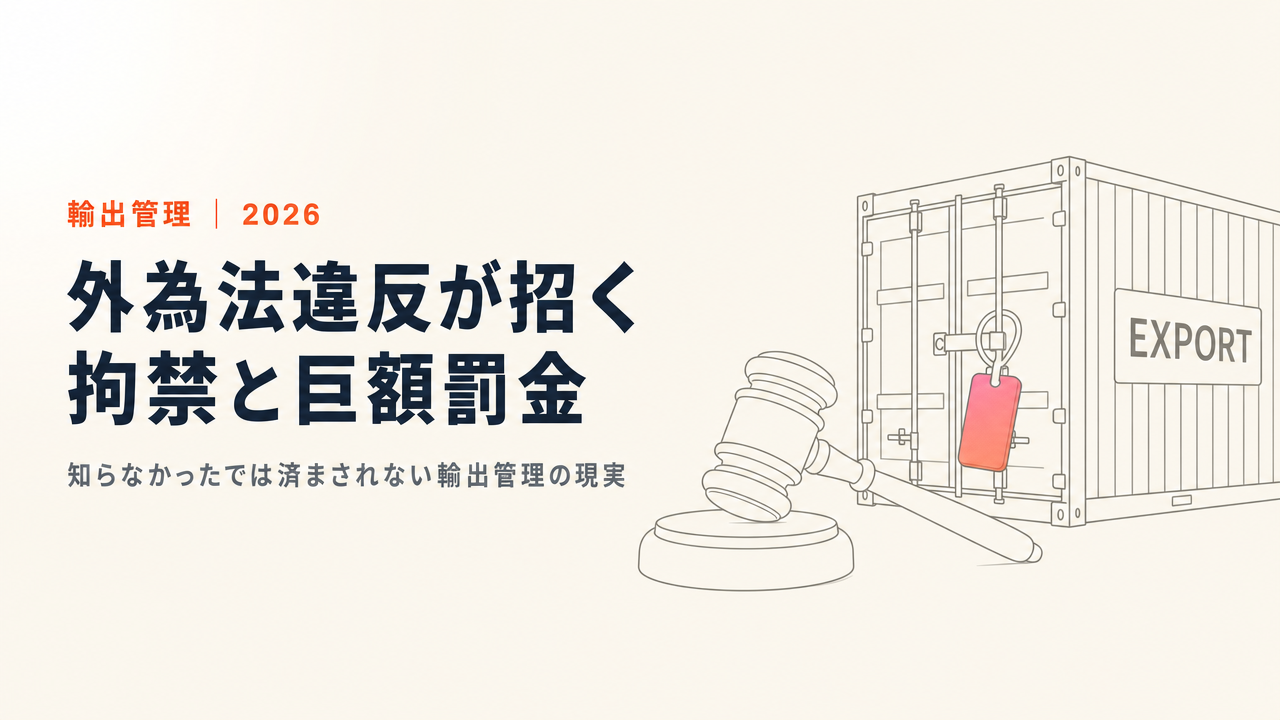
What actually happens when a company violates Japan's Foreign Exchange and Foreign Trade Act (FEFTA)? Here is the short answer. Individuals face up to 10 years of imprisonment, corporations face fines of up to 1 billion yen, and — entirely separately from criminal prosecution — the Ministry of Economy, Trade and Industry (METI) can impose administrative sanctions such as export bans of up to three years and public warnings that name the violator. METI has continued to publish the names of violating companies and individuals in press releases through 2026.
This article lays out the full penalty framework in a quick-reference table based on the current statutory text, then walks through the enforcement cases METI has actually published. Every company name, sanction, and article number below has been verified against METI's own releases and the current text of the law on e-Gov (as of July 2026), not against secondhand summaries.
FEFTA Penalties at a Glance
Start with the conclusion. Criminal penalties under FEFTA scale in three tiers according to the sensitivity of the goods or technology involved.
| Violation type | Criminal penalty (individuals) | Fine (corporations) | Legal basis |
|---|---|---|---|
| Unlicensed export or technology transfer related to weapons of mass destruction (nuclear, chemical, biological weapons, missiles) | Up to 10 years imprisonment and/or a fine up to 30 million yen | Up to 1 billion yen | Art. 69-7(2), Art. 72(1)(i) |
| Unlicensed export or transfer of other list-controlled goods and technology | Up to 7 years imprisonment and/or a fine up to 20 million yen | Up to 700 million yen | Art. 69-7(1), Art. 72(1)(ii) |
| Catch-all control violations and export/import approval violations | Up to 5 years imprisonment and/or a fine up to 10 million yen | Up to 500 million yen | Art. 69-8, Art. 72(1)(iii) |
| Administrative sanctions (separate from criminal penalties) | Export/technology transfer ban of up to 3 years; prohibition on serving as an officer | Applies to both individuals and corporations | Art. 53 |
| Warning (administrative guidance) | Company name published as a rule | Applies to both | Operational measure |
Three footnotes to this table. First, fines operate on a sliding scale: if five times the value of the goods involved exceeds the stated cap, the fine ceiling becomes five times that value — which makes the nominal caps almost meaningless for high-value shipments. Second, attempted unlicensed exports are also punishable (Article 69-7(3)). Third, article numbers have shifted through successive amendments; older commentary describes the same provisions as Article 69-6. The numbering here follows the current e-Gov text as of July 2026.
If you want a quick read on where your own organization stands, try our free Export Compliance Check — five questions, about two minutes, no email required for the light version. The TRAFEED product catalog (PDF) is also available if you are reviewing your screening workflow.
FEFTA Violation Cases Published by METI
When people search for a "list of FEFTA violations," what they usually want is the enforcement record. Here are the administrative dispositions and warnings METI has published since 2021, newest first.
| Published | Party | Violation | Disposition |
|---|---|---|---|
| Mar 24, 2026 | Wang Tianyuan (individual) | Imported 537,660 kg of North Korean-origin shijimi clams via China and South Korea in 35 shipments without approval (declared value approx. 105 million yen) | 3-year ban on all imports; 3-year officer prohibition |
| Dec 16, 2025 | Red Baron Co., Ltd. | Exported motorcycles subject to Russia-related restrictions to Russia without approval, 2022-2024 | Warning (company named) |
| May 9, 2025 | Astrade Co., Ltd. and its representative director | Exported 523 items including motorcycles and personal watercraft to Russia in 18 shipments, falsely declaring South Korea as the destination | 1-year export ban; 1-year officer prohibition |
| Oct 1, 2024 | Masayuki Sekiguchi (individual) | Concealed and imported three parrotlets (CITES-listed) from Thailand without approval | 5-month import ban and officer prohibition |
| Jun 30, 2023 | SEALS Co., Ltd. | Exported controlled machine tools to China, Vietnam, and elsewhere without licenses, 2014-2022 | Warning (company named) |
| Apr 16, 2021 | University faculty member (name withheld) | Imported paintings, leather shoes, beer, and other goods shipped from North Korea in personal luggage | Warning |
A few patterns are worth drawing out.
Russia-related enforcement dominates recent actions
The two most recent corporate cases are both Russia-related. Red Baron — one of Japan's largest motorcycle dealers — received a formal warning in December 2025 for exporting restricted motorcycles to Russia between 2022 and 2024 without approval. Not weapons, not semiconductor equipment: motorcycles. That is what post-2022 sanctions enforcement looks like.
The Astrade case drew a heavier administrative disposition. Between August 2022 and June 2023, the company shipped 523 items including motorcycles and personal watercraft in 18 separate transactions; METI found that South Korea had been declared as the destination when the final destination was Russia. In May 2025, METI imposed a one-year export ban on both the company and its representative director personally under Article 53(2) and 53(3), plus a one-year prohibition on the director serving as an export officer at any other company — closing the "restart under a new entity" loophole.
Past violations remain reviewable (no statute of limitations)
The SEALS warning in June 2023 covered unlicensed exports of machine tools going back to 2014 — roughly a decade before the disposition. As discussed below, administrative sanctions carry no statute of limitations. A past transaction discovered today can be subject to disposition today.
Imports are covered too
FEFTA is not only an export statute. The March 2026 disposition against Wang Tianyuan involved roughly 537 tons of North Korean-origin clams routed through China and South Korea, and resulted in a three-year ban covering all goods from all regions. Japan has prohibited all imports originating in or shipped from North Korea since October 14, 2006 as a unilateral measure. And the 2021 warning against a university faculty member who carried North Korean goods home in personal luggage shows how low the threshold for "accidental" violations really is.
This list covers recent named enforcement only. METI maintains a standing PDF list of parties currently under administrative sanctions on its post-clearance review page, and publishes annual violation-case analyses on its security export control review page. For the classic historical cases — Toshiba Machine's COCOM violation, Yamaha Motor, and others — see our companion piece on eight landmark export control violations.
Replace siloed classification work with AI.
METI's FY2024 data shows 52% of foreign exchange law violations stem from classification errors. Download the TRAFEED product catalog covering features and rollout.
Reading the Criminal Penalty Structure in the Statute
A quick tour of the actual provisions helps you gauge the severity of any FEFTA case you read about.
The heaviest tier is Article 69-7(2): unlicensed export of goods, or transfer of technology, designated by cabinet order as posing a particularly high risk of use in the development of nuclear weapons, military chemical or biological agents, or their delivery systems (rockets and unmanned aerial vehicles). The penalty is up to 10 years imprisonment and/or a fine up to 30 million yen. Article 69-7(1) covers unlicensed exports of other list-controlled goods (Appended Table 1 of the Export Trade Control Order) and unlicensed technology transactions, at up to 7 years and/or 20 million yen.
Article 69-8 is the next tier down — catch-all license violations and export/import approval violations, including violations of Russia-related export approval requirements. Still up to 5 years imprisonment. The instinct that "it's not a listed item, so it can't be serious" does not survive contact with the statute.
For corporations, Article 72's dual liability provision does the heavy lifting. When an employee or officer commits a violation in the course of business, the corporation is fined in addition to the individual — and at much higher ceilings: up to 1 billion yen for WMD-related violations, 700 million yen for other list-control violations. Charging corporations more than individuals is known as corporate aggravated fines, among the heaviest in Japanese business law.
FEFTA also reaches beyond goods and technology. Violations of payment regulations — sending funds to sanctioned parties, for example — fall under Article 70, with up to 3 years imprisonment or fines up to 1 million yen (or three times the value involved). Unreported inward direct investment carries its own penalties. When a headline says "FEFTA violation," it may be about money, not cargo.
One terminology note: Japan's amended Penal Code (Act No. 67 of 2022) took effect on June 1, 2025, merging the former penalties of imprisonment with and without labor into a single custodial sentence (kokinkei). Older articles referencing "10 years penal servitude" describe the same severity.
Administrative Sanctions and Warnings Are Not the "Light" Option
The criminal numbers grab attention, but in practice I consider the administrative track more dangerous for most companies, for three reasons.
First, the threshold is lower. Criminal penalties require intent; administrative sanctions apply even to negligent violations. An honest classification mistake can still end in an export ban. Second, there is no statute of limitations. CISTEC (Japan's Center for Information on Security Trade Control) notes that administrative sanctions have been imposed in cases where criminal liability was time-barred, and even in cases that prosecutors declined to pursue. That is how SEALS came to answer for exports dating back to 2014. Third, the business impact is different in kind. A fine is paid once; a three-year export ban suspends your export business itself — customer relationships, supply commitments, and market position included.
The statutory mechanics: Article 53(1) authorizes METI to ban a party that exported list-controlled goods without a license from exporting or transferring technology for up to three years. Article 53(2) covers other violations, with a one-year ceiling that rises to three years for violations of Japan's unilateral sanctions measures such as the North Korea embargo. Articles 53(3) and 53(4) prevent violators and their former officers from simply reappearing as export officers of another company — the loophole closed by the 2017 reform and applied in the Astrade case.
Even short of formal sanctions, a METI warning names the company as a rule, permanently and searchably. At the other end of the scale, minor violations that a company finds and reports itself are typically closed with a written report (not published). METI's own guidance states that voluntary disclosure may be taken into account in determining the disposition. This is why silence is the worst possible strategy once a violation is discovered.
From Discovery to Disposition: How Cases Unfold
Violations surface through three main routes: internal audits followed by voluntary disclosure to METI, customs findings during export or import screening, and third-party reports. Whichever the entry point, METI's inspection office opens a post-clearance review focused on establishing the facts and preventing recurrence. The exporter submits case investigation forms and classification records and is required to develop remediation measures.
From there the case moves up or down the ladder you have seen in this article. In METI's analysis of fiscal 2023 cases, 79% closed with a written report, 3% ended in warnings, and no administrative sanctions were imposed that year. The small number of egregious cases — intentional evasion, falsified destinations — are the ones that end in named press releases and, where intent is established, criminal referral.
The practical lesson: if you find a violation, fix the facts and disclose. Voluntary reporting is explicitly considered in dispositions; being found out first by customs or a whistleblower changes everything about how the same facts are read.
Penalties Have Been Ratcheting Upward
Today's framework is the product of deliberate escalation. The turning point was the 2017 amendment, promulgated on May 24, 2017 and effective October 1 of that year. It tripled the maximum individual fine from 10 million to 30 million yen, created the corporate aggravated fine of up to 1 billion yen, extended the sanction period for violations of Japan's unilateral embargo measures from one year to three, and introduced the officer-prohibition rules that block sanction evasion through new entities. METI's stated rationale when the bill was approved by cabinet was to strengthen deterrence against the outflow of sensitive technology.
Since Russia's invasion of Ukraine in 2022, the controlled-item list has expanded into everyday commercial goods — passenger cars, motorcycles, machine tools — and enforcement has followed, as the case list above shows. The era when only exotic dual-use hardware required attention is over.
Why Violations Happen: METI's Own Statistics
METI's inspection office publishes an annual analysis of the violations it processes. In the fiscal 2023 analysis (published December 2024), 70% of violations traced back to export classification: 30% were classification or legal-interpretation errors, 21% were cases where no classification was performed at all because the exporter assumed the item was unregulated, and the rest included blind reliance on another company's classification. Governance failures — no compliance program, insufficient knowledge of the law — accounted for another 21%.
In other words, most FEFTA violations are not smuggling; they are classification process failures. It is also striking that 67% of violating companies had not filed an internal compliance program (CP) with METI. Companies without a system are the ones that violate, and they usually build the system only afterward. We dig into these statistics in our analysis of METI's violation data.
"This Doesn't Apply to Us" Is the Most Dangerous Assumption
FEFTA obligations attach to whoever exports the goods or provides the technology. In indirect exports — a manufacturer's product shipped by a trading company — the legal exporter is the trading company, and it is the trading company that answers for violations. METI's guidance calls this out explicitly. An IT company sharing controlled technology with an overseas subsidiary through the cloud can be providing technology; a university instructing foreign students in controlled technology raises deemed-export issues. It is no coincidence that a university faculty member appears in the enforcement list above.
There is a safe harbor worth knowing: for deemed-export screening of counterparties, METI's guidance states that an exporter who follows the specified-category guideline checks is treated as without negligence even if a counterparty later turns out to be covered — meaning no penalty or administrative disposition. The flip side is that skipping the documented procedure forfeits that protection. Written procedures, consistently executed, are themselves a legal defense.
And "we only sell civilian products" offers no shelter either. Under the catch-all controls, even unlisted general-purpose items require a license when there are WMD-related concerns about the end use or end user. In an era when motorcycles and clams draw named enforcement, very few product lines are categorically safe.
What Prevention Actually Requires
The pillars have not changed: systematic export classification, pre-shipment screening of counterparties and end uses, record keeping, and a maintained internal program with training. For the practical mechanics, see our guides to export classification procedure and building an export control program in ten steps.
The hard part is workload. A single classification can take hours to days, and the control lists change several times a year. When 70% of violations trace to classification, I read that less as carelessness and more as a structural problem: manual classification processes are losing the race against regulatory complexity.
Reducing the Burden with AI: TRAFEED
Our answer to that structural problem is TRAFEED, an AI agent built specifically for export control. It supports export classification, counterparty screening, tracking of regulatory changes, and automatic generation of review records. Classification accuracy of 95% or higher was confirmed in joint validation with Okayama University (internal research), the classification logic is patented (Japanese Patent No. 7862062), and TRAFEED is in use at more than 20 organizations.
Given that classification failure is the leading cause of FEFTA violations, adding an AI double-check at exactly that point is, in my view, the most cost-effective insurance against ending up in a METI press release. Download the product catalog (PDF) or talk to us.
Frequently Asked Questions
What is the maximum penalty for a FEFTA violation?
For WMD-related violations, individuals face up to 10 years imprisonment and/or fines up to 30 million yen, and corporations face fines up to 1 billion yen (Articles 69-7(2) and 72). If five times the value of the goods exceeds those caps, the fine ceiling rises to five times the value. Administrative sanctions — export bans of up to three years — apply on a separate track.
Can I be penalized for an unintentional mistake?
Criminal penalties require intent, but administrative sanctions apply to negligent violations as well. Administrative sanctions also carry no statute of limitations and have been imposed even where prosecutors declined to charge. Minor, self-reported cases are typically resolved through non-public written reports, so the initial response matters enormously.
Where can I find a list of FEFTA violation cases?
METI's post-clearance review pages carry a standing list of parties under administrative sanctions, the enforcement press releases, and annual violation-case analyses. The table in this article summarizes the named cases from 2021 through 2026.
What should we do if we discover a violation internally?
Report voluntarily to METI's inspection office and cooperate with the post-clearance review. METI's guidance states that voluntary reporting may be taken into account in the disposition. Waiting until customs or a third party surfaces the issue materially worsens the outcome.
Key Takeaways
- Criminal exposure runs to 10 years imprisonment for individuals and 1 billion yen in fines for corporations, with a five-times-value sliding scale and liability for attempts
- Administrative sanctions are a separate track: export bans up to three years and officer prohibitions, applicable to negligent violations, with no statute of limitations
- METI names violators: Red Baron, Astrade, and SEALS are recent examples, with Russia-related cases dominating since 2022
- 70% of violations stem from classification failures, not malice — and 67% of violators had no filed compliance program
- Start by measuring your gaps with the free Export Compliance Check, then close them systematically
Primary Sources
- Foreign Exchange and Foreign Trade Act (current text, e-Gov)
- METI press release on the warning to Red Baron Co., Ltd. (December 16, 2025)
- METI press release on administrative dispositions against Astrade Co., Ltd. (May 9, 2025)
- METI press release on administrative dispositions (import ban) (October 1, 2024)
- METI press release on the warning to SEALS Co., Ltd. (June 30, 2023)
- METI press release on the warning to a FEFTA violator (April 16, 2021)
- METI post-clearance review page (administrative sanctions and warnings)
- METI security export control post-clearance review page (annual violation analyses)
- METI, Analysis of FEFTA Violation Cases (FY2023), December 2024
- METI Security Export Control Guidance (Introductory), 3rd edition, March 2026
- METI press release on the 2017 FEFTA amendment bill (March 3, 2017)
- House of Councillors Legislative Bureau on the unified custodial sentence (Act No. 67 of 2022, effective June 1, 2025)
- CISTEC, "If a violation is found through self-management"
Related Articles
- Eight Landmark Export Control Violations: From Toshiba-COCOM and Yamaha Motor to the 2024 Russia Cases
- FY2024 Data: 52% of FEFTA Violations Stem from Classification — Lessons from METI's Statistics
- What Is Export Classification? Procedure and Workflow on One Page
- Building an Export Control Program from Zero in Ten Steps
![[2026 Edition] Customer Due Diligence (End-User Screening) in Practice — How to Cross-Reference the Foreign User List and Entity List](/images/columns/default-column.png)