This is Hamamoto from TIMEWELL.
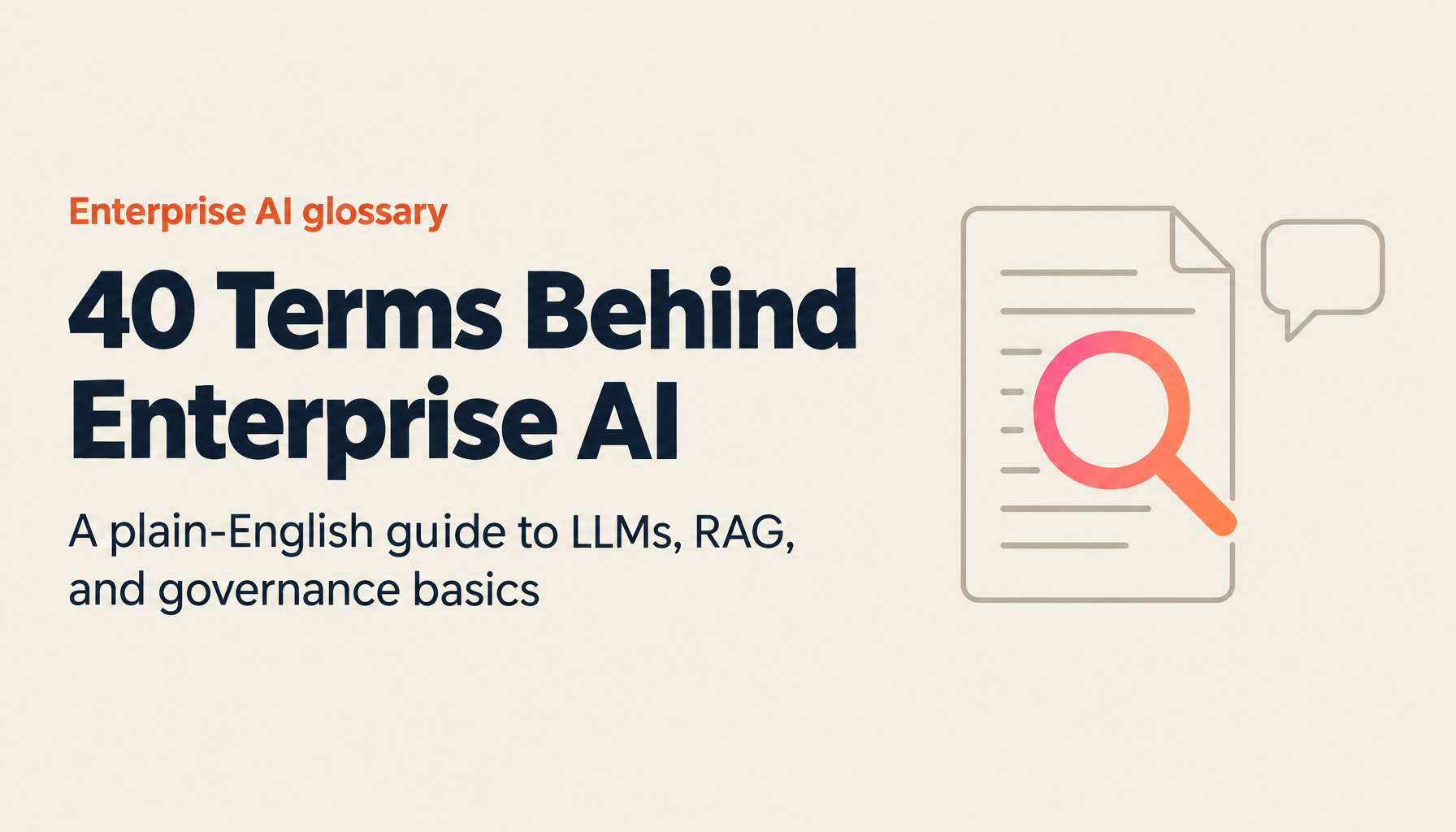
When your organization starts discussing AI adoption, terms like "RAG," "hallucination," and "vector database" start appearing in meetings and vendor conversations — and it can be difficult to follow the substance if the terminology is unfamiliar. This glossary covers 40 essential enterprise AI terms, explained for non-technical professionals who need to participate in these discussions without a computer science background.
Contents
- Foundation Models and Architecture
- Data Processing and Retrieval
- Training and Fine-Tuning
- Operations and Applied Technology
- Security and Governance
- Summary
Looking for AI training and consulting?
Learn about WARP training programs and consulting services in our materials.
Foundation Models and Architecture
AI (Artificial Intelligence) — "Can we automatically sort these emails into sales inquiries and complaints?" The answer to that question is AI. The broad category of technology enabling computers to perform tasks that require human-like judgment — spanning image recognition, language generation, and classification. Automatically routing customer inquiries is a straightforward example of enterprise AI in practice.
LLM (Large Language Model) — An AI model trained on massive text datasets to understand and generate human language. GPT and Claude are LLMs. The distinguishing capability: generating text that reads like it was written by a person, which is why they're used for drafting internal documents, writing summaries, and translating communications.
GPT (Generative Pre-trained Transformer) — OpenAI's LLM series. The name describes the technology: a text-generating (Generative) model trained in advance on large datasets (Pre-trained) using a Transformer architecture. ChatGPT is GPT fine-tuned for conversational interaction.
Claude — Anthropic's LLM, with particular strengths in reading long documents and safety-focused response design. Enterprise adoption has grown steadily. TIMEWELL's enterprise AI product ZEROCK combines Claude with multiple other LLMs to achieve high-accuracy responses.
Gemini — Google DeepMind's multimodal LLM. Capable of understanding not just text but images and video, with integration into Google Workspace.
Transformer — The AI architecture published by Google in 2017 that underlies most current LLMs. The breakthrough was the "attention mechanism" — the ability to understand relationships between words across an entire document simultaneously, enabling far more natural text generation than previous approaches.
Parameters — Think of these as the AI's accumulated learning. A model's parameters are the numerical values acquired during training; more parameters generally allow more complex reasoning. GPT-4 operates at the scale of hundreds of billions. But more parameters doesn't automatically mean smarter — training data quality and architecture also matter significantly.
Multimodal — The ability to process multiple types of information simultaneously: text, images, audio, video. A multimodal AI can accept a product photo with the question "identify the defect in this component" — something text-only models can't do.
Token — The unit of text that AI processes. Not exactly one character — in practice, text is split by words or subword units. Tokens matter practically because API pricing is calculated per token, making this a key concept for cost estimation.
Now the terms that come up in vendor meetings when discussing how AI will actually work with your data.
Data Processing and Retrieval
RAG (Retrieval-Augmented Generation) — Before answering, the AI consults a reference library. When a question comes in, the system searches internal documents or databases for relevant information, then generates an answer grounded in that material. ZEROCK uses RAG to generate accurate answers based on company-specific knowledge.
GraphRAG — An evolution of standard RAG that understands not just documents but the relationships between them — a graph structure of connections. This enables queries that require following relationship chains: "Who is the lead on Project B, and what departments are involved?" where the answer requires linking person → project → department across multiple sources.
Embedding — Converting words and documents into coordinate positions that capture meaning. "Sales report" and "revenue summary" end up at nearby coordinates, so the AI can recognize them as semantically similar even when the exact words don't match. The foundation of semantic search.
Vector Database — The storage layer that powers semantic RAG. Where traditional databases search by keyword matching, vector databases search by semantic proximity — finding what's conceptually related rather than just what shares the same words. Searching for "employee turnover" can surface documents about "retention strategy."
Chunk — A segment created by splitting long documents into pieces sized for AI processing. A 100-page internal manual might be divided by paragraph or heading. How you chunk affects retrieval quality significantly — this is a more consequential operational decision than it appears.
Reranking — After RAG retrieves a set of candidate documents, a second AI model re-scores them to prioritize the ones most relevant to the specific query. Improves answer quality by filtering retrieved content more precisely before it's passed to the response generation step.
Indexing — The preprocessing step that organizes documents for AI-searchable retrieval. Automatically building an index of the knowledge base. Poor indexing means important information won't be found regardless of how good the RAG system is.
Semantic Search — Retrieving results based on meaning rather than exact keyword match. Search for "why did sales decline" and surface documents discussing "contributing factors to revenue performance" — matching intent, not just words.
Context Window — The maximum amount of text an LLM can process in a single interaction. Think of it as the maximum number of pages you can have open simultaneously. Larger context windows allow longer documents to be processed at once; as of 2026, models with 1 million+ token context windows are available.
With data handling covered, here's how the models themselves are trained and customized.
Training and Fine-Tuning
Training — The process of having an AI model learn from data — reading large volumes of text to internalize patterns. Training establishes the model's foundational capabilities.
Inference — The process of a trained model generating a response to new input. If training is studying, inference is the test. For enterprise deployments, inference is where the ongoing operational cost occurs.
Fine-Tuning — Retraining an existing model on domain-specific data to incorporate specialized knowledge — industry terminology, company-specific formats, particular response styles. Effective, but requires significant data preparation and cost. For most enterprise deployments, testing whether RAG achieves sufficient accuracy first is the practical sequence.
A note from experience: the question "should we RAG or fine-tune?" comes up frequently. The clearest distinction: RAG when you want the AI to reference existing internal documents to answer accurately; fine-tuning when you want to fundamentally change the AI's response tone, vocabulary, or domain expertise. Most organizations can get substantial value from RAG before fine-tuning becomes necessary.
LoRA (Low-Rank Adaptation) — A fine-tuning method that adjusts a targeted subset of model parameters rather than rewriting the entire model. Substantially lower computational cost than full fine-tuning, making it more practical for enterprise use.
RLHF (Reinforcement Learning from Human Feedback) — A training method that improves model outputs based on human evaluations. Human raters score AI responses, and the model is updated to produce more of what humans rated positively. This is how ChatGPT and Claude learned to produce natural, safe responses.
Transfer Learning — Applying knowledge learned in one domain to a different domain. A model trained extensively on English can apply that linguistic knowledge to Japanese tasks, achieving good results with less data than training from scratch.
Knowledge Distillation — Transferring the knowledge of a large, high-performance model (teacher) into a smaller, more efficient model (student). The smaller model can then run on devices and infrastructure where the original large model wouldn't fit — edge devices, mobile applications.
Now the applied side — how to use AI effectively in practice.
Operations and Applied Technology
Prompt — The instruction text given to an AI. Simple concept, but the way it's written dramatically affects output quality. "Summarize this" produces a generic summary; "Summarize in under 300 words, leading with the conclusion" produces something closer to what you actually want.
Prompt Engineering — The practice of crafting prompts to reliably extract the desired output from an AI. Techniques include assigning a role ("act as an experienced financial analyst"), specifying output format, and providing examples. ZEROCK's Prompt Library feature lets teams share and manage effective prompts across the organization.
Hallucination — When an AI confidently generates information that is factually incorrect. Citing a non-existent regulation, fabricating statistics, inventing company details. In enterprise contexts — contract review, compliance, financial reporting — this can have serious consequences. RAG reduces hallucination by grounding responses in real documents, but doesn't eliminate it entirely: outdated source documents or poor chunking can still produce errors.
AI Agent — An AI that doesn't just answer questions but plans, uses tools, and executes multi-step tasks autonomously. "Research next month's travel schedule, compile hotel options, and draft booking emails" — an agent works through this sequence independently rather than answering each step when asked.
Agentic RAG — Combining AI agents with RAG. Rather than a single retrieval-and-respond cycle, the system can decide when the initial retrieval is insufficient, conduct additional searches, consult different sources, and iterate toward a better answer. As of 2026, Microsoft and Google have both released enterprise services in this category, making it the emerging frontier for enterprise AI.
One common misconception worth addressing: "RAG eliminates hallucination." It reduces it, but not to zero. If the source documents are outdated, or chunked so that context is cut off mid-sentence, errors still occur. The design question is how to get as close to zero as possible — which is where GraphRAG and reranking become relevant.
Chain of Thought (CoT) — A technique that instructs the AI to reason step by step before answering. "First, list the relevant conditions. Then compare them. Then reach a conclusion." For complex problems, this structured reasoning produces more accurate answers than asking for an immediate response.
Few-Shot Learning — Including examples in the prompt to show the AI the desired pattern. "Q: apple → A: fruit | Q: Toyota → A: automaker" — showing two or three examples before the actual question helps the AI respond in the same format for new inputs.
Zero-Shot Learning — Asking the AI to perform a task with no examples provided. Well-trained LLMs can often handle novel tasks correctly from description alone.
API (Application Programming Interface) — The connection layer between AI models and business systems. Almost all enterprise AI integrations work through APIs. Usage-based pricing is typically calculated per API call, based on token consumption.
On-Premises — Running systems on servers located within the organization's own facilities. Data doesn't leave the building, providing higher confidentiality — but with higher implementation and operational costs than cloud deployment.
Finally, security and governance — the topic that comes up in every enterprise AI conversation.
Security and Governance
Data Governance — The rules and structures defining who can access organizational data, how it can be used, and what AI is permitted to read. Before giving an AI access to internal documents, the question "is this data appropriate for AI to process?" needs to have a clear answer.
PII (Personally Identifiable Information) — Data that can identify a specific individual: names, addresses, phone numbers. When loading internal documents into an AI system, checking whether they contain PII is a necessary step before deployment.
Prompt Injection — An attack that embeds malicious instructions within the prompt to manipulate AI behavior. A concern primarily for customer-facing AI applications where external users can input text that reaches the AI.
Guardrails — Rules and restrictions that prevent the AI from producing inappropriate outputs. Prohibited topic lists, response refusal for certain categories of requests, output filtering. Essential for enterprise AI to maintain reliability and safety.
Model Card — Documentation describing an AI model's performance, intended uses, and known limitations. Enables organizations to select the right model for the right task with transparent information about what the model can and can't do.
Summary
Enterprise AI terminology is expanding, but everything doesn't need to be mastered at once. Start with the terms relevant to your specific role and expand from there.
Key takeaways:
- LLMs are the foundation of text-generating AI; GPT and Claude are the most common enterprise examples
- RAG is the mechanism for accurate responses grounded in internal data — nearly mandatory for enterprise AI
- GraphRAG extends RAG to understand relationships between information, not just documents in isolation
- Hallucination requires active countermeasures: RAG, guardrails, and human review
- RAG before fine-tuning is the practical sequence for most organizations
TIMEWELL's enterprise AI product ZEROCK is built on the technologies covered in this glossary — GraphRAG, prompt libraries, multi-LLM orchestration. If you want to see how these concepts apply to a specific business challenge, contact us.