Hello, this is Hamamoto from TIMEWELL.
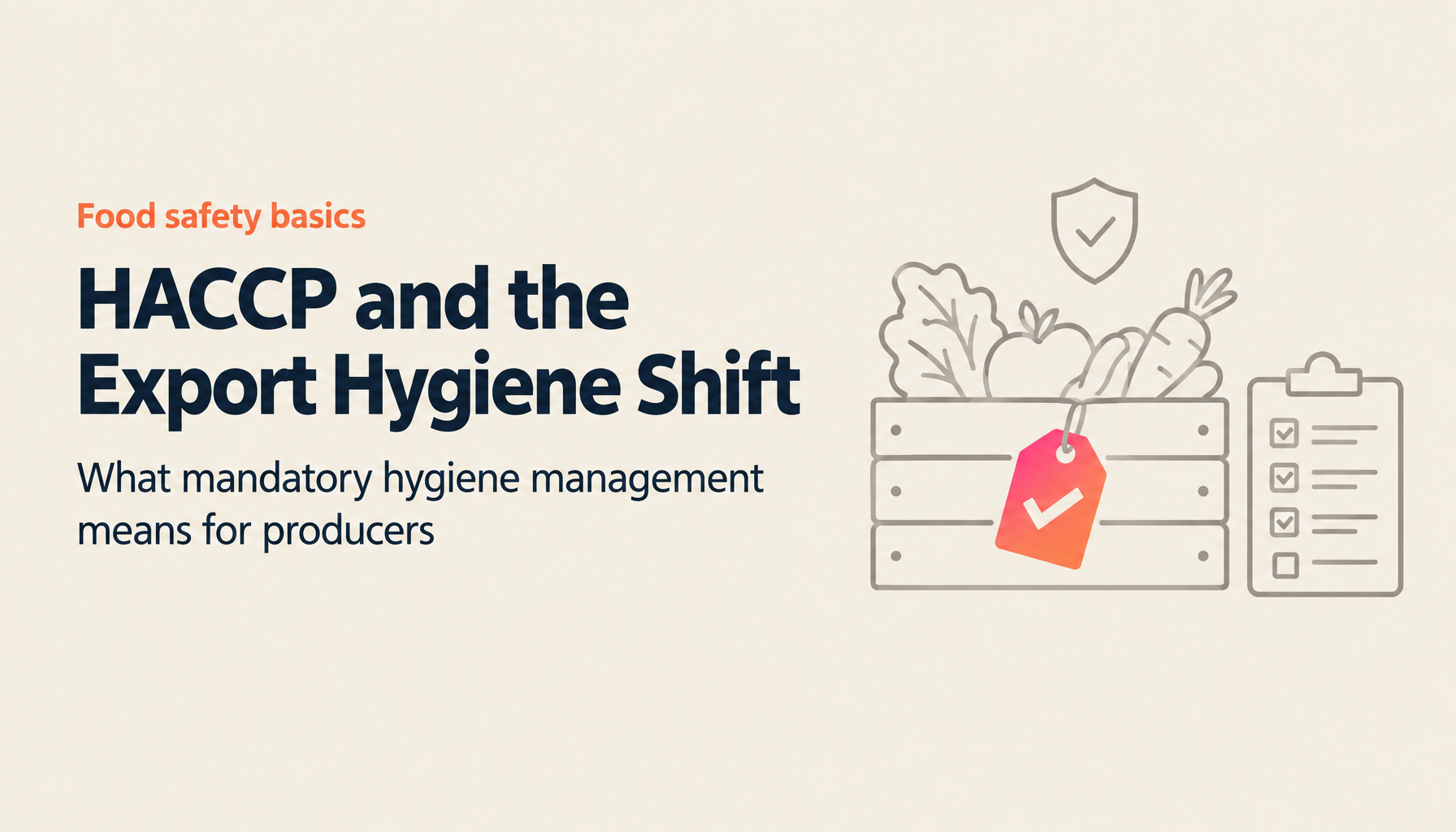
When I talk with producers and food manufacturers who want to sell their products overseas, one question comes up almost without fail: "When it comes to HACCP, what exactly do we have to do, and how far do we have to take it?" Plenty of people have heard the name but are vague on whether it is a certification or an obligation, and on what it has to do with exporting, so anxiety gets ahead of understanding. That happens far more often than you might think.
So in this article, I want to walk beginners through it gently and in order, starting from the basics of what HACCP is, moving on to when it became mandatory in Japan, and then explaining the kinds of requirements that get layered on top of the domestic obligation when you export food. At the end, I will touch on one important distinction that often gets confused on the ground: HACCP for food safety and export control under the Foreign Exchange and Foreign Trade Act look similar but are in fact entirely separate systems.
Personally, I find that whether you see HACCP as "annoying extra work for the sake of exporting" or as "a tool for proving your own quality against a global standard" makes a world of difference to how things go afterward. The businesses that manage to face it as the latter are the ones that steadily build trust with their overseas trading partners.
HACCP is a way of protecting food safety through the process
HACCP is an acronym for Hazard Analysis and Critical Control Point. Japan's Ministry of Health, Labour and Welfare describes it as a hygiene-management method in which food businesses themselves identify hazards such as contamination by foodborne pathogens or the inclusion of foreign objects, and then control the steps that are particularly important for removing or reducing those hazards across the entire process, from receiving raw materials to shipping the product, thereby ensuring product safety1.
A hazard here means a factor that could cause harm to the health of the person who eats the food. It includes foodborne pathogens such as Salmonella, chemical substances such as residual pesticides, and foreign objects such as metal fragments that get into the production line. A critical control point, often abbreviated as CCP, is a step that is especially important and needs to be continuously watched in order to reliably remove a hazard or hold it down to a safe level. For heat sterilization, for instance, the picture is one of measuring and recording every single time whether the product has been heated thoroughly at the prescribed temperature and for the prescribed time.
The traditional approach centered on a "check at the end" mindset, sampling finished products and inspecting them. HACCP flips that around and stands on a "prevent along the way" mindset, identifying in advance the steps where danger is likely to arise and monitoring them continuously on the spot. To use a cooking analogy, it is closer to nipping the risky buds in the bud at the stage of adjusting the heat and doing the prep, rather than tasting the dish after it has been plated. This method was set out by the Codex Alimentarius Commission, the international body for food standards jointly established by the FAO (Food and Agriculture Organization of the United Nations) and the WHO (World Health Organization), and the Ministry of Health, Labour and Welfare explicitly notes that it is an internationally recognized standard1. The pillars of running it boil down to four simple points: drawing up a hygiene-management plan and making sure the people on the floor know it, putting the necessary procedure documents in order, recording and retaining what was actually done, and verifying and reviewing it on a regular basis1.
In Japan, it became fully mandatory for "all businesses in principle" in June 2021
HACCP was originally something that a portion of large-scale businesses adopted voluntarily, but an amendment to the Food Sanitation Act turned it into a system that extends to all businesses. It is quicker to understand if you trace the timeline, so let me lay it out first.
| Point in time | What happened |
|---|---|
| June 13, 2018 | The amended Food Sanitation Act was promulgated, establishing hygiene management in line with HACCP as a system2 |
| June 1, 2020 | The HACCP portion of the amended act came into force (with a one-year transition period)3 |
| June 1, 2021 | The transition period ended, and it became fully mandatory in principle for all food businesses13 |
The Ministry of Health, Labour and Welfare states that "from June 1, 2021, all food businesses are, in principle, required to undertake hygiene management in line with HACCP"1. In other words, this is not just a matter for large corporations. It broadly covers food businesses, right down to the town food-processing plant and the small manufacturer. Note that the amended Food Sanitation Act had several provisions come into force in stages, and different explanations show some variation in how they state the effective dates. In this article, I am adopting the framing that promulgation was on June 13, 2018, the HACCP system came into force on June 1, 2020, and full mandatory application took effect on June 1, 2021.
One thing that tends to trip up beginners is that "mandatory" does not mean everyone is asked to do work of the same weight. The system is split into two tracks depending on the scale of the business. One is "hygiene management based on HACCP," in which the business itself draws up and manages a plan following the seven Codex principles. This applies to slaughterhouses, poultry-processing facilities, and large-scale businesses with 50 or more employees engaged in food manufacturing and processing43. The other is "hygiene management incorporating the HACCP approach," which targets small-scale operators and others for whom rigorous implementation is difficult. For them, a simplified approach is available: they can work in line with guidance documents prepared by industry associations and reviewed by the Ministry of Health, Labour and Welfare14. Note that some operations in agriculture and fisheries at the stage of harvesting raw materials, as well as certain small-scale operations, fall outside the scope1. The labels "Standard A" and "Standard B" were the informal terms used while the system was being deliberated; remembering that the official names are now the two described above will save you from confusion.
Replace siloed classification work with AI.
METI's FY2024 data shows 52% of foreign exchange law violations stem from classification errors. Download the TRAFEED product catalog covering features and rollout.
If you export food, requirements get layered on top of the domestic obligation
This is where things get to the heart of the matter for businesses thinking about exporting. Clearing the domestic HACCP obligation does not, by itself, mean you can sell overseas. When you export, you also have to meet the destination country's requirements for facility approval, health certificates, traceability, and the like, layered on top of the domestic obligation. The basis for the procedures on the Japanese side is the Act on Promoting the Export of Agricultural, Forestry and Fishery Products and Food, promulgated on November 27, 2019, and in force from April 1, 20205. This law placed an export headquarters within the Ministry of Agriculture, Forestry and Fisheries and organized and unified the procedures for issuing export certificates and approving facilities5.
Exactly what gets layered on top varies greatly depending on the destination. For example, to ship animal-origin food such as livestock or fishery products to the EU, you have to satisfy a two-tiered condition: at the national level, the relevant animal species must have its residue and other management plans approved so that the country appears on the "third-country list," and the processing must take place at a facility approved for export to the EU. Approval is granted by a national authority, and the list of approved facilities is published on the Ministry of Agriculture, Forestry and Fisheries website. The ministry has published application guidelines for approval of fishery-product handling facilities bound for the EU, and businesses considering an application will want to check there first6. Note that the number of approved facilities on the Japanese side differs by product, and some media reports and analytical reports point out that facilities for meat and dairy are more limited than those related to fishery products. Because the existence and number of facilities change over time, always confirm the latest situation against the lists of approved facilities maintained by the Ministry of Agriculture, Forestry and Fisheries and the Ministry of Health, Labour and Welfare.
Food bound for the United States runs on yet another set of rules. Japanese processors have to comply with U.S. regulations, and under FSMA (the Food Safety Modernization Act), facilities that manufacture, process, pack, or store food for humans or animals destined for the United States are required to register with the FDA (U.S. Food and Drug Administration)7. Furthermore, Section 204 of FSMA requires keeping detailed records of when something moved, from whom, and to where, for products on the Food Traceability List. The scope includes cheeses, shell eggs, certain fruits and vegetables, fish and crustaceans, and bivalve mollusks, and it applies to those who export these from Japan to the United States and handle them89. The compliance date for this rule was originally set at January 20, 2026, but the FDA proposed a delay, and it has been pushed back to July 20, 2028810. Even with the grace period, it is a point that calls for early preparation for businesses shipping covered products to the United States.
In concrete terms for your own operation, on top of HACCP compliance you end up running several tasks in parallel: checking the requirements for each destination, obtaining the necessary facility approvals and certificates, and putting a recordkeeping system in place. Because exporting, once you start, also means keeping up with regulatory amendments, how you systematize this kind of practical work is something I also touch on concretely in a separate article, Corporate Export Control in Practice. Reading the two together should make the burden of producing documents and managing records easier to picture.
Why hygiene management has become this strict
Some of you may feel that "they never used to ask for this much before." There are a few big currents behind it.
One is the spread of international standardization around food safety and the concept of "equivalence" that importing countries demand. Equivalence is the idea that the importing country recognizes that "this exporting country's hygiene management secures roughly the same level of safety as our own." The EU's third-country list and facility approvals, and the United States' facility registration, are all mechanisms for confirming this equivalence. From the importing side's point of view, in order to protect its own consumers, it wants to verify that overseas production and processing sites are managed at the same level as its own standards. That is precisely why methods like HACCP, which can be demonstrated through documents and records, have become a prerequisite76.
Another is the strengthening of traceability to prevent food incidents and fraud. The FDA explains that the aim of the aforementioned Section 204 of FSMA is to quickly identify and recall contaminated food and to reduce foodborne illness9. If you keep records that let you trace who handled what and when, you can keep the damage to a minimum when a problem arises. It is precisely because food supply chains have become long and complex worldwide that countries have come to require records to be put in order.
And one thing that should not be overlooked is the export-expansion target that Japan itself has set. The government has set targets for the export value of agricultural, forestry, and fishery products and food of 2 trillion yen in 2025 and 5 trillion yen in 2030. The 5-trillion-yen target was maintained in the Export Expansion Implementation Strategy revised on May 30, 202511. Looking at the actual results, the 2025 export value announced by the Ministry of Agriculture, Forestry and Fisheries on February 3, 2026, was 1.7005 trillion yen, up 12.8% year on year, setting a record high for the 13th consecutive year12. It is growing steadily, yet it has not reached the 2-trillion-yen target, and media reports point out that exports are skewed toward a handful of top countries and regions, and that picking up the pace will be essential to reach 5 trillion yen. This skew and the views of officials are media-based information, and the finer details of the figures should be confirmed against primary sources, but it is worth keeping in mind that the country is serious about growing exports, which is exactly why it is putting effort into developing the hygiene management that sits at the entrance to it.
What producers and small and midsize businesses should do before they export
So where do you start, concretely? To keep beginners from getting lost, let me lay it out in rough order.
The first thing to do is to draw up and operate a domestic hygiene-management plan in line with HACCP. If you are a small-scale business, a simplified approach based on an industry association's guidance document is fine14. Next, put procedure documents in order in line with that plan, record what was actually done, and verify and review it on a regular basis. This is how you get the habit of recordkeeping and verification turning. Everything up to this point is the foundation required of you as a domestic business, regardless of whether you export1.
On that basis, if you have exporting in view, check how the requirements differ by destination country and product. Is facility approval required? Is a health certificate required? How far do the traceability records need to go? The contact points for these are unified on the Ministry of Agriculture, Forestry and Fisheries export-related website and at the export headquarters58. Based on what you find, for the EU, after looking at the third-country-list situation, you would pursue approval of an EU-bound facility; for the United States, you would proceed with FDA facility registration and compliance with FSMA Section 204 (with a compliance date of July 20, 2028)106. Because the application contact varies by product and facility type, splitting across prefectures, the Ministry of Agriculture, Forestry and Fisheries, regional bureaus of health and welfare, and others, it reduces rework to figure out early on which one your case falls under. Finally, if you obtain an export certificate issued by a prefectural governor or other authority under the Export Promotion Act, your documentary preparation is in order5.
For those interested not in the agricultural products themselves but in protecting intellectual property such as varieties and cultivation techniques, or in managing the overseas outflow of seeds and seedlings, reading Agricultural IP and Trade Control alongside this will give you a more three-dimensional view of the overall picture of export-related regulation. Food exporting is an area where several layers overlap: hygiene, intellectual property, and the export control I touch on in the next section.
Let me also touch briefly here on our own TRAFEED. TRAFEED is an AI agent that supports the export-control side under the Foreign Exchange and Foreign Trade Act, which I explain shortly; it is not a tool that handles food-safety HACCP itself on your behalf. That said, once you start exporting, hygiene, export control, and intellectual property all start running at the same time, so sorting out "which regulation applies where" and arranging things so that the heavy parts of export control can be entrusted to a machine makes it easier to keep things running even with limited staff. Understanding the difference between the layers and then preparing in a way suited to each is the shortcut.
Most important: HACCP (food safety) and the Foreign Exchange Act (export control) are different things
Finally, let me make crystal clear the point that gets confused most often in the field. When you export food, you hear the term "export control" more often, but the food-safety HACCP we have been discussing and the security export control under the Foreign Exchange and Foreign Trade Act are entirely separate systems. Because the same word "export" comes up, they tend to get lumped together, but the purpose, the governing law, the overseeing authority, and the assessment method all differ.
| Aspect | HACCP / food safety | Foreign Exchange Act security export control |
|---|---|---|
| Purpose | Ensuring food safety (preventing foodborne illness, foreign objects, and fraud) | Maintaining international peace and security (preventing the proliferation of weapons of mass destruction and the like)1314 |
| Governing law | Food Sanitation Act / Act on Promoting the Export of Agricultural, Forestry and Fishery Products and Food | Foreign Exchange and Foreign Trade Act (the Foreign Exchange Act)13 |
| Overseeing authority | Ministry of Health, Labour and Welfare / Ministry of Agriculture, Forestry and Fisheries | Ministry of Economy, Trade and Industry1314 |
| Scope of regulation | Food hygiene and safety (all food businesses) | Goods and technologies that could be diverted to weapons13 |
| Action being assessed | Hygiene-management plans, facility approvals, health certification | Applicability assessment (confirming whether something falls under regulation)13 |
Security export control under the Foreign Exchange Act is a regulation designed to keep goods and technologies that could be diverted to weapons of mass destruction or conventional weapons from reaching dangerous parties. The work of confirming whether the item you intend to export falls under regulation is called the "applicability assessment," and it is overseen by the Ministry of Economy, Trade and Industry1314. While semiconductors, machine tools, and certain technical information are the kinds of things likely to fall within scope, as a rule ordinary food is not an item subject to list controls. So the idea that obtaining HACCP certification will also clear the Foreign Exchange Act does not hold. The two share the word "export" but should be thought of as independent, separate procedures.
Let me add just one caveat: the Foreign Exchange Act has a mechanism called catch-all controls, under which even items not on the list may require a license application if you become aware of a concern that they could be diverted to weapons of mass destruction and the like. In theory, any item can fall within scope, but cases where ordinary food actually becomes subject to a license over such diversion concerns are extremely exceptional in practice. In situations where the judgment varies by specific item and destination, the surest course is to check with specialist contact points such as the Ministry of Economy, Trade and Industry or CISTEC (the Center for Information on Security Trade Control)1314. With food exports, if you sort it out so that the hygiene side is HACCP plus the importing country's requirements, the security side is the Foreign Exchange Act, and the intellectual property side is a separate system, with a different regulation handling each layer, you will not get lost.
If you are unsure whether your food could get caught on something on the export-control side, or how to run an applicability assessment, please feel free to reach out via individual consultation. For food-safety HACCP, your local public health center and the Ministry of Agriculture, Forestry and Fisheries contact points are your reliable resources; for export control under the Foreign Exchange Act, we can sort out together where you should pay attention, drawing on TRAFEED's expertise. Precisely because exporting brings multiple regulations to bear at once, drawing the overall picture at the outset turns out to be the biggest shortcut.
If you are reviewing export-control operations or classification workflows, download the TRAFEED product catalog (PDF) or contact us.
References
Footnotes
-
HACCP — Ministry of Health, Labour and Welfare — accessed 2026-06-29 — https://www.mhlw.go.jp/stf/seisakunitsuite/bunya/kenkou_iryou/shokuhin/haccp/index.html ↩ ↩2 ↩3 ↩4 ↩5 ↩6 ↩7 ↩8 ↩9
-
On the Amendment of the Food Sanitation Act (promulgated 2018-06-13) — Ministry of Health, Labour and Welfare — accessed 2026-06-29 — https://www.mhlw.go.jp/stf/seisakunitsuite/bunya/0000197196.html ↩
-
Establishing Hygiene Management in Line with HACCP as a System — Tokyo Metropolitan Government Bureau of Public Health "Window on Food Sanitation" — accessed 2026-06-29 — https://www.hokeniryo1.metro.tokyo.lg.jp/shokuhin/kaisei/haccp.html ↩ ↩2 ↩3
-
Hygiene Management Incorporating the HACCP Approach — Ministry of Health, Labour and Welfare — accessed 2026-06-29 — https://www.mhlw.go.jp/stf/seisakunitsuite/bunya/kenkou_iryou/shokuhin/haccp/01_00019.html ↩ ↩2 ↩3
-
Act on Promoting the Export of Agricultural, Forestry and Fishery Products and Food (Act No. 57 of 2019, in force from April 1, 2020) — Ministry of Agriculture, Forestry and Fisheries — accessed 2026-06-29 — https://www.maff.go.jp/j/shokusan/export/houritsu.html ↩ ↩2 ↩3 ↩4
-
Export of Agricultural, Forestry and Fishery Products and Food (destination-country regulations, facility approval, etc.) — Ministry of Agriculture, Forestry and Fisheries — accessed 2026-06-29 — https://www.maff.go.jp/j/shokusan/export/ ↩ ↩2 ↩3
-
Exported Food — Ministry of Health, Labour and Welfare — accessed 2026-06-29 — https://www.mhlw.go.jp/stf/seisakunitsuite/bunya/kenkou_iryou/shokuhin/yusyutu/index.html ↩ ↩2
-
On the U.S. Government's Food Traceability Rule — Ministry of Agriculture, Forestry and Fisheries — accessed 2026-06-29 — https://www.maff.go.jp/j/shokusan/export/fsma_traceability.html ↩ ↩2 ↩3
-
FSMA Final Rule on Requirements for Additional Traceability Records for Certain Foods — U.S. FDA — accessed 2026-06-29 — https://www.fda.gov/food/food-safety-modernization-act-fsma/fsma-final-rule-requirements-additional-traceability-records-certain-foods ↩ ↩2
-
Requirements for Additional Traceability Records for Certain Foods: Compliance Date Extension (compliance date moved to 2028-07-20) — U.S. Federal Register — 2025-08-07 — https://www.federalregister.gov/documents/2025/08/07/2025-14967/requirements-for-additional-traceability-records-for-certain-foods-compliance-date-extension ↩ ↩2
-
Export Expansion Implementation Strategy for Agricultural, Forestry and Fishery Products and Food (revised May 30, 2025) — Ministry of Agriculture, Forestry and Fisheries — 2025-05-30 — https://www.kantei.go.jp/jp/singi/nousui/yunyuukoku_kisei_kaigi/202505_jikkousenryaku.pdf ↩
-
"On the 2025 Export Results for Agricultural, Forestry and Fishery Products and Food" — Ministry of Agriculture, Forestry and Fisheries — 2026-02-03 — https://www.maff.go.jp/j/press/yusyutu_kokusai/kikaku/260203.html ↩
-
How to Confirm Applicability to Regulated Items and Requirements in Security Export Control — JETRO Trade and Investment Q&A — accessed 2026-06-29 — https://www.jetro.go.jp/world/qa/04A-001028.html ↩ ↩2 ↩3 ↩4 ↩5 ↩6 ↩7
-
Guidance on Security Export Control [Introductory Edition] — Ministry of Economy, Trade and Industry — accessed 2026-06-29 — https://www.meti.go.jp/policy/anpo/guidance/guidance.pdf ↩ ↩2 ↩3 ↩4