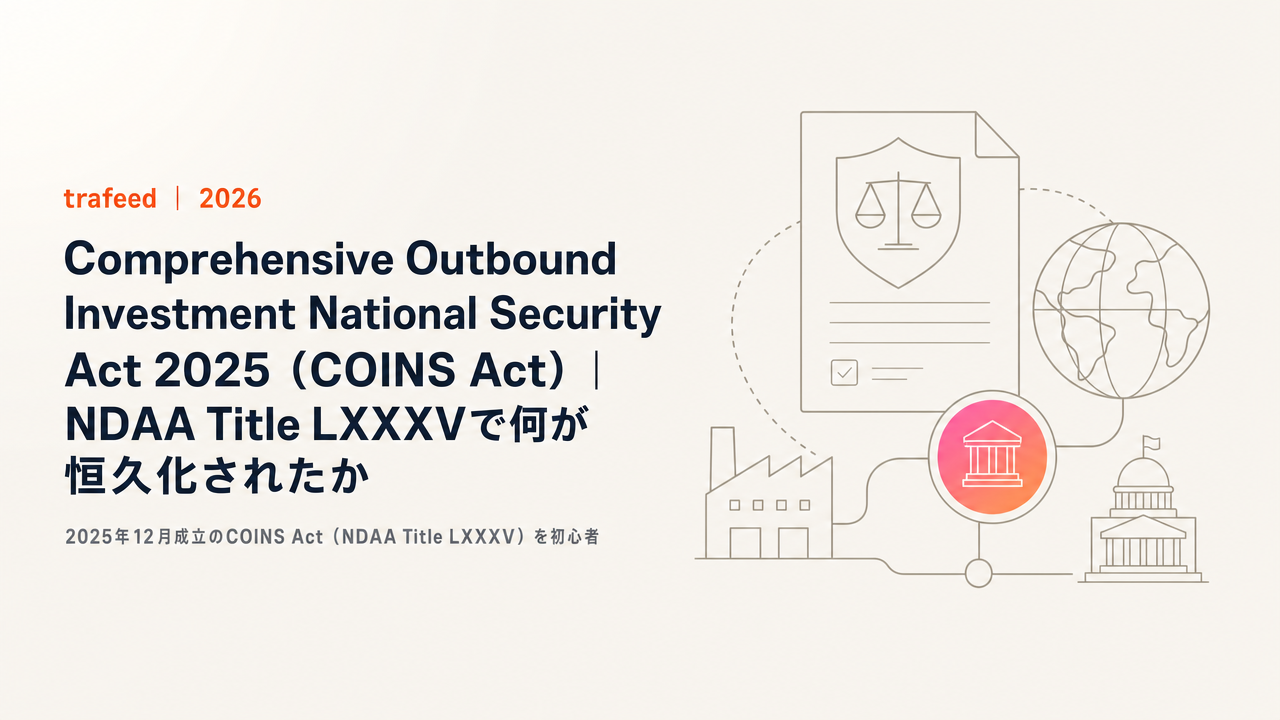
Hello, this is Ryuta Hamamoto from TIMEWELL.
If you searched for “COINS Act U.S. outbound investment,” you probably have questions like these:
- How is this different from the outbound investment rule already running since 2025?
- Why turn an executive-order regime into a statute now?
- Does it affect our company or our U.S. subsidiaries?
Bottom line: COINS Act is not an entirely new system. It locks in and slightly expands the outbound investment rule that has been live since January 2025. The “statutory upgrade” matters because it makes the regime harder to unwind after a change of administration. That is the part I want Japanese CFOs to hear first.
I start with terminology, then what changed, then the five channels that can pull Japanese companies into scope.
What you will learn
- COINS Act’s formal name and its place as NDAA Title LXXXV
- What “upgrade from EO to statute” really means
- Nine concrete changes from the prior 31 CFR Part 850 rule
- HPC and hypersonics added; covered countries expanded to six
- Five impact paths for Japanese companies (U.S. subsidiaries, JVs, fund LPs, etc.)
- Penalties (civil $377,700 or 2× transaction value)
- What to do in the preparation window through about March 2027
Three terms first (NDAA / COINS Act / IEEPA)
NDAA (National Defense Authorization Act)
The annual U.S. defense authorization bill. It does more than set budgets; national-security policy packages often ride inside it. The FY2026 NDAA was signed by President Trump on 18 December 2025.
COINS Act
Comprehensive Outbound Investment National Security Act of 2025, Title LXXXV of the FY2026 NDAA. It began as standalone Senate and House bills (S.3555 / H.R.10559) and was enacted as part of the NDAA.
IEEPA (International Emergency Economic Powers Act)
The statute that often supplies sanctions and export-control penalty frameworks. COINS Act sits on that track; the $377,700 civil figure is an IEEPA-based amount (inflation-adjusted).
From executive order to statute
Old regime (through December 2025)
| Item | Content |
|---|---|
| Legal basis | Executive Order 14105 (August 2023, Biden Administration) |
| Rule | 31 CFR Part 850 (final rule Oct 2024; effective Jan 2025) |
| After a change of administration | A new president could revoke the EO |
| Congressional commitment | Relatively weak |
New regime (COINS Act / from December 2025)
| Item | Content |
|---|---|
| Legal basis | Statute (COINS Act = NDAA Title LXXXV) |
| Rule | Same 31 CFR Part 850 to be revised (by ~March 2027) |
| After a change of administration | Hard to erase by EO alone |
| Congressional commitment | Strong (bipartisan support) |
COINS Act’s essence is codify + strengthen what already existed. A Biden-era program was taken up by a Trump Administration and Congress. Bipartisan support makes a near-term large rollback unlikely.
CFIUS reviews foreign investment into the United States. COINS Act addresses capital leaving the United States. Industry slang is “Reverse CFIUS.” Useful shorthand. Not a legal term.
Replace siloed classification work with AI.
METI's FY2024 data shows 52% of foreign exchange law violations stem from classification errors. Download the TRAFEED product catalog covering features and rollout.
Nine changes from the prior rule
1. Expanded covered technologies (highest operational impact)
| Technology area | Prior rule | COINS Act |
|---|---|---|
| Semiconductors / microelectronics | Covered | Covered (continues) |
| AI systems | Covered | Covered (continues) |
| Quantum information technology | Covered | Covered (continues) |
| High-performance computing (HPC) / supercomputing | — | Newly added |
| Hypersonic systems | — | Newly added |
| Future additions | None | Treasury may add technologies that enhance military, surveillance, or cyber capabilities |
The two-tier prohibited / notifiable structure remains. Technical parameters (e.g., process nodes) will be re-defined in implementing regulations.
2. Expanded covered countries
Prior rule: PRC mainland, Hong Kong, Macau only. COINS Act adds Cuba, Iran, North Korea, Russia, and Venezuela (Maduro government). Six in total.
The five additions are already subject to near-comprehensive OFAC sanctions, so many practitioners treat the expansion as largely symbolic. Day-to-day investment judgments still focus on China-related activity.
3. Expanded covered transactions
Beyond equity, Covered National Security Transactions can include:
- Direct/indirect equity acquisitions
- Contingent equity (including SAFEs and convertibles)
- Certain debt/loan financing
- Greenfield / brownfield investments
- Joint ventures
- Certain limited partner (LP) investments
- Certain property leases
“Not becoming a shareholder” is no longer a complete escape hatch.
4. Broader “Covered Foreign Person”
In addition to persons located, organized, or majority-owned in a country of concern, COINS Act adds persons under the direction or control of the political leadership of a country of concern, with explicit illustration involving members of the Chinese Communist Party Central Committee. Definitions will be refined by rulemaking.
5. Broader “knowingly directing”
Prior rule: U.S. persons knowingly directing non-U.S. persons into prohibited transactions. COINS Act also reaches knowing direction of notifiable transactions. Passive LP investments into non-U.S. funds retain limited carve-outs.
6. Clearer penalties
| Type | Content |
|---|---|
| Civil | $377,700 or 2× transaction value, whichever greater (IEEPA basis; inflation-adjusted) |
| Criminal | IEEPA criminal penalties (up to $1M and/or 20 years) |
| Administrative | Treasury forced divestment orders |
| Mitigation | Self-disclosure mitigation now statutory |
Note the uncapped “2× value” structure. A multi-billion-yen investment implies multi-billion-yen theoretical exposure. That math usually ends the “we’ll just pay if something goes wrong” conversation.
7. Notification duty
U.S. persons must notify Treasury within 30 days after completing a notifiable transaction. The frame matches the prior rule; broader coverage means more operational load. Congress directed Treasury to write a “low-burden” rule.
8. Declaratory ruling / pre-clearance feedback
A prior weakness was the lack of a way to ask Treasury whether a deal was covered. COINS Act adds non-binding pre-transaction feedback (confidential or published in anonymized form). Treasury may limit frivolous inquiries. That should reduce pure “better not invest at all” chilling effects. I still want to see how the queue works in practice.
9. LP exceptions recalibrated
Prior rule: LP investments into non-U.S. funds of $2 million or less could be excepted. COINS Act resets this as a de minimis standard defined by Treasury rule, and clarifies that mere proposal rights alone do not destroy passive status.
Technologies and countries, restated
Technologies: 3 pillars → 5
Semiconductors, AI, and quantum remain. HPC/supercomputing and hypersonic systems (Mach 5+) are added. HPC matters for generative AI training infrastructure and simulation, including manufacturers who never thought of themselves as “AI companies.”
Countries: 1 → 6
China (mainland/HK/Macau) plus Cuba, Iran, North Korea, Russia, and Maduro Venezuela. Practically, investment decisions still turn most often on China-related facts.
Five impact paths for Japanese companies
COINS Act obligations primarily hit U.S. persons. Japanese parents still face indirect exposure:
| Path | Content |
|---|---|
| ① U.S. subsidiary | A U.S. incorporated subsidiary is a U.S. person. Investments into covered China AI/semiconductor/HPC/hypersonics activity are in scope. |
| ② Controlled Foreign Entity (CFE) | U.S. persons must take care that controlled foreign subsidiaries do not engage in covered transactions. Nested SEA subsidiaries under a U.S. holdco matter. |
| ③ Knowingly directing | U.S. persons directing non-U.S. persons into covered deals can violate. U.S. parent directing a Japanese affiliate into China investments is a classic risk pattern. |
| ④ JV counterparties | U.S.–Japan JVs investing into China semiconductors raise Covered Foreign Person and U.S. person compliance questions. |
| ⑤ Fund LPs | Japanese pensions and endowments as LPs in U.S. VCs can face indirect portfolio constraints as GPs comply with COINS Act. |
Paths ① and ⑤ hit many groups. “No U.S. subsidiary” is incomplete if you are an LP in U.S. venture funds. I have watched that surprise land more than once.
As of May 2026 Japan has no direct COINS Act mirror statute. The Act does, however, assign Treasury a duty to consult G7 partners, including Japan, on outbound investment control alignment. Similar Japanese frameworks may be debated in coming years.
Penalty detail
Civil
$377,700 (about ¥57 million) or 2× transaction value, whichever greater; inflation-adjusted. A ¥1 billion investment can imply a ¥2 billion theoretical fine; ¥3 billion implies ¥6 billion. Designed so “pay the fine and keep the deal” is unattractive.
Criminal
Willful violations: up to $1 million and/or 20 years. Individuals can be charged.
Administrative
Treasury may order divestment: unwind the deal, not just pay a fine.
Self-disclosure
Statutory mitigation for non-willful discoveries. Early disclosure usually beats concealment.
Timeline and five preparation steps (through ~March 2027)
| When | Event |
|---|---|
| 9 Aug 2023 | EO 14105 |
| 28 Oct 2024 | Treasury final rule published |
| 2 Jan 2025 | 31 CFR Part 850 effective |
| 18 Dec 2025 | President signs FY2026 NDAA including COINS Act |
| Dec 2025–now | Statute in force; implementing rules pending; Part 850 continues to operate |
| ~Mar 2027 | Treasury to issue new rules within 450 days (notice and comment) |
| After that | Full COINS Act-based program |
You do not need to freeze all activity tomorrow. Treat this as a preparation window.
Step 1: Inventory U.S. persons in the group
U.S. subsidiaries, U.S.-incorporated JVs, U.S. branches: list them on a consolidated basis.
Step 2: Review U.S. subsidiary investment portfolios
Check China, Cuba, Iran, North Korea, Russia, and Maduro Venezuela exposure across semiconductors, AI, quantum, HPC, and hypersonics, including loans, JVs, LPs, and leases.
Step 3: Review fund LP positions
If you are an LP in U.S. VC/PE funds, ask how GPs are implementing COINS Act. “We leave it to the GP” is not enough.
Step 4: Consider public comments
Through 2026 into early 2027, Treasury will take comments. Industry associations and individual companies can push for workable rules reflecting Japanese group structures.
Step 5: Draft internal guidelines on the current Part 850 base
When the new rule lands, apply a delta update rather than starting from zero.
FAQ
Q1. Does COINS Act ban a pure Japanese company investing in a Chinese semiconductor startup?
Not as a direct obligation on a Japanese parent. Indirect exposure arises via (1) U.S. subsidiaries, (2) U.S. parent direction, or (3) LP capital in U.S. VCs.
Q2. When does COINS Act actually bite?
The statute was enacted 18 December 2025. Implementing regulations are due within 450 days (~March 2027). Until then, 31 CFR Part 850 continues to operate.
Q3. How should a U.S. subsidiary approach a China AI investment?
Check (a) covered technology, (b) Covered Foreign Person status, (c) transaction type (equity/JV/loan). Then determine prohibited vs notifiable. Pre-clearance feedback will be an option once available.
Q4. AI ranges from LLMs to robotics. What is in?
Under current Part 850, military/cyber/mass-surveillance AI systems and models above certain compute thresholds are covered. COINS Act will re-parameterize via rulemaking; how far general-purpose LLMs go remains unsettled.
Q5. Will Japan adopt the same regime?
Not as of May 2026. COINS Act’s G7 coordination clause makes analogous debate more likely over several years. Watch FEFTA amendment trends too.
Latest developments as of July 2026
Japan’s inbound screening apparatus moved in parallel: the amended FEFTA was promulgated on 5 June 2026, and the Japan Foreign Investment Committee (JFIC) launched on 29 June 2026 (MOF inbound FDI page). That is CFIUS-like inbound screening, the opposite direction of COINS Act, but it shows investment review as a standing economic-security tool. Japan still has no outbound COINS Act twin as of July 2026, yet stronger screening institutions may become groundwork for future outbound debates. See also Japan–India Summit 2026 and economic security.
If you want to improve export-control operations or classification efficiency, review the TRAFEED service catalog (PDF) or contact us.
Key takeaways
The core change is institutional. EO-based outbound investment rules became statute. Bipartisan support makes them hard to erase. Technologies moved from three pillars to five (HPC and hypersonics join semiconductors, AI, and quantum). Countries moved from one focus cluster to six, though practical focus remains China-related. Transactions now reach loans, JVs, LPs, and leases, not equity alone.
Penalties are severe: $377,700 or 2× value, with forced divestment possible. Implementing rules run through about March 2027. Use the preparation window to inventory U.S. subsidiaries and fund LPs. G7 coordination language raises the odds of parallel debate in Japan over several years.
Export controls once meant “people and goods.” Capital is now firmly in the frame. Japanese groups are already parties through U.S. subsidiaries, JVs, and fund LPs. If you are unsure whether overseas investments touch U.S. outbound investment rules or Japanese export controls, TIMEWELL’s AI export-control agent TRAFEED supports METI-aligned classification and multi-jurisdiction risk checks, including EAR, OFAC, and outbound investment developments.
Related articles
- What is the Outbound Investment Rule (31 CFR Part 850)?
- What is the Entity List? Sanctions lists Japanese companies should know
- BIS budget and organization | Latest export-control enforcement trends
References
U.S. Congress and government
- S.3555 - Comprehensive Outbound Investment National Security Act of 2025: https://www.congress.gov/bill/119th-congress/senate-bill/3555
- H.R.10559 - COINS Act of 2024 (text reference): https://www.congress.gov/bill/118th-congress/house-bill/10559/text
- Treasury Outbound Investment Security Program: https://home.treasury.gov/policy-issues/international/outbound-investment-program
- FAQ: https://home.treasury.gov/policy-issues/international/outbound-investment-program/frequently-asked-questions
- 31 CFR Part 850: https://www.ecfr.gov/current/title-31/subtitle-B/chapter-VIII/part-850
- Federal Register final rule (15 Nov 2024): https://www.federalregister.gov/documents/2024/11/15/2024-25422/provisions-pertaining-to-us-investments-in-certain-national-security-technologies-and-products-in
- Penalty inflation notice (29 Jan 2025): https://www.federalregister.gov/documents/2025/01/29/2025-01633/notice-on-penalty-inflation-adjustments-for-civil-monetary-penalties-for-violations-of-provisions
Selected law-firm analyses
- White & Case; Sidley Austin; Latham & Watkins; Arnold & Porter; Mayer Brown; Pillsbury; Hogan Lovells; Wilson Sonsini; Akin Gump; Baker McKenzie; Covington & Burling (NDAA / COINS Act alerts, late 2025–early 2026)
Think tanks and industry
- WireScreen, “The COINS Act and the New Era of Outbound Investment Controls”: https://www.wirescreen.ai/blog/coins-act
- CSIS on allies’ AI/semiconductor export-control authority: https://www.csis.org/analysis/understanding-us-allies-current-legal-authority-implement-ai-and-semiconductor-export
- Institute of Geoeconomics: https://instituteofgeoeconomics.org/en/research/2024042457361/

![ECCN Number List and Cheat Sheet [2026 Edition]: Categories 0-9 x Groups A-E, Frequent Numbers, and How They Map to Japan's Export Control Items](/images/columns/eccn-number-list-cheatsheet-2026/cover.en.png)