Hello, this is Ryuta Hamamoto from TIMEWELL.
If you follow X for export-control news, the feed is noisy. Sports-language debates, food stockpile reporting rules, and broad economic-security lists all sit next to real regulatory changes. In mid-July 2026, one story cut through in Japanese timelines: Reuters Japan reporting that the United States would ease export controls toward the UAE and allow license-free access to advanced AI semiconductors for certain recipients.
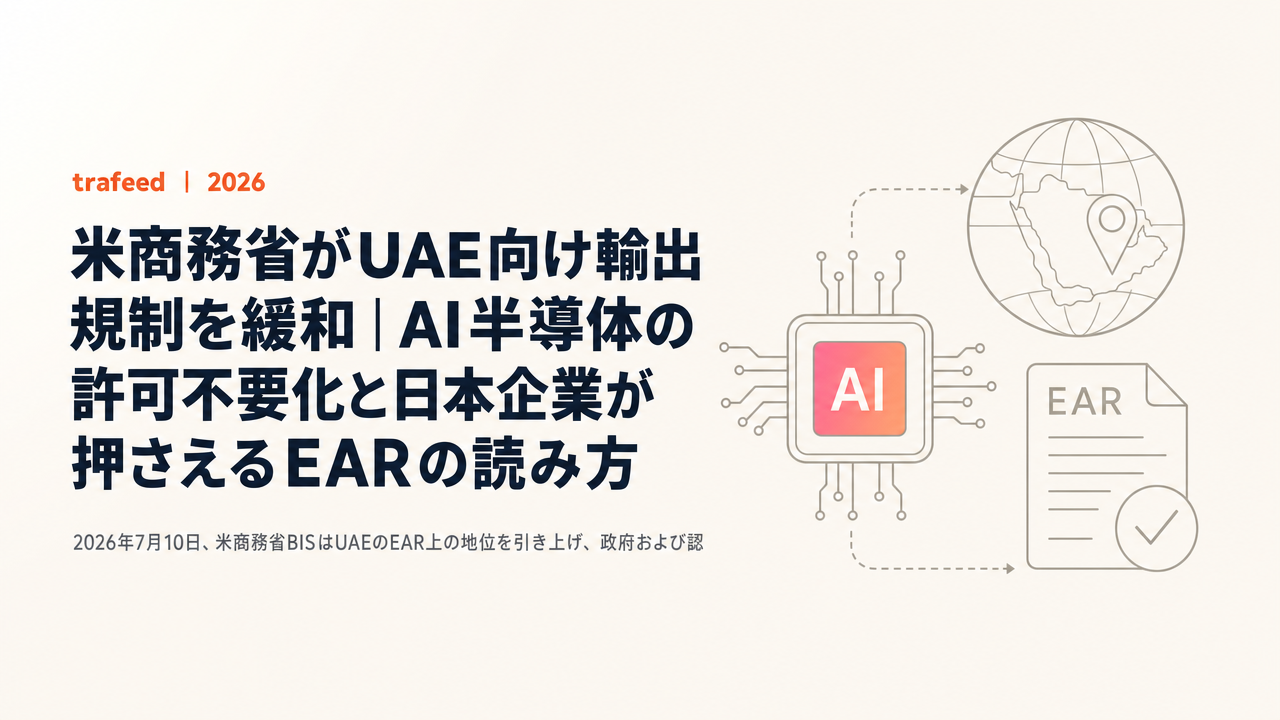
The primary source is cleaner than most social posts. On 10 July 2026, the U.S. Department of Commerce’s Bureau of Industry and Security (BIS) issued a press release on easing export controls for the UAE1, with implementing language available via the Federal Register2. This article stays with that text and asks what Japanese exporters should check first.
What BIS actually announced
BIS said it will significantly upgrade the UAE’s status under the Export Administration Regulations (EAR). It cites the UAE’s role as a U.S. Major Defense Partner, support for U.S. national security interests (including Operation Epic Fury), and commitments to prevent diversion and misuse of sensitive U.S. technology1.
Two changes matter most for practitioners.
First, BIS will remove the UAE from EAR Country Groups D:3 and D:4 and reclassify the UAE as Country Group A:5. Under License Exception Strategic Trade Authorization (STA), the UAE government and approved commercial entities become eligible for license-free exports, reexports, and in-country transfers of Commerce-controlled military items; certain commercial satellites and spacecraft; and dual-use items useful in oil and gas production, desalination, civil nuclear power, and other items available license-free to A:5 destinations1. BIS also notes that removing D:3/D:4 restrictions eases constraints related to support for UAE unmanned aerial vehicle programs.
Second, consistent with the U.S.–UAE Artificial Intelligence Cooperation framework signed in May 2025, Commerce is approving the UAE government and certain companies to receive advanced computing items in the UAE license-free, including AI chips and servers. The UAE reaffirmed investment commitments under that framework, including matching investment in U.S. AI digital infrastructure1.
Secondary reporting, including Reuters, frames the move as easing shipments of advanced AI processors associated with firms such as Nvidia, AMD, and Cerebras3. That market reading is useful, but legal analysis should start with BIS’s country-group and STA language, not ticker symbols.
Replace siloed classification work with AI.
METI's FY2024 data shows 52% of foreign exchange law violations stem from classification errors. Download the TRAFEED product catalog covering features and rollout.
What X got right—and what it oversimplified
Japanese posts often said “Nvidia-related stocks move” or “policy decides which countries can use AI.” Half true. Compute is strategic capacity. But “easing” is not “anyone in the UAE can buy anything without a license.”
BIS consistently focuses on the UAE government and approved commercial entities1. Unapproved private parties, multi-hop reexports, or end uses outside the framework’s assumptions are not automatically free. Entity List parties, military end-use and end-user controls, and other license requirements can still apply depending on the item and the parties.
For Japanese firms, I see three practical implications.
Reexport first. If you ship U.S.-origin AI chips or servers—or products incorporating them—from Japan to the UAE, or through the UAE to a third country, EAR reexport analysis may apply. Country-group changes feed directly into license-exception eligibility. Our EAR compliance guide covers the broader reexport map, including de minimis and foreign direct product issues.
Second, verify “approved” status. Government, approved commercial entity, and ordinary private company are different documentation problems. Long supply chains often lose the final end user.
Third, diversion. AI-chip controls still operate alongside other China-related and partner-country policies. Opening a channel to a partner does not remove the exporter’s duty to design against leakage to parties of concern. In practice, when access expands, questions about storage, access control, and resale limits often get tougher, not softer.
Reading the move as economic security, not only trade facilitation
The same week’s X feed also carried China–Japan dual-use friction and broader diplomatic sparring. Different topics, similar structure: access to critical technology opens and closes as a package of partnership, safeguards, and geopolitics.
BIS grounds the UAE upgrade in military partnership and anti-diversion commitments1. Technology is extended alongside conservation expectations. That is the current language of export control.
Japanese companies sometimes treat EAR as “a U.S. exporter problem.” In reality, design, assembly, and resale in Japan can still land inside EAR’s reach when U.S.-origin advanced compute is in the bill of materials. Data-center projects, space and satellite work, and oil-and-gas control systems—areas close to strategic technology—are where commercial diligence and compliance must run together.
If classification and screening still depend on a few people updating spreadsheets after each headline, a short export-compliance self-check is a practical way to see gaps before the next country-group change.
Three checks for this week
First, inventory UAE-bound or UAE-routed quotes, shipments, and technology transfers that include U.S.-origin advanced computing items or related technology. Some cases that assumed a full license path may now qualify for STA or the advanced-computing approval path; others will not.
Second, classify the counterparty as government, approved commercial entity, or neither, using contracts, public information, and partner confirmation. “Relaxation news appeared, so we are fine” is not a control.
Third, update internal reexport and in-country transfer checklists so Country Group tables and end-use questionnaires match the new A:5 status. Field teams will otherwise trade on headlines.
TRAFEED is an AI agent for export-control groundwork. Final classification remains with your export-control officer. Moments after a Country Group change are exactly when that line matters.
See the TRAFEED product catalog (PDF) for features and rollout, or contact us for a practical discussion.
X is a useful radar. Export-control decisions still start with the Federal Register and BIS text. The more a story sounds like “relaxation,” the more carefully you should re-read the subject of the sentence: who receives what, under which exception.
References
Footnotes
-
U.S. Department of Commerce, Bureau of Industry and Security, “Department of Commerce Eases Export Controls for UAE” (July 10, 2026). https://www.bis.gov/press-release/department-commerce-eases-export-controls-uae ↩ ↩2 ↩3 ↩4 ↩5 ↩6
-
Federal Register notice (public inspection d/2026-14132). https://www.federalregister.gov/d/2026-14132 ↩
-
Reuters, “US makes it easier to export Nvidia AI chips and military equipment to the UAE” (July 10, 2026). https://www.reuters.com/world/middle-east/us-makes-it-easier-export-certain-military-items-ai-chips-commercial-satellites-2026-07-10/ ↩