Hello, this is Ryuta Hamamoto from TIMEWELL.
"Our own servers are well protected. Yet data could still leak through an outside service." In November 2026, an incident posed exactly that question. After unauthorized access to a customer-experience analytics platform, several companies that used it announced, one after another, possible leaks of personal information.
On social media I saw voices saying "SaaS is too dangerous to use now" and "we should go back to on-premises." My view is different. What this incident shows is not the end of SaaS, but that the standards for how SaaS is built and chosen are changing.
This article first sets out the facts confirmed from official sources. It then considers the design questions that follow, from the side of those who provide SaaS and those who use it. Finally, it explains why "on-premises is safe" is not a reliable idea, and why a strong cloud with a fast vulnerability response is the answer.
This article does not criticize any specific company. The vendor is also a victim of the attack. We keep confirmed facts and general design principles clearly apart.
What official sources confirm
This article reflects information as of 19 November 2026. First, what the vendor, Plaid, announced officially.1
The official announcement says unauthorized access occurred in the early hours of 13 November 2026 and was detected at 8:59 the same day. It explains that a third party exploited a vulnerability in Plaid's servers to steal credentials used to connect to systems and databases, and read data out. Using the stolen credentials, Plaid's own accounts were taken over and its admin console was accessed without authorization.
Three kinds of information were confirmed as leaked. The first is email addresses registered to service accounts, 79,249 in number. The second is credentials for connecting to external services, such as secret keys and access tokens. A secret key or access token is like a spare key that lets services verify each other, and whoever holds it can read and write data within its privileges. The third is part of the customer data that user companies imported, including data brought in through a feature called the "linking table" (a table user companies import to tie their own customer records to data on the service). The counts for the second and third are under investigation.
The announcement describes invalidating the stolen credentials, stopping servers and blocking traffic from the attack source, and says containment was completed around 15:23 the same day. No new unauthorized access has been confirmed since. On its status page, on 15 November, the vendor asked user companies again to invalidate integration credentials.2 As of 19 November, all functions remained suspended and the date of resumption was undecided.
What the official sources do not say matters. The type of vulnerability, the intrusion method, the total number of affected user companies and the attacker's identity are not confirmed. Whether the "database connection credentials" and the "integration keys" were taken in the same intrusion, and in what order, is also not stated. This article does not guess at these.
Announcements by user companies, and how to read them
Several user companies also made announcements. According to press reports, one apparel retailer's member data is about 7 million records, one eyewear retailer's registered member accounts are up to about 18.29 million, and one health and beauty company's email addresses are up to about 4.32 million including duplicates. We could not directly confirm the official originals, so we treat these as information via press reports.
Three cautions apply to the numbers.
First, the meaning of a count differs by company. Some come with conditions such as "an upper limit on registered accounts; the actual number leaked is under investigation" or "including duplicates." Counts cannot simply be added.
Second, the items leaked differ by company. Press reports say several companies explained that they had not entrusted names, phone numbers, credit card information or passwords to this service. This matters as an example of how limiting the data you entrust can shape the scope of harm.
Third, the full picture is still unknown. Plaid has not published the total number of affected companies. Figures like "dozens of companies" online are third-party tallies, not official.
So, will SaaS die?
I think it will not, for three reasons.
First, holding everything in-house is no longer realistic. Marketing, customer support, payments and analytics: specialist services have raised the speed and quality of business greatly. Abandoning SaaS would give up those gains.
Second, attackers do not target only SaaS. Systems you run yourself are also attacked. Changing the form does not remove risk.
Third, what is at issue is design, not form. Even among SaaS, the amount of data held, how keys are managed and how customers are separated change the damage from a breach greatly.
That said, it is not fine to carry on as before. A SaaS that gathers many companies' data in one place is an efficient target for attackers. If they get into that one place, they may reach the data of many companies beyond it. Future SaaS must be designed on the premise of this structure.
AI Security training, taken seriously
A 2-day intensive course fully aligned with OWASP, NIST, ISO/IEC 42001, and METI. Take it as executives, practitioners, or both.
Principle 1: hold nothing, or hold less
The most reliable defense is not to hold the data at all. If there is nothing to steal, there is no harm when someone breaks in.
A SaaS provider must ask again: is that data really needed for the service's function? If so, must it hold information that directly identifies a person, such as a name or phone number? Could an identifier or a processed form stand in for it?
User companies face the same question. When marketing is made more sophisticated, the floor asks to "sync age, gender and purchase history, all of it, to the SaaS." It is convenient, but the more you entrust, the larger your own damage if the outside service is breached. Deciding, item by item, whether this item is really needed for this function is data minimization. Applying the same idea to privileges gives "least privilege": grant only the access the work requires and no more.
Principle 2: if you hold it, protect it strongly
Sometimes a service must hold data by its nature. In that case, design on the premise that you will be breached, so that harm stays small.
In concrete terms: encrypt data when storing it. Manage the encryption keys apart from the data. Do not keep using the same credentials for system-to-system connections for long; renew them in short cycles. Narrow privileges to the minimum necessary and remove them as soon as they are not needed. Limit network paths to what is permitted. Record who accessed what and when, and detect anomalies early.
In the Plaid incident, the official explanation is that credentials used to connect to systems were stolen. From this fact we cannot conclude that "credential management was inadequate." The official sources do not go that far. As a general matter, credentials become the most valuable target once an attacker is in. Storing credentials safely and narrowing privileges are central to SaaS design.
Principle 3: even if breached, do not let it cross customers
The third is, I think, the most important. Even if someone gets in, design so that all customers' data cannot be taken across the board.
A SaaS handles many customers' data on one platform. If losing a single credential for that platform opens every customer's data, damage spreads at once.
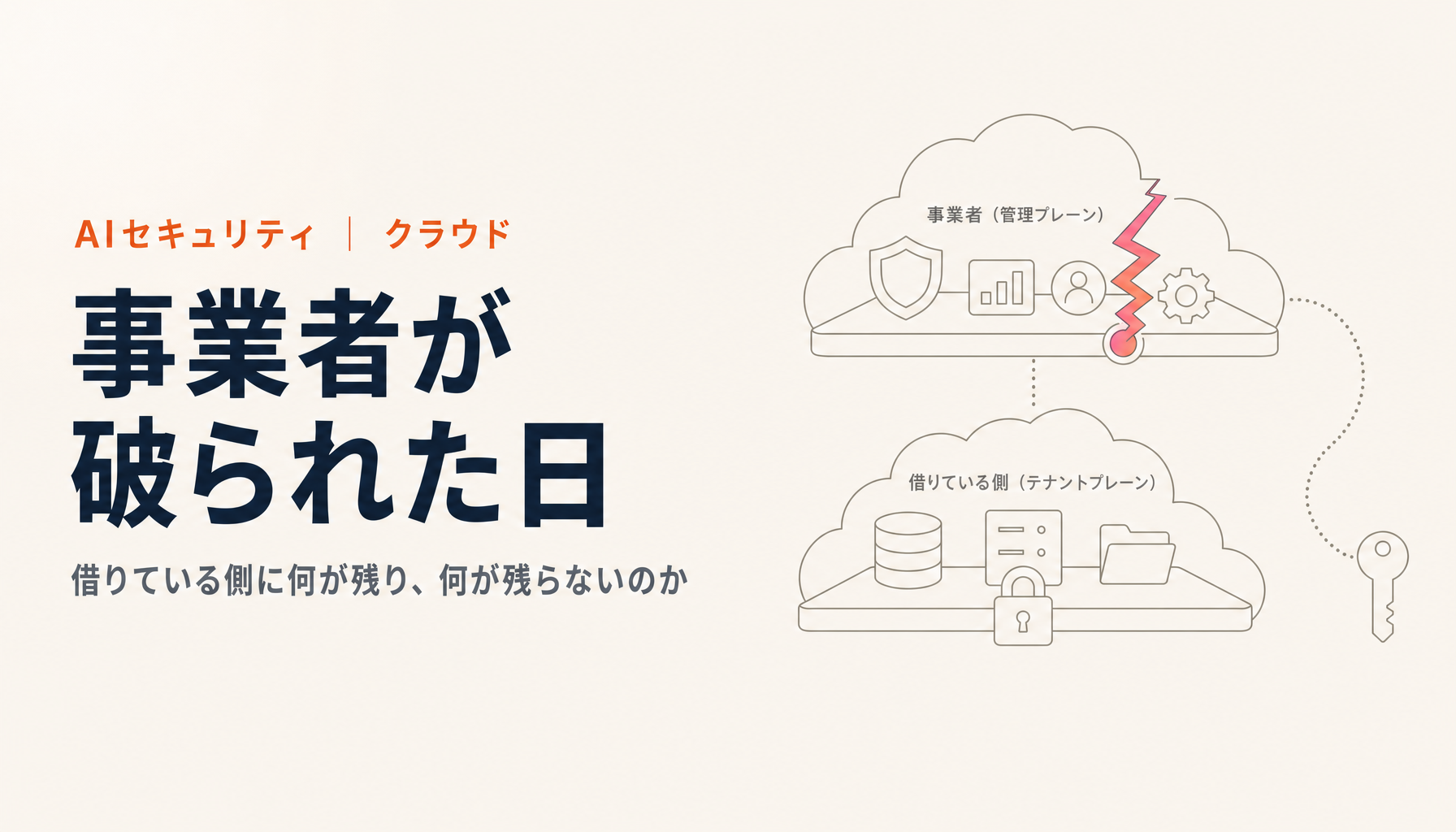
The idea for avoiding this is "isolation." Separate where data is stored, per customer (in SaaS terms, per "tenant"). This is called tenant isolation. Separate encryption keys per customer. Separate connection credentials per customer so they cannot be used on other customers' data. Keep the strong credentials that can operate the whole platform few in number and tightly controlled.
Isolation costs something. Design and operation become more complex. But whether one breach reaches every customer or only some is decided by this design. "Customer data cannot be taken across the board" is, I believe, a basic promise SaaS must make to customers from now on.
The actual design of Plaid's systems has not been explained officially. The principles here are general, not an assessment of any vendor's design.
What user companies can check now
There are things user companies can do starting today.
First, list the external services you integrate with, and for each one, organize which data you pass and which credentials you have issued. Next, stop syncing items you do not need and narrow the privileges of credentials to the minimum.
More important is to think, at design time, "if this external service were fully compromised tomorrow, what of ours would be taken?" And decide in advance a procedure for quickly reissuing the keys of all integrations when a compromise is announced. In a case like this, stopping one service is not the end. Replacing the keys of other services it was linked to reduces the chance of misuse. Without a procedure, this work puts a heavy load on the floor.
Reporting a leak of personal information also has deadlines. According to Japan's Personal Information Protection Commission, from the day the leak is discovered, a preliminary report is due within 3 to 5 days and a final report within 30 days (60 days if the leak may have been committed with unlawful intent). Please check the Commission's page for detailed conditions, such as when reporting applies.3 Build in advance a system that can meet these deadlines.
There is also something for ordinary users. Using leaked information, such as email address, date of birth and area of residence, attackers can craft convincing fake emails and text messages. The vendor's announcement also warns about suspicious emails impersonating the vendor. If you receive a message with wording like "apology" or "re-authentication," do not click the link; check through the official app or a bookmark.
"On-premises is safe" is not reliable either
Reading this far, some will think, "then isn't it safer to run everything on our own servers?" I am cautious about that idea too.
A system run on-premises leaves vulnerability response entirely to you. Delayed updates, old equipment left behind and monitoring that does not reach everywhere are not unusual. There are cases in which systems built on on-premises assumptions suffered serious damage. I covered this point in Is "On-Premises Is Safe" True? The Weaknesses of Legacy Seen Against the Cloud.
What matters is not where a system sits. It is whether you have these three things.
The first is a setup that responds to vulnerabilities quickly: learning of a vulnerability early, judging its impact and applying a fix in a short time. This time can be measured. Manage it with "days from disclosure to patch" as a metric.
The second is a strong foundation. By correctly configuring the network isolation, key management, monitoring and privilege management that cloud providers offer, you can reach a level of protection hard to build alone. But a wrong setting can become a hole. You need a way to check settings continuously.
The third is a design in which a breach does not spread: the three principles above of holding less, protecting strongly and not crossing customers.
So the answer is not "go back to on-premises." It is "use a strong cloud well, together with a setup that responds to vulnerabilities quickly."
New questions when choosing SaaS
Finally, questions for those who choose SaaS. Selection used to center on features, price and ease of use. I recommend adding these questions.
- Which data does this service hold, and why? Is it designed so it need not hold it?
- Are data and keys separated per customer? Can one credential reach all customers?
- Are integration credentials narrow in privilege, short-lived and quick to revoke and reissue?
- With what setup and how quickly does the vendor respond to vulnerabilities?
- In a breach, how fast and with what content are customers informed?
A vendor's ability to answer these questions concretely will, I think, become the condition of trust in SaaS. We at TIMEWELL also provide SaaS, and we consider the same questions to be directed at us.
Closing: from "entrust" to "choose the design"
SaaS will not die from this incident. What changes is how SaaS is chosen and built. I think we have entered an era in which the quality of design, "do not hold too much," "do not let a breach spread" and "fix quickly," becomes a reason to choose.
The matter is still under investigation. We will update this article as new information appears, and keep separating facts from general principles.
How to respond
Integration with external services, narrowing privileges, procedures for reissuing keys and a setup for vulnerability response: you cannot do all of it at once. Setting priorities and improving step by step is realistic.
TIMEWELL's WARP SECURITY supports the design and operation of security around AI and cloud use. From taking stock of integrated services and reviewing what you entrust, to preparing procedures for a compromise, we think it through with you, starting from priorities.
If you want to know what you pass to external services, or what you would do first when a compromise is announced, feel free to reach out.
Footnotes
-
Plaid, Inc., "Notice of unauthorized access" (posted 13 November 2026, updated 16 November), https://plaid.co.jp/news/20261113/ , and "Apology and notice regarding the leak of information that may include personal information due to unauthorized access" (16 November 2026), https://plaid.co.jp/news/20261116/ . The date and time of occurrence and detection, the explanation of cause, the three kinds of information confirmed leaked, the 79,249 email addresses and the course of response are from these announcements. Checked by us on 19 November 2026 (in Japanese). ↩
-
KARTE status page, https://status.karte.io/ . The update of 15 November (a renewed request to invalidate integration credentials) and the undecided resumption as of 11:08 on 19 November are from this page. Checked by us on 19 November 2026. ↩
-
Personal Information Protection Commission of Japan, page on responding to leaks, https://www.ppc.go.jp/personalinfo/legal/leakAction/ . The deadlines (preliminary report within 3 to 5 days, final report within 30 days, or 60 days where unlawful intent may be involved, from the day of discovery) are from this page. Checked by us on 19 November 2026. The counts and items in user companies' announcements come from press reports quoting each company's official announcement (ITmedia, Net Shop Tantosha Forum and others, 17 to 19 November 2026). We could not directly confirm the official originals. The conditions on counts (upper limit, including duplicates) follow the wording in those reports. ↩