Hello, this is Ryuta Hamamoto from TIMEWELL.
Announcing the "world's first agentic AI governance framework" at Davos is classic Singapore strategy. On 22 January 2026, during the World Economic Forum, IMDA published the Model AI Governance Framework for Agentic AI. It is voluntary — and still likely to become a de facto reference in global enterprise AI governance documents.
I call it a "translator for the agent era that fills the gaps between ISO/IEC 42001 and NIST AI RMF." While the EU, US, Korea, and Vietnam bind through statute, Singapore deliberately stays voluntary. That voluntary text is becoming the shared language for agent implementation projects worldwide.
Why does a non-law document matter this much? Let's walk through it.
TL;DR
- IMDA at Davos, 22 January 2026 — world's first agent-specific governance framework
- Voluntary, but crosswalked to AI Verify, ISO/IEC 42001, NIST AI RMF, and the EU AI Act
- Four dimensions: Risks Upfront / Human Accountability / Technical Controls / End-User Responsibility
- Technical core: least privilege, whitelisted servers, sandboxing, logging, continuous monitoring
- Functions as a "regulatory hub" that lowers multinational compliance friction
Why a non-law document matters — Singapore's strategy
EU AI Act, US SB 53, Korea AI Basic Act, Vietnam AI Law — 2026 is the year hard law with penalties goes live across regions. Only Singapore keeps a voluntary frame. That is strategy, not neglect.
Hard law would risk the regional-HQ pull of Google, Meta, Microsoft, Anthropic, ByteDance and others, said to exceed SGD 10 billion a year in economic effect.1 No regulation at all would brand Singapore a free-for-all and erode market trust.
IMDA's answer: voluntary rules aligned to other jurisdictions. AI Verify (the world's first AI governance test tool, 2022) is crosswalked to ISO/IEC 42001 and NIST AI RMF so Singapore compliance documents transfer into other regimes' files.
I call this a "regulatory hub strategy." One AI Verify pack can support NIST AI RMF Measure records, ISO/IEC 42001 audit evidence, and EU AI Act conformity files. Economic rationality makes multinationals adopt Singapore even without legal force.2
The January 2026 Agentic AI framework is that strategy for the agent era: ChatGPT Agents, Claude Computer Use, and peers are spreading, and Singapore is claiming the gap ISO/IEC 42001 does not fully cover.
AI Security training, taken seriously
A 2-day intensive course fully aligned with OWASP, NIST, ISO/IEC 42001, and METI. Take it as executives, practitioners, or both.
Four dimensions — where to start
The core is a four-dimension structure for agentic governance.3
Dimension 1: Assess and Bound Risks Upfront
Start with whether the use case should be agentized at all. RPA may be enough; agentizing everything is over-engineering. If you proceed, set explicit caps on autonomy level, tool access, and data scope — that is "Bound."
Dimension 2: Human Accountability
Draw the line between full autonomy and human approval. The framework uses "Significant Checkpoints" for mandatory human approval — e.g. monetary thresholds for autonomous trades, database write types, external API classes.
Dimension 3: Technical Controls Throughout Lifecycle
The thickest section — design, development, deployment, operations. Detail in the next section.
Dimension 4: End-User Responsibility
Help end users (workers and consumers) understand agent capabilities and limits through transparency and education, including escalation when the agent cannot decide.
For Japanese firms, Dimensions 2 and 3 are the easiest entry points. Dimensions 1 and 4 need HQ business decisions. My field order is Dim 3 → Dim 2 → Dim 1 → Dim 4. Start where engineers can act this sprint.
Technical controls — least privilege and whitelisted servers
Dimension 3 is written at implementation grain.4 Five controls that matter most:
(1) Least-privilege access
Limit tool and data access to the minimum required for the task. Classic security, newly critical for agents: prompt injection can push agents beyond intended privileges, so shrinking privilege shrinks the attack surface.
Practically: dedicated service accounts; IAM that strictly separates read-only from write; OAuth scopes, API key scopes, and row-level security (RLS).
(2) Whitelisted servers
Restrict agent network/API reach to a pre-approved list. Whitelists beat blacklists: you cannot enumerate every forbidden destination, but you can enumerate allowed ones.
Build at three layers: network (egress firewall), application (MCP server list, tool list), and contract (SLA). Since Anthropic's Model Context Protocol (MCP) scaled in 2025, more firms run an approved MCP server list internally.
(3) Sandboxed execution
Run agent-generated code, SQL, and shell in sandboxes — Docker, gVisor, Firecracker, AWS Lambda, Cloud Run — so unexpected side effects stay contained.
(4) Plan and reasoning logs
Log plan and reasoning before action for later audit. LangSmith, LangFuse, Helicone, and Datadog LLM Observability support this.
(5) Continuous monitoring
After deployment, watch traffic, errors, tool-call frequency, cost, latency; set anomaly thresholds and human escalation.
(1) and (2) are the controls Japanese agent projects most often skip. In PoC, engineers hand admin API keys and open outbound access. That becomes "Excessive Agency" risk in production. Honestly, this part is still messy in practice on most floors I visit.
Crosswalk — one file, multiple jurisdictions
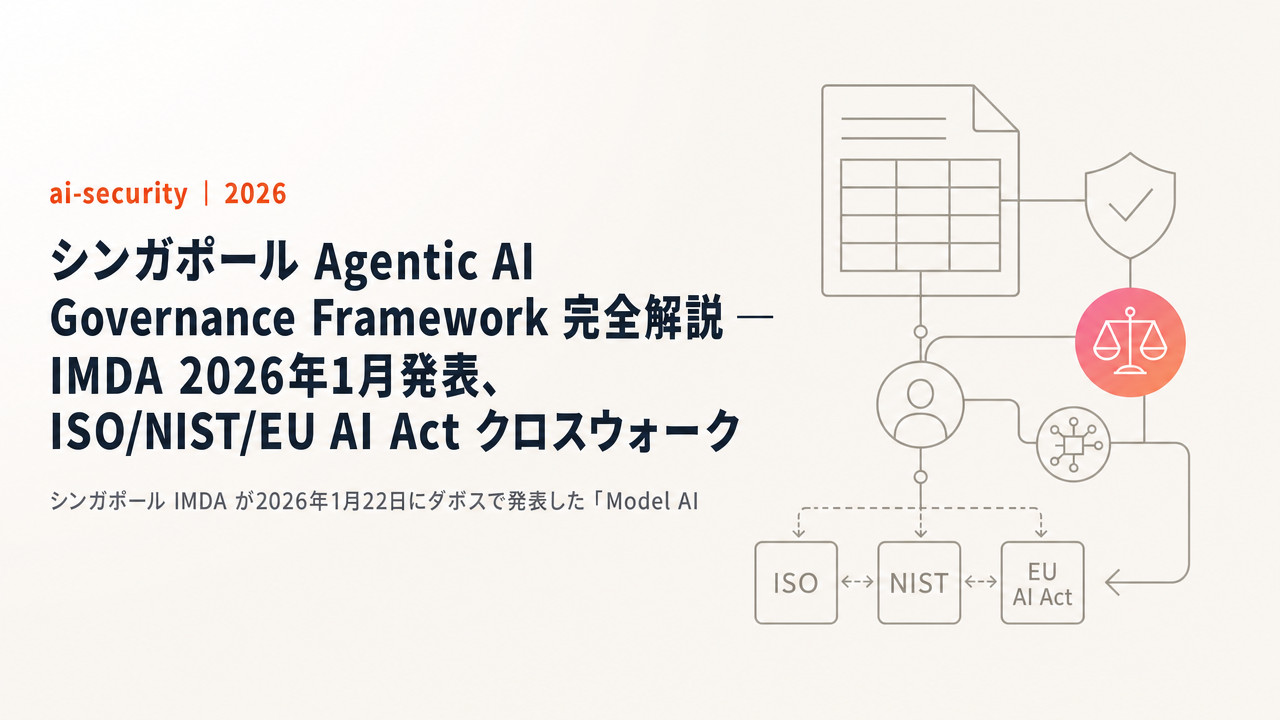
Singapore's real value is the crosswalk to other regimes.5
| Singapore MGF area | ISO/IEC 42001 | NIST AI RMF | EU AI Act |
|---|---|---|---|
| Risks Upfront | A.6 risk assessment | Map | Art. 9 risk management |
| Human Accountability | A.7 roles and responsibilities | Govern-1 | Art. 14 human oversight |
| Technical Controls | A.8 controls + Annex A | Measure / Manage | Art. 15 cybersecurity etc. |
| End-User Responsibility | A.4 transparency | Trustworthy AI principles | Art. 13 transparency |
Singapore documentation can simultaneously support four regimes' conformity stories. AI Verify results feed ISO 42001 audits, NIST Measure records, and EU high-risk assessment files.
That is the hub in practice: even without hard law, acting as a translator for other laws drives de facto standardization.
Using it on Japanese agent projects
Three effects I see on the ground:
Effect 1: Standard technical control checklist
Without Singapore MGF, technical controls are often "engineer gut feel." A Dim 3 checklist — least privilege ✓, whitelist ✓, sandbox ✓ — makes projects auditable across teams.
Effect 2: Shared language HQ ↔ local
Four dimensions give security, Singapore AI engineers, and US counsel a common vocabulary.
Effect 3: Reusable audit evidence
J-SOX, ISMS (ISO/IEC 27001), GDPR, PCI DSS can share plan logs, whitelist configs, and sandbox architecture.
Caveat: voluntary does not clear every legal duty. EU high-risk conformity still needs Annex IV technical documentation. Crosswalk covers roughly 90%; the remaining 10% is jurisdiction-specific.
Agent-era security reference — WARP SECURITY
TIMEWELL's WARP SECURITY uses Singapore MGF as a technical-control skeleton early in agent projects:
- Custom Dim 3 checklist fitted to your cloud, MLOps, and security stack
- Internal ISO/IEC 42001 ↔ Singapore MGF crosswalk in SharePoint / Confluence / Notion
- Stage-gate reviews: design, build complete, pre-deploy, day-90 ops — each dimension checked
PoCs are absurdly easy; production is absurdly hard. LangChain or AutoGen demos take a day; least privilege and whitelist production readiness takes at least three months of operating model work. Singapore MGF is the right checklist for that build.
Hard-law agent rules will take another year or two. Building on Singapore MGF now cuts later adaptation cost. If I had to pick one document for a Japanese agent kickoff, it would be this framework — not the EU AI Act text.
Latest developments as of 1 August 2026
The hard-law side of the crosswalk is moving. The EU AI Act's general date of application is 2 August 2026. From that date, Chapter IV transparency obligations (Art. 50), Chapter III Section 5 (Arts. 40-49: harmonised standards, conformity assessment, CE marking, registration), and the Commission's power to fine general-purpose AI (GPAI) model providers (Art. 101) start to apply. The GPAI model obligations themselves (Chapter V) and the penalty provisions (Chapter XII, Arts. 99-100) have applied since 2 August 2025; what is added on 2 August 2026 includes Art. 101. Fines run up to €35 million or 7% of global turnover for prohibited practices under Art. 5, and up to €15 million or 3% of global turnover for GPAI-related and other breaches (whichever is higher) — a sharp contrast to the voluntary Singapore MGF (Regulatory framework on AI, European Commission).
The substantive high-risk AI obligations do not start on 2 August 2026. The amending act debated as the Digital Omnibus was adopted as Regulation (EU) 2026/1744 (adopted 8 July 2026, published in the OJ on 24 July 2026, in force from 27 July 2026). Chapter III Sections 1, 2 and 3 now apply to Annex III high-risk systems (Art. 6(2)) from 2 December 2027, and to Annex I product-embedded high-risk systems (Art. 6(1)) from 2 August 2028. Art. 22 (authorised representatives), Art. 25 (value chain responsibilities), Art. 26 (deployer obligations) and Art. 27 (fundamental rights impact assessment) trigger on the same dates. The transitional rule for systems already placed on the market (Art. 111(2)) is likewise no longer tied to a fixed date: it bites only where designs undergo significant changes after the Chapter III application dates. Separately, on 2 December 2026 the newly added prohibitions take effect (Art. 5(1)(ba) non-consensual sexual deepfakes, (bb) CSAM generation, plus Art. 5(1a) and (1b)), and providers of synthetic-content generators placed on the market before 2 August 2026 must comply with Art. 50(2) by that date under the new Art. 111(4).
As EU enforcement hardens in stages, the practical question "how far Singapore packs transfer into EU conformity" gets heavier. Crosswalk aligns the skeleton; it does not replace EU technical documentation. With the high-risk deadlines set at 2 December 2027 and 2 August 2028, companies starting now have room to build controls in at design time. For implementation-side agent control, see Governed AI enterprise agents.
Summary
- IMDA Davos, 22 January 2026 — world's first agent-specific governance framework
- Voluntary, but AI Verify / ISO 42001 / NIST / EU AI Act crosswalks make it de facto standard
- Four dimensions: Risks Upfront / Human Accountability / Technical Controls / End-User Responsibility
- Technical core: least privilege, whitelisted servers, sandbox, logging, continuous monitoring
- Designed as a "regulatory hub" — one file, multiple jurisdictions
Not writing a hard law was probably the right call. Amid a hard-law pile-up, Singapore MGF softens fragmentation by serving as translator and hub.
When a Japanese company starts an agent project, the first document to open is usually not the EU AI Act or Korea's AI Basic Act — it is Singapore MGF for Agentic AI. No legal force; still the practical global baseline. Open Dim 3 first. Least privilege and whitelists are Monday-morning work.
Further reading: Korea AI Basic Act, January 2026, Vietnam AI Law — ASEAN's first comprehensive statute, EU AI Act digital simplification and 2026 schedule.
References
- Model AI Governance Framework for Agentic AI PDF - IMDA
- Singapore's IMDA Agentic AI Framework: What SaaS Vendors Need to Know - SaaSVista
- Singapore Issues Governance and Security Guidance for Agentic AI - Inside Privacy
Footnotes
-
Singapore Launches New Model AI Governance Framework for Agentic AI - IMDA ↩
-
Singapore's Digital & AI Governance: A Pro-Innovation, Framework-Driven Model - Duane Morris ↩
-
Singapore: Governance Framework for Agentic AI Launched - Baker McKenzie ↩
-
Singapore Issues Governance and Security Guidance for Agentic AI - Global Policy Watch ↩
-
Singapore's Agentic AI Framework: Practical Guidance for Market Entry - Mayer Brown ↩