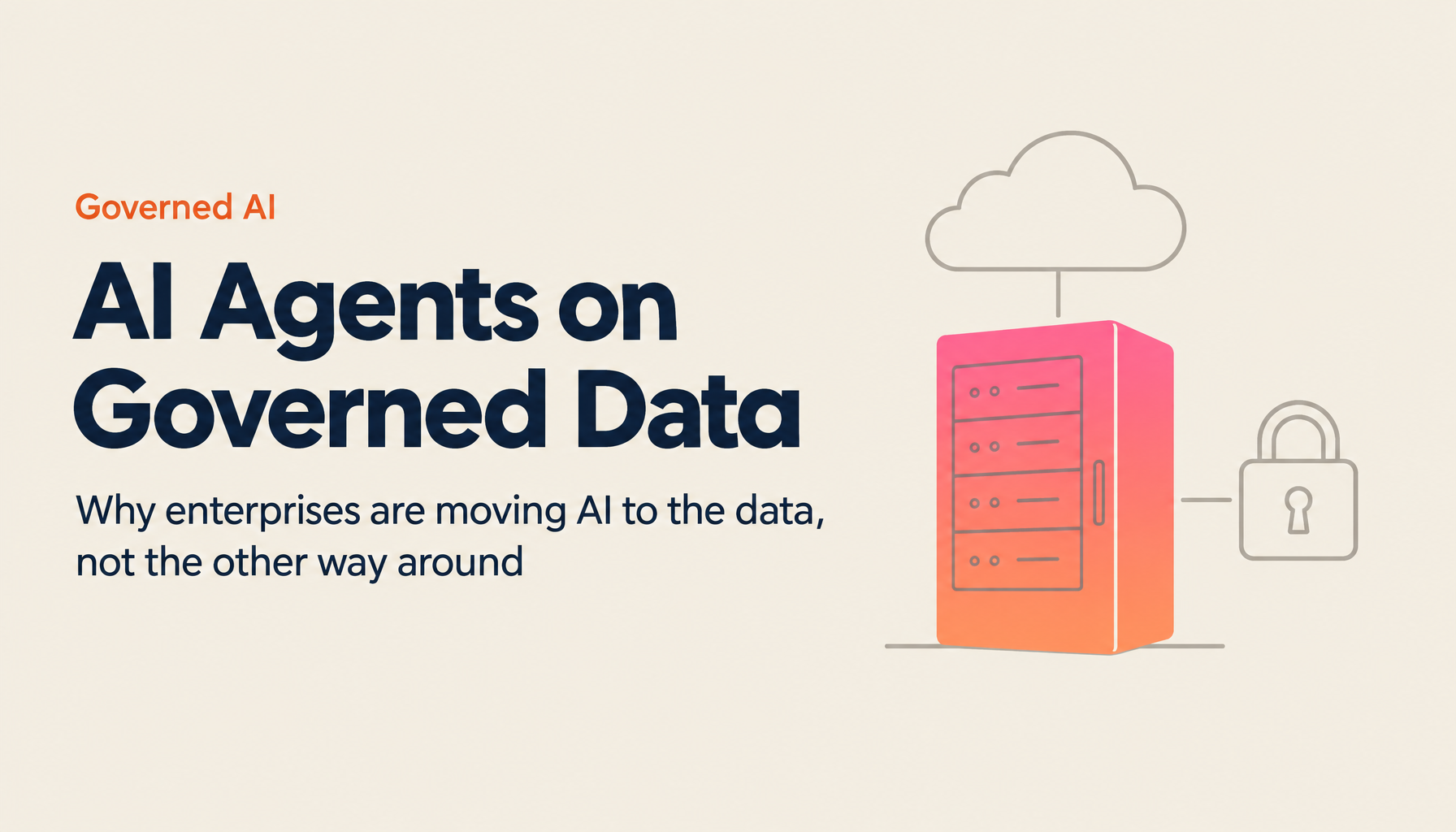
Hello, this is Hamamoto from TIMEWELL. June 2026 was a month when I kept hearing the same phrase across the enterprise AI world. Snowflake, DXC, TCS. Three companies with different industries and different positions were all, as if reading from the same script, talking about "running AI on top of governed data."
Through last year, the debate around AI adoption centered on a performance contest: which model is smarter, which is faster. This year, though, the lead role is no longer intelligence itself. The axis has shifted to "how do you put that intelligence to work safely, without letting your own confidential data out of the building." In this article, I trace the primary sources each company published in June and sort out the real nature of this trend that people have started calling Governed AI. And I think through what Japanese companies need to design when they run AI agents on internal data, weaving in the perspective of our enterprise AI platform ZEROCK.
I should say up front what I am and am not doing here. I am not trying to sell you on any single vendor's stack. What I want to extract is the pattern underneath these announcements—a shared assumption that the interesting problem is no longer the model, but the discipline around the data the model reaches. That assumption travels well across company size and industry, and it is the part worth internalizing even if you never touch Snowflake or sign a partnership of your own.
What happened in June 2026
It started on June 1. At Snowflake Summit 26, Snowflake and Anthropic announced a partnership set against a backdrop of "rising demand for Governed AI"1. In a sentence, it means that Snowflake customers can now use Anthropic's Claude against their own Snowflake data, via Snowflake Cortex AI. What matters decisively here is the design that lets you operate AI agents under enterprise-grade governance without moving confidential data outside the Snowflake environment. Rather than carrying the data to where the AI lives, you call the AI to where the data lives. That reversal of direction is the heart of the matter.
A comment from Snowflake's EVP of Product, Christian Kleinerman, is emblematic: customers want AI that operates directly on governed data, not on separated systems2. Steve Corfield, Anthropic's Head of Global Business Development & Partnerships, echoed the point: Snowflake provides the governed data environment enterprises already rely on, and Claude provides the reasoning that puts that data to work3. Snowflake holds the vessel for the data, and Claude plugs the brain of reasoning into it. You can see the division of roles laid out cleanly.
The technical vehicle for this is Cortex Agents. This is Snowflake's framework for building enterprise AI agents that can search, reason over, and act on governed enterprise data4. The use cases range widely, from customer support automation to data analysis to core business operations. Adopting customers include names like Basis, Block, Carvana, eSentire, Indeed, Notion, and Deloitte Consulting LLP. Let me clear up one easily confused fact here. The multi-year, $200 million partnership itself did not first appear at the June Summit. The large-scale, dollar-denominated partnership was already announced on December 3, 2025, delivering Claude to more than 12,600 Snowflake customers and having Claude Sonnet 4.5 power Snowflake Intelligence5. At that time, customers in regulated industries such as financial services, healthcare, and life sciences were said to be able to move "from pilot to production." The accurate reading of the June announcement is that it is about landing that partnership into real, productized operation.
Snowflake was not the only one moving in June. On June 11, DXC Technology and Anthropic announced a multi-year global alliance to embed AI into mission-critical enterprise systems6. DXC became one of the few "Global Premier" partners in the Claude Partner Network, and through the 90-day certification of the Anthropic Partner Academy, it said it would train tens of thousands of Claude-certified engineers. The targets are the IT infrastructure that the world's largest banks, airlines, insurers, manufacturers, and government agencies depend on. The initial focus areas are agentic systems for insurance, embedding AI into cybersecurity SOCs, and legacy code modernization7. The next day, June 12, TCS (Tata Consultancy Services) and Anthropic announced a Global Premier partnership. TCS said it would provide Claude to 50,000 of its own employees across 56 countries, and would design and operate Claude-based systems for regulated industries such as financial services, public sector, insurance, banking, life sciences, aviation, telecommunications, and medical devices8. What the three companies share is not a laboratory demo but the resolve to run AI on top of core systems that cannot be stopped.
Struggling with AI adoption?
We have prepared materials covering ZEROCK case studies and implementation methods.
What Governed AI is, and why it takes this form now
I still treat Governed AI as a concept without a fixed Japanese translation. If I had to render it, it would be something like "AI on top of governed data." The point is that the center of gravity sits not on the intelligence of the AI, but on the managed state of the data the AI touches.
Why is this form demanded now? The answer is distilled in the words of Anthropic's CEO and co-founder, Dario Amodei: enterprises have spent years building secure, trusted data environments, and now they want AI that can work without compromise inside those environments9. You can see, through this, the pain enterprises learned over the past few years. When generative AI first appeared, the first thing many companies did was send internal data to some external service to summarize or search it. Convenient, yes. But it moved forward with the question of who sees the confidential information, and where it ends up, left vague. That anxiety kept stopping companies right at the doorstep of production adoption.
TCS's announcement pins down the true nature of this anxiety precisely: regulated industries need their operations to be highly accurate and auditable10. Accuracy and auditability. Without these two, you cannot embed AI into work such as insurance claims processing or bank lending advisory10. Put the other way around, once you can guarantee that, the heavy work that has been handled by hand comes within reach of AI agents. Governed AI looks like a story about performance, but it is in fact a story about accountability and explainability. That is how I understand it.
As the technical groundwork supporting this trend, let me also touch on the Model Context Protocol (MCP). MCP is an open-source standard for connecting AI applications to external data sources, tools, and workflows, often described as "the USB-C of AI"11. A wide range of clients such as Claude, ChatGPT, VS Code, and Cursor support it, and it becomes the foundation for connecting agents to governed data sources in a standardized way. The side that holds the vessel and the side that provides the AI can shake hands through a common connector. It is precisely because this standardization exists that a data platform like Snowflake and a model like Claude can connect without strain.
The design theory of production operation
I have been describing clean partnership stories, but when it comes to actually running this in your own company, plain, unglamorous design work awaits. Press releases compress months of that work into a single sentence, and the compression is where teams get misled. The gap between "we connected Claude to our data" and "we can defend, in an audit, every answer the agent gave last quarter" is enormous, and it is filled almost entirely with decisions you have to make yourself. To run AI agents close to the data in production, I believe you need to decide at least four points up front: data provenance, audit logs, access control, and hallucination governance.
Data provenance means making it possible to trace afterward what the AI based its answer on. When Snowflake started the private preview of Claude Sonnet 5 on Cortex AI on June 30, what it emphasized repeatedly was that it runs "within the secure Snowflake perimeter"12. It can be accessed via routes such as Cortex AI Functions, Cortex Agents, and CoCo, and you can build AI apps close to the data while preserving Snowflake's security and governance capabilities. It is said to demonstrate Opus-class accuracy in parsing financial and medical documents, but just as important as accuracy is being able to trace, inside the perimeter, which data an answer came from.
Audit logs and access control sound obvious, and yet they suddenly get harder with AI. With a human, "this employee can only see files in this department" is enough. But an AI agent, depending on the instructions, will crawl across data horizontally. That is exactly why you need a design that records, one operation at a time, under whose permission, against which data, and what operation was performed—and that enforces the same permission walls on the agent. TCS's word "auditability"10 only holds up once those records exist. I dig into the concrete thinking around authentication and audit controls in the article Audit controls for enterprise AI and SOC 2 / ISO compliance, so reading it together should sharpen the outline.
The fourth point, hallucination governance, is an area where setting expectations is exceptionally difficult. Retrieval-augmented generation (RAG, a method that retrieves external data before generating an answer) is regarded as a promising means of reducing how often AI says things that differ from fact. But its effectiveness varies widely by domain and implementation. In peer-reviewed research, a method called MEGA-RAG reduced hallucinations by more than 40% in the field of public health13, while Stanford RegLab's evaluation found that a leading legal RAG tool (Westlaw AI-Assisted Research) still showed a hallucination rate of up to 33%14. In other words, there is no universally guaranteed number for "add RAG and it drops by X percent." This is a point I want to state plainly: there is a reduction effect, but no uniform numerical guarantee. That is exactly why you need to decide, before adoption, how to measure accuracy, how much to tolerate, and how to detect it when the AI gets things wrong. I have summarized concrete techniques for actually raising RAG accuracy in How to improve RAG accuracy, and the underlying thinking about graph structures in What is GraphRAG.
For what it is worth, DXC has reported that in its own operations, Claude accelerated software delivery by 10x, with Claude generating 95% of the code and human engineers reviewing it15. This is an eye-catching number, but it is DXC's own reported figure. It has not been verified by an independent third party, so I will not generalize it as a representative capability across the industry. Keeping a vendor's self-reported claims separate from verified facts is, I think, the honest way to handle it.
Points for Japanese companies
Up to here, the story has mostly been about global enterprises. So how should Japanese companies receive Governed AI? The point I feel is the largest is domestic data sovereignty.
The principle the Snowflake partnership signaled—"do not let confidential data leave the environment"—carries an even heavier meaning for Japanese companies. Wariness about entrusting internal data to overseas clouds in the first place runs deep in some industries. In regulated industries such as finance, healthcare, and the public sector, the requirement to process data while keeping it within the country is not unusual as a management-level precondition. The areas DXC and TCS focused on—finance, insurance, public sector78—overlap in Japan too with industries that are sensitive about where data is placed.
Another point is alignment with the institutional side of governance. In Japan, discussions are advancing around guidelines for the use of AI and controls calibrated to the sensitivity of the information handled. Japanese companies will be asked the same question that overseas partnerships put forward—"is it auditable"10—but within the domestic framework. The wording of the domestic rules may differ, yet the underlying demand is identical: show that you knew where the data was, who could reach it, and what the system did with it. A company that has designed for that demand once does not have to redesign every time a new guideline lands; it only has to map its existing controls onto the new vocabulary. I have organized the full picture of this regulatory compliance in Enterprise AI governance and domestic guideline compliance, so please use it as a base when setting internal policy.
Honestly, I do not think Japanese companies need to imitate the large overseas partnerships as they are. Handing AI to tens of thousands of people is a story for a subset of companies with the muscle for it. What works for many Japanese companies is not scale but the design philosophy. Where do you place the data, who touches it, and what gets recorded. If you can decide these three points in your own words, you can obtain the essence of Governed AI even at small scale. Conversely, if you chase only convenience while leaving those points vague, you will eventually get stuck at the moment accountability is demanded. Not getting the order wrong is what matters.
There is also a quieter advantage in starting small and governed. When the perimeter is clear from day one, every later expansion inherits the same rules, rather than forcing you to retrofit controls onto a system that has already sprawled. I have watched more projects stall over that retrofit than over any modeling problem. The teams that move fastest in the long run are usually the ones that looked slow at the start, because they spent their first weeks arguing about data placement and logging instead of chasing a demo. That order feels backwards while you are in it, and correct the moment a regulator, an auditor, or your own security team starts asking questions.
How to implement this with ZEROCK
Finally, let me briefly introduce how our company answers this trend. ZEROCK is an enterprise AI platform built on exactly the Governed AI idea of putting AI to work without letting internal data leave the building.
The backbone of the design is being able to process data while keeping it within the country. ZEROCK runs on AWS domestic servers and controls internal knowledge inside that boundary. I would ask you to understand it as a concrete embodiment—for Japanese companies that prioritize domestic data sovereignty—of the principle the overseas partnerships signaled: "do not let confidential data leave the environment." On top of that, it structures internal knowledge using a method called GraphRAG, making it easier to trace what the AI based its answer on. It is a mechanism for facing head-on the data provenance point I mentioned earlier.
Features such as the prompt library and knowledge control are the toolkit for landing auditability into on-the-ground operation. Organizing who used the AI with what instructions and which knowledge they referenced is the first step to establishing TCS's "auditability"10 inside your own company. A prompt library, in particular, does more than save people from retyping. It turns the way your organization actually asks questions of its data into something reviewable and improvable—so that when an answer is wrong, you can go back to the instruction that produced it rather than shrugging at a black box. Behind the flashy performance contest, it is precisely this plain build-out of governance that I believe is the condition for keeping AI running in production without stopping it.
Governed AI is still a young concept as a term. But the fact that three companies faced the same direction in June 2026—Snowflake with its data platform, DXC and TCS with their reach into mission-critical systems—signals, I feel, that this is not a passing fad, but the shape the next phase of enterprise AI is settling into. How do you govern your own data, and how do you put AI to work on top of it? Companies that can hold an answer to this question in their own words will be the ones able to run AI agents in production. If you want to organize your enterprise AI design once, starting from how you handle internal data, please reach out via Book a consultation. Before getting into the performance discussion, thinking together first about where data sits and how it is governed turns out, in the end, to be the shortcut.
References
Footnotes
-
Snowflake and Anthropic Accelerate Enterprise AI Adoption Driven by Rising Demand for Governed AI — Snowflake — June 1, 2026 ↩
-
Snowflake and Anthropic Accelerate Enterprise AI Adoption Driven by Rising Demand for Governed AI (comment by Christian Kleinerman) — Snowflake — June 1, 2026 ↩
-
Snowflake and Anthropic Accelerate Enterprise AI Adoption Driven by Rising Demand for Governed AI (comment by Steve Corfield) — Snowflake — June 1, 2026 ↩
-
Snowflake and Anthropic Accelerate Enterprise AI Adoption Driven by Rising Demand for Governed AI (Cortex Agents and adopting customers) — Snowflake — June 1, 2026 ↩
-
Snowflake and Anthropic announce $200 million partnership to bring agentic AI to global enterprises — Anthropic — December 3, 2025 ↩
-
DXC and Anthropic Announce Multi-Year Global Alliance to Bring AI into Mission-Critical Enterprise Systems — DXC Technology — June 11, 2026 ↩
-
DXC and Anthropic Announce Multi-Year Global Alliance (focus areas: insurance, cybersecurity, legacy modernization) — DXC Technology — June 11, 2026 ↩ ↩2
-
TCS and Anthropic bring Claude to regulated industries — Anthropic — June 12, 2026 ↩ ↩2
-
Snowflake and Anthropic announce $200 million partnership to bring agentic AI to global enterprises (comment by Dario Amodei) — Anthropic — December 3, 2025 ↩
-
TCS and Anthropic bring Claude to regulated industries (auditability, claims processing, lending advisory) — Anthropic — June 12, 2026 ↩ ↩2 ↩3 ↩4 ↩5
-
What is the Model Context Protocol (MCP)? — Model Context Protocol (Anthropic) — November 1, 2025 ↩
-
Announcing Anthropic Claude Sonnet 5 on Snowflake Cortex AI — Snowflake — June 30, 2026 ↩
-
MEGA-RAG: a retrieval-augmented generation framework with multi-evidence guided answer refinement for mitigating hallucinations of LLMs in public health — PMC (National Library of Medicine) — 2025 ↩
-
Hallucination-Free? Assessing the Reliability of Leading AI Legal Research Tools — Stanford RegLab / HAI (published in the Journal of Empirical Legal Studies) — 2025 ↩
-
DXC and Anthropic Announce Multi-Year Global Alliance (DXC OASIS, self-reported figures) — DXC Technology — June 11, 2026 ↩