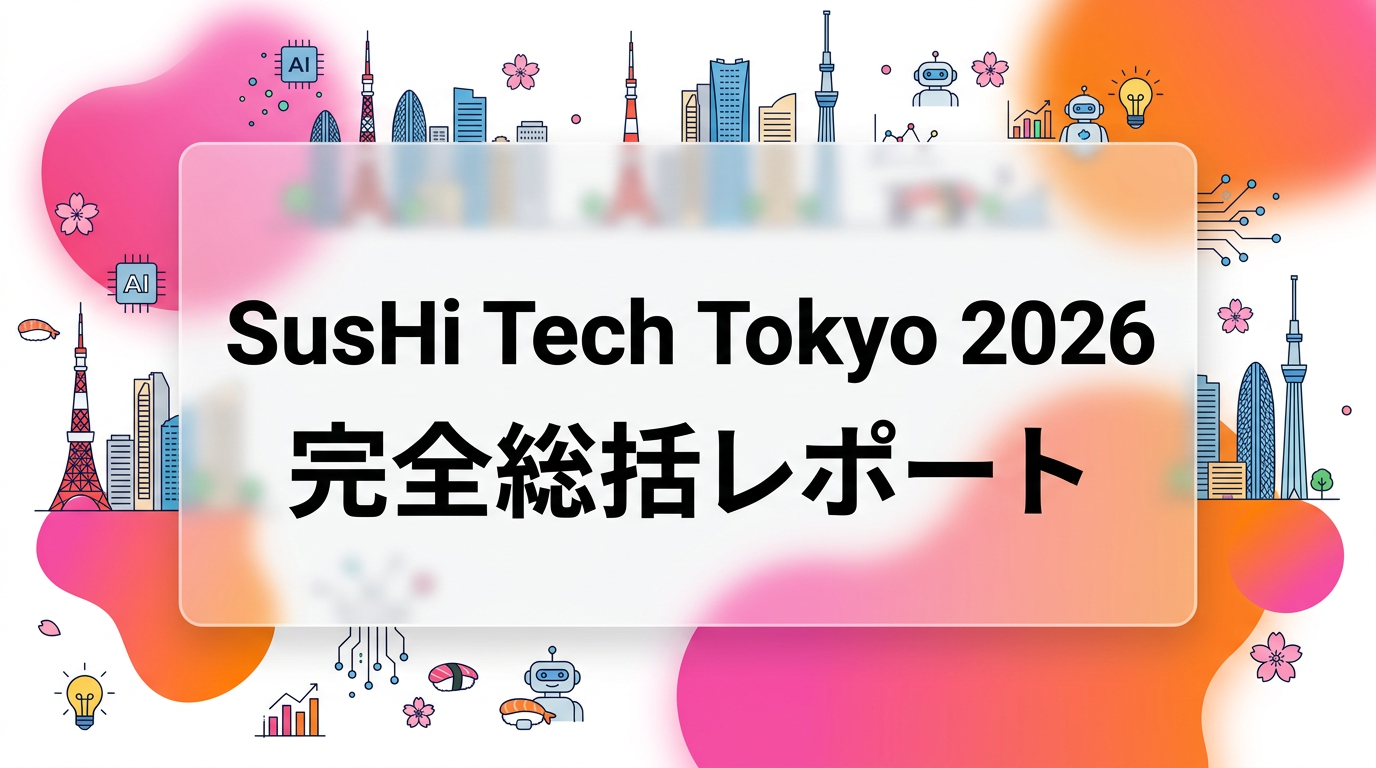
Hello, this is Ryuta Hamamoto from TIMEWELL. My day-to-day work is supporting startups and intrapreneurs under our vision of "building the world's number-one infrastructure for ambition."
A note before I start. This time, TIMEWELL did not attend SusHi Tech Tokyo 2026 purely as observers or media. We operated our own TIMEWELL booth, and additionally exhibited as a co-exhibitor at the EMC GLOBAL booth, with whom we are running a joint initiative. On top of that, TIMEWELL was selected as one of the official corporate ambassadors of the event, supporting pre-event promotion via our social channels and partner network. For three days I was at the booths talking with visitors, sprinting between sessions in the gaps, and engaging in deep conversations with mayors, investors, and overseas founders at the many networking gatherings we were invited to. In other words, this article is written from an "insider's" vantage point as well. I have tried to weave together three angles—what the organizers intended, what we sensed as exhibitors, and what we picked up from the sessions we covered.
Let me be direct. After spending three days at SusHi Tech Tokyo 2026, the difference from four years ago is striking. I attended City-Tech.Tokyo 2023 at the Tokyo International Forum in February 2023, when winter was still hanging on1. Four years later, the West Exhibition Halls of Tokyo Big Sight were filled wall-to-wall with startups, mayors and senior officials from 55 cities stood side by side under one roof, and the 4F Future Experience Pavilion featured walking dinosaurs, striding humanoids, and a full-scale lunar lander on display. Somewhere along the way, Tokyo became a city that hosts "Asia's largest startup conference" with full conviction2.
This article is my comprehensive summary of those three days—what I witnessed on the ground, the conversations I had with speakers, and the hardware I tested at the booths. It walks through the keynotes, country pavilions, the 4F experience zone, the Public Day on April 29, and digest summaries of all 13 session reports we published on the TIMEWELL site. The goal is for readers to grasp the entire arc of SusHi Tech Tokyo 2026 in a single read. It may not be a ten-minute read, but compressing the energy of three intense days into one piece naturally requires this kind of depth.
A quick note on intended audience. This piece is written for three groups in particular. First, executives and corporate development leaders at Japanese and international companies who are weighing how to integrate startup-driven innovation into their corporate strategy. Second, founders and operators at startups—both Japan-based and overseas—who want to understand the gravity Tokyo now exerts on Asia's innovation flows. Third, public-sector leaders and policy designers who are looking for replicable patterns for city-led ecosystem building. If you fall into one of those groups, I hope the framing here gives you something concrete to act on, not just to admire.
Four Years of Evolution: From City-Tech.Tokyo to SusHi Tech Tokyo 2026
Let me briefly retrace the history of this event. Knowing the trajectory completely changes the meaning of what we saw this year.
The first edition was City-Tech.Tokyo 2023, held in February 2023 at Tokyo International Forum. It drew 10,000 people from 30 countries and 100 cities3, with 300 startups exhibiting. At the time, Tokyo Governor Yuriko Koike had just announced the metropolitan government's startup strategy "Global Innovation with STARTUPS"—a plan to deliver "10 unicorns, 10x the number of entrepreneurs, and 10x the volume of public-private collaboration by 2027." City-Tech.Tokyo was the flagship event launched to embody that strategy. My honest impression on the ground that year was that the scale was still nascent, but Tokyo was clearly serious about building this.
The following year, SusHi Tech Tokyo 2024 was held across the Tokyo Bay area in April and May4. The event introduced Tokyo's distinctive brand—"Sustainable High City Tech Tokyo," abbreviated as "SusHi Tech." The naming layered Tokyo's intent to "deliver sustainable cities through high tech" onto sushi, an icon of Japanese culture. The 2024 edition drew an extraordinary 500,000 visitors and was structured around three programs: Global Startup, City Leaders, and Showcase.
Then came 2026. Comparing the numbers makes the trajectory unmistakable56.
| Metric | City-Tech.Tokyo 2023 | SusHi Tech Tokyo 2024 | SusHi Tech Tokyo 2026 |
|---|---|---|---|
| Venue | Tokyo International Forum | Tokyo Bay area (multiple venues) | Tokyo Big Sight West Halls 1–4 |
| Startup exhibitors | 300 | ~500 | ~770 (incl. 400 international) |
| Attendees | 10,000 | 500,000 | ~60,000 (conference + Public Day) |
| Countries / cities | 30 countries, 100 cities | 100+ cities | 55 mayors / 49 countries exhibiting |
| Sessions | ~60 | ~120 | 151 |
| Partner companies | ~30 | ~50 | 62 (Sony, Google, Microsoft, Mizuho, etc.) |
The 2024 visitor figure looks higher, but that reflects the multi-venue, public-facing format. The 2026 edition was deliberately designed to concentrate "business dealmaking" and "public experience" at a higher density. TechCrunch captured this perfectly: "This isn't a conference. It's a deal room with 60,000 people"7. I nodded heavily reading that line. The deal volume generated over three days will easily exceed last year's 6,000+ business meetings.
If City-Tech.Tokyo was the founding year and 2024 was the year Tokyo tested whether it could credibly call itself "Asia's largest," then 2026 is the year that claim was substantiated in practice. This is the result of Governor Koike's leadership combined with three years of execution by the Tokyo Metropolitan Government's Bureau of Industrial and Labor Affairs and the Tokyo SME Support Center. This event has stopped being a one-off and has begun functioning as part of the operating system of Tokyo's urban strategy.
It is worth noting that ecosystem flagships in other regions follow a similar arc. Slush in Helsinki took roughly a decade to grow from a student-run gathering into the global stage it is now. Web Summit moved from Dublin to Lisbon and only after that move did it consolidate its position. The pattern is consistent: ambition in year one, scaling debate in years two and three, and substantiation by year four or five. Looked at through that lens, SusHi Tech Tokyo's trajectory is right on schedule. The next question is whether the platform can compound advantages year over year—and the early signs from 2026 suggest that compounding has begun.
The Numbers Behind 2026: Proof That Tokyo Is Asia's Largest
Right before the opening, Business Insider Japan reported that SusHi Tech Tokyo 2026 would be the largest edition ever, with around 750 startup exhibitors6. By the time the event opened, that number had grown to roughly 77078.
The figure that stands out most is 400 international startups. More than half of all exhibitors coming from abroad is unusual among Asia's major conferences (CES Asia, Tech in Asia, SLUSH Asia, and others). As I walked the floor and observed which language each booth used, the share of booths actively selling in English was higher than I expected; finding a booth with Japanese-only signage was harder than the reverse.
The 151 sessions also deserve attention. Cramming 151 into three days means many were running in parallel across multiple stages, and reporters like me spent the entire event deciding which sessions to give up on. The 13 sessions I prioritized for TIMEWELL coverage were the ones I judged to deliver the highest value for executives, business unit leaders, and corporate venturing teams.
The 62 partner companies were equally striking. In addition to Sony, Google, Microsoft, and Mizuho, the lineup included Fujitsu, NEC, Tokio Marine & Nichido, Lotte, Money Forward, Pegasus Tech Ventures, 500 Global, and TechCrunch—each operating their own dedicated booths and sessions57. We have moved past the era of large companies merely sponsoring the event; the major players are now choosing SusHi Tech as the venue to announce their own corporate strategy.
The 49 countries participating is also a significant jump from 45 the prior year2. The strongest international presence this year came from Italy, France, South Korea, Singapore, the UAE, India, Germany, Finland, Estonia, Taiwan, and Saudi Arabia. Each set up a country pavilion and ran focused pitch lineups for their startups.
One of the most symbolic announcements of the event was Tokyo Launches $1 Billion Investment Framework9. The Tokyo Metropolitan Government unveiled plans for a public-private fund of substantial scale, framing it as part of the strategy to compete with Singapore's long-running sovereign-fund approach via Temasek and EDB. This signals that Japan's startup ecosystem is finally moving to break through the "capital scale wall."
One more figure worth noting. SusHi Tech Global Startups, a new pavilion launched this year, presented 45 growth-stage Japanese companies hand-picked by the Tokyo Metropolitan Government for global debut5. This is Tokyo's distinctive answer to Singapore's SGInnovate, France's La French Tech, and the UK's Tech Nation Global Talent Visa—a structured platform for sending Japanese startups out into the world.
The selection criteria for Global Startups, as I understand them from conversations with the operations team, focused on four dimensions: defensible technology or business model, demonstrated international demand signals, founders capable of pitching in English, and willingness to commit to overseas business development. Several of the 45 companies were already in advanced fundraising conversations with international VCs at the time of the event, and a handful announced fundraising or partnership news during the three days themselves. This is the kind of "press cycle by design" that elite ecosystem events orchestrate, and seeing it executed at SusHi Tech told me the operating maturity of the program has caught up with its ambitions.
The 4F Future Experience Pavilion: From Watching to Touching
Another area where SusHi Tech Tokyo 2026 clearly leveled up was the depth of experiential content1011.
The event used both the 1F and 4F floors of the West Exhibition Hall at Tokyo Big Sight, and the Future Experience Pavilion on the 4F was arguably the symbol of SusHi Tech Tokyo 202612. Stepping off the escalator on arrival, the first thing visitors saw was a moving dinosaur. ON-ART's lifelike dinosaur robots—Tyrannosaurus and Pachycephalosaurus among them—stood more than twice the height of a child and even simulated breathing patterns11. There was already a queue forming before doors opened.
Right next to the dinosaurs stood a transforming humanoid robot11. It shifted between an upright bipedal walking mode and a vehicle mode that visitors could actually ride—a spec that startled the audience no matter how many times they watched it transform. Watching children gasp "Wait, it really moves?!", I felt an unexpected wave of nostalgia. The generation that grew up watching Transformers on TV twenty years ago is now living in an era where the real thing exists.
The pavilion also debuted the world's first gesture-controlled humanoid11. The robot read hand movements and finger angles in real time, demonstrating an interaction model that requires neither controllers nor keyboards. This approach is critical for elder-care robots, disaster-response robots, and humanoid deployment in manufacturing—an area I expect to commercialize meaningfully over the next five years.
On the space side, a full-scale replica of ispace's RESILIENCE lunar lander was on display11. ispace, a Japan-born lunar transportation company, is developing this craft to deliver low-cost lunar payload services, and the exhibit came right before this year's lunar landing mission. Seeing it at full scale, the lander is more compact than imagined—you find yourself wondering whether this is really what travels to the Moon.
Beyond those highlights, the floor offered XR exhibits, drone-piloting simulators, AI-avatar interaction booths, generative-AI painting experiences, and a 3D food-printing tasting corner. The design ethos—don't let visitors stop at watching—was thorough. This is the biggest single difference from SusHi Tech Tokyo through 2024. The 2024 edition had experiential content too, but the scale and quality this year were on another level.
In my view, this push into experience is intentional. Startup conferences left to themselves end up as a sequence of pitch sessions and booth lineups, which is rarely strong enough to make people say "I'm glad I came." SusHi Tech's response was a three-layer structure: Business Days for dealmaking, Public Day for experience, and the 4F floor for experience across all days. That structure dramatically increased the volume of memorable images visitors took home.
There is also a less obvious benefit to investing this heavily in experiential content. Memorable visuals propagate. A child waving at a dinosaur, a humanoid mid-transformation, a full-scale lunar lander—these are images that travel through social media without any orchestration from the organizers. In an era when conferences increasingly compete with one another for international attention, the production design of an event has effectively become its second marketing budget. SusHi Tech 2026 understood that and acted on it.
Looking for AI training and consulting?
Learn about WARP training programs and consulting services in our materials.
Country Pavilions Reach New Heights: Italy and the Wave of "Human-Centered Deep Tech"
The country pavilions also operated at a noticeably higher density this year. Participating countries grew from 45 to 49, with European participation especially prominent.
The Italy pavilion left the strongest personal impression on me. Backed by the Italian government's "Italy Innovation Platform," nine deep-tech startups delivered concentrated pitches13. I covered this in detail in a separate article, "The Human Edge in Italian Deep Tech," but as you would expect from a country home to global brands like Ferrari, Brembo, and Lavazza, the lineup competed on the trinity of "technology × design × craftsmanship."
The France pavilion, led by La French Tech, showcased dozens of companies in AI, healthtech, and deep tech. The Korea pavilion, organized by KOTRA, took an aggressive stance in AI robotics, batteries, and entertainment tech. The Singapore pavilion, jointly hosted by Enterprise Singapore and EDB, focused on sustainability and fintech. The UAE pavilion, with Abu Dhabi Investment Office and DIFC working in tandem, emphasized connections to global family office capital.
This year, two notable shifts caught attention: the expanded scale of the India pavilion and the debut of the Saudi Arabia pavilion. India brought more than 30 companies in AI, SaaS, and healthtech, aggressively pursuing business matches for entry into the Japanese market. Saudi Arabia, framing its participation in the context of NEOM and Vision 2030, looked to partner with Japanese companies on smart cities, energy transition, and tourism tech.
What these pavilions signal is that SusHi Tech Tokyo has moved beyond being "an event for gathering Japanese startups" and has become "the hub where the world's startups connect to the Japanese market." This is the role long played by Slush Singapore, RISE in Hong Kong, Web Summit in Lisbon, and 4YFN in Barcelona—and Tokyo is now stepping into that role.
The Keynote with PM Takaichi and Governor Koike: How Serious Is "Japan as a Startup Nation"?
The most charged moment of the three days, without question, was the opening keynote on the morning of April 27.
Taking the stage were Tokyo Governor Yuriko Koike and Prime Minister Sanae Takaichi14. Two of Japan's top leaders sharing the stage on the topic of startup ecosystems—a domain inherently driven by the private sector—was something almost unimaginable four years ago.
Governor Koike opened with her now-familiar cadence. "By combining the 'SUS' from Sustainable and the 'HI' from High-Tech, we get the word sushi"—an explanation she has now given four years running. Yet, scanning the room of 60,000 people, the confidence in her delivery had a different weight this time, the weight of four years of substantiation. Tokyo Innovation Base (TIB) operating metrics, the evolution of G-NETS, the announcement of the $1 Billion investment framework—the speech was a compressed summary of four years of accumulated work.
Then Prime Minister Takaichi took the stage. "I'm not as powerful a presence as Governor Koike," she opened, drawing a quick warm laugh from the crowd—and from there, the room shifted. She anchored her remarks in a concrete number: "Japan's nominal GDP has grown 32% over the past two years." From there, she laid out three pillars for startup support.
First, scale-up support. Second, deep-tech support. Third, procurement support by local governments. Her direct commitments—"lower the bar for government procurement" and "strengthen Japan's SBIR-equivalent program"—were a deeply gratifying moment for someone who has watched deep-tech support in Japan up close. We have finally arrived here. I covered this session in detail in "SusHi Tech Keynote Report: How Serious Is 'Japan as a Startup Nation'? Inside the Koike × Takaichi Dialogue."
What this session symbolized is the fact that startup support in Japan has moved past the "cheering" phase and is now being treated as part of national-strategy operating system. Ten years ago, when I was running an intrapreneurship program at Panasonic, even university students would react skeptically when I said "startups in Japan." Today, the Prime Minister publicly calls startups "a growth engine of the nation." The atmosphere itself has changed—and you feel it directly when you are in the room.
G-NETS Leaders Summit: A New Frontline for City Diplomacy
The other event that gave SusHi Tech 2026 its meaning was the co-located 3rd G-NETS Leaders Summit15.
G-NETS (Global City Network for Sustainability) is a senior-city-leaders network that Tokyo has operated since 2022, and this year's summit gathered senior officials from 55 cities across five continents15. The theme was "A New Urban Future built on Climate and Disaster Resilience."
Helsinki, Barcelona, Seoul, Montreal, Singapore, Lisbon, Espoo (Finland), Busan, Jakarta, Ho Chi Minh City, Dubai, Mexico City—senior leaders from the world's startup-hub cities spent three days debating urban policy and technology deployment. This is more than a mayors' summit; it is a startup-flow platform between cities. From what I saw on the ground, several pairs of cities signed concrete MoUs for startup expansion.
Co-locating G-NETS Leaders Summit with SusHi Tech Tokyo created a structure where the private market (startups) and the public market (city governments) meet in the same hall. That single design choice opens a path for startups to become procurement targets of city governments in domains like smart cities, disaster prevention, energy transition, mobility, and education. I covered concrete examples in two session reports: "What Do Smart Cities Look Like When Citizens Come First" and "Solving Social Problems Is the Largest Business Opportunity."
In my read, the G-NETS co-location elevates SusHi Tech Tokyo from a startup conference into "Asia's first urban-diplomacy platform." Global smart-city budgets are projected to swell to $2 trillion by 2030. Whether Tokyo can position itself at the convergence point of those flows will heavily influence Japan's startup ecosystem growth rate over the next decade.
April 29 Public Day: Handing the Future to the Next Generation
Closing out SusHi Tech Tokyo 2026 was Public Day on Wednesday, April 29 (a national holiday)161718.
Business Days require pre-registration and skew toward visitors with business intent. Public Day is the opposite: admission and all experiences are free, high school students and younger enter free (with elementary schoolers requiring an accompanying guardian). Falling on the first day of Golden Week, Tokyo Big Sight was filled with families and kids of all ages.
From the publicly announced lineup, the items I found most compelling include1718:
- Science Live by science artist Genki Ichioka — A live stage where children watch real chemical reactions and physics experiments unfold and think through "why does this happen?" together with the host
- Real-dinosaur mechanical suits — A Public Day–exclusive show on top of the 4F pavilion content
- Robot battle game — Children operate real robots with controllers and compete head-to-head
- Drone piloting — Children fly drones themselves inside a safe enclosed area
- Electronics workshops by Tokyo Metropolitan College of Industrial Technology — Students serve as instructors while participants pick up soldering irons and assemble small circuits
- Stage presentations by middle and high school students nationwide — Teenagers pitch their solutions to social problems
- AI Vision Board experience by ikigAI — Children's drawings of their future are visualized by AI and printed on a Cheki instant photo to take home19
- Hands-on making workshops — From paper crafts to prototyping to 3D printers
What is happening here, the way I see it, is a day for handing the future to the next generation as something they have actually experienced. Even if Prime Minister Takaichi declares "we will revive Japan" at the keynote, the people who will carry that out are the children who were in elementary school in 2026. Their experiences—shaking hands with a dinosaur, looking a humanoid in the eye, flying a drone with their own hands—will be the starting points of Japan's startup ecosystem ten or twenty years from now.
I plan to take my middle-school-aged daughter to the event again on the 29th. I still remember being in third grade at a robotics club, touching a robot for the first time. That memory is the deep root of how I ended up doing this kind of startup-support work three decades later. The weight of childhood "future experiences" is greater than adults usually assume.
Digest of 13 Session Reports: Reading SusHi Tech 2026 from Multiple Angles
From here, I share digests of the 13 sessions TIMEWELL covered over the three days. Each one is published as its own standalone article, so feel free to dive deeper into the themes that interest you.
01 Keynote: How Serious Is "Japan as a Startup Nation"? Inside the Koike × Takaichi Dialogue
GDP growth of 32%, the three pillars of scale-up, deep tech, and local-government procurement, Tokyo Innovation Base, and the meaning of co-locating the G-NETS senior-leaders summit. This article distills the message we received in the room from two of Japan's top women leaders as they opened the three days.
02 The Frontline of "Human-Centered AI Cities" as Drawn by Seoul, Barcelona, and Tokyo
Seoul's 210,000 AI cameras and "Digital Inclusive Plaza," Barcelona's Superblock, and Tokyo's Society 5.0—a session where three cities' smart-city implementation philosophies converged. The piece unpacks the shift from "smart cities as technology showcases" to "smart cities as platforms for citizen wellbeing."
→ Read the smart cities frontline report
03 The Frontline of European Agri-Food Innovation
StartLife from Wageningen University, Leviage's network linking 49 hubs / 3,000 companies / 900 startups, and Norinchukin Bank Europe—how Europe is rebuilding food systems through deep-tech collaboration and regulatory reform under the triple pressure of climate change, geopolitical risk, and food security. A theme directly tied to Japan's 38% food self-sufficiency reality.
→ Read the European agri-food report
04 The Real Battlefield in Autonomous Driving Has Moved to Software
Applied Intuition's Wunes, Nissan's NSOP, and Isuzu's commercial-vehicle strategy—the structural shift in 2026 from "hardware-centric" to "software-defined mobility (SDV)" through the lens of "Transformers changed everything." The Physical AI sovereignty argument was the highlight of this session.
→ Read the autonomous-driving SDV report
05 Who Drives Discontinuous Growth? Four Inflection Points for Risk-Taking by Japanese Companies
Lotte's Tamatsuka, Money Forward's Tsuji, and Pegasus Tech Ventures' Ishiguro debated the four inflection points Japanese companies must clear to reach the next stage of growth. CEO accountability for risk-taking, side-door strategy, and the cultural shift to treat "failure resumes" as positive—this was a must-watch for executives.
→ Read the discontinuous growth report
06 Fujitsu CTO Takagi on the "AI-Driven Society"
Concrete steps for legacy companies to transform into AI-native organizations, deployment cases from Fujitsu Kozuchi, the philosophy of human-centered AI, and policy simulation through social digital twins. A summary of the message—"design society with AI"—delivered by the CTO of one of Japan's largest IT vendors.
→ Read the Fujitsu AI strategy report
07 What Italy's Deep Tech Showed Us About "the Human Edge"
The trinity approach—deep tech × design × craftsmanship—presented by the Italy pavilion. How do you commercialize a "human edge" that AI cannot replace? Read as a set of implications for Japan's long-established companies and regional startups.
→ Read the Italian deep-tech report
08 Conditions for Tokyo to Become a Global Startup Hub
500 Global's Chan, Kimura, Mizuho's Doi, and Aki—what Tokyo's strengths and weaknesses are compared to Singapore, San Francisco, and London, the role of Tokyo Innovation Base, and the institutional, tax, and housing barriers that need to be cleared to attract foreign founders. All organized through the lens of what we observed on the ground.
09 Green Intelligence and the Circular Economy
Taiwan's "government all-in-on-AI" strategy, Associate Professor Kubo of the University of Tokyo on wellbeing-centered smart cities, and Dr. Nagano of Fujitsu on supply-chain carbon neutrality—a three-perspective synthesis of the practical answers needed at the intersection of AI and climate tech as we head into 2030.
→ Read the green intelligence report
10 The Future Pioneered by AI Agents
Tokyo's "1,000 agents in one month," ServiceNow Agent 365, Telexistence's Tomioka on physical AI, Kakehashi's Nakagawa on the pharmacy infrastructure stack, and Kathy Matsui's investor lens—the article maps the major AI-agent players of 2026 and the barriers to enterprise deployment, framed as the technology-selection axes that decision-makers actually need.
11 Can Kabuki Become the Ultimate Entertainment Experience?
Shochiku and frontier tech companies are sketching a global strategy for traditional performing arts—AR, subtitle translation, VR live, NFT, and SNS marketing all stacked together. The piece reads kabuki as "Japan's oldest startup."
→ Read the kabuki × entertainment-tech report
12 Solving Social Problems Is the Largest Business Opportunity
Mayor Sazhinov of Helsinki, Espoo (Finland's quantum-tech city), Tokyo's "T 10x10x10 Innovation Vision," and Matsuda of NEC on plastic waste and international collaboration—a read of the new "city-led innovation diplomacy" era unlocked by co-locating with G-NETS.
→ Read the social-issues × business-opportunity report
13 Achieve Wellbeing Through AI × Education: University of Tokyo President Fujii × AI Academia
In a world where 2.2 billion people remain disconnected from the internet and 750 million still lack electricity, will AI act as an enabler of inequality or as a solver of it? A dialogue between Teruo Fujii, President of the University of Tokyo, and the CEO of Mongolia-born AI Academia Asia, Battungalag, read through the lens of "democratizing the right to challenge."
→ Read the AI × education × wellbeing report
Reading all 13 in sequence, the full picture of the themes the 2026 startup ecosystem is working on becomes clear. AI × policy, AI × education, AI × cities, AI × traditional culture, AI × supply chain—SusHi Tech Tokyo 2026 was three days that declared the shift of AI from "a technology used in specific domains" to "a foundational technology assumed at the OS layer of society."
TIMEWELL's Booth, Promotion Support, and Networking: Three Days as an "Insider"
Before getting to the closing, let me share a bit more about how TIMEWELL itself was involved in SusHi Tech Tokyo 2026. As I mentioned at the top, we operated our own TIMEWELL booth and additionally co-exhibited at the EMC GLOBAL booth, with whom we are running a joint initiative. Beyond the booths, TIMEWELL was named as one of the event's official corporate ambassadors and contributed to pre-event promotion through our social media channels and partner network.
At our standalone booth we showcased TIMEWELL's three services—the enterprise AI platform ZEROCK (AWS Japan-region servers × GraphRAG), the AI-native community platform BASE (60 seconds to launch a community), and the AI consulting service WARP (executive strategy × AI implementation). Visitor traffic over three days exceeded our internal projections by a wide margin. The share of overseas visitors was particularly high, and the volume of English-language conversations and business-card exchanges far surpassed what we had expected. Watching this unfold from inside our own booth, I finally felt in my gut what I had only known intellectually before: "Japanese startups conducting business in English with overseas peers, at a Japanese event, has become the default."
Co-exhibiting at the EMC GLOBAL booth let us stand shoulder to shoulder with peers who share our ambition to build globally-oriented businesses, and to drive matching with overseas investors, large enterprises, and city officials. The strength of co-exhibiting is that multiple services and thought lines coexist in one booth, naturally turning it into a "comprehensive consultation desk" for visitors. Conversations like "We came in for ZEROCK, but we'd also like to hear about EMC GLOBAL's offering" surfaced repeatedly, in ways that wouldn't have happened in a single-company booth.
The biggest unexpected harvest of these three days came from the many networking gatherings we were invited to by organizers and fellow exhibitors. Closed-door dinners with overseas startups, round-table discussions with city officials, investor nights, small expert-level exchanges in specific domains—all of these gave us space for the kind of conversations that don't fully unfold during sessions. My honest take is that these off-site gatherings make up roughly half of "what really happens" at SusHi Tech Tokyo, alongside the conference itself. Many of the invitations we received were extended specifically because TIMEWELL was both a corporate ambassador and an exhibitor, and the relationships born in those rooms feel certain to translate into business collaborations going forward.
The most consequential takeaway for TIMEWELL across three days was the gut-level realization that "Japan's startup ecosystem is moving past the stage of speaking only to a domestic audience." The number of overseas startups and investors who walked into our booths in English, the multiple conversations from city government officials saying "we have similar challenges in our country—could we collaborate?" and the temperature of every standing chat at the networking gatherings—all of it was outward-facing rather than inward.
Standing simultaneously as a standalone booth exhibitor, a co-exhibitor with EMC GLOBAL, an official corporate ambassador supporting promotion, and a journalist over three days has become a foundational experience for TIMEWELL. To the SusHi Tech Tokyo program team, to the EMC GLOBAL team, to the speakers and exhibitors and the people we met at the networking events, and to everyone who stopped by our booths, I want to take this opportunity to say thank you.
Closing: What SusHi Tech Tokyo 2026 Asks of Japan
After running through three days of the event on the ground, the question I left with was a simple one.
"How far can we actually push the energy that ignited here into real-world implementation?"
There is real value in attending startup conferences. The chest-tightening moments at the keynote, the rush of touching future technology at a booth, the possibility you feel when you exchange business cards with mayors from overseas—those moments hold value in themselves.
That said, my view is that the real evaluation only arrives in the implementation we deliver three days, three months, and three years later.
Even if a Prime Minister speaks of 32% GDP growth, the speech is meaningless unless it translates into behavior change for entrepreneurs, intrapreneurs, and government officials on the ground. Even if a $1 billion investment framework is announced, the framework remains a desk-bound number unless capital actually reaches promising deep-tech startups. Even if mayors from 55 cities gather, it stays a social occasion unless each city's startup procurement system actually begins to move.
This is precisely why TIMEWELL has organized the 13 sessions we covered into formats that can be acted on. I have tried to write each one with "the kind of specificity an executive can move on starting Monday morning" in mind. Whether you are a CXO at a large company, a startup CEO, a project manager at a local government, or a student aspiring to start a company, let April 30 be the start of the actions that, three years from now, will let you say "those three days were the turning point."
For TIMEWELL, I personally took three things home from the event.
First, scaling TIMEWELL BASE (our community platform) overseas in earnest. Symbolized by the launch of Studio STELLAR, community operations for "the era of independent creators" will not stay within Japan; they will extend to Southeast Asia, North America, and Europe. We are already entering partnership discussions with players from Singapore, Taiwan, and Thailand whom I met at SusHi Tech.
Second, expanding WARP (AI consulting) into the "policy × AI" domain. The EU AI Act, the US MATCH Act, Japan's revised export-control regime, and Japan's AI Business Operator Guidelines—these are exactly the strategic conversations TIMEWELL has been good at, applied to the policy layer. Several large companies approached us with concrete inquiries during SusHi Tech.
Third, going global with TIMEWELL ZEROCK (our enterprise AI). The architecture of running GraphRAG on AWS infrastructure inside Japan resonates with European and Middle Eastern enterprises that face strict data-sovereignty requirements. Walking the country pavilions at SusHi Tech, I confirmed that "we want our data to stay inside our country" is a need shared by every market.
Let me close with something a speaker said, almost off-handedly, right after City-Tech.Tokyo 2023 ended four years ago:
"Tokyo can become the city that says, to the world, not 'omotenashi' but 'let's build the future together.' That is what 'Japan as a startup nation' truly means."
Across three days in 2026, Tokyo unmistakably reached that stage. From here, it is about how each of us moves.
At TIMEWELL, we also support clients in translating SusHi Tech-style energy into actual implementation through WARP (AI consulting). If you'd like to weave startup ecosystem dynamics into your corporate strategy, launch a new business inside your company, or take the first concrete step toward partnering with overseas startups, please reach out via a 30-minute online consultation.
Thank you for an extraordinary three days. And starting tomorrow, let's keep running. I look forward to seeing you again at SusHi Tech Tokyo 2027.
References
Footnotes
-
City-Tech.Tokyo 2023 Official — https://city-tech.tokyo/en/ ↩
-
WIRED.jp "Evolving into Asia's Largest Innovation Hub: Highlights of SusHi Tech Tokyo 2026" (2026-04-17) — https://wired.jp/branded/2026/04/17/sushitechtokyo/ ↩ ↩2
-
Mitsubishi Estate xTECH "City-Tech.Tokyo 2023" — https://xtech.mec.co.jp/event/8300 ↩
-
SusHi Tech Tokyo 2024 Official Archive — https://www.sushi-tech-tokyo2024.metro.tokyo.lg.jp/ ↩
-
Tokyo Metropolitan Government "Details of SusHi Tech Tokyo 2026 Announced" (2026-03-27) — https://www.metro.tokyo.lg.jp/information/press/2026/03/2026032717 ↩ ↩2 ↩3
-
Business Insider Japan "Asia's Leading Innovation Conference 'SusHi Tech Tokyo 2026' Opens April 27—Largest Edition Ever, with 750 Startup Exhibitors" (2026-04) — https://www.businessinsider.jp/article/2604-sushi-tech-tokyo-2026/ ↩ ↩2
-
TechCrunch "SusHi Tech Tokyo isn't a conference — it's a deal room with 60,000 people" (2026-04-21) — https://techcrunch.com/2026/04/21/sushi-tech-tokyo-isnt-a-conference-its-a-deal-room-with-60000-people/ ↩ ↩2 ↩3
-
The Japan Times "SusHi Tech Tokyo underway, bringing startups, big companies and investors together" (2026-04-27) — https://www.japantimes.co.jp/business/2026/04/27/tech/sushi-tech-tokyo-2026/ ↩
-
BigGo Finance "SusHi Tech Tokyo 2026 Kicks Off: Tokyo Launches $1 Billion Investment Framework, Startup Database, 770 Exhibitors Gather" — https://finance.biggo.com/news/qojqzZ0BoQmpnl36lhw4 ↩
-
Monthly Event Marketing "SusHi Tech Tokyo 2026 Report (2): Match-Friendly Venue Design and Experience Delivery" — https://www.event-marketing.co.jp/stt2026_report2 ↩
-
SusHi Tech Tokyo 2026 Official Future Experience Pavilion — https://sushitech-startup.metro.tokyo.lg.jp/future-experience-pavilion/ ↩ ↩2 ↩3 ↩4 ↩5
-
Tokyo Odaiba.net "SusHi Tech Tokyo 2026 at Tokyo Big Sight" — https://www.tokyo-odaiba.net/event_lerning/sushitech_2026/ ↩
-
Robostart "Can Japan-Born Physical AI Win Globally? DG Daiwa Ventures Takes the Stage at SusHi Tech Tokyo 2026" (2026-04-27) — https://robotstart.info/article/2026/04/27/381831.html ↩
-
AsiaBizToday "Governor Yuriko Koike Opens SusHi Tech Tokyo 2026, Positions Tokyo as a Global Hub for Innovation and Sustainable Cities" (2026-04-27) — https://www.asiabiztoday.com/2026/04/27/governor-yuriko-koike-opens-sushi-tech-tokyo-2026-positions-tokyo-as-a-global-hub-for-innovation-and-sustainable-cities/ ↩
-
G-NETS Official "SusHi Tech Tokyo 2026: The 3rd G-NETS Leaders Summit Announced" — https://www.g-nets.metro.tokyo.lg.jp/en/events/2508-3rd-leaders-summit.html ↩ ↩2
-
SusHi Tech Tokyo 2026 Official Public Day — https://sushitech-startup.metro.tokyo.lg.jp/publicday/ ↩
-
Tokyo Metropolitan Government PR "Experience the Future! SusHi Tech TOKYO 2026 Public Day" — https://www.koho.metro.tokyo.lg.jp/2026/04/02.html ↩ ↩2
-
Tokyo Sukusuku "SusHi Tech Tokyo 2026: April 29 Family Event with Dinosaur Mechanical Suits and Science Live" — https://sukusuku.tokyo-np.co.jp/education/110259/ ↩ ↩2
-
ikigAI "Official Participation in 'SusHi Tech Tokyo 2026' Public Day: New Children's Content Debut and Take-Home AI Vision Board on Cheki Instant Photo" — https://prtimes.jp/main/html/rd/p/000000005.000151279.html ↩
![Who Drives Discontinuous Growth? Four Turning Points for Japanese Companies to Take Risk at the Next Level [SusHi Tech Tokyo 2026]](/images/columns/discontinuous-growth-japanese-risk-taking-2026/cover.en.png?dpl=dpl_GTagW71VKjD4VDo3w4ymrXrCfn1y)