This is Hamamoto from TIMEWELL.
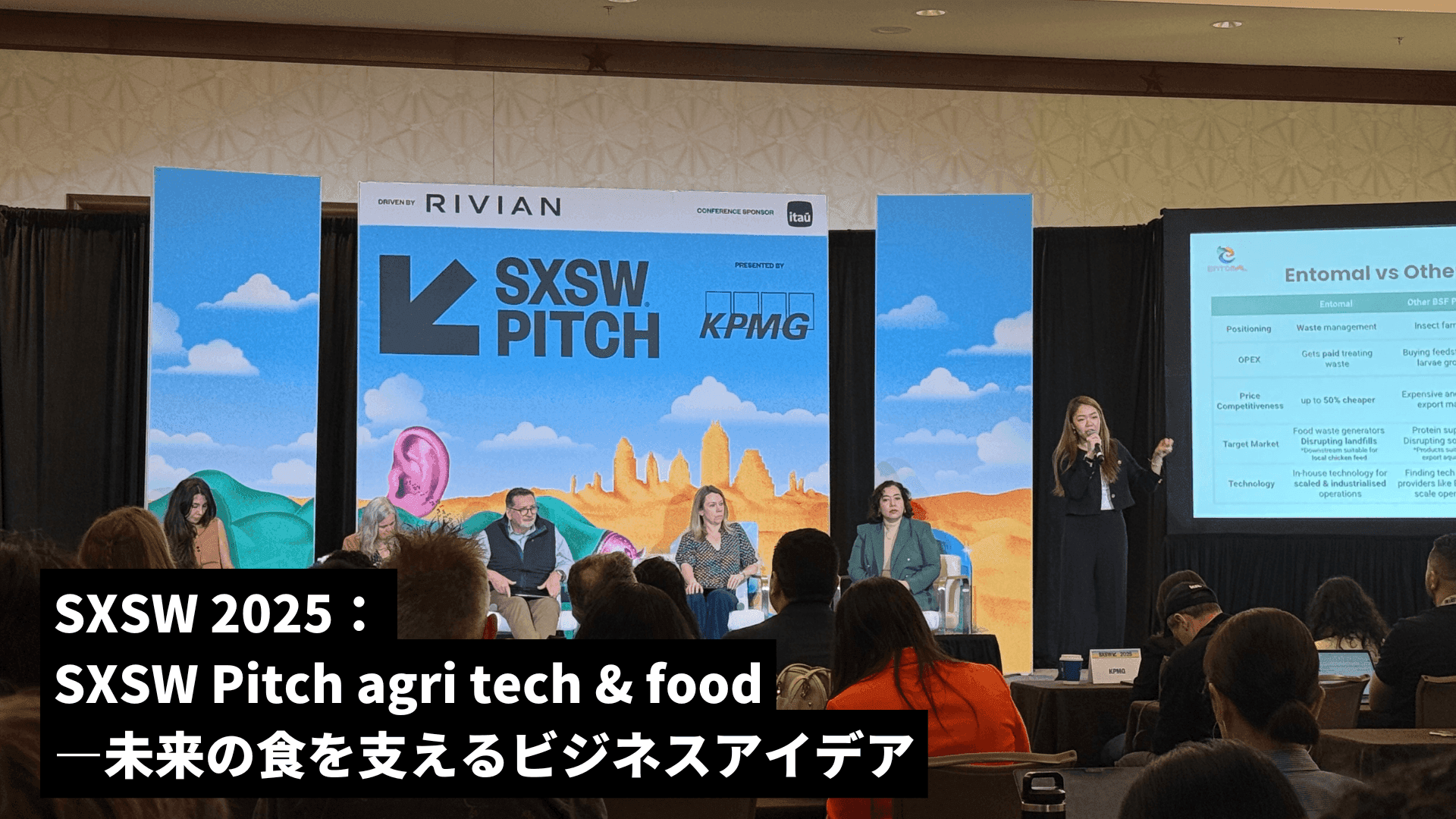
SXSW Pitch: Agri & Food Finals
Here is my rapid-fire coverage from SXSW Pitch.
SXSW Pitch has been running since 2009. In 2025 the competition was held March 8–10 in Austin across nine categories. The AgTech & Food category focuses on food production and environmental protection. Past finalists have collectively raised over $23.2 billion — Siri and Klout both got their start here. Details are available on the official site.
The event gives early-stage startups the chance to present before industry experts, investors, and media. In 2025, the AgTech & Food category had a particularly strong theme: solutions targeting environmental challenges and food security.
Azul Bio — Protecting Coral Reefs with Microbiome Science
What they do: Azul Bio is a biotech company specializing in coral reef protection. Their product, Coral Microbiome Boosters (CMB), increases corals' heat stress tolerance by 4 degrees Celsius and prevents bleaching. Delivery is via microparticles and nets, with a dedicated vehicle planned for future rollout.
The problem: 50% of coral reefs are already lost, with 90% projected to disappear within 20 years. In Florida, 90% of decorative coral was lost in 2021 alone. One million people depend on coral reef-related income, with downstream impacts on tourism and real estate.
Business model: Target customers are hotels, resorts, and governments. CMB is designed for rapid global deployment. $140,000 in pre-orders and $1M in funding already secured. Pilot projects planned for Bermuda and East Florida in 2026, targeting large-scale rollout.
Team: CEO Benjamin has NASA microbiology experience. Team includes a Tesla automation engineer and biologists. The producer of Netflix documentary Chasing Corals, James Fowler, recently joined.
Q&A highlights:
- Customer value: Hotels and governments pay to protect tourism revenue through coral protection; payments are project-based.
- Customer acquisition: Starting with pilot projects through existing connections; two years in with momentum.
- Competitive advantage: Competitors merely replant corals. Azul Bio is the only solution that increases heat tolerance.
Looking for AI training and consulting?
Learn about WARP training programs and consulting services in our materials.
Earnest Agriculture — Probiotic Seed Coatings for Healthier Soil
What they do: Earnest Agriculture develops probiotic seed coatings that reduce pesticide use and improve soil health. A proprietary microbial matching platform increases crop yields by 10% and improves soil structure.
The problem: 150,000 farms have gone bankrupt in the past five years. Pesticide costs and Russia-Ukraine-driven fertilizer price spikes are major factors. Overuse of chemicals is degrading soil and eroding farmer ROI.
Business model: Cost is $2/acre; selling price is $4/acre — a 50% margin. Starting with organic corn and soybeans in the US Midwest before expanding to Brazil. Market size: $18.5M addressable; $13M+ in potential revenue. 2024 target: 800 acres; 2025 revenue target: $500K.
Team: Michigan State University and Northern Illinois University researchers, supported by experienced investors and farmers. Backed by AG Launch and the Tennessee Department of Agriculture, among others.
Q&A highlights:
- Scalability: New products can be developed in 3 months by retraining the algorithm, though US food testing requires 3 years.
- Customer acquisition: Starting with trial farms in Illinois via university and state networks.
Entomal Biotech — Turning Food Waste into Resources via Black Soldier Fly Bioconversion
What they do: Entomal Biotech uses Black Soldier Fly bioconversion to transform food waste into valuable outputs. Their container-based processing system (EMV) handles 1 ton of waste per month and generates carbon credits plus downstream products (animal feed and fertilizer). A 15 ton/day facility is in planning.
The problem: Food waste is a $940 billion annual problem and a major driver of climate change. 18 million Americans go to bed hungry every night, largely due to logistics failures.
Business model: Monthly subscription or tonnage-based fees for waste processing. Downstream products sold B2C in partnership with poultry producers and seed companies. Market size: $70 billion. Planning to deploy 300 EMV units over 10 years. Already profitable with international credibility.
Team: Multi-award-winning team with 20 years of Black Soldier Fly industry experience and an international track record.
Q&A highlights:
- Revenue model: Three streams — engineering consulting, monthly subscriptions, downstream product sales.
- Customers: Small models serve schools and hotels; large models serve shopping malls and restaurants.
- Regulatory risk: Asian markets have lighter regulation; international expansion will begin with product exports.
Farmish — A Marketplace Connecting Local Farmers to Buyers
What they do: Farmish is a marketplace platform connecting local farmers directly to consumers and wholesale buyers. Farmers sell directly and earn up to 70% more than through traditional supply chains. 300,000 registered buyers and 22,000 farmers are currently on the platform.
The problem: Climate change and long-distance supply chain fragility are squeezing farmers. The food system optimizes for scale at the expense of resilience. Farmers need to maintain independence while growing income.
Business model: Marketplace model with transaction and connectivity fees. Market size: $100M. Expansion planned to Switzerland and Canada. Growing both consumer and institutional sides.
Team: Founder Tara Ana has technology and supply chain experience. Advisors include a major grocery chain executive. Tara built the first version herself — $100K in revenue within the first two months.
Q&A highlights:
- Transport: Consumer side uses existing logistics; institutional side uses short-haul delivery.
- Scaling: Starting domestically, leveraging institutional partners and consumer base. International expansion still under evaluation.
- Liability: 90% shared between farmers and buyers; insurance is being introduced.
Knead Technologies — Software That Makes Food Rescue Efficient
What they do: Knead Technologies provides B2B SaaS software that streamlines food rescue logistics. Their SmartMatch feature saves coordinators hundreds of hours, and a carbon credit calculator creates a new revenue stream. Deployed at the 2024 NBA All-Star Game and NFL Draft.
The problem: Food waste in North America is a $106 billion market. 18 million Americans go hungry every night. Food waste generates methane — 25x the climate impact of CO2.
Business model: Monthly subscription for food banks and municipalities. Partnering with cities to help achieve ESG goals. Completed a December 2024 funding round.
Team: Founders with frontline food rescue experience, backed by strong advisory teams in Canada and the US.
Q&A highlights:
- Revenue model: Subscriptions and city contracts; restaurant and grocery data collection planned.
- Food safety: Food delivered within 20 minutes; liability managed via Good Samaritan laws.
- Market size: $5B recoverable food market in North America.
Summary
All five finalists are addressing the intersection of agricultural innovation and environmental sustainability. Azul Bio tackles reef protection, Earnest Agriculture supports farmers, Entomal Biotech converts waste, Farmish improves supply chains, and Knead Technologies rescues food. Judge questions consistently focused on customer acquisition, regulatory risk, and scalability — the key variables for any business in this space.
For business leaders, the investment opportunity here lies at the convergence of environmental solutions and food security. These innovations point to a clear emerging trend.
Reference: SXSW Pitch official finalists announcement