TIMEWELL
Solutions
Free ConsultationContact Us
TIMEWELL

Unleashing organizational potential with AI

ISO/IEC 27001 (ISMS) certification mark (SGS / ISMS-AC)

ISO/IEC 27001:2022 certified Certificate No. JP26/00000255 Scope: Planning, development and operation of SaaS products utilizing AI technology

Services

  • ZEROCK
  • TRAFEED
  • TIMEWELL BASE
  • WARP
  • WARP 1Day
  • WARP NEXT Corporate
  • WARP BASIC
  • WARP ENTRE
  • Alumni Salon
  • WARP for Schools
  • FDE
  • AI Consulting
  • EMC GLOBAL

Company

  • About Us
  • Team
  • Why TIMEWELL
  • News
  • Contact
  • Free Consultation

Content

  • Insights
  • Knowledge Base
  • Case Studies
  • Whitepapers
  • Events
  • Solutions
  • AI Readiness Check
  • ROI Calculator

Legal

  • Privacy Policy
  • Manual Creator Extension
  • WARP Terms of Service
  • WARP NEXT School Rules
  • Legal Notice
  • Security
  • Anti-Social Policy
  • ZEROCK Terms of Service
  • TIMEWELL BASE Terms of Service

Newsletter

Get the latest AI and DX insights delivered weekly

Your email will only be used for newsletter delivery.

© 2026 株式会社TIMEWELL All rights reserved.

Contact Us
HomeColumnsTagsRequirements
Tag

Requirements

Articles about "Requirements"

4 articles

4 articles

The Interview Skills That Make an FDE Work | How to Draw Real Insight Out of the Shop Floor
WARP

The Interview Skills That Make an FDE Work | How to Draw Real Insight Out of the Shop Floor

Whether a Forward Deployed Engineer succeeds is decided less by how fast they write code than by how they listen. Our engineers take interview training before they go on site, but the "form" you learn in training and the "eye for mismatch" you only develop in the field turned out to be different things. This article lays out the three kinds of FDE interviews, question design built on the critical incident technique and Toyota's five whys, silence and mirroring, working in pairs, and where AI transcription fits, in a form engineers can use as is.

2026-09-15Ryuta Hamamoto
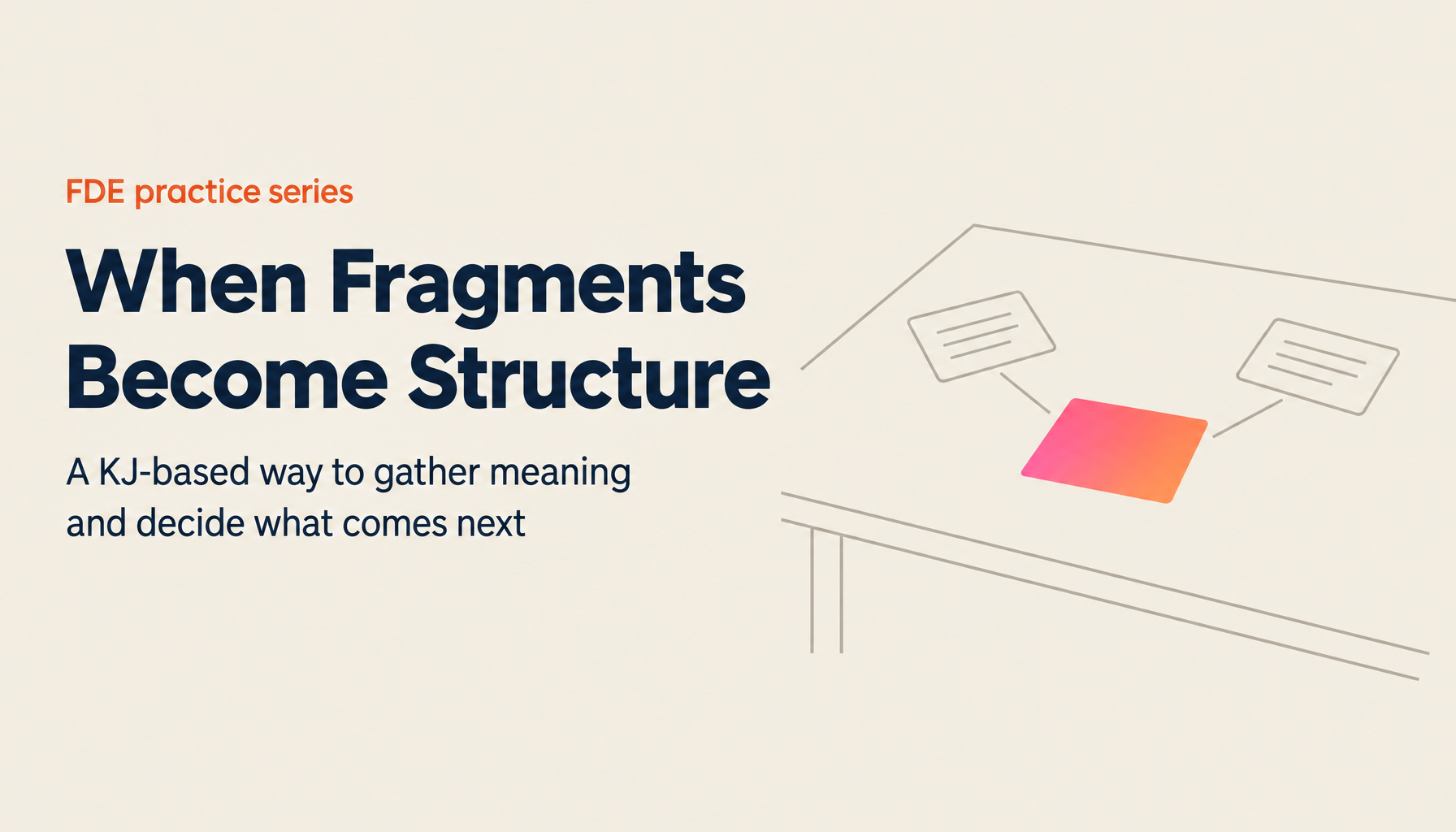
FDEs and the KJ Method | Turning Field Fragments into Structure, and Where AI Stops
WARP

FDEs and the KJ Method | Turning Field Fragments into Structure, and Where AI Stops

The fragments collected through interviews, observation, and ethnography cannot be used for implementation as they are. To turn fragments into structure, our engineers use the thinking behind the KJ method, which the anthropologist Jiro Kawakita created for field research. The fourth article in our FDE practice series walks through the steps, one idea per card, gathering by meaning, diagramming, and writing up, using real field notes as material. It covers the boundary between what AI does and what people keep, how this differs from requirements consolidation in contract development, and how the structured result feeds the next week's implementation. The KJ method is a registered trademark of Kawakita Research Institute, which provides formal training.

2026-09-15Ryuta Hamamoto
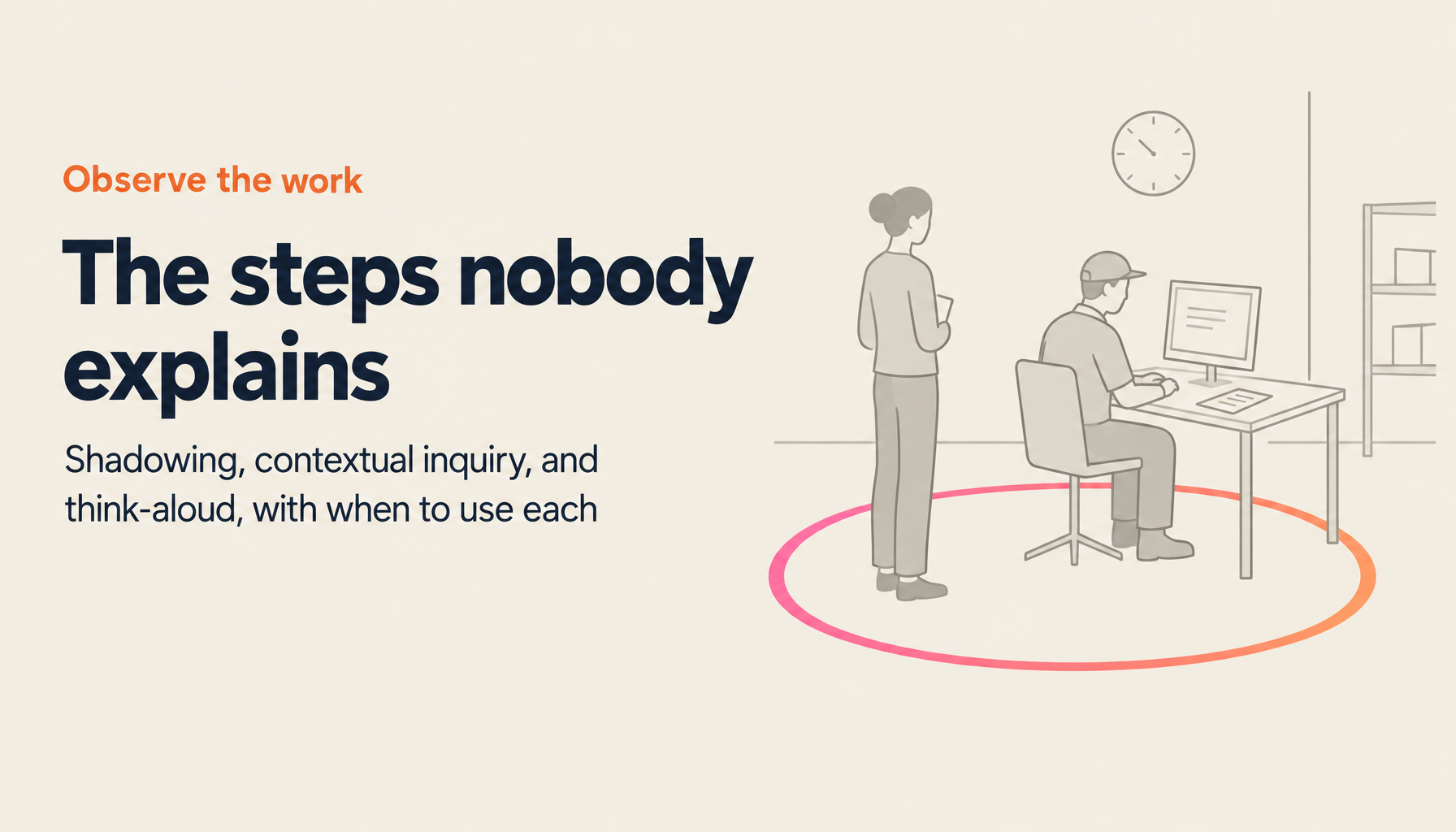
How FDEs Observe | Shadowing and Contextual Inquiry to Catch the Steps Nobody Explains
WARP

How FDEs Observe | Shadowing and Contextual Inquiry to Catch the Steps Nobody Explains

Interviews get you half of how work is actually done. The other half sits in steps the people doing the work cannot explain, and only observation catches it. The second article in our FDE practice series lays out three observation methods, shadowing, contextual inquiry, and think-aloud, down to when to use each, where to sit, what to watch, and what to write. It covers Taiichi Ohno's chalk circle, how to handle the Hawthorne effect, how FDE observation differs from the as-is analysis in contract development, the FDE habit of putting a working artifact down the day after observing, and four patterns we keep finding on shop floors.

2026-09-15Ryuta Hamamoto
AI Spec-Driven Development (AI-SDD) in 2026: Why SDD Is Back and Docs Become Code
WARP

AI Spec-Driven Development (AI-SDD) in 2026: Why SDD Is Back and Docs Become Code

Since GitHub's Spec Kit and AWS's Kiro arrived in autumn 2025, spec-driven development (SDD) has become the standard discipline for AI coding. Written for corporate new-business teams, this article explains why "fix the documents before writing code" made a comeback, how to write the four documents (requirements, specification, basic design, detailed design) with a coding agent, and why development docs, progress docs and memory docs now play a role close to code, quoting Andrej Karpathy's statements along the way. A full rewrite of the March 2026 original. Part 3 of the AI-native new business development series.

2026-03-25Ryuta Hamamoto

Related Tags

WARP(4)FDE(3)Field Work(3)Insight(2)Interviewing(1)AI-Native(1)KJ Method(1)Affinity Diagram(1)Observation(1)Shadowing(1)Contextual Inquiry(1)AI-driven development(1)Spec-driven development(1)AI-SDD(1)Development documentation(1)
View all tags